
Contents of this guide
The shortlist
Our top 3 for security buyers

Bitdefender GravityZone
Lab-verified detection
- Best for
- Small teams that want top independent lab detection scores
- Features
- 4 noted: Machine learning, Cloud sandbox, EDR included, Single agent

CrowdStrike Falcon Go
Published per-device price
- Best for
- Small teams that want enterprise-grade protection with listed pricing
- Features
- 4 noted: NGAV, Device control, Firewall management, 100 device cap

Sophos Intercept X
Ransomware file rollback
- Best for
- Businesses where ransomware recovery is a priority
- Features
- 4 noted: CryptoGuard, File rollback, MDR add-on, Cloud console
Disclosure for this guide. All 8 tools here are unpaid editorial picks. The position of a paid listing can be part of what the vendor pays for. Paid and unpaid tools are scored on the same rubric and keep their cons. Details are in the advertising disclosure.
The ledger
Index of every tool
| Tool | Free plan | Trial | Rubric | Compare | ||
|---|---|---|---|---|---|---|
| 01 | Bitdefender GravityZoneSmall teams that want top independent lab detection scores | See websiteQuote-based, Business Security and Small Business Security tiersNot published | No | Free trial | ||
| 02 | CrowdStrike Falcon GoSmall teams that want enterprise-grade protection with listed pricing | $59.99Falcon Go, per device, billed annually, $29.99 first-year promo through Dec 4, 2026, 100 device capChecked Nov 25, 2026 | No | 15-day free trial, no credit card required | ||
| 03 | Sophos Intercept XBusinesses where ransomware recovery is a priority | See websiteSold through partners by quoteNot published | No | Free trial | ||
| 04 |  Norton Small BusinessOwners with no IT background who want simple setup | See websiteAnnual plan for up to 3 employees, renews at $119.99 a yearNot published | No | 30-day free trial | ||
| 05 |  ThreatDownFast deployment with one agent and one console | $345Core Next-Gen AV, per year, extra 20% off for 3 yearsChecked Nov 25, 2026 | No | Free trial | ||
| 06 | ESET PROTECTMixed device fleets on older or constrained hardware | See websiteQuote-based, PROTECT Entry tierNot published | No | 30-day free trial | ||
| 07 |  Avast BusinessNo-IT teams managing between 1 and 100 devices | See websiteQuote-based, per device pricingNot published | No | 30-day free trial | ||
| 08 |  SentinelOne SingularityAutonomous response with minimal manual analyst work | $179.99Singularity Complete, per endpoint, billed annually, price displayed for 5 to 100 workstationsChecked Nov 25, 2026 | No | Trials offered |
Prices are the lowest paid plan the vendor shows, read on November 25, 2026. Sort by price ranks published monthly figures; tools without one go last. Pin up to three tools to compare them side by side.
How this guide was put together
We score every tool on this list against the same five criteria. The order is editorial: it reflects how well each product fits the buyer described in its entry, plus the disclosed Featured placement. Scores sit beside each tool so you can re-sort for your own priorities.
Protection depth carries the most weight at 30 percent, because detection results decide whether an incident becomes an afternoon of cleanup or a lost quarter. Pricing clarity gets 20 percent: a published number a small team can budget beats a quote, even when the quote later turns out lower. Small team fit gets 20 percent, covering whether the product assumes a security analyst who is not on your payroll. Management effort takes 15 percent, and recovery tools, meaning rollback and restore, take the final 15.
Prices, plan names, trial lengths and free plan facts come from vendor pricing pages checked on November 25, 2026. Where a vendor publishes no number, the entry says pricing is on the vendor site and we do not guess. Confirm any figure with the vendor before you budget.
The Featured listing is a paid placement. It is scored with the same rubric as every other tool and carries the same kind of honest cons, so Featured tells you about placement, not about score.
Two limits are worth stating. Lab results test detection under controlled conditions, not your network, so use the trials. And device caps and headcount bands change the real price, which is why each entry quotes the cap instead of a headline rate alone.
The full process, including how we handle corrections, is on the methodology page. Paid listings follow the advertising disclosure.
Rubric and weights
Every tool below is scored from 1 to 10 on these five criteria. The scores describe each tool; the order is an editorial call on fit for the buyer each card describes, plus the disclosed Featured position.
- 30%Protection depthDetection results from independent labs and the range of threats the agent blocks.
- 20%Pricing clarityWhether a small team can see a real number and budget without a sales call.
- 20%Small team fitHow well the product works for an organization with no dedicated security analyst.
- 15%Management effortSetup time, console complexity and the daily admin load carried by one person.
- 15%Recovery toolsRollback and restore options that limit damage after something gets through.
Plate 01 of 08
Bitdefender GravityZone
Best for small teams that want top independent lab detection scores
Our verdict
The strongest detection results on this list, held back only by a quote-only price that slows budgeting for a small team.
Bitdefender GravityZone leads this list because detection results come before everything else for a small team that cannot afford a miss. The product holds an AV-TEST award for best protection and best performance for business users, and it recorded the top breach prevention result with the lowest total cost of ownership in a 2025 enterprise lab test. Detection runs through machine learning, behavioral analysis and cloud sandboxing, and all of it arrives through a single lightweight agent, so employee laptops stay responsive during scans.
The console is the practical argument. One screen covers endpoints and servers, and the same platform carries endpoint detection and response plus managed detection services if you later want someone else watching. The vendor positions the Business Security tier at sites without dedicated security staff, which describes most small companies. Premium and Enterprise tiers sit above it and raise costs quickly.
Budgeting is the weak point. The business homepage publishes no prices, so buyers must request a quote before they can put a number in a spreadsheet. Confirm pricing directly with the vendor before you budget.
Pick it if strong lab scores and a light agent matter more to you than a listed price. A five person office will find the quote process slower than Falcon Go, but will end up on a platform with room to grow into detection and response and managed services without changing vendors.
What works
- Holds an AV-TEST award for business protection and performance
- Top breach prevention result with lowest total cost of ownership in a 2025 lab test
- One lightweight agent and one console for endpoints and servers
What to weigh
- No published business prices on the vendor homepage
- Premium and Enterprise tiers raise costs quickly
- Buyers must request a quote before budgeting
Pick it if
You want the best independent detection scores on this list and can absorb a quote process before you sign.
Skip it if
You need a published price today or your budget requires a fixed number on a spreadsheet this week.
Plate 02 of 08
CrowdStrike Falcon Go
Best for small teams that want enterprise-grade protection with listed pricing
Our verdict
Enterprise-grade antivirus with a published price and a 100 device cap, which suits a small fleet that wants no sales call.
Falcon Go is the cleanest answer for a small team that wants enterprise-grade protection and a number it can budget without a sales call. Pricing is $59.99 per device billed annually, with a $29.99 first-year promotion running through December 4, 2026, and a hard cap of 100 devices. The 15-day trial requires no credit card, which makes a two week test on real machines cheap and fast.
What you get at that price is next-generation antivirus, device control, mobile protection and firewall management, delivered through the same Falcon platform large enterprises run and deployed in minutes per device. A single lightweight agent handles the work. Express support is aimed at small and mid-sized businesses, so the first line of help is not stuck behind an enterprise queue.
The cap is the constraint. Endpoint detection and response, threat intelligence and threat hunting sit on Pro or higher, listed at $99.99 per device per year, and Enterprise is listed at $184.99. Teams that outgrow 100 devices must move up a tier, so the entry price is a floor rather than a destination, and the jump from antivirus to detection and response raises the per device cost.
Pick it if your fleet is small, your budget needs a published figure, and antivirus plus device and firewall control covers your risk. The published trial terms also make this the easiest product here to evaluate on a Friday afternoon without a procurement email.
Skip it if you already need full detection and response or expect to pass 100 devices within a year, because the upgrade path resets the per device cost upward.
What works
- Published list price with no quote required
- Same Falcon platform used by large enterprises
- Trial signup needs no payment details
What to weigh
- Go is capped at 100 devices
- EDR, threat intelligence and threat hunting require Pro or higher
Pick it if
You want a real number, a fast rollout and antivirus-grade protection for a fleet well under 100 devices.
Skip it if
You need detection and response features in the base tier or expect to exceed 100 devices soon.
Plate 03 of 08
Sophos Intercept X
Best for businesses where ransomware recovery is a priority

Our verdict
Ransomware rollback and a managed detection add-on make this the recovery pick, though you will need a partner quote first.
Sophos Intercept X earns its place on recovery rather than on price. CryptoGuard watches for ransomware behavior, and file rollback restores encrypted files to a clean state, which turns a ransomware incident from a shutdown into an afternoon of cleanup. Deep-learning detection catches malware that signature matching misses, and the same agent covers firewall protection and mobile devices.
The wider platform is the reason to look at Sophos rather than a pure antivirus. Firewalls, mobile protection and a managed detection and response add-on sit alongside the endpoint agent, and the managed add-on gives around-the-clock analyst coverage for teams that do not staff a night shift. The vendor serves more than 625,000 customers worldwide and is recognized across endpoint, firewall, mobile and managed detection categories, so the platform is not a side project.
Two things slow buyers down. Pricing runs through partner quotes rather than a published list, so you cannot compare it to Falcon Go without emailing someone. The cloud console also assumes more security knowledge than a consumer-style tool, and for a three person office it feels enterprise-heavy, with settings and policies that exist for organizations with a security lead.
Pick it if ransomware recovery and an integrated firewall and managed detection path matter to you, and you are willing to work with a partner to get a number. The rollback feature alone justifies a serious look for any business whose files are the product.
Skip it if you want a self-serve price and a setup you finish in an evening without reading documentation.
What works
- Ransomware rollback restores encrypted files without paying
- Managed threat response add-on gives around-the-clock analyst coverage
- Serves more than 625,000 customers worldwide
What to weigh
- Pricing runs through partner quotes, not a published list
- Console assumes more security knowledge than most small teams have
Pick it if
Ransomware recovery is your main fear and you are comfortable buying through a partner.
Skip it if
You want a published price and a console a non-technical owner can run unaided.
Plate 04 of 08
Norton Small Business
Best for owners with no IT background who want simple setup
Our verdict
The easiest setup for an owner with no IT background, priced per employee, with a renewal that more than doubles.
Norton Small Business is built for the owner who does not want to become an IT department. Setup is set-and-forget, the plan is sold per employee with plain annual pricing published on the site, and the 30-day trial lets an owner test it before committing. The annual plan covers up to 3 employees and renews at $119.99 a year.
The bundle is broader than antivirus. Always-on device protection sits alongside a secure browser, an encrypted password vault, dark web monitoring and 250GB of cloud backup. Premium adds financial monitoring, a VPN and 24/7 business tech support for virus removal and device issues, which is the piece most non-technical owners actually value: a person to call when something looks wrong.
Pricing steps by headcount, and the annual plan for up to 3 employees renews at $119.99 a year. There is a 60-day money-back guarantee on annual plans. Read the renewal line before you buy, because the first-year price more than doubles at renewal and that is the number your budget will meet for years two and three.
Some features, including cloud backup and SafeCam, are Windows-only, so a Mac-heavy office gets less than the brochure suggests. Phone support and the VPN also require the Premium tier.
Pick it if you have no IT staff, want one invoice and a support line, and will put the renewal price in your budget today. Skip it if you run mostly Macs or need detection and response rather than a well-packaged basics bundle.
What works
- Plain per-employee pricing published on the site
- 60-day money-back guarantee on annual plans
- Premium adds 24/7 business tech support
What to weigh
- First-year price more than doubles at renewal
- Cloud backup and SafeCam are Windows-only
Pick it if
You want a simple per-employee plan, a support phone number and a setup you never think about again.
Skip it if
Your office runs mostly Macs or you need endpoint detection and response.
Plate 05 of 08
ThreatDown
Best for fast deployment with one agent and one console
Our verdict
One agent and one console a solo administrator can run, now with a published starting figure of $345 per year.
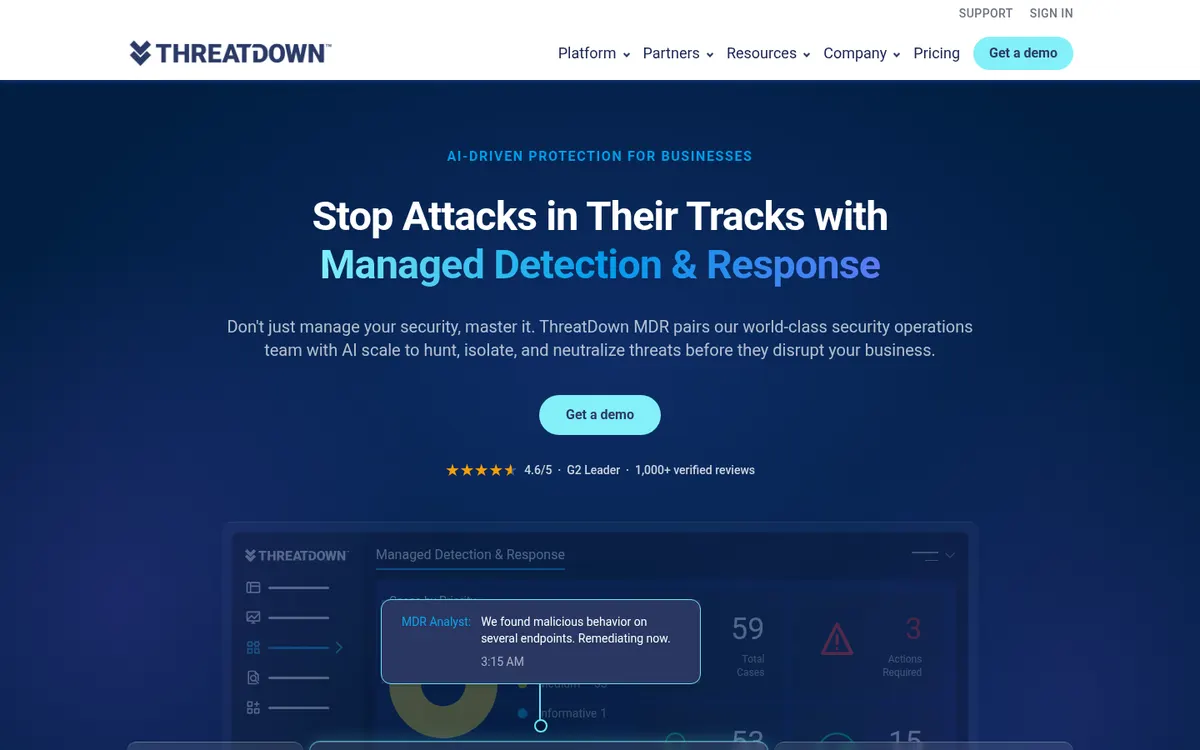
ThreatDown is what the Malwarebytes business products are called now, and the rebrand brings a straightforward proposition: one agent, one console, fast installation. It protects immediately after install, which matters when a single administrator is doing the rollout between other jobs, and that same person can run the whole console without a second pair of hands.
The stack goes further than antivirus. Endpoint detection and response, vulnerability and patch management, email security and ransomware rollback are all part of the platform, and an optional 24/7 managed detection and response service hunts, isolates and neutralizes threats outside business hours. Detection runs on the same engine as the consumer Malwarebytes product, so the malware blocking is familiar ground rather than an unknown quantity.
Pricing has moved. The business page now publishes a starting figure where it previously listed only quote-based pricing, and the Core Next-Gen AV package starts at $345 per year with an extra 20 percent off for a three year term. The published starting figure covers Core Next-Gen AV, so confirm trial length and the final price for other packages with the vendor.
The rebrand is the main friction. Existing customers searching for Malwarebytes business licensing land on a different name and a different pricing sheet, and renewal conversations get confusing for exactly the person who has least time for them.
Pick it if you want fast deployment, one console a solo admin can run, and rollback plus optional managed response without a heavy platform. Skip it if you need published per device pricing you can compare line by line before contacting sales.
What works
- Installs in minutes and protects immediately
- One agent and one console suit a single administrator
- Optional 24/7 managed detection and response
What to weigh
- Rebrand from Malwarebytes business products confuses renewals
- Trial length and final price must be confirmed in a quote
Pick it if
A solo admin needs to roll out protection quickly and wants rollback plus an optional managed service.
Skip it if
You need to compare published per device rates before you will talk to sales.
Plate 06 of 08
ESET PROTECT
Best for mixed device fleets on older or constrained hardware
Our verdict
Full marks in a 2026 lab test and a tiny footprint, built for mixed fleets run by someone who knows IT.
ESET PROTECT is the pick for mixed fleets and older hardware. The agent has a very small system footprint, claimed up to five times lighter than rivals, so older or constrained laptops still work after installation. It covers Windows, macOS, Linux, mobile and cloud VMs from one platform, which is rare at this price point and useful for a small business running a Mac for design, Windows for finance and a Linux server in the back room.
Protection is not the compromise. The product took full marks for protection, speed and usability in an August 2026 German lab test. The entry tier bundles next-generation antivirus with a firewall, web control, device control, AI-powered threat analysis and full disk encryption, which is more than most small teams switch on. Email and Microsoft 365 protection, vulnerability discovery and automated patching arrive in higher bundles.
The cost of that capability is configuration. Deep settings and policy options can overwhelm a beginner, and the console rewards someone who knows what a rule is. Business prices are not published on the homepage, so budgeting starts with a quote for the PROTECT Entry tier. Confirm the entry tier rate in a quote before you budget. A 30-day trial is available.
Pick it if you have at least one confident IT person, a mixed device estate, and machines that cannot take a heavy agent. Skip it if nobody on staff wants to open a policy editor or if you need a self-serve price today.
What works
- Very small system footprint on older hardware
- Full marks for protection, speed and usability in an August 2026 lab test
- Covers Windows, macOS, Linux, mobile and cloud VMs from one platform
What to weigh
- Business prices are not published on the homepage
- Deep configuration options can overwhelm beginners
Pick it if
You have one confident IT person and a fleet that mixes operating systems and aged hardware.
Skip it if
Nobody wants to manage policies or you need a published price to shortlist.
Plate 07 of 08
Avast Business
Best for no-IT teams managing between 1 and 100 devices
Our verdict
Explicitly built for no-IT teams and cloud managed, with an unpublished price that keeps it off some shortlists.
Avast Business is the most explicit about who it serves: organizations with no IT skills, running somewhere between 1 and 100 devices. Everything is administered from the cloud-based Business Hub, so there is no server to stand up and no console to patch, which is the right shape for an office where the office manager also handles software.
The tier ladder is easy to follow. Essential, Premium and Ultimate step up in capability, with patch management arriving on Ultimate, and the platform scales from 1 to 10 devices up to 11 to 100 devices. Antivirus, firewall, web control, USB protection and server antivirus are covered, backed by behavioral detection and cloud machine learning. The vendor holds independent lab approvals for business endpoint protection in 2024 and 2025.
Pricing is the gap. Business prices are not published on the site, so the per device rate stays unverified until you request a quote, and there is no free tier intended for business use. That last point catches people out: the free consumer antivirus is not licensed for organizations, and the vendor states plainly that its free consumer product is not designed for organizational use, so home licenses should not be stretched across an office.
For a small team that wants a cloud console and a simple ladder, Avast Business is a reasonable shortlist entry, provided you accept the quote step. It fits dental practices, agencies and workshops more than it fits a company with a part-time security lead who wants detection and response in the base tier.
Pick it if you have no IT staff, want cloud management and a clear upgrade path, and are happy to get a quote. Skip it if you need a published price before you can shortlist.
What works
- Designed for organizations with no IT skills
- Clear Essential, Premium and Ultimate ladder
- Scales from 1 to 10 devices up to 11 to 100 devices
What to weigh
- Business prices are not published on the site
- No free tier intended for business use
Pick it if
You want a cloud console, a simple tier ladder and no server to maintain.
Skip it if
You need a published per device rate or detection and response in the entry tier.
Plate 08 of 08
SentinelOne Singularity
Best for autonomous response with minimal manual analyst work
Our verdict
Autonomous containment and rollback at $179.99 per endpoint, priced and shaped for teams with a real budget.
SentinelOne Singularity is the autonomous option. The agent detects, contains and responds in real time without waiting for a person to approve each action, and one-click ransomware rollback restores files after an incident. Purple AI and agentic response workflows handle triage and correlation so a lone administrator sees fewer alerts and more context.
Coverage extends past the endpoint. The platform reaches identity, AI tools and cloud from a single management console, which is useful for a small business that has already scattered workloads across SaaS and a cloud account. Trials are offered even though there is no free plan.
Pricing is listed as $179.99 per endpoint billed annually for Singularity Complete, displayed for 5 to 100 workstations, which is workable for a small fleet but well above antivirus-only tools. The enterprise customer base makes minimum order size a question worth asking before you shortlist: a ten seat office may find the buying process designed for larger accounts.
The trade is autonomy for complexity. Autonomous response can quarantine a file or isolate a machine without a human in the loop, which is exactly what you want at 2am and exactly what you want to test during a trial rather than discover on a payroll Friday.
Pick it if you want autonomous containment, rollback and one platform across endpoint, identity and cloud, and your budget absorbs a premium per endpoint price. Skip it if you need the lowest cost per seat or only want antivirus with firewall control.
What works
- Autonomous response with one-click file rollback
- AI triage cuts alert noise for a lone administrator
- Consolidates endpoint, identity and cloud coverage in one platform
What to weigh
- No free plan
- Enterprise positioning may bring higher minimum order sizes
Pick it if
You want autonomous containment and rollback and can justify a premium per endpoint price.
Skip it if
You need the lowest cost per seat or a simple antivirus and firewall bundle.
What does small business security software actually protect?
Small business security software protects the devices your team uses, the files on them and the accounts that reach them. The core is endpoint protection: an agent on each laptop, desktop and server that scans for malware, blocks known bad sites and stops suspicious programs from running. Vendors call this next-generation antivirus when machine learning and behavioral analysis sit behind the scan.
From there the category widens. Most business products in this list add:
- Device and web control, so a USB stick or a blocked category of site can be restricted
- Patch and vulnerability management, which closes the holes attackers use
- Email and Microsoft 365 protection, where phishing arrives
- Backup, rollback or both, so files survive encryption
- A cloud console, so one person can see every machine without visiting desks
Two labels confuse buyers. Endpoint detection and response is not a bigger antivirus; it records what processes do and lets you isolate a machine or reverse changes. Managed detection and response means humans at the vendor watch those alerts for you around the clock, which matters when your office has no night shift.
What none of this replaces: backups you have tested, multi-factor authentication on email and finance, and a short list of who holds admin rights. Security software catches technical attacks. It does not stop an invoice paid to a fake supplier because someone was rushed, and it does not recover a file that was deleted last month if no backup exists.
For a small business, the practical question is not which product has the most features. It is which product will actually be installed on every machine, left running, and watched by somebody. A lightweight agent with a console one person understands beats a full platform that nobody opens. That is why this list weights detection and pricing clarity heavily and treats a quote-only price as a real cost: friction in buying usually predicts friction in using.
This guide sits in the Security collection. Buyers weighing nearby tools often read the guides to api security platforms and dynamic application security testing tools next.
How do vendors charge small businesses for security software?
Security software for small business bills on four models, and the model matters as much as the number. Per device subscriptions are the easiest to forecast. Per employee plans track headcount instead of hardware, which suits offices where one person uses a laptop and a phone. Package prices with a multi-year discount trade commitment for a lower rate. Quote-based buying hides the number until a partner or sales team scopes your site.
| Model | How it bills | Typical fit | Example from this list |
|---|---|---|---|
| Per device, annual | One license per machine, billed once a year | Teams that know their device count | CrowdStrike Falcon Go at $59.99 per device |
| Per employee, annual | Plan tiers set by headcount and renewed yearly | Owners who count people, not machines | Norton Small Business, renews at $119.99 a year for up to 3 employees |
| Per year with a term discount | A package price with a lower rate for a longer commitment | Buyers willing to commit to three years | ThreatDown Core Next-Gen AV at $345 per year, extra 20 percent off for 3 years |
| Per endpoint, annual, tiered | Higher tiers unlock detection and response | Teams that need autonomous response | SentinelOne Singularity Complete at $179.99 per endpoint |
| Quote-based | Price set by a partner or sales team after scoping | Complex fleets and partner-led buying | Bitdefender GravityZone, Sophos Intercept X, ESET PROTECT, Avast Business |
The cheapest headline is rarely the cheapest year. Introductory pricing is common: Falcon Go lists $59.99 per device but runs a $29.99 first-year promotion through December 4, 2026, and Norton's annual plan renews at $119.99 a year for up to 3 employees after a lower first year. Ask for the renewal figure in writing before you sign.
Caps change the arithmetic. Falcon Go stops at 100 devices, and Norton's entry annual plan covers up to 3 employees. SentinelOne displays its $179.99 per endpoint figure for 5 to 100 workstations, which tells you the tier is built for a fleet rather than a five person office.
Finally, count everything. Servers, phones and cloud VMs are billed like laptops in most of these products, and a fleet of 30 endpoints at $59.99 for a year is a different conversation from 30 at $179.99. Get your device count before you get a quote and you will compare like with like.
Every price in this guide was read on the vendor's own pricing page on November 25, 2026. Where a vendor does not publish a figure we could confirm, the card says "See website" rather than a guess. For the arithmetic around this purchase, try the free Email campaign metrics calculator.
How to choose in six steps without a security hire
Count your devices. Write down every laptop, desktop, server, phone and cloud VM in use. Vendors bill per device, per endpoint or per employee, and the count decides which pricing model is cheaper for you.
Name your worst case. Decide whether your nightmare is a single infected laptop or a shared file server locked by ransomware. Recovery features such as file rollback cost more, so only pay for them if the answer is ransomware.
Check the cap. Read the device or employee limit attached to the cheap tier. Falcon Go stops at 100 devices, and Norton's entry annual plan covers up to 3 employees, so growth changes the bill.
Test on real machines. Use the trial on the oldest laptop in the office, not a fresh demo unit. Weight matters: an agent that slows a five year old machine will be uninstalled by your staff within a month.
Ask for the renewal number. Get the year two price in writing. Norton's plan renews at $119.99 a year for up to 3 employees, and quote-based vendors can raise rates at renewal unless the contract says otherwise.
Decide who answers alerts. If nobody on staff will look at a dashboard, price managed detection and response into the deal, or choose a tool with autonomous response. An unread alert queue is not protection.
What do small teams get wrong when buying security software?
Buying on the first-year price. Introductory pricing is real but temporary. Norton's plan renews at $119.99 a year for up to 3 employees after a lower first year, so budget the renewal and not the discount.
Stretching a home license across the office. Consumer antivirus licenses are not business licenses. Avast states its free consumer product is not designed for organizational use, and using it anyway leaves you outside the terms you agreed to.
Skipping the trial. A trial on your own oldest hardware answers questions no comparison can: whether the agent slows payroll, whether the console makes sense to your staff, whether deployment finishes in an afternoon.
Assuming antivirus is the whole job. Antivirus blocks known and suspected malware. Endpoint detection and response watches behavior after something gets through, and it usually sits on a higher tier with a higher per device price.
Forgetting the quote clock. Quote-based buying adds weeks. Bitdefender, Sophos, ESET and Avast publish no business price, so starting the conversation three days before a renewal is a self-inflicted deadline.
Best security software for small business 2026: questions
Does a small business need paid security software beyond the protection built into Windows or macOS?
Often yes, once you hold client data or money. Built-in tools are a reasonable baseline for a single machine, but paid business products add centralized management, device and web control, patching and reporting, and they come with a business license. The jump is justified when you have several devices, remote staff or a regulatory obligation. A one person office with no client data can survive on built-in protection plus tested backups.
Which tool here has the lowest published starting price?
CrowdStrike Falcon Go at $59.99 per device billed annually is the lowest published per device figure, with a $29.99 first-year promotion through December 4, 2026. SentinelOne Singularity lists $179.99 per endpoint and ThreatDown starts at $345 per year for Core Next-Gen AV. Norton prices per employee rather than per device, and Bitdefender, Sophos, ESET and Avast quote instead of publishing a business price.
What happened to the Malwarebytes business product line?
It is now sold as ThreatDown. The rebrand moved the business products under a new name while keeping the detection engine used in the consumer Malwarebytes product. Practically, that means customers renewing business licenses deal with a new brand and a new pricing sheet, and the business page now lists a starting figure where it once quoted only. Confirm which package your renewal maps to before it auto-renews.
How does antivirus differ from endpoint detection and response?
Antivirus blocks files it recognizes or suspects as malicious at the point of entry. Endpoint detection and response watches behavior after execution, records what a process did, and lets an administrator isolate a machine or roll back changes. EDR usually costs more and sits on a higher tier: CrowdStrike puts it on Pro and above, and ThreatDown sells it inside a broader package. Small teams buy EDR when one missed infection would be expensive.
When is managed detection and response worth paying for?
When nobody on your payroll will look at alerts outside office hours. Managed detection and response puts analysts on the queue around the clock. Sophos sells it as an add-on, ThreatDown offers it as an option, and Bitdefender carries managed services in its console. It is worth the money if you handle client data, run systems that cannot go down, or have no IT hire and no plan to make one.
How does device or employee counting change the total price?
Every model here multiplies a unit price by a count. CrowdStrike bills per device and caps Go at 100 devices. Norton bills per employee and its entry annual plan covers up to 3 employees. SentinelOne displays its $179.99 figure for 5 to 100 workstations. Count servers, phones and cloud VMs as well as laptops, because a fleet of 30 endpoints at $59.99 is a very different year from 30 at $179.99.