
Contents of this guide
The shortlist
Our top 3 for software buyers
Adobe Experience Manager
Digital asset management
- Best for
- Large enterprises already using the Adobe stack
- Features
- 4 noted: Multi-site CMS, Asset management, Adobe Analytics links, Headless APIs

Optimizely
Experimentation built in
- Best for
- Mid-market to enterprise teams unifying content, commerce, and experimentation
- Features
- 4 noted: CMS and commerce, A/B testing, Personalization, .NET friendly
Acquia
Enterprise Drupal operations
- Best for
- Organizations running Drupal at enterprise scale
- Features
- 4 noted: Drupal hosting, Multi-site governance, Security controls, Marketing Cloud
Disclosure for this guide. All 8 tools here are unpaid editorial picks. The position of a paid listing can be part of what the vendor pays for. Paid and unpaid tools are scored on the same rubric and keep their cons. Details are in the advertising disclosure.
The ledger
Index of every tool
| Tool | Free plan | Trial | Rubric | Compare | ||
|---|---|---|---|---|---|---|
| 01 | Adobe Experience ManagerLarge enterprises already using the Adobe stack | See websiteNot published | Not confirmed | Not confirmed | ||
| 02 | OptimizelyMid-market to enterprise teams unifying content, commerce, and experimentation | See websiteNot published | No | No | ||
| 03 | AcquiaOrganizations running Drupal at enterprise scale | See websiteNot published | No | No | ||
| 04 | SitecoreLarge enterprises needing headless delivery, personalization, and search | See websiteNot published | No | No | ||
| 05 | LiferayCustomer portals, intranets, and authenticated B2B experiences | See websiteNot published | Yes | No | ||
| 06 |  ContentstackProduct and engineering teams running headless content operations | See websiteNot published | No public free plan | No | ||
| 07 |  MagnoliaMid-market companies wanting headless flexibility with usable editing | See websiteNot published | Yes | No | ||
| 08 |  KenticoMid-market .NET teams wanting CMS, automation, and commerce in one license | See websiteNot published | Not confirmed | Not confirmed |
Prices are the lowest paid plan the vendor shows, read on November 25, 2026. Sort by price ranks published monthly figures; tools without one go last. Pin up to three tools to compare them side by side.
How this guide was put together
We ranked these eight platforms on five criteria, weighted for the buyer each entry describes rather than for a generic enterprise. Content and experience (25 percent) covers what the platform actually does: content management, assets, personalization, commerce, portals, and delivery to more than one channel. Pricing clarity (20 percent) asks how much of the cost a buyer can see before a sales call, which is why quote-only vendors score low here even when they are otherwise strong. Stack fit (20 percent) checks whether the platform matches skills a team already pays for, such as .NET, Drupal, Java, or front-end engineering. Editor usability (20 percent) weighs how much a marketer can do without a developer. Governance and scale (15 percent) covers permissions, multi-site control, and compliance tooling at enterprise size.
Every price statement in this list comes from vendor pricing pages checked on November 25, 2026. All eight returned quote-based or unconfirmed pricing on that date, so no dollar figure appears here. Where a vendor publishes a free edition, such as the Liferay and Magnolia Community Editions, we say so and nothing more. We do not convert currencies or estimate ranges.
A Featured position on this site is a paid placement. Where a listing carries the Featured label, the vendor has paid for that position and is scored on the same five criteria as every other entry, with the same honest weaknesses listed. No entry in this list carries that label this month. The order is editorial: it reflects fit for the buyer described in each entry, not a weighted total.
The full process, including how we handle corrections, is on the methodology page. Paid listings follow the advertising disclosure.
Rubric and weights
Every tool below is scored from 1 to 10 on these five criteria. The scores describe each tool; the order is an editorial call on fit for the buyer each card describes, plus the disclosed Featured position.
- 25%Content and experienceHow much of the experience stack the platform covers, from content and assets to personalization, commerce, and portals.
- 20%Pricing clarityHow much of the cost a buyer can see before a sales call, and whether any free or published tier exists.
- 20%Stack fitWhether the platform matches the engineering skills and ecosystem a team already has.
- 20%Editor usabilityHow much a marketer can build, edit, and publish without waiting on a developer.
- 15%Governance and scalePermissions, multi-site control, workflow, and compliance tooling at enterprise size.
Plate 01 of 08
Adobe Experience Manager
Best for large enterprises already using the Adobe stack
Our verdict
The deepest enterprise suite here, and the hardest to budget for without a quote and a partner.
Adobe Experience Manager is the broadest platform here, covering content management, digital asset management, forms, and personalization in one suite. Multi-site and multi-language management sits at the core, so teams running dozens of country sites can share components and templates while keeping governance per site. The asset side is the strongest single module: images, video, and documents are managed with the same metadata and approval structure that governs the pages. Forms and document workflow tools extend it toward back-office processes that most CMS products leave to integrations.
The practical argument for AEM is the native wiring to Adobe Analytics and Adobe Target. Segmentation built in Target feeds personalization decisions in AEM without a middleware project, and Adobe Analytics data is available where authors assemble pages. Headless delivery through APIs is supported, so the same content can feed apps and kiosks alongside the web. Enterprise governance, approval chains, and role structures are built for organizations where publishing requires sign-off across regions and legal teams.
The cost side is where AEM gets hard to justify. Adobe does not publish list pricing for AEM, so budgeting starts with a sales quote, and hosting and implementation partner services are separate lines. Implementations are long and usually need a certified partner, and the platform has many modules to scope before anyone can quote a number. Confirm support levels, renewal terms, and the exact modules in the quote before signing.
It fits large enterprises that already run Adobe analytics and testing, have a certified partner lined up, and can carry a multi-year budget across license, hosting, and services. Smaller teams will find the scope and the sales cycle heavier than they need.
What works
- Broad suite across content, assets, forms, and personalization
- Strongest digital asset management on this list
- Native links to Adobe Analytics and Adobe Target
What to weigh
- Quote-only pricing with hosting and services billed separately
- Long implementations that usually need a certified partner
- Many modules to scope before you get a number
Pick it if
You are a large enterprise already running Adobe Analytics or Target, with a certified partner and a multi-year budget.
Skip it if
You need a published price, a fast launch, or a platform your marketing team can run without engineering support.
Plate 02 of 08
Optimizely
Best for mid-market to enterprise teams unifying content, commerce, and experimentation
Our verdict
Content, commerce, and testing in one contract, with a setup burden that rewards teams able to staff it.
Optimizely bundles content management, B2B and B2C commerce, experimentation, personalization, and campaign tools into one contract. The experimentation heritage is the differentiator: A/B testing and optimization workflows grew out of a dedicated testing product, and that thinking shapes how personalization and campaigns are configured here. Teams that want to test a page variant, a pricing message, or a checkout flow can do it inside the same platform that serves the content.
Commerce is the piece that changes the buying conversation. Optimizely supports B2B and B2C storefronts, and for .NET shops it sits in familiar territory. Content, catalog, and testing data sharing one data model reduces the number of integrations a mid-market team has to maintain, and it can collapse two or three vendor contracts into one.
The tradeoff is portfolio complexity. Optimizely has grown through acquisitions, so legacy product names and edition differences surface during evaluation, and buyers have to check bundle contents against add-ons rather than assume the demo covers everything. When commerce is in scope, setup runs heavy: catalog structure, pricing rules, and tax logic all need configuration before launch. Optimizely does not publish pricing, so every number comes from a quote.
Expect to confirm bundle inclusions, add-ons, renewal uplift, and annual contract terms in writing. Ask the vendor to walk through edition differences line by line, because the product names carried over from acquisitions do not map cleanly to what you will buy. It fits mid-market to enterprise teams that want content, commerce, and experimentation under one roof and have the internal capacity to run a substantial setup. A marketing-only team with a simple site will pay for commerce capability it never switches on.
What works
- Content, commerce, testing, and personalization in one platform
- Experimentation heritage shows in the testing tools
- Fits .NET teams and B2B commerce
What to weigh
- No published pricing
- Bundle contents versus add-ons need checking
- Heavy setup when commerce is in scope
Pick it if
You want content, commerce, and experimentation under one contract and can staff a substantial implementation.
Skip it if
You only need a content site, since you would pay for commerce and testing capability you never switch on.
Plate 03 of 08
Acquia
Best for organizations running Drupal at enterprise scale
Our verdict
The mature operations layer for Drupal estates, priced by quote and metered on sites, users, and page views.
Acquia is the operations layer for Drupal at enterprise scale. The platform handles hosting, deployment pipelines, developer tooling, security controls, and multi-site governance around Drupal, which means the CMS itself stays open source while the surrounding infrastructure is managed. Organizations that have already committed to Drupal get a mature path to running many sites with shared code, controlled releases, and compliance evidence that auditors accept.
Multi-site governance is the strongest element. A central team can set policy across dozens of properties while local teams keep editing rights inside their own sections. Security and compliance controls are handled at the platform level rather than rebuilt per project. Marketing Cloud adds customer data capabilities and personalization add-ons, so the stack can extend past publishing into audience work.
The constraint is the Drupal tie. Everything here assumes Drupal, and moving to another CMS later is a replatforming project rather than a migration. Acquia does not publish pricing, so contracts come from a quote and usage is commonly metered by sites, users, and page views. Those three dimensions are worth pinning down early, because the same site count can land at very different annual numbers depending on traffic and editor seats. Implementations often involve an agency partner for the site build.
It fits organizations with Drupal skills in house, or a partner they trust, and a portfolio of sites that justifies a managed platform. A single marketing site on Drupal does not need this layer. Ask for the metering definitions in writing before you sign, and model a traffic increase against the quoted number to see how the contract behaves as the estate grows.
What works
- Mature operations layer for enterprise Drupal
- Strong security, governance, and multi-site tooling
- Marketing Cloud adds customer data and personalization
What to weigh
- Tied closely to the Drupal ecosystem
- Metered by sites, users, and page views
- Moving away later is a replatforming project
Pick it if
Your organization has already committed to Drupal and runs enough sites to justify a managed operations layer.
Skip it if
Drupal is not settled, because moving off Acquia later is a replatforming project rather than a migration.
Plate 04 of 08
Sitecore
Best for large enterprises needing headless delivery, personalization, and search
Our verdict
A broad composable portfolio built on XM Cloud, with premium opaque packaging and an integrator in the room.
Sitecore has moved from a classic .NET CMS to a composable SaaS portfolio built around XM Cloud. XM Cloud provides headless content delivery, so content is authored once and pushed to web, app, and other channels through APIs. Around it sit personalization, site search, digital asset management, and a customer data platform, sold as modules that can be adopted in stages rather than as one monolith. That shift matters for buyers who last evaluated Sitecore five years ago and remember a server install.
The breadth is real. Few vendors can cover content, search, assets, and customer data from one catalog, and Sitecore shows up in regulated industries where those pieces have to pass procurement and security review together. Composable modules mean a team can start with content and add search or a customer data platform later without a full replatform.
The cost of that breadth is sprawl. The portfolio grew through acquisitions, so module names, overlaps, and packaging are not obvious from the website, and buyers have to pin down exactly which modules a demo and a quote cover. Pricing is premium and packaging is opaque, with no public list. Most implementations run through a systems integrator, which adds services spend on top of subscription. Renewal uplift terms deserve a close read in an annual contract.
It fits large enterprises that need headless delivery plus personalization and search, have an integrator relationship, and can absorb a multi-module contract. Mid-market teams should look at narrower platforms first, because the commercial entry point assumes enterprise scale. Bring a written module list to the demo and require the vendor to confirm which line items are included at the quoted tier.
What works
- XM Cloud gives headless SaaS delivery
- Portfolio spans content, search, assets, and customer data
- Common in regulated industries
What to weigh
- Premium pricing with opaque packaging
- Product sprawl after acquisitions
- Usually needs a systems integrator
Pick it if
You need headless delivery plus personalization, search, and customer data from one catalog, and you have an integrator.
Skip it if
You want transparent packaging or a self-service launch, because the commercial entry point assumes enterprise scale.
Plate 05 of 08
Liferay
Best for customer portals, intranets, and authenticated B2B experiences
Our verdict
The pick for authenticated portals, provided you have Java developers and a quote in hand.
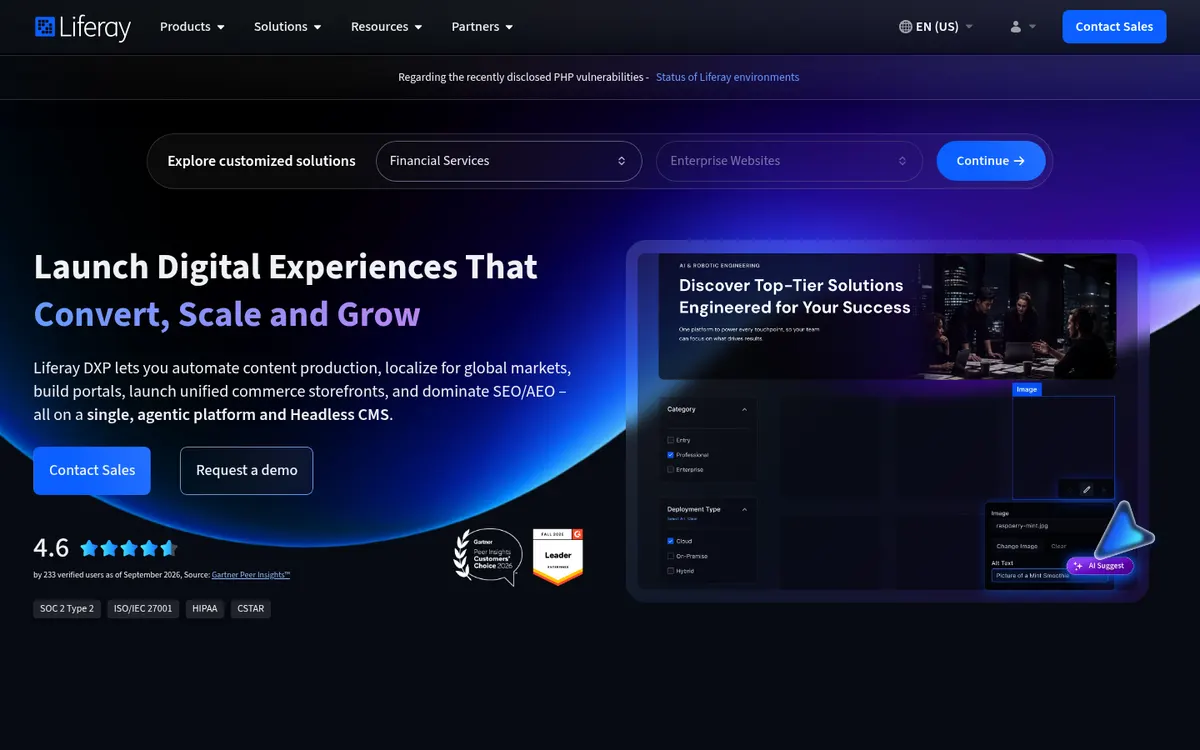
Liferay is built for authenticated experiences: customer portals, partner extranets, intranets, and B2B self-service sites where the visitor logs in and sees content scoped to their role. Role-based permissions and access control are granular, which is the point. A distributor can give each dealer a different catalog, pricing, and document set from one installation without building a custom permission system.
The Java foundation is both the strength and the barrier. Developers get extensibility, workflow, and multi-site management on a stack they likely already run, and complex user hierarchies are handled natively. Marketers get a page builder, but the platform assumes engineering capacity nearby. This is not a tool a content team adopts on its own.
Liferay publishes a free Community Edition for evaluation and self-hosting, which lets a team prove a portal concept before commercial talks. Commercial use needs a quote, and contracts are annual. Because pricing is quote-based, the free edition is the only public reference point, and support, updates, and indemnity are what the commercial license actually buys.
It fits organizations building portals or intranets with a Java team behind them, where permissions complexity is the hard problem. A marketing site with public pages is the wrong job for it. Liferay is developer-heavy and less marketer friendly than the headless products on this list, and it needs significant engineering capacity to keep running. Budget for that capacity before you budget for the license. Workflow and multi-site management are strong, but the editing experience will not win over a design team used to simpler CMS tools.
What works
- Built for authenticated portal experiences
- Granular role permissions on a Java stack
- Free Community Edition for evaluation and self-hosting
What to weigh
- Developer-heavy and less marketer friendly
- Commercial pricing is quote-based
- Needs significant engineering capacity
Pick it if
You are building a portal or intranet with complex roles and have Java developers on staff.
Skip it if
Your need is public marketing pages, where a lighter CMS will cost less and ship faster.
Plate 06 of 08
Contentstack
Best for product and engineering teams running headless content operations
Our verdict
Pure headless content operations for engineering teams that accept building and running their own front end.
Contentstack is a pure headless content platform. Content is modeled in structured types, stored, and delivered through APIs to whatever front end a team builds. There is no bundled rendering layer, no page templates, and no visual site builder in the traditional sense. Engineering teams get automation workflows, an app marketplace, localization support, and multi-brand governance, and they keep full control of the presentation stack.
That architecture is the appeal for product and engineering teams. Content operations that serve a website, a mobile app, and in-store displays from one content model avoid the copy and drift that comes from three separate systems. Marketplace apps and automation reduce the glue code that headless projects usually accumulate. Multi-brand governance lets a group run several brands with shared structures and separate editorial teams.
The cost is that the front end is yours. Someone has to build, host, and maintain the rendering layer, and that work does not appear on the vendor quote. Contentstack does not publish a free plan or public tiers, so pricing comes from a quote and commonly meters users, locales, and API calls. Those three dimensions are worth confirming in writing, because content operations grow in all of them.
It fits engineering-led organizations with front-end capacity already on staff. Marketing teams without developer support will find the platform thin on authoring comfort and will need an agency or new hires to make it usable. Omnichannel distribution through APIs is the payoff, provided the team treats content modeling as a design discipline rather than an afterthought.
What works
- Pure headless architecture with clean APIs
- Strong developer experience and app marketplace
- Enterprise governance for multi-brand operations
What to weigh
- You build and maintain the front end
- Quote-based pricing with no public tiers
- Thin authoring comfort for marketing-only teams
Pick it if
You have front-end engineers who want structured content delivered by API and full control of presentation.
Skip it if
Nobody on your team can build and maintain a front end, since the platform will not do it for you.
Plate 07 of 08
Magnolia
Best for mid-market companies wanting headless flexibility with usable editing
Our verdict
Headless delivery with a visual editor, a free Community Edition, and a smaller partner bench to draw on.
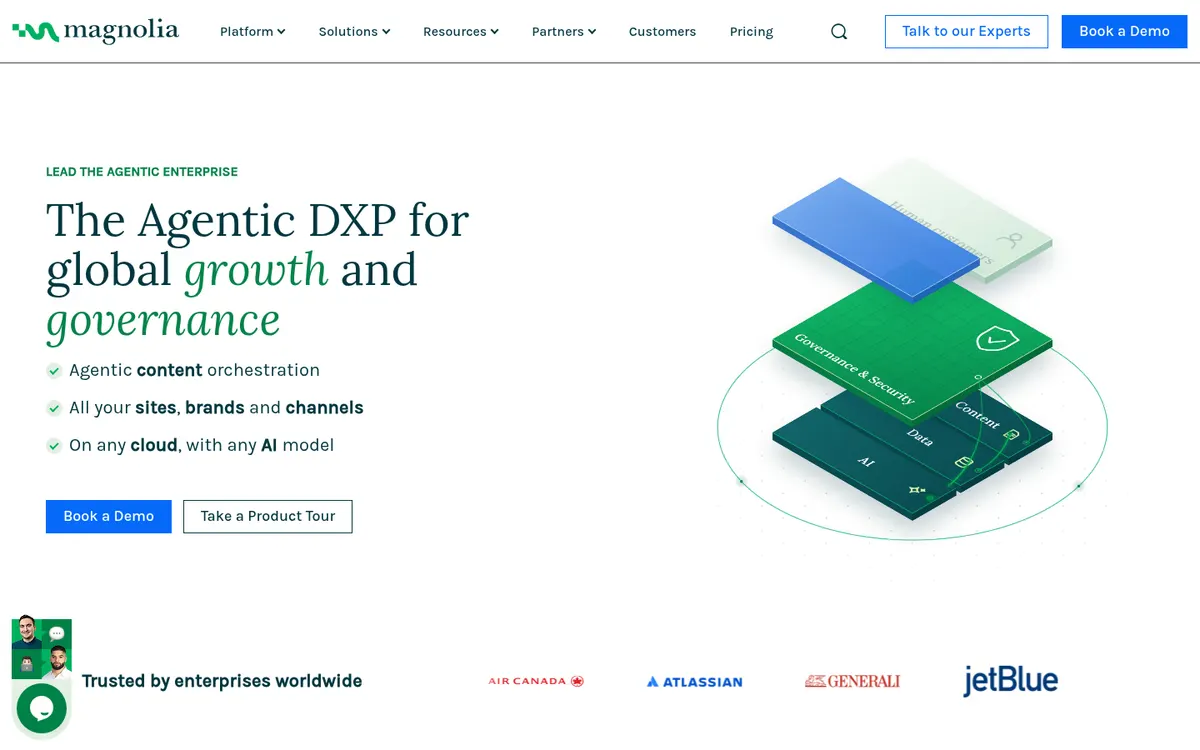
Magnolia pairs headless delivery with a visual editor marketers can actually use. Content is modeled and delivered through APIs, so the architecture supports multi-channel publishing and multi-brand management, but authors work in a visual interface rather than a bare content type form. That combination is rarer than it sounds: most headless platforms leave the editing experience to whatever front end the customer builds.
Multi-brand and multi-channel management are handled at the platform level, and localization is built in, which suits mid-market companies running several regional sites or brand properties from a small team. The free Community Edition supports evaluation and self-hosting, so a team can test the editor with real content before a commercial conversation.
Commercial deployments are quote-based, with no public tiers. The partner ecosystem is smaller than those around Adobe, Sitecore, or Optimizely, which matters most at implementation time. Fewer partners means less choice and sometimes less competitive rates, so mid-market buyers should check references from partners who have shipped a comparable build rather than accepting the first introduction. First builds often need a partner, because setup is moderate even when the scope is modest.
It fits mid-market companies that want headless flexibility without handing marketers a blank API. Organizations that need heavy commerce or a large integrator bench will find the surrounding ecosystem thinner. Editing comfort is the reason to choose it, so put real content into the Community Edition before you compare quotes, and ask a prospective partner for two references in your sector.
What works
- Visual editor on top of headless delivery
- Free Community Edition for evaluation and self-hosting
- Solid multi-brand and multi-channel management
What to weigh
- Smaller partner ecosystem than larger competitors
- Commercial pricing is fully quote-based
- First build often needs a partner
Pick it if
You want headless delivery but your marketers still need a visual editor they can use without a developer.
Skip it if
You need a large integrator bench or heavy commerce, where bigger ecosystems offer more choice.
Plate 08 of 08
Kentico
Best for mid-market .NET teams wanting CMS, automation, and commerce in one license
Our verdict
CMS, automation, and commerce in one license for .NET teams, with edition and hosting terms still to confirm.
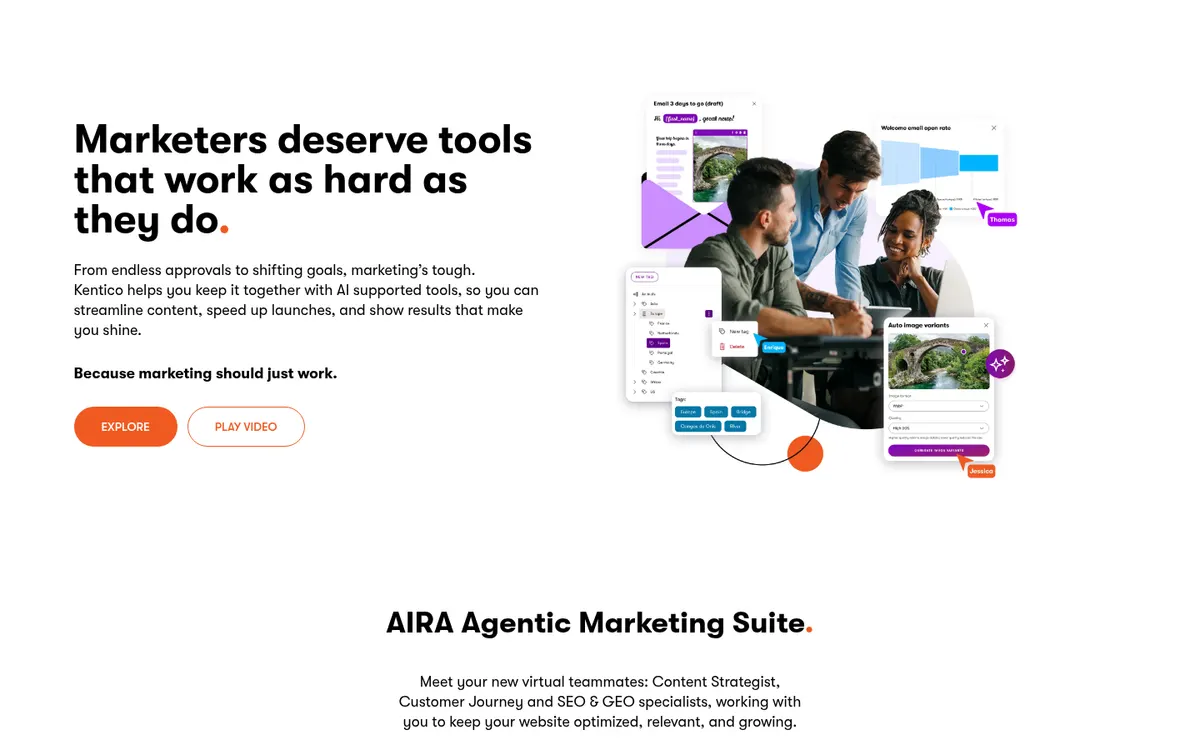
Kentico sells content management, marketing automation, e-commerce, and personalization under one license. For a mid-market company running a Microsoft stack, that means a product catalog, a content site, email automation, and personalization rules can share one data model instead of being stitched together from four vendors. Fewer integrations means fewer places for customer records to disagree.
The SaaS edition, Xperience by Kentico, modernizes the platform, and older self-hosted deployments remain in use, so buyers will meet both during evaluation. The self-hosted option still matters to organizations that need their data on their own infrastructure. Integration with Microsoft.NET environments is the natural fit, and the platform assumes a team comfortable in that world.
Kentico does not publish prices. Edition, user counts, and hosting terms have to be confirmed in a quote, and commerce scope can add implementation work beyond a content-only build. Setup runs moderate to heavy once commerce is in play, because product data, tax, shipping, and payment configuration all sit in scope. Buyers should confirm which edition they are quoting and whether hosting is included.
It fits mid-market.NET teams that want CMS, automation, and commerce in one license and one vendor relationship. Teams outside the Microsoft ecosystem, or those wanting pure headless delivery, will find the fit narrower than the feature list suggests. Ask for the quote to separate license, hosting, and any commerce modules, so you can compare it against a stitched-together alternative on equal terms. Personalization and automation are included rather than sold as a separate suite, which is the main reason to consolidate.
What works
- One license for content, automation, and commerce
- Strong fit for Microsoft stack shops
- SaaS edition modernizes the platform
What to weigh
- No public pricing
- Best fit is narrow to .NET teams
- Setup runs moderate to heavy with commerce
Pick it if
You are a mid-market .NET team that wants CMS, automation, and commerce from one vendor and one license.
Skip it if
You are outside the Microsoft stack or want pure headless delivery with no bundled marketing tools.
What Is a Digital Experience Platform, and When Do You Need One?
A digital experience platform is a content system with extra machinery around it: personalization, asset management, testing, customer data, commerce, or portal permissions. A plain CMS stores pages and publishes them. A DXP does that plus some combination of targeting, experimentation, and delivery to more than one channel.
The line is blurry, because vendors define it to suit their own catalog. Optimizely calls content, commerce, and testing one platform. Sitecore sells composable modules. Liferay treats authenticated portal access as the core job. Adobe Experience Manager spans content, assets, and forms. Contentstack does one thing, structured content delivered by API, and expects you to build the rest. All of them appear on DXP shortlists, and none of them describe the same product.
Two questions separate a CMS purchase from a DXP purchase:
- Does the content need to reach more than one surface, such as a website, an app, and a store display, from one source?
- Does the experience need to change for who is looking, whether that is a segment, a logged-in customer, or a partner with a contract?
If the answer to both is no, a CMS is enough, and a DXP will cost more in licenses, implementation, and staff time than it returns. If the answer to either is yes, the next question is capacity: who builds it, who runs it, and who fixes it when something breaks on a Monday morning.
Headless architecture shifts work rather than removing it. Contentstack and Magnolia both deliver by API, but Magnolia ships a visual editor and Contentstack leaves the rendering layer to your engineers. The tradeoff is control versus speed to publish.
Timelines follow scope. Platforms with commerce or portal permissions take longer than content-only builds, and every product here is sold through a quote, which adds a procurement cycle before work starts. Migration is the quiet risk: content, assets, and URLs export at different levels of fidelity, so ask what an export looks like before you commit to a platform you may want to leave.
This guide sits in the Software collection. Buyers weighing nearby tools often read the guides to commission software and research platforms next.
Why Almost Every DXP Price Ends in a Sales Call
Every tool on this list is priced by quote, so the honest answer is that you cannot get a number from a website. Each vendor site points to a sales conversation. That is not evasion for its own sake: the variables that drive cost, such as sites, users, page views, locales, API calls, modules, and hosting, differ so much between buyers that a list price would be wrong for almost everyone.
| Model | How it bills | Typical fit | Example from this list |
|---|---|---|---|
| Quote-based subscription | Annual contract set by vendor sales, no public list | Enterprises whose scope varies by sites and modules | Adobe Experience Manager, Sitecore |
| Quote with usage metering | Annual contract metered by sites, users, page views, locales, or API calls | Portfolios and content operations that keep growing | Acquia, Contentstack |
| Edition-based quote | Quote per edition, SaaS or self-hosted | Mid-market teams that want one vendor for several jobs | Optimizely, Kentico |
| Open-source edition plus commercial quote | Free Community Edition for evaluation or self-hosting, paid quote for commercial use | Teams that want to test before committing | Liferay, Magnolia |
Four cost lines sit behind any quote: subscription, hosting, implementation partner services, and your own staff time. Adobe Experience Manager is explicit about this, with hosting and partner services billed separately from the license. Acquia commonly meters sites, users, and page views, and Contentstack commonly meters users, locales, and API calls, so a quote built for today's estate will not hold if any of those grow.
The only public reference points on this list are the free Community Editions from Liferay and Magnolia, which support evaluation and self-hosting. Commercial use of either still needs a quote.
When you request pricing, ask for one document that separates subscription, hosting, support, and services, then ask what triggers a change at renewal. Compare two vendors on that same structure rather than on headline numbers.
Every price in this guide was read on the vendor's own pricing page on November 25, 2026. Where a vendor does not publish a figure we could confirm, the card says "See website" rather than a guess. For the arithmetic around this purchase, try the free Email campaign metrics calculator.
A Six Step Path From Shortlist to Signed Contract
Define the job. Write down what the experience has to do that a plain CMS cannot: authenticated access, personalization, commerce, or multi-channel delivery. If the list is empty, stop here and price a CMS instead.
Check the stack. Match the platform to skills you already pay for: .NET for Optimizely, Sitecore, or Kentico, Drupal for Acquia, Java for Liferay, front-end engineers for Contentstack.
Scope the build. Decide who implements. Adobe, Sitecore, Acquia, and Magnolia commonly need a partner or agency for the first build, so ask for two references in your sector before you shortlist.
Request written quotes. Ask every vendor to separate subscription, hosting, support, and usage metering, then model a traffic and content increase against each number rather than accepting the first figure.
Test with real content. Use the free Community Edition from Liferay or Magnolia, or a vendor sandbox, and put actual pages, assets, and translations in before deciding anything.
Plan the exit. Ask what a content and asset export looks like and who owns it. Platforms tied to Drupal or a specific portal data model are the hardest to leave later.
Five Mistakes Buyers Make With Platform Shortlists
Buying commerce you will not use. Optimizely and Kentico bundle commerce, automation, and personalization, so a content-only buyer pays for capability that never goes live. Match the license to the roadmap, not the demo.
Ignoring implementation cost. Partner services for Adobe Experience Manager, Sitecore, and Acquia are usually a separate line from the subscription, and that line rarely appears in the first conversation.
Assuming headless removes work. Contentstack leaves the front end to you, and Magnolia softens that with a visual editor. Someone still has to build, host, and maintain the rendering layer.
Skipping the metering definitions. Acquia meters sites, users, and page views, while Contentstack meters users, locales, and API calls. Get the definitions in writing or the renewal will surprise you.
Treating the demo as the contract. Sitecore and Optimizely both carry product sprawl from acquisitions, so confirm which modules the quote covers and which ones appeared only on screen.
Best Digital Experience Platform 2026: questions
How is a digital experience platform different from a CMS?
A DXP adds experience machinery on top of content management, typically personalization, testing, asset management, commerce, or authenticated portal access. A CMS stores and publishes pages. In practice the labels overlap: Liferay is built around portals, Contentstack is headless content with enterprise governance, and both appear on DXP shortlists. Judge by the capabilities you need, not the category name.
What does an enterprise DXP cost, and what drives total spend?
None of the eight vendors here publish a list price, so cost starts with a quote. Total spend has four parts: subscription, hosting, implementation partner services, and internal staff time. Usage metering matters too, since Acquia meters sites, users, and page views and Contentstack meters users, locales, and API calls, so growth changes the number.
When is a CMS enough instead of a DXP?
A CMS is enough when content goes to one surface and does not change per visitor. If you need partner logins, segment targeting, testing, or one content model feeding a site and an app, a DXP is justified. Write that list before you talk to vendors, because every demo will look like it solves a problem you may not have.
What are the tradeoffs of headless architecture?
Headless gives you structured content, clean APIs, and freedom to pick a front end. It also moves rendering, hosting, and performance work onto your team. Contentstack is purely headless, while Magnolia adds a visual editor over the same delivery model. If you have no front-end engineers, headless means hiring or an agency retainer.
How long does an enterprise DXP implementation take?
Longer than the sales cycle suggests. Content-only builds move fastest. Once commerce or portal permissions are in scope, as with Optimizely, Kentico, or Liferay, configuration of catalogs, pricing rules, and role structures adds phases. Adobe Experience Manager and Sitecore are usually delivered with a certified partner or systems integrator, and that partner's availability sets the real start date.
What are the migration and data export risks when changing platforms?
Content rarely exports at full fidelity. Pages, assets, metadata, translations, and URL structures each carry over differently, and redirects have to be mapped by hand. Platforms tied to a specific stack are hardest to leave: Acquia assumes Drupal and Liferay assumes its own portal data model. Ask for a sample export before you sign.