
Contents of this guide
The shortlist
Our top 3 for software buyers

Banger
Free mockups in 24 hours
- Best for
- Premium team merchandise at direct factory rates
- Features
- 5 noted: 1,000+ products, Free mockups, 10-piece minimum, 3D puff, Custom labels

Custom Ink
Group order links
- Best for
- Group orders with design help and size collection
- Features
- 4 noted: Group order links, Design help, Fundraising campaigns, Uniform catalog

RushOrderTees
Rush production
- Best for
- Fast bulk orders with low or no minimums
- Features
- 5 noted: Rush production, No minimum, No setup fees, Embroidery, Free design tools
Disclosure for this guide. All 9 tools here are unpaid editorial picks. The position of a paid listing can be part of what the vendor pays for. Paid and unpaid tools are scored on the same rubric and keep their cons. Details are in the advertising disclosure.
The ledger
Index of every tool
| Tool | Free plan | Trial | Rubric | Compare | ||
|---|---|---|---|---|---|---|
| 01 | BangerPremium team merchandise at direct factory rates | See websiteNot published | No | No | ||
| 02 | Custom InkGroup orders with design help and size collection | See websiteNot published | No | No | ||
| 03 | RushOrderTeesFast bulk orders with low or no minimums | See websiteNot published | No | No | ||
| 04 |  PrintfulBranded print on demand with in house quality control | Printful Growth $24.99/monthChecked Nov 25, 2026 | Yes, Free plan at $0/month | 14-day trial on Growth | ||
| 05 |  PrintifyLow cost print on demand through a provider network | Premium $24.99/month billed yearlyChecked Nov 25, 2026 | Yes, free plan with 5 stores | No trial; free plan | ||
| 06 | Broken Arrow WearLow unit costs for bulk screen printed blanks | See websiteNot published | No | No | ||
| 07 | ooShirtsBudget group orders on standard blank garments | See websiteNot published | No | No | ||
| 08 |  UberPrintsSmall runs with quick standard turnaround | See websiteNot published | No | No | ||
| 09 | VistaprintApparel bundled with other branded business materials | See websiteNot published | No | No |
Prices are the lowest paid plan the vendor shows, read on November 25, 2026. Sort by price ranks published monthly figures; tools without one go last. Pin up to three tools to compare them side by side.
How this guide was put together
We built this list for operators who have to place a real apparel order, not for people browsing design ideas. Every vendor was read against the same five criteria: decoration range, minimums, pricing clarity, turnaround, and support and proofing. Decoration range carries the most weight at 25 percent, because the print method decides what a garment can look like and how long it lasts. Minimums and pricing clarity take 20 percent each, and turnaround takes another 20, since a quote that arrives after your event is worth nothing. Support and proofing closes the rubric at 15 percent.
Prices and plan details were read from vendor pricing pages on November 25, 2026. Where a vendor only quotes per order, the listing says pricing is on the vendor site and no number is estimated. Where a page could not be read, the entry says so rather than repeating an unverified figure. A few price points came from earlier research and are flagged as unconfirmed in the notes.
The order is editorial. It reflects fit for the buyer each entry describes, plus the disclosed Featured position. Scores are not added up into a rank. One position in this list is a paid Featured placement, and it is judged with the same rubric and given the same honest cons as every other entry.
Treat the notes as a starting point for a quote request, not a substitute for one.
The full process, including how we handle corrections, is on the methodology page. Paid listings follow the advertising disclosure.
Rubric and weights
Every tool below is scored from 1 to 10 on these five criteria. The scores describe each tool; the order is an editorial call on fit for the buyer each card describes, plus the disclosed Featured position.
- 25%Decoration rangeHow many garments, print methods and finishing options a vendor offers for the kind of order you are placing.
- 20%MinimumsThe smallest order a vendor accepts and whether mixed styles can be combined to reach it.
- 20%Pricing clarityWhether per item prices are published, calculated online or only issued as a custom quote.
- 20%TurnaroundStandard and rush production windows plus delivery terms and shipping costs.
- 15%Support and proofingDesign help, mockups, pre-production photos and how easily a group can collect sizes and payment.
Plate 01 of 09
Banger
Best for premium team merchandise at direct factory rates
Our verdict
Best pick for premium team merchandise: factory level embroidery and finishing at a 10 piece minimum, but every price is a quote.
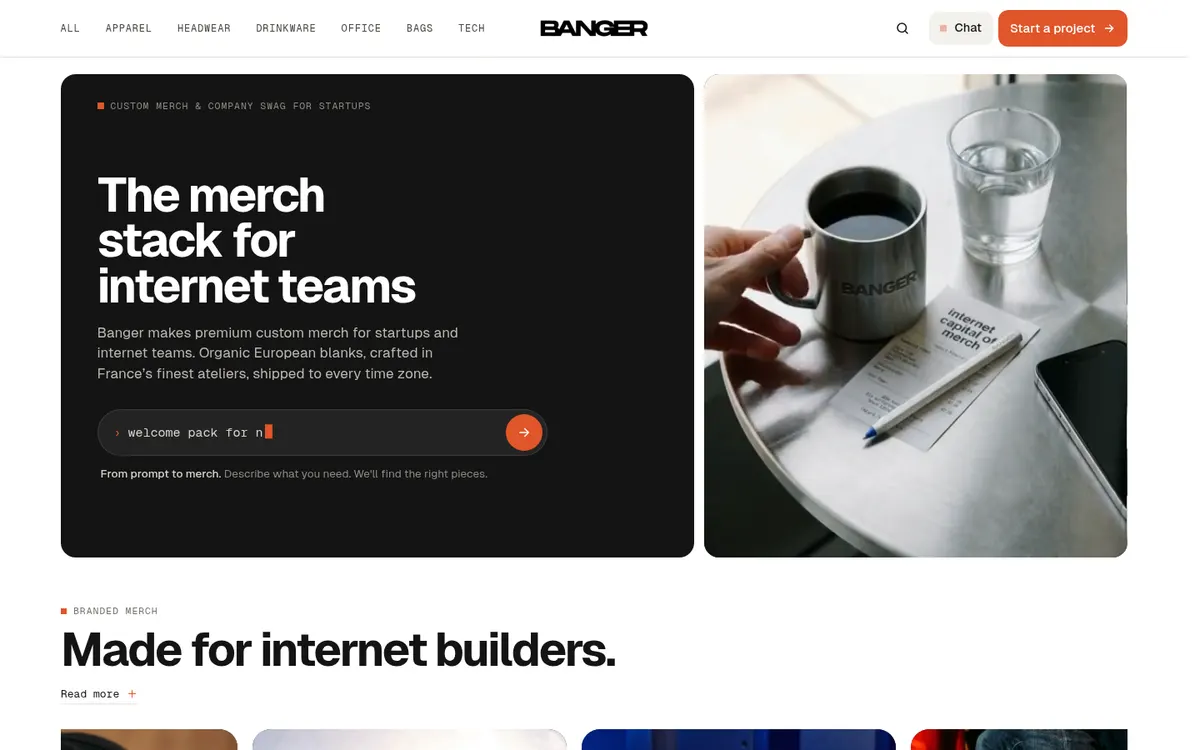
Banger is a Paris-based provider that routes orders through a network of French ateliers. The catalog carries more than 1,000 apparel and accessory products, and each product page shows indicative pricing so you can size a budget before asking for a quote. Decoration covers embroidery, 3D puff, screen print, DTG and DTF, which is a wider method list than most group order shops publish.
The finishing options are the reason to look closely. Patches, woven labels, hangtags and custom boxes sit alongside the garments, so a team kit or a small brand drop can arrive with detailing that usually needs a second supplier. Mockups are free and returned within 24 hours, revisions cost nothing extra, and you see real production photos before manufacturing starts. That approval step matters when you are signing off on 10 embroidered jackets you cannot easily return.
The minimum is 10 pieces across mixed styles, so one order can combine hoodies, tees and caps. Delivery runs about 15 business days worldwide after mockup approval. Pricing is the catch: listed prices are indicative and every order is quoted, so the figure on a product page is a guide, not a checkout total. There is no self serve cart for one-off sales, and the whole model assumes a batch rather than a single shirt.
The per product price could not be confirmed because no pricing page could be fetched, so treat any number you see as a starting point for a conversation. Skip Banger if you sell print on demand one unit at a time or need a firm total before you contact anyone. It fits teams, clubs and small labels that want factory level finishing at 10 pieces and can plan around three weeks.
What works
- Direct factory pricing through specialized French ateliers
- Free mockups and pre-production photos
- 10 pieces across mixed styles
What to weigh
- No self-serve checkout for one-off sales
- Listed prices are indicative until quoted
- The 10-piece minimum rules out single samples
Pick it if
You need premium finishing such as 3D puff, woven labels or custom boxes on a 10-piece mixed run.
Skip it if
You sell print on demand one unit at a time or need a fixed price before you speak to anyone.
Plate 02 of 09
Custom Ink
Best for group orders with design help and size collection
Our verdict
Best for coordinated group orders where design help and a size and payment link matter more than the lowest per shirt price.
Custom Ink is the group order specialist here. The catalog covers shirts, hoodies, workwear and uniforms, so one order can dress a whole team, with polos for staff and tees for volunteers. An online design lab handles simple layouts, and human design assistance is available when you would rather have someone else clean up artwork or place a logo correctly.
The group tools are what separate it. A group order link collects sizes and payments from individuals, which removes the awkward part of chasing 30 people for cash and a size chart. Fundraising campaigns are built in for schools, teams and charities that sell shirts rather than buy them. Design support comes with the order instead of being sold as an add-on.
Pricing is quote based. You settle the design and the quantity, then get a firm number, which is why this list shows pricing on the vendor site. Per shirt prices at low quantities are high, and the convenience first approach is not aimed at retail grade merch where fabric weight and margin decide the sale. For a 12 shirt order with a deadline, that trade is often worth it. For a 500 unit brand drop, it usually is not.
The catalog is broad enough for most workplace and event needs, and the uniform range means one vendor can cover a client facing polo and a warehouse tee. No page text was available when this list was compiled, so pricing stays quote based rather than estimated here. Pick it when the hard part is coordination rather than decoration.
What works
- Broad apparel and uniform catalog
- Group ordering and payment collection tools
- Design support included with the order
What to weigh
- High per-shirt prices at low quantities
- Firm pricing requires design and quantity first
- Convenience-first model may not suit retail-grade merch
Pick it if
You are organizing 20 or more shirts for a group and want one link for sizes and payments.
Skip it if
You are building a retail product line and need low unit costs on large volumes.
Plate 03 of 09
RushOrderTees
Best for fast bulk orders with low or no minimums
Our verdict
Best for deadline driven bulk orders, with rush production, no minimum on much of the catalog and mixed decoration in one order.
RushOrderTees is built around speed. Rush production options sit alongside standard turnaround, and most of the catalog carries no minimum order, so a single shirt and a 200 piece team order use the same order flow. Decoration covers screen printing, embroidery and direct to film, and one order can mix printed tees with embroidered polos.
Setup fees are not charged, and the design tools are free, which keeps the entry cost low for a first order. Turnaround is the selling point. When a deadline moves, rush production is usually why buyers land here instead of a shop quoting a two week standard window.
The trade is cost and method range. Rush service carries premium fees, direct to garment options are limited next to print on demand platforms, and the final per shirt cost depends on the number of colors and print locations and on the blank you choose. Earlier research cited a per shirt figure, but it could not be checked when this list was compiled, so ask for a written quote.
No minimums, mixed decoration methods and rush capacity make this a strong fit for events, teams and small businesses that need shirts this week. It is a weaker fit for a brand building a repeatable product line, where fabric spec, fit and consistency matter more than calendar speed. Confirm the delivery date in writing before paying for a deadline order, because the rush clock usually starts after artwork approval.
What works
- Rush turnaround options on most orders
- No minimum on much of the catalog
- Screen print, embroidery and direct to film in one order
What to weigh
- Rush service adds premium fees
- Direct-to-garment options are limited
- Final cost depends on colors, locations and blank
Pick it if
Your order has a hard date and you need printed and embroidered pieces in the same run.
Skip it if
You want the lowest possible unit cost and your timeline is measured in months, not days.
Plate 04 of 09
Printful
Best for branded print on demand with in house quality control
Our verdict
Best for sellers who want print on demand from in house facilities and will pay a higher base price for consistent print and packing.
Printful is print on demand with its own production facilities. Orders are fulfilled under the seller's brand, with no inventory and no minimums, and the platform connects to Shopify, Etsy, WooCommerce and other stores. Because production sits in house rather than in a partner network, print and packing stay consistent across a run, which is the main argument for paying more per item.
Pricing works on a subscription. There is a Free plan at $0 per month and a Growth plan at $24.99 per month with a 14 day trial. Volume discounts reach above 30 percent at high unit counts. Per order shipping runs about $4.95 for the first item, and base prices sit higher than Printify on many products. An earlier figure of about $9.25 per item for US base prices is no longer the headline on the pricing page, which now leads with the plan tiers.
The design maker and mockup tools are free, so a seller can build product pages without a separate design subscription. What Printful does not do is drive traffic. Fulfillment is the product, and marketing stays with the seller. For a store already getting orders, that division is clean. For someone expecting the platform to supply demand, it is a gap worth knowing about before you build 40 listings.
Pick Printful if you want one accountable supplier for printing, packing and shipping and will pay a higher base price for consistency. Skip it if the lowest unit cost decides the purchase, or if you need bulk screen printing with specialty inks and finishing.
What works
- In-house facilities keep print and packing consistent
- Broad ecommerce integrations
- Free design maker and mockup tools
What to weigh
- Base prices are higher than Printify on many items
- About $4.95 shipping on the first item
- Does not drive store traffic
Pick it if
You run an online store and want fulfillment handled by one supplier with its own production floor.
Skip it if
You are chasing the absolute lowest base cost per item or need bulk specialty screen printing.
Plate 05 of 09
Printify
Best for low cost print on demand through a provider network
Our verdict
Best for margin focused print on demand, where a provider network keeps base prices low and regional production shortens delivery.
Printify is a network rather than a single printer. Orders route to print providers across multiple countries, and providers compete on price for the same product, which pushes base prices down. Many tees start near $7 before shipping. Production in the customer's region can shorten delivery, and several providers may offer the same product at different prices.
The free plan covers up to five stores, which is generous for a seller running more than one storefront. Premium is $24.99 per month billed yearly, or $39 month to month, and adds product price discounts. There is no trial. The free plan is how you test the platform, and paying monthly costs more than paying yearly, so commit only after samples clear.
The trade is consistency. Quality varies by provider, the same product can carry different prices depending on who prints it, and support is mediated between seller and printer rather than handled by one company. The same product can be printed by different providers, so a seller who picks a different printer for every listing ends up with mixed packaging and finishing across one catalog. Ordering samples from the specific provider you plan to use is the only reliable way to know what a customer will receive.
Pick Printify if margin is tight and you want regional production without holding stock. Skip it if you need a single party accountable when an order goes wrong, or if a uniform look across a large catalog matters more than the lowest base price per item.
What works
- Low base prices from provider competition
- Regional production can shorten delivery
- Free plan supports up to five stores
What to weigh
- Quality varies by provider
- Same product can have different provider prices
- Support is split between seller and printer
Pick it if
You sell across several storefronts and want low base costs with production close to your buyers.
Skip it if
You need one company accountable end to end for quality and support.
Plate 06 of 09
Broken Arrow Wear
Best for low unit costs for bulk screen printed blanks
Our verdict
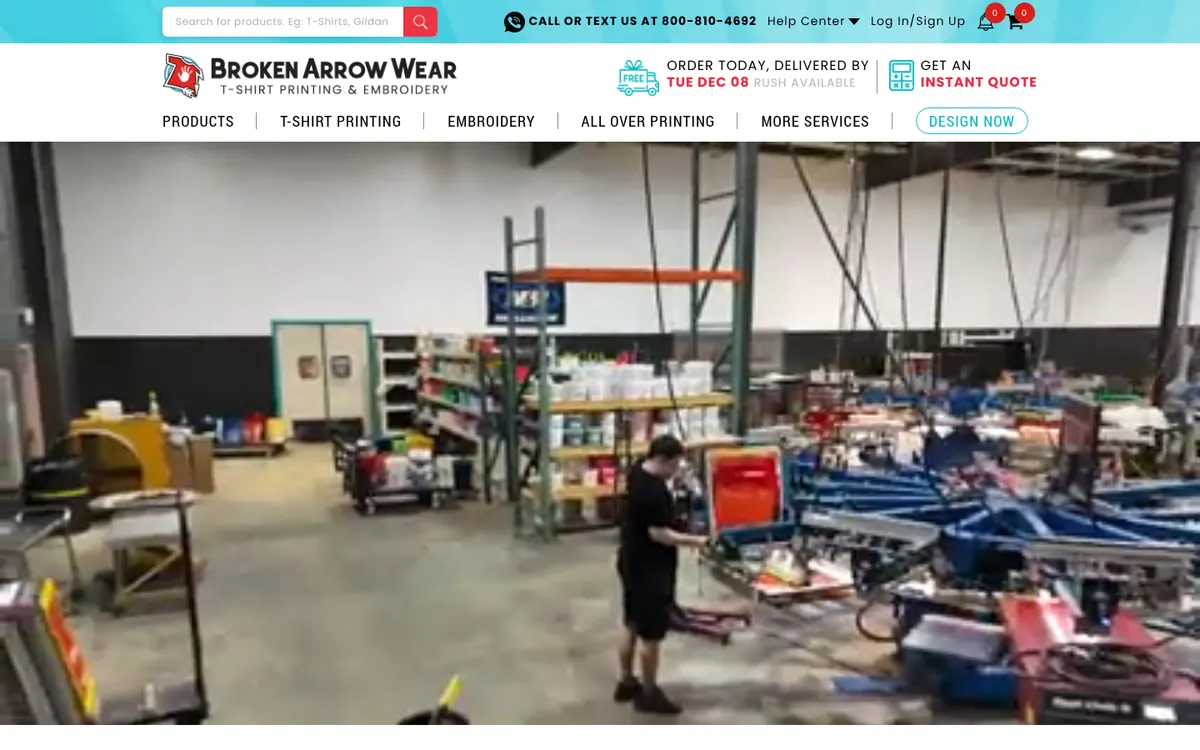
Best for bulk runs of standard blanks, with published per style pricing that makes comparison possible before you request a quote.
Broken Arrow Wear competes on unit cost for bulk screen printing. Per style pricing is published, which is rare enough in this category to be worth noting, because it lets you compare blanks and quantities before you talk to a salesperson. Direct to garment printing and online design tools round out the offer, and the design tools are enough for a simple logo layout.
Free standard shipping applies on qualifying orders, and the vendor runs fundraising and team stores for groups that sell rather than buy. Earlier research cited a per shirt figure, though it could not be confirmed when this list was compiled, so treat it as a starting point for a quote rather than a budget line.
The catalog leans toward standard blanks, so you will find everyday tees and hoodies rather than fashion fits and technical fabrics. Best pricing requires larger quantities, and turnaround is solid but not the fastest on this list. That combination suits schools, teams, small businesses and event organizers who already know their garment and need a low unit cost at a few dozen pieces.
Pick Broken Arrow Wear if you are printing several dozen standard blanks and want published prices you can compare without a sales call. Skip it if you need a single shirt, an unusual garment, or a rush date measured in days rather than weeks.
What works
- Aggressive bulk pricing
- Published per-style prices aid comparison
- Free standard shipping on qualifying orders
What to weigh
- Best pricing requires larger quantities
- Catalog leans toward standard blanks
- Turnaround is solid but not the fastest
Pick it if
You are ordering a few dozen standard blanks and want to see prices before you call.
Skip it if
You need one or two shirts, a fashion fit, or delivery inside a week.
Plate 07 of 09
ooShirts
Best for budget group orders on standard blank garments
Our verdict
Best for tight budgets on simple group orders, with no minimum, free standard shipping and an instant price calculator.
ooShirts targets budget group orders on standard blank garments. There is no minimum order and free standard shipping, and a low price guarantee matches comparable quotes. An instant pricing calculator shows cost before you commit, which shortens the quoting loop compared with vendors that reply by email a day later.
The catalog is narrower than larger competitors and the design tools are basic, so complex artwork may need to be prepared elsewhere. Art help is limited. Earlier research cited per shirt examples, but that price could not be verified when this list was compiled, and the guarantee only applies when the competing quote is genuinely comparable on garment, quantity and decoration.
The model works for straightforward decoration on common garments: a club tee, a staff polo, a reunion shirt. It works less well when you need specialty inks, unusual placements, premium blanks or a design team to fix a low resolution file. Sample checks are advised before a large run, since a low quote is only good value if the print holds up after a few washes.
Pick ooShirts if you have print ready artwork, a standard garment in mind and a tight budget per shirt. Skip it if the order depends on art help, an uncommon style or a decoration method beyond the basics, because switching vendors mid design costs more than the discount you chased.
What works
- Low delivered quotes on standard blanks
- No minimum order
- Free standard shipping and a price match
What to weigh
- Narrower catalog than larger competitors
- Basic design tools with limited art help
- Sample checks advised before large runs
Pick it if
Your artwork is ready and you want a delivered price on a standard blank without a minimum.
Skip it if
You need design support, premium garments or a specialty decoration method.
Plate 08 of 09
UberPrints
Best for small runs with quick standard turnaround
Our verdict
Best for small runs on a quick standard turnaround, with low minimums and pricing shown early in the design flow.
UberPrints handles screen printing and digital printing with low minimums and a fast standard turnaround. The design studio is simple enough for a first time buyer, pricing appears early in the flow rather than after a sales call, and the group order range runs from tees to hoodies and workwear.
For a small run, that combination is the point. A 20 shirt order with a two week deadline does not need a national supplier with a high per style minimum. Earlier research cited a per shirt figure, though it could not be confirmed when this list was compiled, so ask for a current quote on your garment.
The limits are scale and range. It is a smaller operation than the national leaders, embroidery and specialty print options are limited, and shipping raises the per shirt cost on very small orders. A 12 shirt order can look cheap per unit until freight is added, so compare delivered totals rather than the quoted unit price. The simple studio also means less help when artwork needs rebuilding.
Pick UberPrints if you need a small run of simple printed shirts quickly and want to see pricing without a long sales process. Skip it if you are outfitting a large uniform program with embroidery across several departments, where a bigger supplier with account management will fit better.
What works
- Low minimums suit small runs
- Quick standard turnaround
- Pricing shown early in the design flow
What to weigh
- Smaller operation than the national leaders
- Limited embroidery and specialty print options
- Shipping raises per-shirt cost on tiny orders
Pick it if
You need 20 or so printed shirts within a couple of weeks and want pricing up front.
Skip it if
You need broad embroidery options or a multi-department uniform program.
Plate 09 of 09
Vistaprint
Best for apparel bundled with other branded business materials
Our verdict
Best when apparel is one line item among business cards, banners and packaging, and convenience beats decoration depth.
Vistaprint puts custom tees next to business cards, banners, stickers and packaging. One design system covers the whole set, so a small business can order shirts, signage and cards in the same session and keep the look consistent. The editor is simple and past designs can be reordered quickly.
There is no minimum on digitally printed apparel, and frequent promotions move list prices around. Earlier research cited a range for tees before promotions, though no pricing page could be fetched when this list was compiled, so pricing stays on the vendor site. Because list prices shift with promotions, the same shirt can cost different amounts in different weeks, which makes budgeting for a recurring order harder than with a fixed quote.
The apparel range and print method range are narrower than dedicated decorators. Quality is aimed at small business and event use rather than retail apparel, so it suits a giveaway shirt or a staff tee rather than a product line you plan to sell at a premium. If your logo needs specialty ink or a specific blank weight, look at a decorator instead.
Pick Vistaprint if apparel is one item on a longer branded materials list and convenience matters more than print method depth. Skip it if you need specialty decoration, technical garments or a per unit price you can lock for a season.
What works
- Apparel bundles with other branded business materials
- No minimum on digitally printed apparel
- Simple editor and quick reordering
What to weigh
- Narrower apparel and print method range
- Quality aimed at small business and event use
- List prices move with promotions
Pick it if
You are ordering shirts alongside cards, banners or stickers and want one design system.
Skip it if
You need specialty decoration, premium blanks or a stable price across repeat orders.
What Counts as a Custom Apparel Company?
A custom apparel company takes a blank garment and adds your design, then ships the finished piece to you or, on print on demand, to your customer. The category covers three fairly different businesses, and mixing them up is the most common reason buyers end up with the wrong vendor.
The first group is decorators. They print or embroider onto garments they source, work from a minimum quantity, and quote per order. Screen printing, embroidery, direct to garment, direct to film and 3D puff all fall here, and the method chosen decides the look, the durability and the setup cost.
The second group is print on demand platforms. They hold no stock of your design, print after an order arrives, and fulfill under your brand. You pay a subscription plus a per item cost, and you never touch inventory.
The third group is general print shops that add apparel to a wider catalog of business materials, useful when a shirt is one item on a longer list.
Three details separate good from bad in all three groups:
- The minimum, and whether mixed styles count toward it.
- Whether pricing is published, calculated online or only quoted.
- What proofing you get before production, such as a mockup or a pre production photo.
Decoration capability matters more than catalog size. A vendor with 1,000 products and one print method is narrower in practice than a vendor with 200 products and five methods, because your design has to survive the process. Turnaround is the other half of fit: a two week standard window and a 72 hour rush option are different products, and rush fees can double a unit cost.
Finally, decide who receives the goods. A group order shipping to 30 individuals needs different tools from a bulk shipment to one warehouse. Vendors that collect sizes and payment per person solve a coordination problem, not a printing problem.
This guide sits in the Software collection. Buyers weighing nearby tools often read the guides to 1099 filing software and AI-powered video ad editing software next.
How Custom Apparel Pricing Works: Quotes, Minimums and Unit Costs
There is no single price list for custom apparel, because most vendors price per order. Four billing models appear in this list, and knowing which one you are dealing with tells you how much of the final number you can control.
| Model | How it bills | Typical fit | Example from this list |
|---|---|---|---|
| Quote per order | Firm total after design, quantity and decoration are set | Group and team orders with variable artwork | Custom Ink, Banger |
| Subscription plus per item | Monthly platform fee plus a base cost per product and shipping | Sellers running an online store | Printful at $24.99/month for Growth, Printify at $24.99/month billed yearly for Premium |
| Published tier pricing | Per style price that falls as quantity rises | Bulk runs of a few dozen or more | Broken Arrow Wear |
| Instant calculator | Self serve estimate from garment, colors and quantity | Simple orders on standard blanks | ooShirts, UberPrints |
Quantity is the biggest lever on decorator pricing. Setup work, screens and shipping spread across more pieces as the order grows, which is why a 50 piece run usually beats a 12 piece run on unit cost. A low minimum does not mean a low unit price; it means you can order at all.
Decoration drives the rest. Each extra print color and each extra print location adds cost on screen printing. Embroidery is priced per stitch count in many cases. Direct to garment avoids screens but has its own per item cost, which is why it suits short runs and detailed artwork.
The blank decides the floor. A heavyweight ring spun tee and a basic cotton tee carry different wholesale costs, and the gap between them can exceed the difference between two vendors. Fix the garment first if you want a fair comparison.
Then check the delivered total. Shipping, taxes and any setup fees can move a quote by more than the headline unit price, especially on small orders sent to multiple addresses. Ask for one number that includes everything shipped to your door.
Every price in this guide was read on the vendor's own pricing page on November 25, 2026. Where a vendor does not publish a figure we could confirm, the card says "See website" rather than a guess. For the arithmetic around this purchase, try the free Email campaign metrics calculator.
How to Choose a Custom Apparel Vendor in Six Steps
Fix the garment and quantity first. Decide the blank, the number of pieces and the deadline before you look at vendors. Quantity sets which pricing models are even available, since bulk screen printing and print on demand solve different problems.
Match the decoration to the artwork. Embroidery suits logos and left chest marks, screen printing suits bold flat graphics at volume, and direct to garment handles detailed color work on short runs. Pick the method first, then find a vendor that offers it.
Test the minimum against your real order. A 10 piece mixed style minimum and a high per style minimum are different products. Read whether mixed styles count toward one minimum before you assume your order qualifies.
Ask for a delivered total, not a unit price. Request garment, decoration, setup, shipping and taxes in one figure, and give the delivery address. Freight on a small order can add more per shirt than the gap between two competing quotes.
Order a sample for anything repeatable. A sample costs real money, and it is the only way to check print placement, color against your brand and how the blank survives a wash. Do it before a 200 piece run, not after.
Confirm dates and proofing in writing. Ask when the mockup arrives, when production starts and when the parcel ships. Mockup approval usually starts the production clock, so a slow internal approval delays everything downstream.
Five Pricing Mistakes That Raise Your Per Shirt Cost
- Comparing unit prices across different garments. A quote on a lightweight blank is not comparable to one on a ring spun tee. Fix the garment, color count and print locations before you compare any two vendors.
- Ignoring shipping until checkout. Freight on 12 shirts can add more per unit than the gap between vendors. Ask for the delivered total to your address, not the printed unit price on a product page.
- Approving a mockup without checking placement. Mockups are free at some vendors and easy to skim. Check logo size, placement height and spelling before you approve, because approval usually locks the artwork and starts production.
- Assuming a minimum is per style. Many vendors count mixed styles toward one minimum and some do not. Ask whether 10 hoodies and 10 tees qualify as 20 pieces or as two separate runs.
- Paying for rush before checking the print method. Rush production cannot fix a method that does not suit the artwork. Confirm the decoration is available on your chosen garment before paying a premium for a faster date.
Best Custom Apparel Companies 2026: questions
How much does a custom T-shirt cost at different order quantities?
Cost per shirt falls as quantity rises, but no single number holds across vendors. Earlier research in this list cited per shirt figures, though they could not be re-checked on November 25, 2026. Small runs carry setup and shipping costs that a 100 piece order spreads across more units, and colors and print locations move the number again.
How do screen printing and print on demand differ for small and large orders?
Screen printing gets cheaper per unit as quantity rises and usually needs a minimum, so it suits batches. Print on demand has no minimum and no inventory, but the per item cost stays roughly flat however many you sell, and per order shipping adds up. For 10 to 20 shirts on a deadline, a decorator with low minimums is usually simpler. For a store selling one at a time, print on demand wins.
Which vendors fit premium team merch, group orders, rush jobs and budget bulk buys?
Banger fits premium team merchandise at factory rates with a 10-piece mixed style minimum. Custom Ink fits group orders that need design help and size collection. RushOrderTees fits rush jobs with low or no minimums. Broken Arrow Wear and ooShirts fit budget bulk buys on standard blanks. UberPrints covers small runs, and Vistaprint covers apparel bundled with other branded materials.
Can print on demand work without holding inventory?
Yes. Printful and Printify both print only after an order is placed, so you hold no stock. Printful fulfills from its own facilities, with a $0 Free plan and Growth at $24.99/month including a 14-day trial. Printify routes to a provider network on a free plan covering up to five stores, with Premium at $24.99/month billed yearly. Neither drives traffic, so marketing stays with you.
Why do per-shirt quotes vary so much between vendors?
Because the quote bundles different things. Garment brand and weight, number of print colors, number of print locations, decoration method, setup fees, shipping and quantity all move the total. A quote that looks cheaper per shirt can lose on freight or on a lighter blank. Compare delivered totals for the same garment, same artwork and same deadline before you decide.
How long does a custom apparel order take?
Standard turnaround at most decorators runs one to two weeks after artwork approval, and rush options shorten it at a premium. Banger quotes about 15 business days worldwide after mockup approval, and its mockups come back within 24 hours. Print on demand fulfillment depends on the provider and the destination. Confirm the ship date in writing for anything tied to an event.