
Contents of this guide
The shortlist
Our top 3 for security buyers

Salt Security
Runtime attack detection
- Best for
- Enterprises needing runtime API attack protection
- Features
- 4 noted: Behavioral baselining, API discovery, BOLA detection, Hybrid estates
Akamai API Security
Edge scale protection
- Best for
- Akamai customers wanting API security at the edge
- Features
- 4 noted: Edge enforcement, API posture, Compliance mapping, AI APIs

42Crunch
Contract based security
- Best for
- Teams embedding API security in CI/CD
- Features
- 4 noted: OpenAPI checks, CI/CD gates, API firewall, IDE plugins
Disclosure for this guide. All 9 tools here are unpaid editorial picks. The position of a paid listing can be part of what the vendor pays for. Paid and unpaid tools are scored on the same rubric and keep their cons. Details are in the advertising disclosure.
The ledger
Index of every tool
| Tool | Free plan | Trial | Rubric | Compare | ||
|---|---|---|---|---|---|---|
| 01 | Salt SecurityEnterprises needing runtime API attack protection | See websiteNot published | No | No | ||
| 02 | Akamai API SecurityAkamai customers wanting API security at the edge | See websiteNot published | No | No | ||
| 03 | 42CrunchTeams embedding API security in CI/CD | See websitecustom quoteCustom quote | No | 14-day free trial, no credit card required | ||
| 04 |  WallarmCloud-native teams needing WAF plus API discovery | See websiteNot published | No | No | ||
| 05 |  ImpervaEnterprises wanting API security in a full suite | See websiteNot published | No | No | ||
| 06 |  EscapeTeams needing business-logic-aware API scanning | See websiteNot published | No | No | ||
| 07 |  APISecTeams wanting automated penetration testing for APIs | See websiteNot published | No | No | ||
| 08 |  StackHawkDevelopers wanting DAST in their pipeline | $10Wingman, per user per month, 50 scans per user per month, free 14 day trialChecked Nov 25, 2026 | No | Free 14 day trial | ||
| 09 |  InvictiEnterprises wanting DAST plus IAST in one platform | See websitecustom quoteCustom quote | No | Proof of concept licenses available |
Prices are the lowest paid plan the vendor shows, read on November 25, 2026. Sort by price ranks published monthly figures; tools without one go last. Pin up to three tools to compare them side by side.
How this guide was put together
We compared nine API security platforms on five criteria: API discovery, runtime defense, testing depth, deployment fit and pricing clarity. API discovery carries the most weight because an inventory you cannot see is an inventory you cannot protect. Runtime defense covers inline blocking, behavioral analysis and how well a tool stops attacks at request time. Testing depth covers contract checks, DAST, penetration testing and exploit validation. Deployment fit asks whether the product works in the environments buyers actually run, including CI/CD, Kubernetes, edge networks and hybrid data centers. Pricing clarity rewards vendors that publish enough detail for a buyer to build a budget without a sales call.
Prices and plan facts come from vendor pricing pages checked on November 25, 2026. Where a page could not be fetched or a vendor keeps pricing behind sales, the listing says pricing is on the vendor site or quote based. We did not convert currencies, invent plan terms or fill gaps with estimates. The StackHawk entry uses the published $10 per user per month Wingman plan and its 50 scans per user per month limit. Other vendors with a public trial or proof of concept are noted in their entries.
The Featured placement is a paid placement. It is scored with the same five criteria and carries the same kind of honest cons as every other entry. The order is editorial: fit for the buyer each entry describes, plus the disclosed Featured position. It is not a weighted total. Use the scores as a starting point for your own requirements, then verify contract terms, deployment support and trial scope with the vendor.
The full process, including how we handle corrections, is on the methodology page. Paid listings follow the advertising disclosure.
Rubric and weights
Every tool below is scored from 1 to 10 on these five criteria. The scores describe each tool; the order is an editorial call on fit for the buyer each card describes, plus the disclosed Featured position.
- 25%API discoveryFinds unknown APIs and keeps the inventory current across traffic, code and specifications.
- 25%Runtime defenseMeasures inline blocking, behavioral analysis and how well a tool stops attacks at request time.
- 20%Testing depthCovers contract checks, DAST, penetration testing and exploit validation for API flaws.
- 15%Deployment fitShows whether the product works in CI/CD, Kubernetes, edge networks and hybrid data centers.
- 15%Pricing clarityRewards vendors that publish enough detail for a buyer to build a budget without a sales call.
Plate 01 of 09
Salt Security
Best for enterprises needing runtime API attack protection
Our verdict
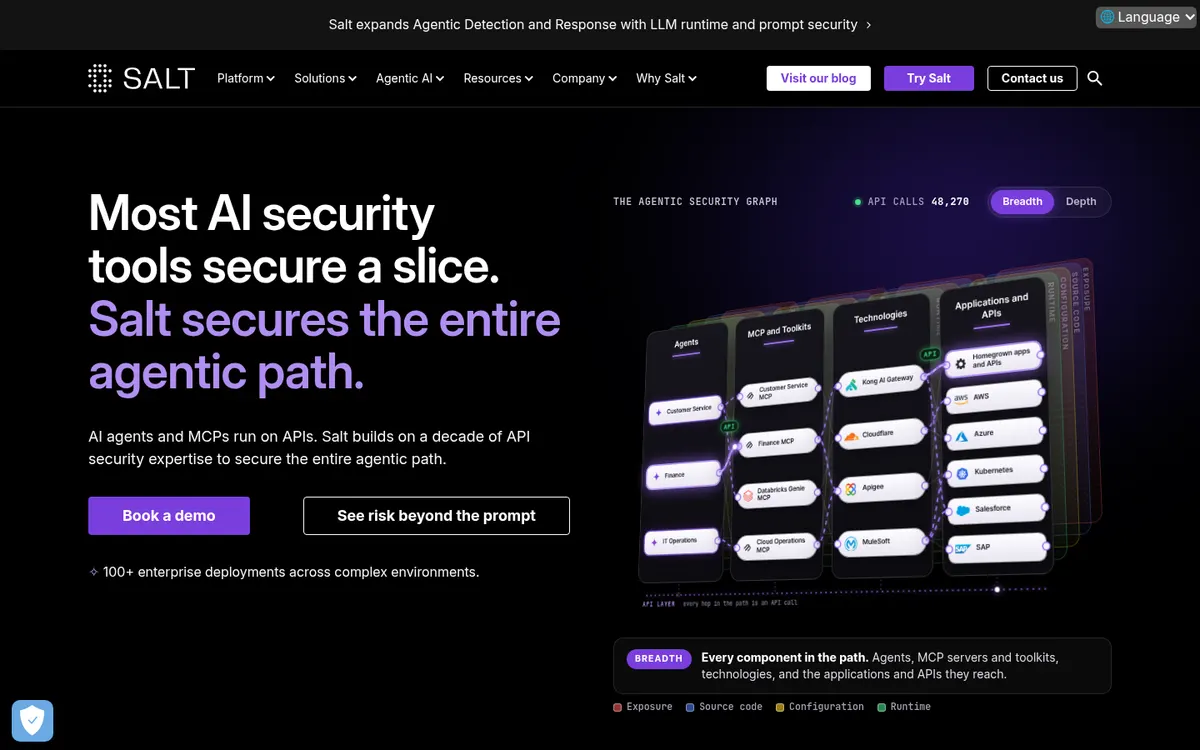
A runtime-focused option for large teams that need behavioral API detection, continuous discovery and posture management in one platform.
Salt Security focuses on runtime API protection. It baselines normal API behavior, discovers APIs continuously and watches for attacks such as BOLA and data exfiltration. That behavioral model matters when an API is working as designed but an attacker is abusing the logic. It also carries posture assessment across large estates, so the same platform can surface weak configurations and active abuse.
The product is built for security teams running thousands of endpoints across hybrid and multi environment deployments. Alert quality is tuned on historical attack data, which is the kind of advantage that only appears after long operation in real customer environments. That tuning is a benefit, but it also means the first weeks are about learning your own traffic. The tradeoff is operational weight: a small team without a dedicated API security owner may find the platform larger than its needs.
Pricing is not published. Commercial terms run through sales, so budget work starts with a scoping call, a demo and a quote rather than a public calculator. That is normal for this tier, but it slows down buyers who want to compare costs before a security review. There is no free plan and no trial listed in the facts we checked. The sales process reflects that enterprise focus, and it is best handled with security and procurement in the same room.
Pick Salt Security when runtime attack detection, continuous discovery and posture management need to live in one platform and the team can support a sales led purchase. Skip it when the need is a lightweight scanner for a small engineering group or when a public price list is a hard requirement.
What works
- Strong behavioral detection
- Continuous API discovery
- Fits hybrid estates
What to weigh
- Quote only pricing
- No trial listed
- Heavy for small teams
Pick it if
Runtime attack detection and continuous discovery must live in one enterprise platform.
Skip it if
You need a low cost scanner or a public price list before a sales call.
Plate 02 of 09
Akamai API Security
Best for akamai customers wanting API security at the edge
Our verdict
A strong edge option for Akamai customers, though its value drops sharply outside that ecosystem and pricing stays quote based.
Akamai API Security is the edge scale option. It discovers APIs from traffic, code and specifications, maps posture, and runs behavioral runtime analysis to catch abuse. Testing adds hundreds of built in security checks, and compliance mapping and remediation routing help turn findings into work. The product also covers APIs tied to AI workloads, which matters as more teams expose models and agent tools through APIs.
The strongest argument is the network underneath it. Protection is delivered at Akamai's edge, and the product works alongside App and API Protector. For an organization already using Akamai at the edge, that pairing can fit the existing network. The API security capability is built on technology acquired with Noname Security, so buyers should ask how the acquired functions are packaged and supported in their contract.
The weakness is ecosystem dependence. The value depends heavily on being inside the Akamai stack, and the platform is complex for small teams. A startup with a handful of APIs will likely find a developer first scanner easier to adopt. A large enterprise that already routes traffic through Akamai will see a clearer operational fit, especially where edge enforcement and compliance mapping must be consistent.
Pricing is quote based and not published. There is no free plan or trial in the facts checked, so the path starts with a sales conversation and a scoping exercise. Pick Akamai API Security when edge enforcement and an existing Akamai relationship matter more than a simple standalone purchase. Skip it when you need a low cost, self serve testing tool or when you want to avoid adding another network dependency.
What works
- Edge scale enforcement
- Broad compliance mapping
- Fits Akamai estates
What to weigh
- Needs Akamai stack
- Complex for small teams
- Quote only pricing
Pick it if
Your traffic already runs through Akamai and you want API protection at the edge.
Skip it if
You need a standalone tool with a public price or a simple small team setup.
Plate 03 of 09
42Crunch
Best for teams embedding API security in CI/CD
Our verdict
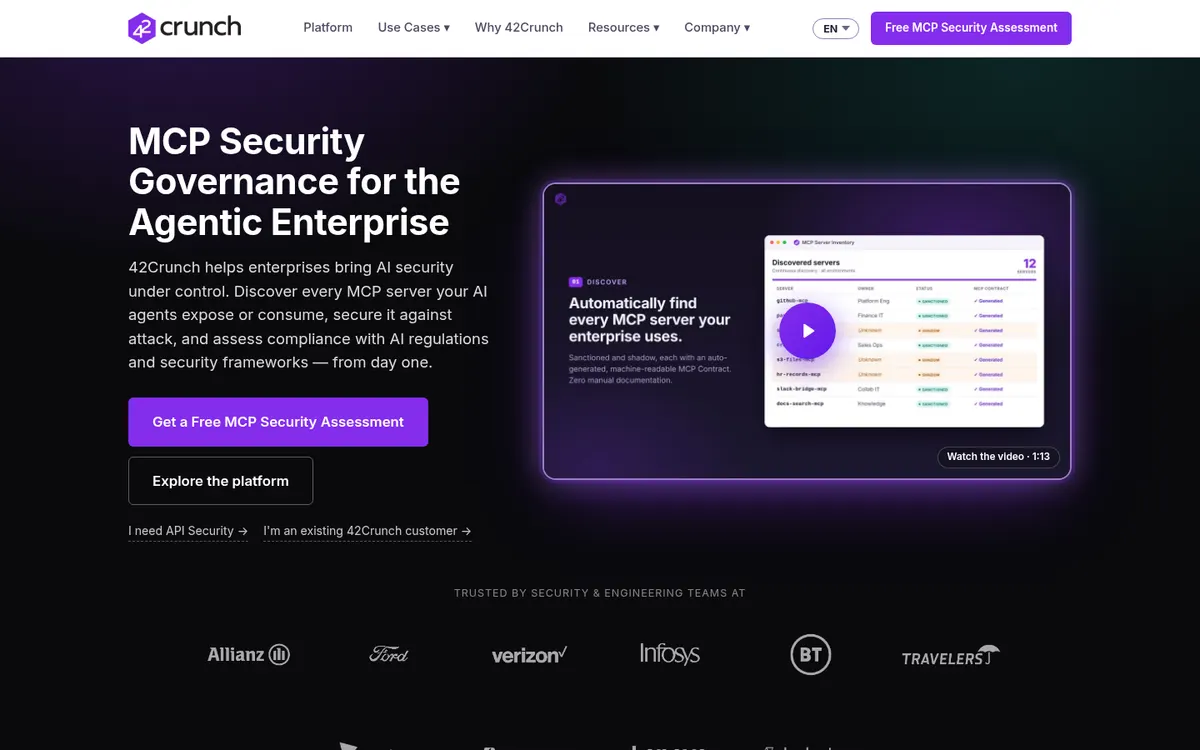
A strong fit for API first teams that want OpenAPI contract checks, CI/CD gates and a runtime firewall in one workflow.
42Crunch focuses on contract first API security. It derives a security baseline from OpenAPI definitions, runs hundreds of automated audit checks, and puts review into IDE plugins so design flaws appear before code ships. CI/CD gates can fail builds on design problems, and a runtime micro firewall blocks traffic that falls outside the declared contract. That combination links design, build and run around the same API definition.
The model is deterministic, which is the point. Buyers get checks tied to a contract rather than a scanner guessing from traffic alone. For API first engineering teams, that makes findings easier to explain and easier to fix. The platform also includes the API firewall, so a team does not need a separate runtime product just to enforce the contract. The tradeoff is developer centricity. Non technical buyers may need an engineering champion to run the workflow and interpret the results.
Pricing is a custom quote for teams and enterprises, with a 14 day free trial that requires no credit card. A separate self serve route exists for individual developers, but the main commercial path is sales led. That fits organizations that already treat API specifications as a controlled artifact and want procurement to match a real deployment plan. It is less attractive when a buyer wants a public price list before any conversation.
Pick 42Crunch when OpenAPI contracts are the source of truth and you want design time checks, pipeline gates and runtime enforcement in one workflow. Skip it when the team has no contract discipline, or when the main need is advanced behavioral detection of attacks on APIs that are already live.
What works
- OpenAPI contract checks
- CI/CD build gates
- Runtime micro firewall
What to weigh
- Developer centric
- Team pricing quoted
- Requires contract discipline
Pick it if
Your teams maintain OpenAPI definitions and want contract checks to block bad builds.
Skip it if
You need behavioral runtime detection or have no contract discipline.
Plate 04 of 09
Wallarm
Best for cloud-native teams needing WAF plus API discovery
Our verdict
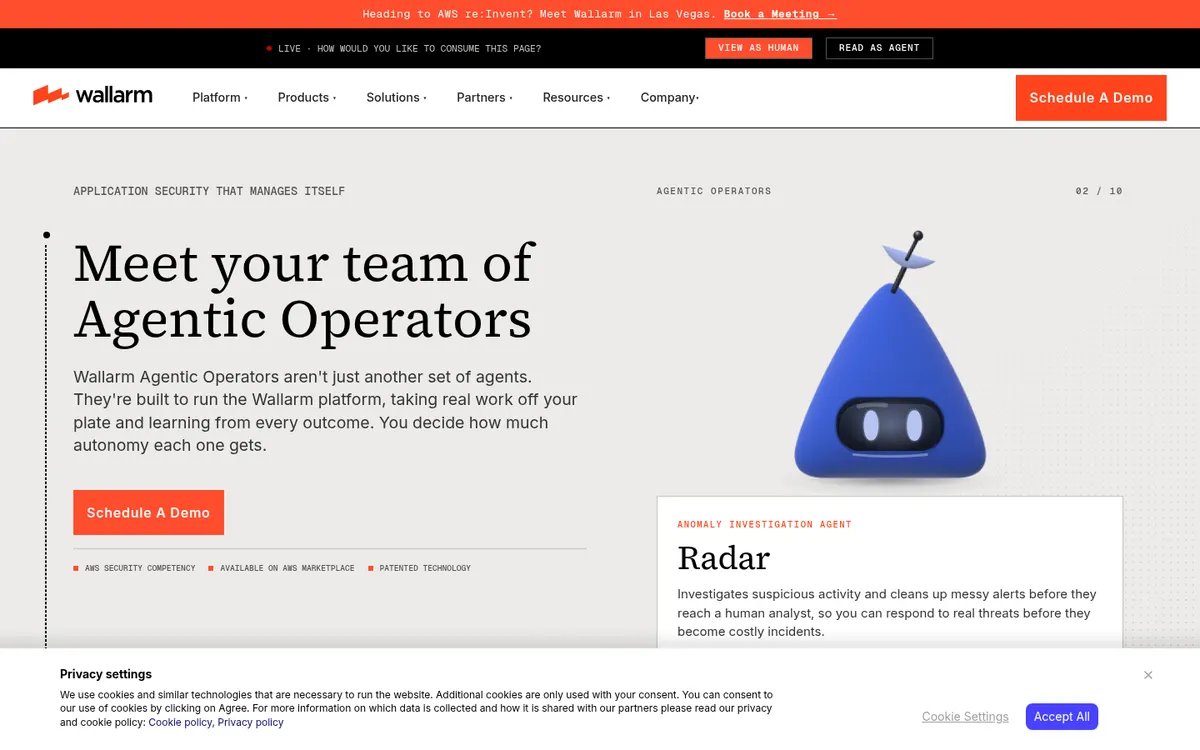
A flexible cloud native platform for inline API blocking and discovery, provided the team can invest time in tuning.
Wallarm combines API discovery, vulnerability testing and inline blocking in one platform. It detects OWASP API Top 10 threats in real time and can deploy across cloud, containers and on premise, with Kubernetes support that matters to platform teams. The open source firewall component and DevOps oriented pipeline tooling make it a practical fit for teams that want protection inside their existing deployment model rather than a bolt on appliance.
The breadth is useful but not plug and play. Buyers should expect an initial tuning period before rules settle, especially when traffic patterns are new or when multiple teams own different services. Discovery helps build the inventory, and testing helps find flaws, but the platform still needs an owner who can review alerts and adjust policy. That owner can sit in security or in a platform engineering group.
Deployment flexibility is the main advantage over narrower API testing tools. A team can start with discovery and blocking in a cloud account, extend to Kubernetes, and keep an on premise path for regulated workloads. The open source component can help with early experiments, but the commercial platform is where testing and inline protection come together. Pricing is not published, and the facts checked show no free plan or trial.
Pick Wallarm when you need WAF style blocking plus API discovery and your infrastructure spans cloud and Kubernetes. Skip it when you want a pure scanner with a low touch setup, or when a public price and a self serve trial are required before a technical evaluation. The platform rewards a team that can invest time in tuning and policy maintenance.
What works
- Inline API blocking
- Kubernetes support
- Flexible deployment
What to weigh
- Tuning effort
- Pricing not published
- No trial listed
Pick it if
You need inline API blocking and discovery across cloud and Kubernetes.
Skip it if
You want a low touch scanner or need public pricing before a trial.
Plate 05 of 09
Imperva
Best for enterprises wanting API security in a full suite
Our verdict
A broad suite play for enterprises that want API security tied to WAF, DDoS and bot defenses, not a standalone scanner.
Imperva treats API security as a layer inside a broader application security suite. It discovers and classifies APIs, assesses risk, protects business logic and detects BOLA with behavioral baselines. Those functions sit alongside WAF, DDoS and bot defenses, with compliance reporting and deployment across cloud WAF, on premise and hybrid environments. For an enterprise already standardizing on Imperva, that integration is the product's main appeal.
The suite story is strong where one policy and one reporting model matter. API discovery feeds classification, classification feeds risk assessment, and the WAF and bot controls can act on what the API layer learns. BOLA detection gets behavioral context rather than a static rule, which is important for broken object level authorization flaws that look like normal traffic until the sequence is examined. Compliance reporting also reduces the manual work of proving controls.
The limit is scope. This is more product than an API only team needs, and suite pricing is enterprise grade. Buyers who want a focused scanner or a lightweight runtime shield may find the buying process and the product surface too large. There is no free plan or trial in the facts checked, and pricing is not published. The best fit is an organization that already uses Imperva and can fold API security into an existing renewal or expansion.
Pick Imperva when API security must be part of a single application defense suite, with WAF, DDoS, bot management and compliance reporting under one vendor relationship. Skip it when you need a standalone API testing tool, a fast self serve start, or a price that can be compared without a suite conversation.
What works
- Suite integration
- BOLA behavioral detection
- Compliance reporting
What to weigh
- Enterprise suite pricing
- More than API only teams need
- Quote only
Pick it if
You already run Imperva and want API security inside a wider application defense suite.
Skip it if
You need a focused API scanner or a simple self serve purchase.
Plate 06 of 09
Escape
Best for teams needing business-logic-aware API scanning
Our verdict
A focused API DAST tool for business logic and access control flaws, with no runtime blocking and quote based pricing.
Escape is a DAST platform built for APIs rather than a general web scanner with an API checkbox. It tests multi step business workflows, checks access control and tenant isolation, and looks for IDOR style flaws that only appear when one user tries to reach another user's object. Findings include reproduction steps written for developers, and severity is tied to exploitability rather than a generic score.
That focus on logic flaws is the reason to shortlist it. Escape focuses on authorization mistakes and workflow abuse, not only missing headers or outdated libraries. Escape also covers GraphQL and integrates with CI/CD for continuous testing, so a team can run checks on every build and keep evidence close to the change that caused it. The output is designed to be actionable for engineers, which reduces the back and forth between security and product teams.
It is a testing platform, not a runtime shield. There is no inline blocking, so a buyer still needs a WAF, API gateway policy or a runtime API security product if the requirement is to stop attacks in production. Pricing is not published, and the facts checked show no free plan or trial. The commercial path is quote based, which fits a team that wants a scoped scanning program rather than an instant credit card purchase.
Pick Escape when business logic, access control and multi step workflows are the main risk and you want scan results that developers can reproduce quickly. Skip it when you need runtime protection, when the API estate is mostly simple CRUD endpoints, or when a public price and self serve trial are mandatory.
What works
- Logic flaw scanning
- Developer friendly reports
- GraphQL coverage
What to weigh
- No runtime blocking
- Pricing not published
- No free plan
Pick it if
Business logic and access control flaws are your main API risk.
Skip it if
You need production blocking or a public price before a scan.
Plate 07 of 09
APISec
Best for teams wanting automated penetration testing for APIs
Our verdict
A specialist automated pen testing service for teams that value exploit validation more than runtime defense or public pricing.
APISec sells automated API penetration testing. It generates attacker style test cases from API definitions, validates which findings are actually exploitable and covers the OWASP API Top 10. CI/CD integrations let a team run the tests continuously, and AI driven updates adjust test logic as attack patterns shift. The promise is less false positive fatigue and a clearer queue of issues that deserve engineering time.
Exploit validation is the center of the pitch. A scanner can produce a long list of possible problems, but a finding that has been safely exploited is easier to prioritize and harder to dismiss. That helps security teams that spend too much time triaging and helps developers trust the report. The automated pen testing model also fits organizations that want repeatable testing without booking a human pen test for every release.
The limit is that APISec is testing focused. It does not provide runtime defense, so production blocking still needs a separate layer. The vendor footprint is smaller than the suite competitors on this list, which may matter to buyers who want one throat to choke across WAF, API discovery and compliance reporting. Pricing is not published, and there is no free plan or trial in the facts checked. Commercial terms are quote based.
Pick APISec when automated penetration testing and exploit validation are the priority, especially if your team already has a runtime control in place. Skip it when you expect one platform to discover, test and block in production, or when vendor size and a broad suite are procurement requirements. The tool is strongest as a focused testing layer, not a replacement for a full API security program.
What works
- Automated pen testing
- Exploit validation
- OWASP API Top 10
What to weigh
- No runtime defense
- Smaller vendor footprint
- Quote only pricing
Pick it if
Automated penetration testing and exploit validation match your testing gap.
Skip it if
You need runtime blocking or a broad one vendor security suite.
Plate 08 of 09
StackHawk
Best for developers wanting DAST in their pipeline
Our verdict
A developer focused option here, with $10 per user pricing, CI/CD native DAST and a free 14 day trial.
StackHawk is the developer first DAST option in this list. HawkScan runs against the app on every build, with YAML based configuration and Docker based scanning. Findings include guidance written for engineers, and the workflow is built to live inside CI/CD rather than in a separate security console. It tests APIs and applications, so teams can cover both in the same pipeline.
The pricing is unusually clear for this category. The Wingman plan is $10 per user per month, with 50 scans per user per month, and a free 14 day trial. There is no free plan in the facts checked. For a small team, that is a low friction way to put security checks into the build before a procurement cycle. Advanced enterprise features sit in higher tiers, so larger organizations should confirm the limits they need before standardizing.
The product is testing focused, not a WAF. It will find issues and give engineers a path to fix them, but it will not block production traffic. That makes it a poor fit for a buyer who needs runtime API protection as the primary control. It is a strong fit for a buyer who already has a gateway or WAF and wants continuous testing inside the development loop.
Pick StackHawk when developers own the pipeline and you want a published entry price, a trial and CI/CD native DAST. Skip it when you need runtime blocking, when per user pricing does not match a large occasional user base, or when the program requires enterprise features that sit above the Wingman plan.
What works
- Clear $10 entry price
- CI/CD native DAST
- Free 14 day trial
What to weigh
- Not a WAF
- Advanced features cost more
- No free plan
Pick it if
Developers own the pipeline and you want DAST inside CI/CD at a published price.
Skip it if
You need runtime blocking or enterprise features above the Wingman plan.
Plate 09 of 09
Invicti
Best for enterprises wanting DAST plus IAST in one platform
Our verdict
A mature DAST plus IAST platform for enterprises that want proof based findings and can handle a heavier setup.
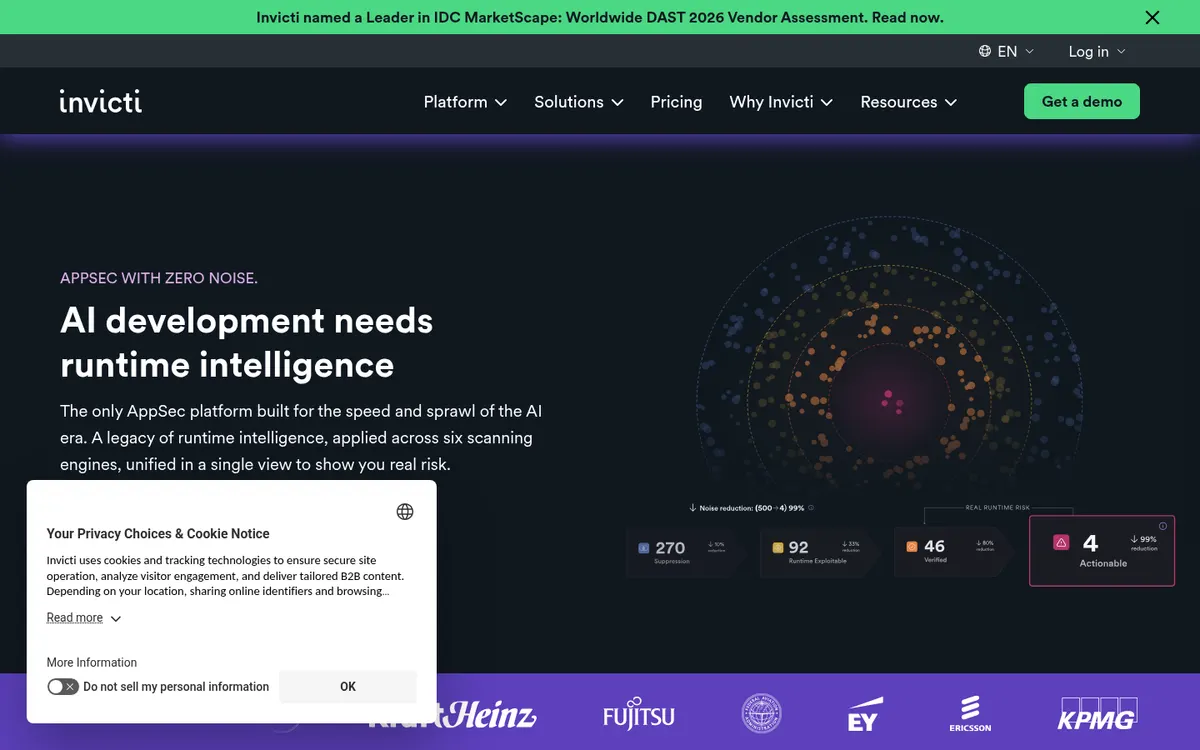
Invicti combines DAST and IAST in one platform, with proof based scanning that confirms vulnerabilities by safe exploitation. Automatic API discovery feeds the scanner, and coverage spans web applications and APIs, plus tracking of AI components. The proof based model is aimed at low false positive output, which matters when a security team needs developers to trust the queue and fix real issues.
The platform is mature and broad. It suits AppSec programs that are consolidating tools and want web, API and AI component tracking under one roof. Proof based scanning can shorten triage because a confirmed exploit is stronger evidence than a guess. The setup is heavier than developer first tools, so buyers should plan for configuration, integration and a pilot before rolling it across every application team.
Pricing is a custom quote. The platform packages are quoted by sales, and the page only states a $500 maximum per pentest for the Agentic Pentest offering. Proof of concept licenses are available, which is the right way to test depth and noise before a large commitment. There is no free plan in the facts checked. Enterprise pricing and heavier setup are the main tradeoffs.
Pick Invicti when you need DAST plus IAST, proof based findings and broad web and API coverage in one enterprise platform. Skip it when you want a lightweight, self serve scanner with a public price, or when the team cannot support a heavier implementation and tuning cycle. It rewards a buyer with a formal AppSec program and a clear owner for the rollout.
What works
- Proof based scanning
- DAST plus IAST
- Broad API coverage
What to weigh
- Enterprise pricing
- Heavier setup
- Quote only
Pick it if
You need proof based DAST and IAST across web apps and APIs in one platform.
Skip it if
You need a lightweight self serve scanner or cannot support a heavy setup.
What do API security platforms actually do?
API security platforms are software that finds, tests and protects the interfaces applications use to exchange data. They sit around the API layer rather than inside the user interface, because APIs are where mobile apps, partners, internal services and AI tools connect. The category is broader than a scanner and broader than a firewall. A platform may cover discovery, inventory, posture, testing, runtime detection and response, and the strongest products connect several of those jobs.
Discovery is the starting point. You cannot protect an endpoint you do not know exists, and many organizations have shadow APIs created by teams outside central review. Inventory work maps traffic, code and specifications to a list of APIs, then tracks ownership, versions and exposure. Posture management checks configuration and design against policy. Testing looks for authorization gaps, injection, data exposure and business logic abuse. Runtime protection watches live traffic and blocks or flags attacks.
The difference from a web application firewall matters. A WAF applies generic rules to HTTP traffic. API security adds contract awareness, object level authorization checks, behavioral baselining and business workflow context. A WAF may stop a simple injection attempt but miss a user requesting another tenant's invoice because the request looks valid. That is why many buyers run both.
A company needs dedicated API security when APIs carry sensitive data, partner access, mobile traffic or complex business logic, and when no one can produce a current inventory. The OWASP API Top 10 is a common checklist for risks such as broken object level authorization and excessive data exposure. Vendors map to it because buyers ask for that coverage, but a mapping is not proof.
Testing and runtime protection answer different questions. Testing asks what is broken before release. Runtime asks what is happening now. Most mature programs use both, and a small team can start with testing plus gateway controls.
- Discovery and inventory
- Posture and design review
- Testing and exploit validation
- Runtime detection and blocking
This guide sits in the Security collection. Buyers weighing nearby tools often read the guides to accounting practice management software and law firm accounting software next.
How API security pricing works in practice
Pricing in this category is mostly a sales conversation. Only one tool here publishes a starting price a buyer can use for a budget estimate without a call. The rest keep pricing behind a quote or publish too little detail for a full deployment. That changes the buying process: define API count, traffic and deployment model before numbers mean anything.
| Model | How it bills | Typical fit | Example from this list |
|---|---|---|---|
| Quote based | No public figure; terms set through sales | Teams that need a scoped agreement rather than a public list | Salt Security, Akamai API Security, Wallarm, Imperva, Escape, APISec |
| Custom quote | Team and enterprise pricing quoted by sales | API first engineering teams with contract driven workflows | 42Crunch |
| Per user subscription | $10 per user per month on Wingman, 50 scans per user per month, free 14 day trial | Developer teams putting DAST in CI/CD | StackHawk |
| Quote plus proof of concept | Platform packages quoted by sales; proof of concept licenses available | Enterprises consolidating DAST and IAST | Invicti |
A quote based model can hide cost drivers. Ask whether price depends on API count, traffic, seats, environments or modules, and request a written example at your scale. Do not assume a low entry price covers runtime blocking; testing and runtime are separate needs. StackHawk publishes $10 per user per month on Wingman, with 50 scans per user per month and a free 14 day trial, but advanced features sit higher. Invicti's page states a $500 maximum per pentest for Agentic Pentest; platform packages are quoted. 42Crunch offers a 14 day free trial with no credit card. No vendor here has a free plan.
Budget for a pilot before a broad contract. A proof of concept, trial or limited scan scope lets you compare signal quality and setup effort, which matter more than list price when analyst time is scarce.
Every price in this guide was read on the vendor's own pricing page on November 25, 2026. Where a vendor does not publish a figure we could confirm, the card says "See website" rather than a guess. For the arithmetic around this purchase, try the free Email campaign metrics calculator.
How to choose an API security platform without overbuying
- Map the exposed surface. List every production API, the data it touches, who owns it and whether it is internet facing. If the list is incomplete, put discovery at the top of your requirements and make the vendor show how it finds shadow APIs.
- Choose the control you lack. Decide whether the gap is testing, runtime blocking, discovery or suite consolidation. Testing tools find flaws before release, while runtime products stop abuse in production. Buying both when you only need one wastes budget and attention.
- Check deployment fit. Confirm support for your cloud, Kubernetes, edge network and on premise footprint. Ask how policies are deployed, who approves changes and whether the product needs traffic to flow through a new path. Fit beats feature count.
- Test the developer workflow. Run a pilot against real APIs and watch how long it takes to reproduce findings, assign fixes and close them. Strong reports and CI/CD integration matter more than a long feature list if developers ignore the tool.
- Price the full scope. Ask for a written quote at your expected API count, traffic and environment count, not a demo price. Clarify which modules cost extra and whether runtime blocking, compliance reporting or proof of concept work is included.
- Plan the first months. Name an owner, define alert triage and decide which findings must block a release. A platform without an operating model becomes shelfware, especially when discovery produces a long list of endpoints and owners.
Common mistakes when buying API security
- Buying a scanner for a runtime problem. A DAST tool finds flaws but cannot block an active attack. If production abuse is the risk, pair testing with a gateway, WAF or runtime API control instead of forcing a scanner to do that job.
- Treating discovery as a one time task. API estates change with every deployment. An inventory that is refreshed quarterly will miss new endpoints and retired ones. Ask how discovery stays current and how owners are assigned when a new API appears.
- Ignoring the OpenAPI contract. Contract checks catch design drift before code ships. If your teams maintain OpenAPI definitions, a contract first tool can fail builds on missing authorization and schema problems. Skipping that discipline leaves a gap no runtime tool fully closes.
- Letting pricing stay vague too long. A quote based process can consume weeks. Ask early which cost drivers matter, request a written example at your scale and set a budget ceiling before the demo. Vague pricing favors the vendor, not the buyer.
- Skipping the operating model. Alerts need an owner, a triage path and a fix process. A platform that produces findings without a weekly review will lose developer trust. Assign responsibility before rollout, not after the first noisy month.
Best API Security Platforms 2026: questions
What does API security cover?
API security covers discovery, inventory, posture, testing and runtime protection for the interfaces applications use to exchange data. It includes authentication and authorization checks, business logic abuse, data exposure, rate limiting and attack detection. It also covers the lifecycle: design review, CI/CD testing, production monitoring and incident response. Dedicated platforms usually combine several of these functions, but few cover every layer alone.
How is API security different from a web application firewall?
A web application firewall filters HTTP traffic against known attack patterns, while API security focuses on the API contract, business logic, object level authorization and the full inventory of endpoints. A WAF can block common injection attempts, but it often misses broken object level authorization or multi step abuse. Many teams need both: API security for context and testing, and a WAF or gateway for enforcement.
When does a company need dedicated API security?
A company needs dedicated API security when APIs expose sensitive data, support partners or mobile clients, or carry business logic that a generic WAF cannot understand. The need rises with API count, regulatory scope, multi cloud deployment and developer autonomy. If no one can list every production API and who owns it, discovery alone is a strong reason to start. A pilot on the highest risk APIs is a sensible first step.
What is the OWASP API Top 10 and why do vendors map to it?
The OWASP API Top 10 is a community list of the most serious API security risks, including broken object level authorization, broken authentication and excessive data exposure. Vendors map to it because buyers use it as a common checklist for testing and reporting. Mapping does not prove coverage, so ask which specific risks a tool detects, how it validates findings and whether it blocks attacks at runtime or only reports them.
Does testing or runtime protection matter more?
Neither matters more in every case. Testing finds design flaws, authorization gaps and logic abuse before attackers do, while runtime protection catches active abuse in production. Teams with mature CI/CD and a strong gateway often start with testing. Teams exposing high value APIs to the internet usually need runtime detection as well. The right mix depends on risk, deployment model and who owns the response.
How should a small team start with API security?
A small team should start with inventory and a risk ranked list of APIs, then add continuous testing in the build pipeline and a runtime control only where exposure justifies it. StackHawk is the easiest entry on this list because its Wingman plan is $10 per user per month with 50 scans per user per month and a free 14 day trial. Pair that with gateway or WAF enforcement and review findings weekly.