
Contents of this guide
The shortlist
Our top 3 for software buyers

CedCommerce
Newer marketplace reach
- Best for
- Sellers entering newer marketplaces with flat pricing
- Features
- 5 noted: TikTok Shop, SHEIN and Temu, Flat subscription, AI attribute mapping, No GMV fee

SellerCloud
Warehouse and inventory depth
- Best for
- Sellers with complex inventory and warehouse operations
- Features
- 4 noted: Skustack WMS, 350+ channels, FBA and 3PL, Order automation

Feedonomics
Managed feed team
- Best for
- Mid-to-large sellers wanting managed product feed work
- Features
- 4 noted: Managed feeds, A/B testing, Category mapping, Flat rate
Disclosure for this guide. All 8 tools here are unpaid editorial picks. The position of a paid listing can be part of what the vendor pays for. Paid and unpaid tools are scored on the same rubric and keep their cons. Details are in the advertising disclosure.
The ledger
Index of every tool
| Tool | Free plan | Trial | Rubric | Compare | ||
|---|---|---|---|---|---|---|
| 01 | CedCommerceSellers entering newer marketplaces with flat pricing | See websiteNot published | No | No | ||
| 02 | SellerCloudSellers with complex inventory and warehouse operations | See websiteNot published | No | No | ||
| 03 | FeedonomicsMid-to-large sellers wanting managed product feed work | See websiteNot published | No | No | ||
| 04 |  GoDataFeedSmall and mid-sized sellers needing simple feed automation | $39Lite, per month, 1,000 SKUs, 1 PPC feed, 14-day free trialChecked Nov 25, 2026 | No | 14-day free trial | ||
| 05 | ChannableSellers driving growth from feeds and shopping ads | €29Boost CSS Standard, per month per merchant, Core Standard €59 per month at 5,000 itemsChecked Nov 25, 2026 | No | Free trial, no time limit | ||
| 06 |  ChannelEngineBrands and retailers selling across many marketplaces internationally | See websiteNot published | No | No | ||
| 07 |  LinnworksSellers whose main pain is stock accuracy across channels | See websiteNot published | No | No | ||
| 08 | SellbriteSmall teams moving from spreadsheets to first multichannel tool | See websiteNot published | No | 14-day free trial |
Prices are the lowest paid plan the vendor shows, read on November 25, 2026. Sort by price ranks published monthly figures; tools without one go last. Pin up to three tools to compare them side by side.
How this guide was put together
Every tool here was scored on the same five criteria, and the weights add up to 100 percent: channel coverage (25), pricing clarity (20), inventory depth (20), onboarding speed (20) and support for newer marketplaces (15). Channel coverage asks how many marketplaces a tool connects and how well it adapts one catalog to each one's attribute rules. Pricing clarity rewards vendors who publish a number and penalizes quote-only pages. Inventory depth covers stock, order and warehouse handling beyond a feed. Onboarding speed reflects how quickly a seller can go live. Newer marketplaces covers TikTok Shop, SHEIN and Temu specifically.
Prices, plan names, trial lengths and free-plan status come from vendor pricing pages checked on November 25, 2026. Where a page could not be reached or returned no plan pricing, the entry says pricing is on the vendor site and no number is guessed. For example, GoDataFeed's pricing page now publishes a $39 Lite tier, while SellerCloud's returned no pricing page at all. CedCommerce's stated $99 to roughly $999 tier range comes from vendor material rather than a pricing page, and is labeled that way.
The order is editorial. Each position reflects how well a tool fits the buyer described in its own entry, not a weighted total. Any entry labeled Featured is a paid placement and is scored with the same rubric as every other tool; no entry carries that label this month.
Where two tools looked close, we favored the one with a clearer answer on cost and a narrower, more honest scope over the one with a longer feature list and no published terms.
The full process, including how we handle corrections, is on the methodology page. Paid listings follow the advertising disclosure.
Rubric and weights
Every tool below is scored from 1 to 10 on these five criteria. The scores describe each tool; the order is an editorial call on fit for the buyer each card describes, plus the disclosed Featured position.
- 25%Channel coverageHow many marketplaces and feed destinations a tool connects, and how well it adapts one catalog to each one's attribute rules.
- 20%Pricing clarityWhether the vendor publishes a plan price and what it covers, rather than routing every buyer into a quote.
- 20%Inventory depthHow far the tool goes beyond a feed into stock levels, order management, multi-warehouse routing and fulfillment partners.
- 20%Onboarding speedHow quickly a seller can get a live catalog syncing, measured in days for self-serve tools and weeks for configured platforms.
- 15%Newer marketplacesSupport for channels such as TikTok Shop, SHEIN and Temu, where attribute rules change often and connectors are newer.
Plate 01 of 08
CedCommerce
Best for sellers entering newer marketplaces with flat pricing
Our verdict
Best for sellers adding TikTok Shop, SHEIN or Temu on a flat subscription with no revenue share.
CedCommerce is a marketplace connector built around the newer channels. It syncs products, inventory, orders and fulfillment from one place, then adapts the catalog to each marketplace's attribute rules. Profile-based mapping handles the field-level work, and AI-assisted attribute translation speeds up the parts that usually stall a launch, such as category-specific required fields. TikTok Shop, SHEIN and Temu are native integrations rather than bolt-ons, which is why it appears in this list.
Pricing is not published, and the vendor site showed no plan figures when checked on November 25, 2026. The vendor states that subscription tiers run from $99 to roughly $999 per month, with custom enterprise plans available, and that plans carry no revenue share or GMV fee. If your current tool takes a percentage of marketplace revenue, that single difference can outweigh a higher headline subscription at volume.
The limits are real. The total marketplace count is smaller than what older platforms carry, so a seller who needs dozens of established connectors will find gaps. Some of the newer channels are still maturing, which means attribute changes and edge cases arrive more often. Onboarding is measured in days rather than weeks, and that speed is the trade you make against depth.
It fits a seller entering TikTok Shop, SHEIN or Temu who wants a flat bill and can live without every legacy marketplace. It fits less well as the only tool for a seller running complex multi-warehouse fulfillment, where a platform such as SellerCloud covers more ground.
What works
- No revenue share or GMV-based fees
- Native TikTok Shop, SHEIN and Temu integrations
- Onboarding in days rather than weeks
What to weigh
- Fewer marketplace integrations than older platforms
- Some newer channels are still maturing
- No plan price published on the vendor site
Pick it if
You are expanding into TikTok Shop, SHEIN or Temu and want a flat subscription without a percentage fee.
Skip it if
You need dozens of established marketplace connectors or a published price before shortlisting.
Plate 02 of 08
SellerCloud
Best for sellers with complex inventory and warehouse operations
Our verdict
Best when inventory and warehouse control matter more than fast setup, and a per-order quote works.
SellerCloud is an operations platform first and a channel connector second. Inventory management, order fulfillment and warehouse management through Skustack sit in one system, and more than 350 channel integrations push that single stock position outward to Amazon, Shopify, Wayfair and others. Purchasing, inventory and shipping tasks can be automated, and multi-warehouse, FBA and 3PL workflows are handled inside the same tool rather than through a chain of connectors.
Pricing follows a pay-per-order model and is quoted per deal. No entry cost is published, and no pricing page could be fetched when checked on November 25, 2026. That structure suits sellers shipping predictable volume and can surprise sellers whose order counts swing hard, because the bill moves with the orders. Ask for a quote at your busy-season volume, not your average month, and ask what counts as an order.
The trade for that depth is implementation weight. This is not a feed tool you switch on quickly: setup involves warehouse and workflow decisions, and the platform expects you to configure how purchasing and fulfillment actually run. A seller who only needs product listings syndicated to three marketplaces will find it heavy for the job.
It fits wholesalers, retailers, 3PLs and FBA sellers, particularly where stock accuracy across several locations is the expensive problem. SellerCloud is now part of Descartes, which matters if the direction of the wider product suite affects your long-term plans. It fits less well for a small team that wants a list of listings live this week with no configuration project.
What works
- Combines inventory and warehouse management
- More than 350 channel integrations
- Order and fulfillment automation
What to weigh
- Pay-per-order pricing adds up at volume
- Heavier implementation than feed-only tools
- Quote-based with no published entry cost
Pick it if
You run several warehouses or 3PL relationships and want stock, orders and fulfillment in one system.
Skip it if
You need three marketplaces connected quickly and cannot take on a configuration project.
Plate 03 of 08
Feedonomics
Best for mid-to-large sellers wanting managed product feed work
Our verdict
Best for mid-to-large sellers who want a managed team running product feeds instead of doing it in-house.
Feedonomics is a managed product feed service, not self-serve software with a login and a help center. A dedicated team runs feed operations across Amazon, Google, Bing and Facebook, handling title and attribute optimization, category mapping and the ongoing corrections that marketplace requirements generate. A/B testing shows which titles and images actually convert, which is the part most feed tools leave to guesswork.
Pricing is flat-rate and quoted, with no revenue sharing. No pricing page exists or was reachable when checked on November 25, 2026, so nothing could be confirmed on cost here. The model pairs software with a service team, and that pairing is what you are buying: someone else owns the feed errors at 11pm before a promotional window, rather than your marketing coordinator.
The service-led shape fits larger catalogs better than small ones. A seller with a small catalog and one Google feed will usually find a self-serve tool cheaper and fast enough. A seller with a very large catalog across several languages gets more from a team that does this daily. Note also that inventory depth is thinner than a full operations platform: this is feed work, so stock and order management stay in another system.
It fits mid-to-large sellers who want feed work off their own plate and can absorb a quoted contract. It fits less well for a small store testing one channel, or for a seller who wants to keep every feed change in-house and iterate hourly.
What works
- Flat-rate pricing with no revenue sharing
- A dedicated team runs feed operations
- A/B testing proves which titles convert
What to weigh
- Quote-based, so entry cost is unclear
- Service-led model fits larger catalogs
- Less inventory depth than operations platforms
Pick it if
Your catalog is large enough that feed errors cost real revenue and you want a team accountable for them.
Skip it if
You have a few hundred SKUs on one channel and want a cheap self-serve tool you control.
Plate 04 of 08
GoDataFeed
Best for small and mid-sized sellers needing simple feed automation
Our verdict
Best for small sellers who want feed automation live quickly at a published $39 a month.
GoDataFeed does the plain version of this job well. It syncs product feeds to Amazon, eBay and Walmart, applies automation rules to pricing and inventory, and maps categories so items land in the right place. Setup is straightforward and the interface does not require a consultant, which is why it turns up on shortlists for Shopify and WooCommerce stores adding two or three marketplaces.
Pricing is public: $39 per month on the Lite plan, which covers 1,000 SKUs and 1 PPC feed, with a 14-day free trial before you pay. Tiered monthly plans let a seller start small and move up as SKU counts and feed counts grow. That published entry price is unusual in this category, where most rivals hide behind a quote, and it makes budgeting possible without a sales call.
The limit is depth. Compared with full-service feed management or an operations platform, GoDataFeed does less: a smaller channel list than broader tools, less hand-holding, and plan tiers that are not fully laid out on the comparison pages. A seller with a messy catalog and strict marketplace requirements may spend more time on rules than expected, and it is a self-serve tool rather than a managed service.
It fits small and mid-sized sellers who want feed automation live quickly at a known monthly cost, and who sell mainly on Amazon, eBay and Walmart. It fits less well for sellers running a dozen marketplaces or needing managed feed operations, where a service or a broader platform earns its price.
What works
- Tiered monthly plans let sellers start small
- Simple setup and automation rules
- Covers Amazon, eBay and Walmart
What to weigh
- Less depth than full-service rivals
- Pricing tiers are not fully published
- Smaller channel list than broader platforms
Pick it if
You sell on Amazon, eBay or Walmart and want feeds running quickly at a price you can budget.
Skip it if
You need managed feed operations across a dozen channels or a large, messy catalog cleaned by hand.
Plate 05 of 08
Channable
Best for sellers driving growth from feeds and shopping ads
Our verdict
Best for sellers whose growth comes from feeds and shopping ads, at the lowest published entry price here.
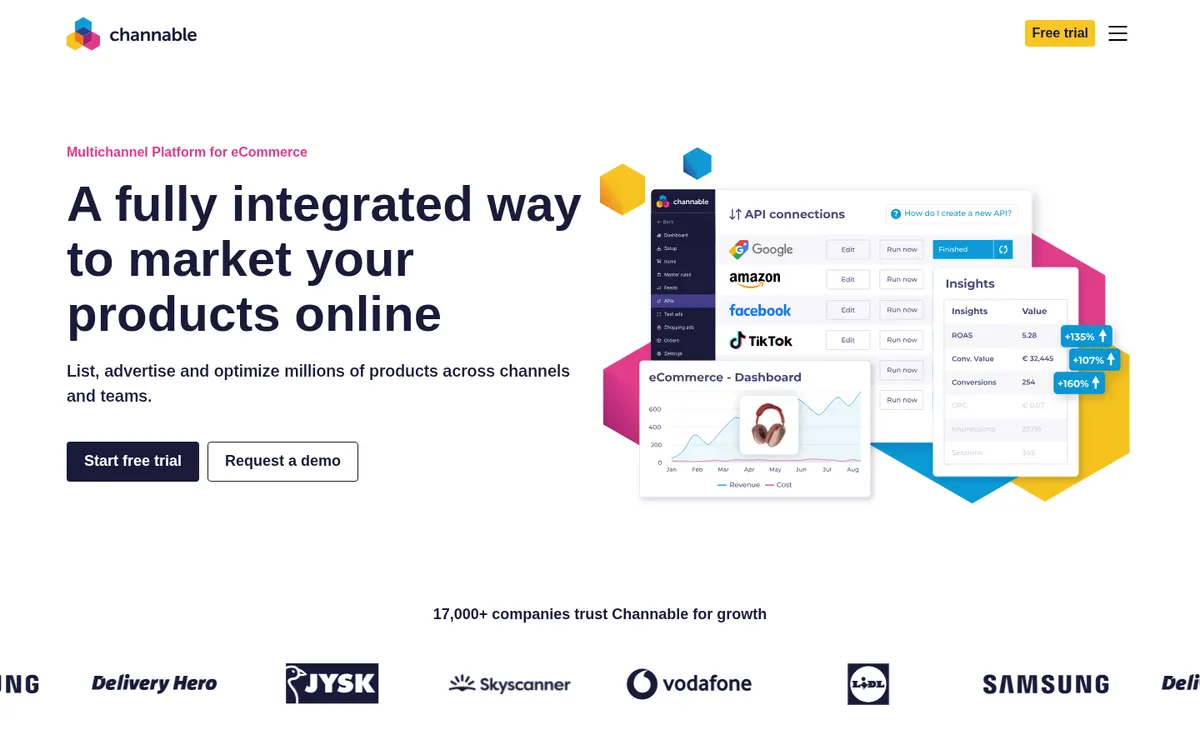
Channable is built for sellers whose growth comes from feeds and shopping ads rather than warehouse logistics. Templates cover more than 2,500 price comparison sites, affiliate platforms and marketplaces, so a single catalog can be pushed to a long tail of destinations without building each connection yourself. Google Ads and Microsoft Advertising feeds are generated from the same product data, and a rule engine transforms titles, prices and attributes per channel. Bulk edits keep large catalogs manageable.
Pricing is published and low at the entry: €29 per month per merchant on Boost CSS Standard, with Core Standard at €59 per month at 5,000 items. That €29 is the lowest published entry figure in this list. A free trial with no time limit lets you test before committing. Costs climb with item counts and extra channels, so a large catalog can outgrow the entry tier quickly.
The rule engine is powerful and takes learning. Sellers who expect a guided setup will spend a few sessions understanding how rules stack and override each other, and a mistake there can push wrong prices to a channel. It is also feed-focused rather than a full inventory platform: stock and order management are shallow, and most sellers pair it with a separate inventory tool.
It fits sellers driving growth from feeds and shopping ads, especially where price comparison sites carry more weight in the buying journey. It fits less well as a single system for a seller whose real problem is stock accuracy across warehouses, where Linnworks or SellerCloud is a better shape.
What works
- Templates for more than 2,500 channels
- Lowest published entry price here
- Google and Microsoft ad feeds built in
What to weigh
- Feed-focused, not full inventory management
- Costs rise with items and channels
- Rule setup involves a learning curve
Pick it if
Product feeds and shopping ads drive your revenue and you want a cheap, flexible rule engine.
Skip it if
You need stock, orders and fulfillment managed in one place rather than feed data pushed outward.
Plate 06 of 08
ChannelEngine
Best for brands and retailers selling across many marketplaces internationally
Our verdict
Best for brands selling across many marketplaces internationally, especially with a European footprint.
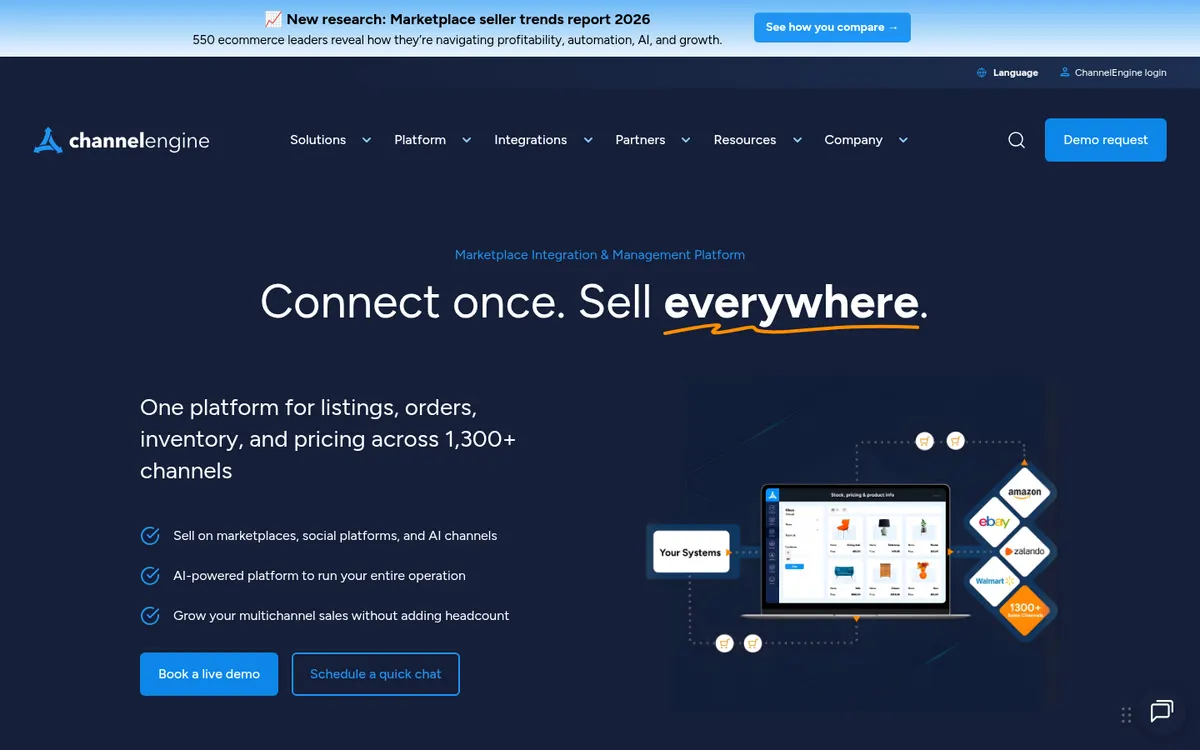
ChannelEngine connects brands and retailers to a broad set of marketplaces, with Amazon and Walmart alongside many regional and European channels. Listings, inventory and orders sync from one central catalog, and per-channel pricing and content rules keep a product presented correctly wherever it appears. Product adaptation handles the attribute differences each marketplace imposes, and the central catalog keeps price and stock consistent across regions.
Pricing is quote-based. The vendor site could not be fetched when checked on November 25, 2026, so no figure is confirmed here and none should be assumed. Budget for a scoping conversation, and expect the quoted number to move with marketplace count, regions and catalog size. Sellers who need a number before the first call will find that frustrating.
The strengths show up in cross-border selling. European marketplace support is deeper than most US-focused rivals manage, which matters if you sell into several countries with different content and pricing expectations. The cost is implementation effort: a large catalog across many channels takes real work to configure, and the platform rewards sellers who can commit internal time to the launch rather than treating it as a plug-in.
It fits brands and retailers selling across many marketplaces internationally, especially with a European footprint and a team that can staff an implementation. It fits less well for a US seller with only domestic channels, where a simpler, US-focused tool will be quicker to live and easier to hand to a small team.
What works
- Broad marketplace coverage
- Deep European marketplace support
- Order and inventory sync from one catalog
What to weigh
- Quote-based pricing
- Implementation effort for large catalogs
- Less established among US sellers
Pick it if
You sell into several European marketplaces and want one catalog keeping price and stock consistent.
Skip it if
You sell only on US channels and want a domestic tool with a faster, lighter setup.
Plate 07 of 08
Linnworks
Best for sellers whose main pain is stock accuracy across channels
Our verdict
Best for sellers whose real problem is stock accuracy across channels and multiple warehouses.
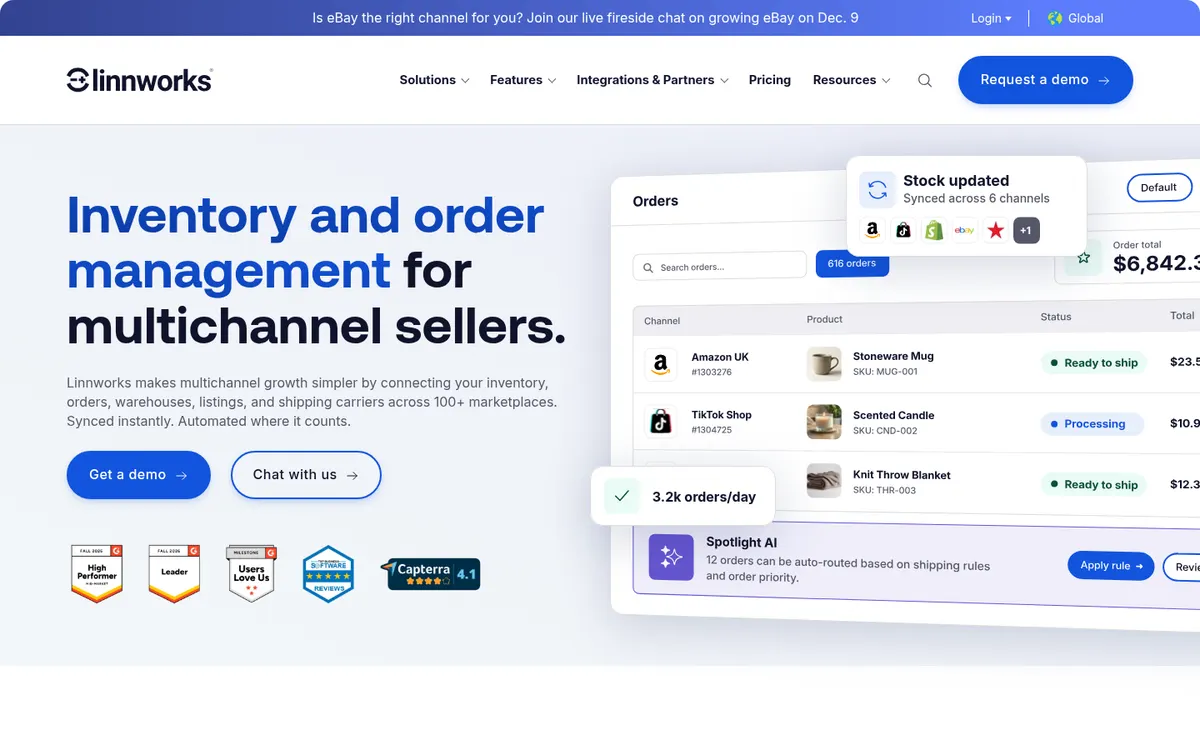
Linnworks attacks one problem first: stock accuracy. Central stock levels, orders and fulfillment sit in one place, and availability updates across every connected channel after each sale, which is what stops the same unit being sold twice on two marketplaces. Automation rules route orders to the right warehouse or fulfillment partner, and multiple warehouses and partners are supported without adding a separate tool.
Pricing is quote-based, and no page content was returned when checked on November 25, 2026, so the cost stays unconfirmed here. Treat any figure you see quoted elsewhere as unverified and get a number against your own order volume and warehouse count. Because the platform replaces several smaller tools at once by combining inventory and order management, compare it against the total of what you would otherwise pay.
Two things slow adoption. Marketplace setup takes time, and the interface feels dated to some users, which shows up in training time for new staff and in how quickly seasonal hires become productive. Neither is a dealbreaker for an operations team that lives in the tool daily, but both matter for a small team without dedicated operations staff.
It fits sellers whose main pain is stock accuracy across channels and who run more than one warehouse or fulfillment partner. It fits less well for a small team that wants a modern interface and a fast setup, or for a seller whose only need is product listing syndication, where a feed tool costs less and goes live sooner.
What works
- Central inventory control
- Order management across channels
- Automation rules for fulfillment routing
What to weigh
- Quote-based pricing
- Interface feels dated to some users
- Marketplace setup takes time
Pick it if
Overselling and stock drift across channels are costing you money and you run multiple warehouses.
Skip it if
You have one location, a small catalog and no appetite for a configured implementation.
Plate 08 of 08
Sellbrite
Best for small teams moving from spreadsheets to first multichannel tool

Our verdict
Best for small teams moving off spreadsheets who want listings and stock sync without a project.
Sellbrite is the on-ramp tool. It gets products listed across major marketplaces quickly, syncs inventory as orders arrive, and keeps stock levels consistent so the same item does not sell twice. The interface is simple enough for a small team to learn quickly, which is the point: this is for sellers moving off spreadsheets and into a first multichannel tool.
Pricing is quote-based, and the page checked on November 25, 2026 confirms a 14-day free trial but shows no paid plan figures. Use the trial to test listing speed and sync reliability on your own catalog rather than a demo catalog, and ask for a quote at your expected order volume before you commit to a term.
The limits appear as you grow. Warehouse depth is lighter than SellerCloud, so a seller with multi-location fulfillment and 3PL routing will outgrow it and end up migrating. Sellbrite also now sits inside GoDaddy, so product direction follows the larger company's priorities rather than a standalone roadmap, which is worth knowing if you are planning a long-term stack.
It fits small teams listing on a handful of major marketplaces who want inventory sync without a configuration project. It fits less well for high-volume sellers, sellers needing warehouse management, or anyone who needs a published price before shortlisting, since the cost only appears after a conversation with sales.
What works
- Fast listing across marketplaces
- Inventory sync as orders arrive
- Simple interface for small teams
What to weigh
- Quote-based pricing
- Less warehouse depth than SellerCloud
- Roadmap now follows GoDaddy priorities
Pick it if
Your team is small, your catalog is simple and you want listing and stock sync working quickly.
Skip it if
You need warehouse routing, multi-location fulfillment or a published price before you talk to sales.
What does multichannel ecommerce management software actually do?
Multichannel ecommerce management software keeps one catalog, one stock count and one order queue consistent across every marketplace you sell on. That is the direct answer, and it explains why the category exists: once a seller lists on three or four channels, spreadsheets and manual uploads fail at the first busy weekend.
Most products in this category do one of three jobs, and the labels on a vendor homepage rarely make the difference clear:
- Feed management: adapts product data to each channel's rules and pushes it out.
- Inventory and order sync: holds stock and orders centrally and updates every channel.
- Warehouse operations: adds purchasing, fulfillment routing, 3PL and multi-location stock.
The overlap is where buyers get confused. Channable and GoDataFeed do feed work well and stop short of warehouse management. SellerCloud and Linnworks own stock and fulfillment but treat feed optimization as a side task. ChannelEngine sits in the middle, syncing listings, inventory and orders across a broad marketplace set with per-channel pricing and content rules.
ChannelAdvisor is not covered by the verified data here, so a seller comparing alternatives should first choose which half of the job matters more. A seller whose pain is listings rejected for missing attributes needs a feed tool. A seller whose pain is overselling on Amazon while orders sit unshipped needs an operations platform.
Two practical tests separate the tools quickly. First, ask which side of the catalog the tool writes to: does it change your source data, or copy and transform it per channel? Tools that transform per channel keep your master catalog clean. Second, ask what happens on a stock change. A real multichannel system propagates availability after every sale, not on a nightly refresh.
Skip the category entirely if you sell on one channel. A single marketplace's own seller tools usually cost less and carry fewer moving parts. The case for paying for this software starts at two or three channels, and gets stronger with each one you add.
This guide sits in the Software collection. Buyers weighing nearby tools often read the guides to commission software and research platforms next.
How do vendors charge for multichannel management in 2026?
Most vendors in this category do not publish a price, so the first job is working out which pricing model you are being quoted. Three shapes dominate: a flat subscription, a fee per order, and a negotiated contract that bundles software with service.
Flat subscriptions are the easiest to budget. GoDataFeed publishes $39 per month on Lite, which covers 1,000 SKUs and 1 PPC feed, and Channable publishes €29 per month per merchant on Boost CSS Standard, with Core Standard at €59 per month at 5,000 items. Both scale with SKUs, items or feed count, so run the number at your twelve-month catalog size, not today's.
Pay-per-order moves the bill with volume. SellerCloud prices this way and quotes per deal, which means a strong quarter costs more than a quiet one. Ask for the quote at your peak month, since that is the month the bill hurts.
Managed services and enterprise contracts are quoted. Feedonomics is flat-rate and quoted, pairing software with a team. ChannelEngine, Linnworks and Sellbrite list no plan figures at all and quote per deal. CedCommerce shows no plan pricing on its site, though the vendor states tiers from $99 to roughly $999 per month, with custom enterprise plans available.
Revenue share and GMV fees are the term to check first. CedCommerce states its plans carry neither, and Feedonomics prices without revenue sharing. If a tool takes a percentage, model it against your annual marketplace revenue before comparing headline numbers, because a low subscription with a percentage fee can cost more than a higher flat one.
| Model | How it bills | Typical fit | Example from this list |
|---|---|---|---|
| Flat monthly subscription | Fixed fee per month, tiered by SKUs, items or feeds | Small and mid-sized sellers who want a known cost | GoDataFeed at $39 on Lite, Channable at €29 |
| Pay per order | Fee scales with order volume, quoted per deal | High-volume sellers with warehouse and 3PL needs | SellerCloud |
| Managed feed service | Flat rate quoted, software plus a service team | Mid-to-large catalogs wanting feed work handled | Feedonomics |
| Quote per deal | Negotiated contract after a scoping call | Complex, multi-region or multi-warehouse catalogs | ChannelEngine, Linnworks, Sellbrite |
| Tiered subscription, price on request | Vendor states tiers but the site lists no plan figures | Sellers entering newer marketplaces | CedCommerce |
Add the implementation cost to every row. A cheaper subscription that needs weeks of internal setup can cost more than a quoted platform that goes live in days.
Every price in this guide was read on the vendor's own pricing page on November 25, 2026. Where a vendor does not publish a figure we could confirm, the card says "See website" rather than a guess. For the arithmetic around this purchase, try the free Email campaign metrics calculator.
Which channeladvisor alternative fits your operation?
- Name the problem in one sentence. Stock accuracy, feed quality or marketplace reach? Write it down, because a feed tool and a warehouse platform solve different problems and no single shortlist covers both.
- Count the channels you actually sell on. Two or three major marketplaces points to a simple feed tool. A dozen channels with regional variations points to a platform with per-channel content and pricing rules.
- Match the pricing model to your volume. A flat subscription suits steady catalogs, while pay-per-order punishes a peak season you can predict. Model both against your busiest month, not your average.
- Run a trial on your own catalog. Import real products with real attribute gaps. A demo catalog hides every failure mode, and the trial is the cheapest place to find out that a connector cannot map your category.
- Ask about TikTok Shop, SHEIN and Temu directly. Do not accept broad coverage claims. Ask which of those three are live, what their attribute rules require, and how often the connector changes.
- Budget for the second tool. Feed work and warehouse work rarely live in one product at a fair price. Plan for a pair, then decide which one you buy this quarter.
Five mistakes that cost sellers money in 2026
- Buying a warehouse platform for a feed problem. SellerCloud and Linnworks are excellent at stock and fulfillment, and both carry implementation weight you do not need if rejected listings are your actual complaint.
- Comparing a subscription with a revenue share. A $39 subscription and a percentage fee are not the same number. Model the percentage against annual marketplace revenue before you call one option cheaper.
- Scoping the quote at off-peak volume. Pay-per-order pricing looks reasonable in a quiet month and arrives as a shock in peak season. Ask for the quote at your peak order count.
- Treating a trial as proof of the integration. A trial that syncs a small set of clean SKUs proves little. Test the messy categories, the missing attributes and the marketplace that already rejects your listings.
- Ignoring who owns the roadmap. Ownership changes, as Sellbrite's move inside GoDaddy shows. Ask how product direction is set before you build long-term process around a tool.
ChannelAdvisor Alternatives: questions
What happened to ChannelAdvisor, and does it still trade under the same name?
Verified data here does not cover ChannelAdvisor's ownership, brand status or contract terms. Confirm the product line, account status and renewal terms directly with the vendor before comparing alternatives on price.
Which alternatives publish an entry price and which are quote-based?
Two of the eight publish a number: GoDataFeed starts at $39 per month on Lite and Channable at €29 per month per merchant on Boost CSS Standard. Six list no plan price on their sites. One of those, CedCommerce, states a $99 to roughly $999 range in its own material. For the rest, budget a scoping call before you can compare cost.
How do feed tools differ from inventory and warehouse platforms?
Feed tools move product data outward: titles, attributes, categories and prices adapted to each channel. Inventory and warehouse platforms own stock, orders and fulfillment inside your operation and push availability outward. Feedonomics, GoDataFeed and Channable sit in the first group. SellerCloud, Linnworks and ChannelEngine sit closer to the second. Many sellers end up running one of each.
Does any tool here charge a revenue share or a GMV-based fee?
CedCommerce states that its plans carry no revenue share or GMV fee, and Feedonomics prices at a flat rate with no revenue sharing. For the other six, no revenue-share term is listed in the verified data. Ask the question directly before signing, since percentage fees change the math at volume.
How long does onboarding take for feed tools versus warehouse platforms?
Feed tools are the faster install. CedCommerce describes onboarding in days rather than weeks, Channable offers a free trial with no time limit and GoDataFeed offers a 14-day free trial. Warehouse platforms take longer: SellerCloud and Linnworks both involve configuring warehouses, workflows and fulfillment rules, and neither is a quick switch for a large catalog.
Which tools support TikTok Shop, SHEIN and Temu?
CedCommerce lists native TikTok Shop, SHEIN and Temu integrations, which is the clearest match for those three channels. Others describe broad marketplace coverage without naming them, and CedCommerce itself notes that some newer channels are still maturing. If those marketplaces carry real revenue for you, verify the connection and its attribute rules on a trial before committing.