
Contents of this guide
The shortlist
Our top 3 for compliance buyers

Vanta
Evidence automation depth
- Best for
- SaaS startups and mid-market teams pursuing SOC 2 or ISO 27001
- Features
- 5 noted: 300+ integrations, SOC 2 coverage, Trust Center, Questionnaire automation, Continuous monitoring
Drata
Real-time monitoring
- Best for
- Cloud-first SMBs and growth-stage SaaS with 50 to 200 employees
- Features
- 5 noted: Continuous monitoring, Open API, Auditor hub, Tiered plans, Cloud integrations
SecureFrame
Guided first audit
- Best for
- Startups under 100 staff doing a first SOC 2
- Features
- 5 noted: AI gap analysis, Policy templates, Trust Center, Federal tier, Questionnaire automation
Disclosure for this guide. All 9 tools here are unpaid editorial picks. The position of a paid listing can be part of what the vendor pays for. Paid and unpaid tools are scored on the same rubric and keep their cons. Details are in the advertising disclosure.
The ledger
Index of every tool
| Tool | Free plan | Trial | Rubric | Compare | ||
|---|---|---|---|---|---|---|
| 01 | VantaSaaS startups and mid-market teams pursuing SOC 2 or ISO 27001 | See websiteNot published | No | Demo only | ||
| 02 | DrataCloud-first SMBs and growth-stage SaaS with 50 to 200 employees | See websiteNot published | No | Demo only | ||
| 03 | SecureFrameStartups under 100 staff doing a first SOC 2 | See websiteNot published | No | Free trial reported in third-party listings; ask sales, vendor site is demo-first | ||
| 04 |  HyperproofMid-market and enterprise GRC teams running several frameworks at once | See websiteNot published | No | Demo only | ||
| 05 |  LogicGateMid-market and enterprise teams needing a flexible GRC platform | See websiteNot published | No | Demo only | ||
| 06 | SprintoStartups to mid-market wanting automation below big-three prices | See websiteNot published | No | Free trial reported in third-party listings; no self-serve purchase | ||
| 07 |  Scrut AutomationSMBs and mid-market wanting a risk-aligned security program | See websiteNot published | No | No | ||
| 08 |  ThoropassSmall to mid-sized firms wanting software and audit in one contract | See websiteNot published | No | Demo only | ||
| 09 | AnecdotesMid-market to enterprise companies with mature GRC programs | See websiteNot published | No | Demo only |
Prices are the lowest paid plan the vendor shows, read on November 25, 2026. Sort by price ranks published monthly figures; tools without one go last. Pin up to three tools to compare them side by side.
How this guide was put together
Every entry was scored on the same five criteria: audit automation (30 percent), framework coverage (20 percent), ease of setup (20 percent), price clarity (15 percent) and scale and flexibility (15 percent). Audit automation carries the most weight because evidence collection is the task buyers want off their plates, and a tool that does it badly costs more in staff time than it saves in subscription fees.
Price clarity scores low across the board. We checked pricing on November 25, 2026 and found that none of the nine vendors publishes a price list; every one routes buyers to a demo or a quote. Where a price could not be checked, the entry says so rather than guessing a number. Any figure you get is a quote rather than a published price, so reconfirm it with the vendor before you sign anything.
Framework coverage rewards tools that let one control set satisfy several standards, since almost every buyer ends up adding a second framework within a year. Ease of setup covers how much of a first certification the product carries on its own. Scale and flexibility separates guided automation tools from configurable GRC platforms that assume a dedicated administrator.
We also read the cons. Headcount-based quotes that jump at renewal, per-framework fees, implementation charges and audits billed outside the subscription all count against a tool, because they change what you actually pay in year two.
Featured placements are paid. A Featured tool would be scored on the same five criteria and carry the same honest cons; this edition has no Featured entry, so the order reflects fit for the buyer each entry describes.
The full process, including how we handle corrections, is on the methodology page. Paid listings follow the advertising disclosure.
Rubric and weights
Every tool below is scored from 1 to 10 on these five criteria. The scores describe each tool; the order is an editorial call on fit for the buyer each card describes, plus the disclosed Featured position.
- 30%Audit automationHow much evidence collection, monitoring and control testing the product does without manual work from your team.
- 20%Framework coverageHow many standards are supported and whether one control set can satisfy several of them at once.
- 15%Price clarityWhether pricing is published, how predictable year two and year three are, and how many fees sit outside the subscription.
- 20%Ease of setupHow much of a first certification the product carries on its own, from templates to guided gap analysis.
- 15%Scale and flexibilityWhether the platform handles multi-entity structures, custom risk models and complex programs as the company grows.
Plate 01 of 09
Vanta
Best for saaS startups and mid-market teams pursuing SOC 2 or ISO 27001
Our verdict
The broadest evidence automation for a first SOC 2, with pricing that scales up as you grow.
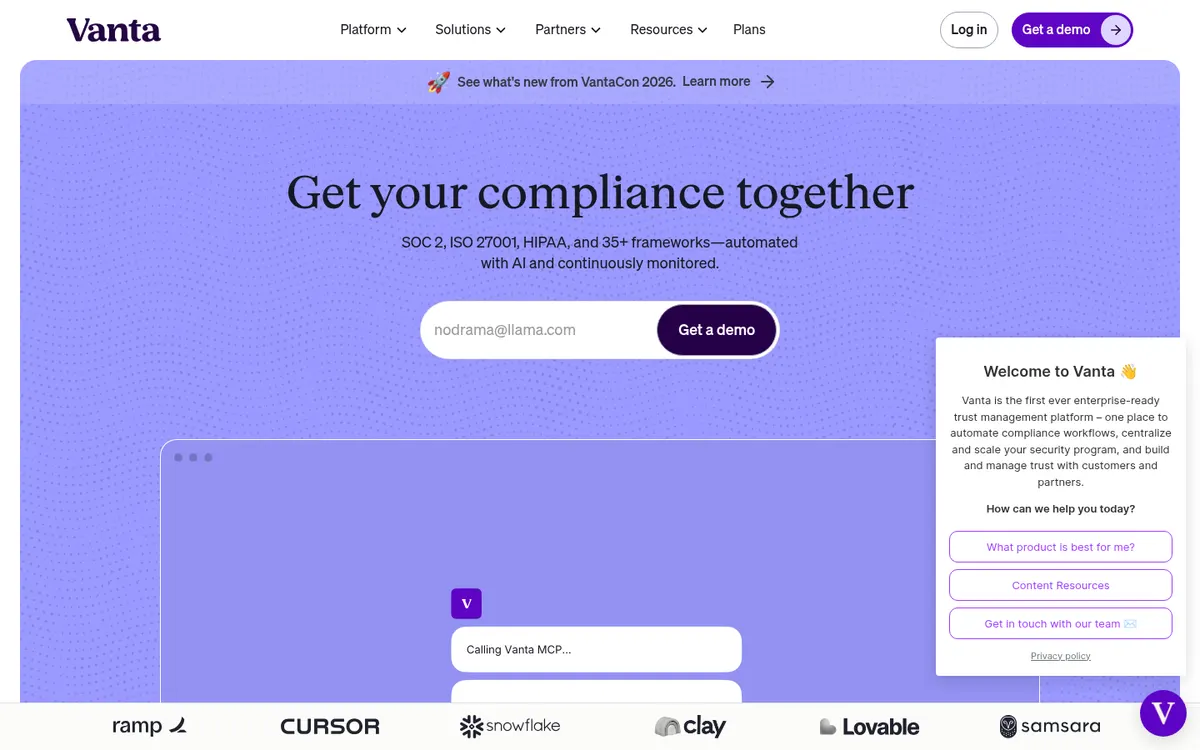
Vanta is the name most buyers already know, and the product earns the recognition. It connects to your cloud, identity and code repositories (AWS, Google Workspace, Okta, GitHub and 300+ integrations in total) and pulls evidence on a schedule rather than in a scramble the week before an audit. The control set stays maintained between audits, which is the part that matters after the first report lands.
Framework coverage centers on SOC 2 and ISO 27001, the two standards most SaaS buyers ask about. The Trust Center publishes your security posture to prospects, and questionnaire automation handles the inbound security reviews that arrive with enterprise deals. Vendor risk management is an add-on rather than part of the base subscription, so budget for it separately.
Pricing is quote-only and scales with headcount. The quote comes from sales rather than a price list, and the external audit is billed outside the subscription on top of it. Renewal increases and occasional multi-year minimums are worth asking about in writing. None of that appears on a price list, so the number you get depends on the call.
Pick Vanta if you want the safest brand recognition among auditors and investors and you can absorb a quote-only annual contract. The depth of the integration library is real, and the modular add-ons let you expand into vendor risk and trust publishing without switching tools. Smaller companies should get the Drata and Sprinto quotes side by side before signing, since all three scale with headcount.
What works
- Continuous evidence collection across 300+ integrations
- Auditor and investor recognition speeds up reviews
- Modular add-ons for vendor risk and Trust Center
What to weigh
- Quote-only pricing that rises with headcount
- External audit billed separately from the subscription
- Renewal increases and multi-year minimums to confirm
Pick it if
You want the most established automation platform and can work through a quote plus a separate audit fee.
Skip it if
You need a published price or you are a team of ten that cannot absorb headcount-based quotes.
Plate 02 of 09
Drata
Best for cloud-first SMBs and growth-stage SaaS with 50 to 200 employees
Our verdict
A cloud-native monitoring engine built for engineering teams that already live inside their cloud console.
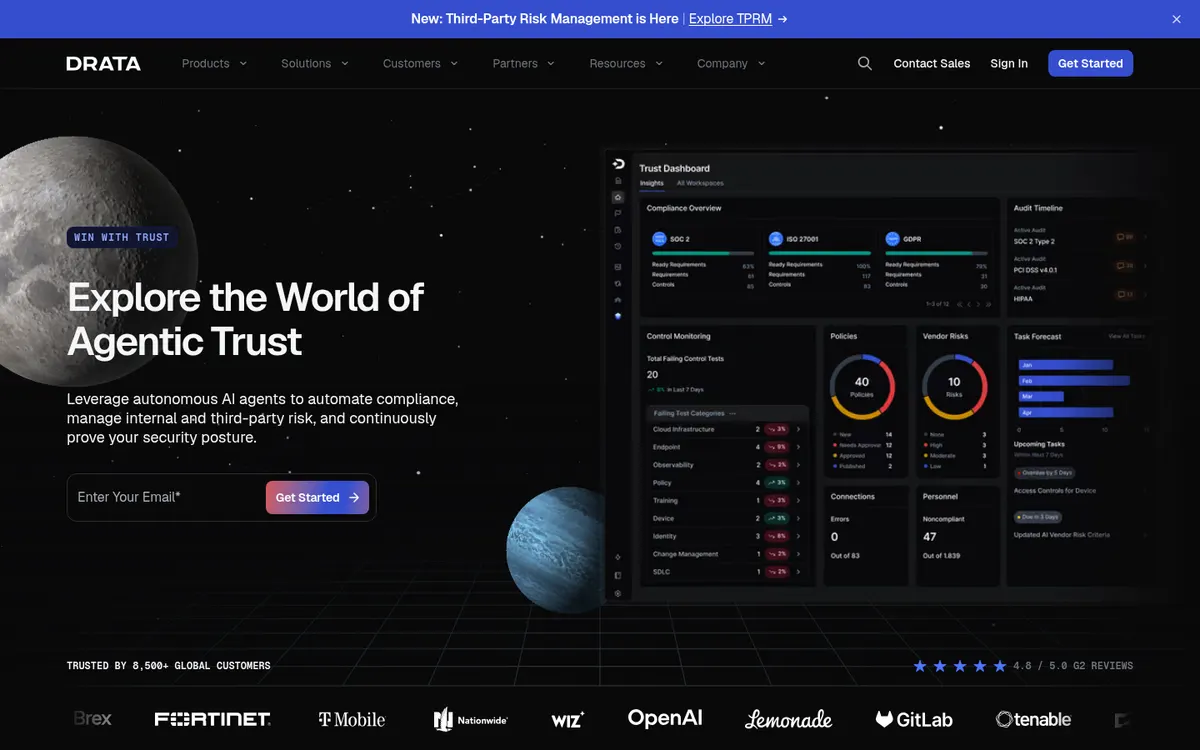
Drata targets cloud-first SMBs and growth-stage SaaS companies of roughly 50 to 200 employees, and the product reflects that. Real-time continuous control monitoring runs against your infrastructure, and the pre-mapped frameworks remove a lot of manual setup for a first SOC 2. If your team already works inside its cloud console every day, the workflow feels natural rather than bolted on.
For engineering-led teams, the open API and custom fields are the differentiator. You can push evidence from in-house tooling and shape fields to match how you actually operate, instead of fitting your process to a fixed schema. The auditor hub gives an external accounting firm a place to pull evidence, which cuts the email chains that otherwise dominate audit season. Plans run in tiers (Foundation, Advanced, Enterprise), and per-framework add-ons sit on top.
Pricing is quoted, not published, and onboarding packages are quoted separately, so the first real number arrives after a sales call. Costs climb at renewal as headcount or framework count grows, which is worth modeling for year two and three rather than year one. Control customization is less flexible than a modular GRC suite, so teams with unusual or heavily bespoke control sets can hit the ceiling.
Drata fits companies with a technical compliance owner, ideally an engineer who owns the program part time. Non-technical owners often prefer a more guided interface. The trade is straightforward: you get strong monitoring and API access in exchange for doing more of the configuration yourself, and the quote needs the same scrutiny as Vanta's because both scale with seats.
What works
- Real-time monitoring on cloud infrastructure
- Open API and custom fields for in-house tooling
- Auditor hub simplifies evidence handoff
What to weigh
- Quote-only tiers with onboarding billed separately
- Renewal costs rise with headcount and frameworks
- Less flexible control customization than GRC suites
Pick it if
You have an engineer who can own compliance work inside your cloud console and want real-time monitoring rather than a checklist.
Skip it if
No one on your team can administer the tool or you need heavy custom control logic.
Plate 03 of 09
SecureFrame
Best for startups under 100 staff doing a first SOC 2
Our verdict
The quickest guided path from zero to audit-ready for a small team chasing a first SOC 2.
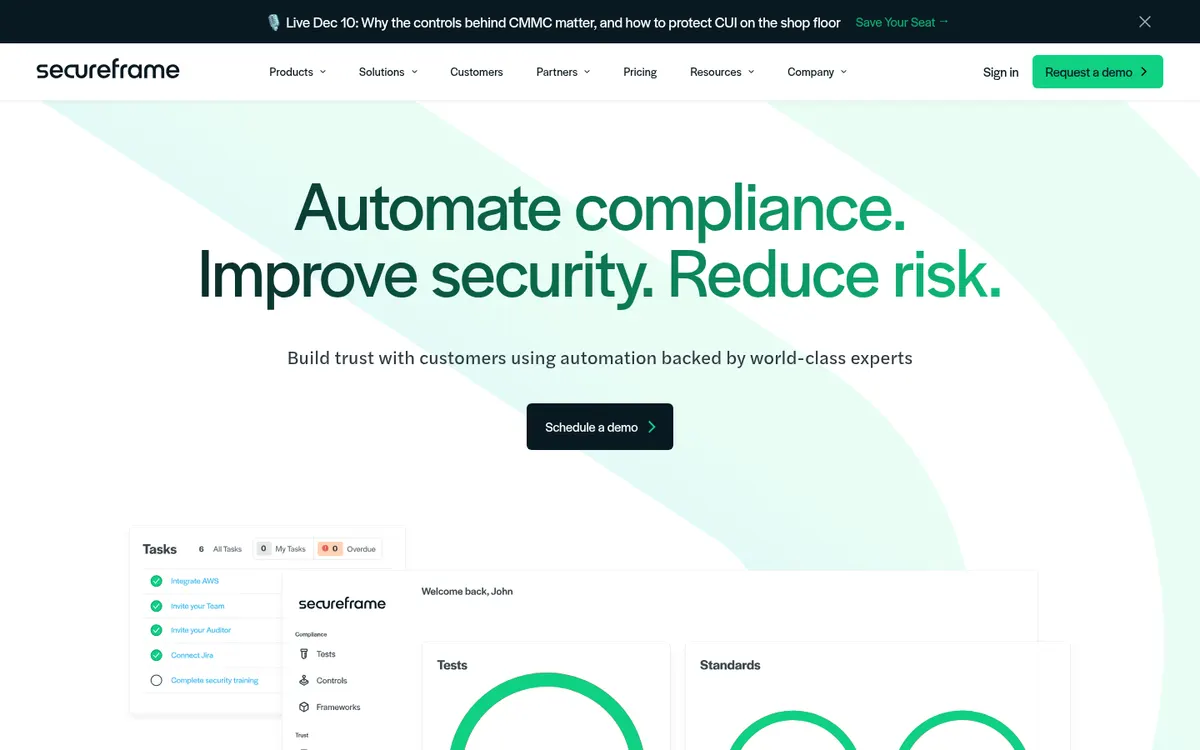
SecureFrame is built for startups under 100 staff doing a first SOC 2, and the product is organized around speed. AI-assisted gap analysis shows what is missing before you start, continuous monitoring keeps evidence current, and the built-in policy templates remove the blank-page problem that stalls small teams. Setup is more guided than Drata's, which is the point.
The feature set goes further than a first audit strictly requires. Questionnaire automation appears on the Complete tier, the Trust Center publishes your posture, and vendor risk management is included rather than sold as a separate module. The federal tier is unusual at this size: SSP Builder and POA&M management are capabilities most automation-first rivals skip entirely, which makes SecureFrame a rare fit for contractors selling to government buyers.
Pricing is fully quote-only with headcount bands. Per-framework add-ons and implementation work are quoted on top, and audit fees sit outside the subscription. The vendor site is demo-first, so ask sales whether a trial is available. Nothing about the pricing is self-serve, and the total for year one is often meaningfully higher than the subscription line suggests.
This is a strong choice for a small company with no dedicated compliance staff that needs a report fast. It is a weaker choice if you plan to run four frameworks in two years, because per-framework fees stack and a common-controls model would serve you better. Get the framework fees in writing at the quote stage rather than discovering them when you add ISO 27001.
What works
- Guided setup for first-time compliance owners
- Federal tier with SSP Builder and POA&M management
- Trust Center and vendor risk included
What to weigh
- Quote-only pricing with headcount bands
- Per-framework add-ons quoted on top of the base plan
- Audit and implementation billed separately
Pick it if
You are under 100 staff, have no compliance hire, and want a guided run at a first SOC 2.
Skip it if
You expect to add three or four frameworks within two years, since per-framework fees stack quickly.
Plate 04 of 09
Hyperproof
Best for mid-market and enterprise GRC teams running several frameworks at once
Our verdict
One evidence set covers several frameworks, and unlimited users mean no per-seat penalty as the team grows.
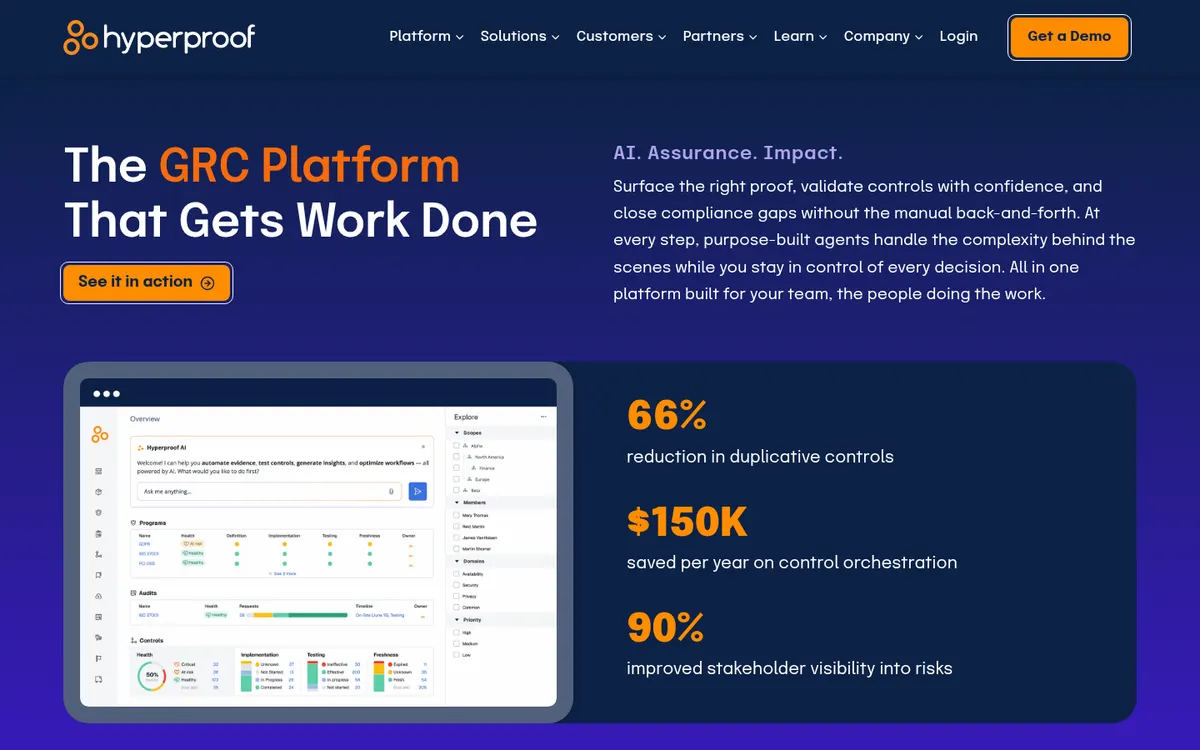
Hyperproof is a GRC platform rather than a certification sprint. Its common-controls framework maps SOC 2, ISO 27001 and other standards to a single evidence set, so adding a second or third framework does not mean collecting everything twice. That one idea drives most of the value, and it is why mid-market and enterprise teams running several frameworks at once end up here.
Unlimited users on flat-rate tiers is the second differentiator. When finance, HR, legal and engineering all have to answer questionnaires and attest to controls, per-seat pricing punishes you for doing compliance properly. Hierarchical scopes handle multi-entity structures, and centralized reporting rolls up across entities and frameworks. The shared evidence and control library is where administrators spend most of their time.
The trade is cost and complexity. Entry costs exceed automation-first rivals for small teams. Setup takes longer than guided automation tools, and a dedicated administrator is close to mandatory, while native reporting is thin. Implementation fees belong in the negotiation, in writing.
Hyperproof suits organizations that already treat compliance as a program with owners, calendars and a control library, not a one-time report. If you are a 20-person startup chasing a first SOC 2, the setup burden will cost more than it saves. If you are a 300-person company with three frameworks, two entities and an auditor who wants everything in one place, it is one of the few platforms that fits without custom work.
What works
- One evidence set satisfies multiple frameworks
- Unlimited users on flat-rate tiers
- Hierarchical scopes for multi-entity groups
What to weigh
- Higher entry cost than automation-first tools
- Steep learning curve that needs a dedicated admin
- Thin native reporting
Pick it if
You run three or more frameworks, have multiple entities, and want the whole company in the tool without seat fees.
Skip it if
You are a small team chasing a first SOC 2 and want the product to do most of the setup for you.
Plate 05 of 09
LogicGate
Best for mid-market and enterprise teams needing a flexible GRC platform
Our verdict
A no-code GRC builder for teams with bespoke risk workflows, not a shortcut to a first certification.
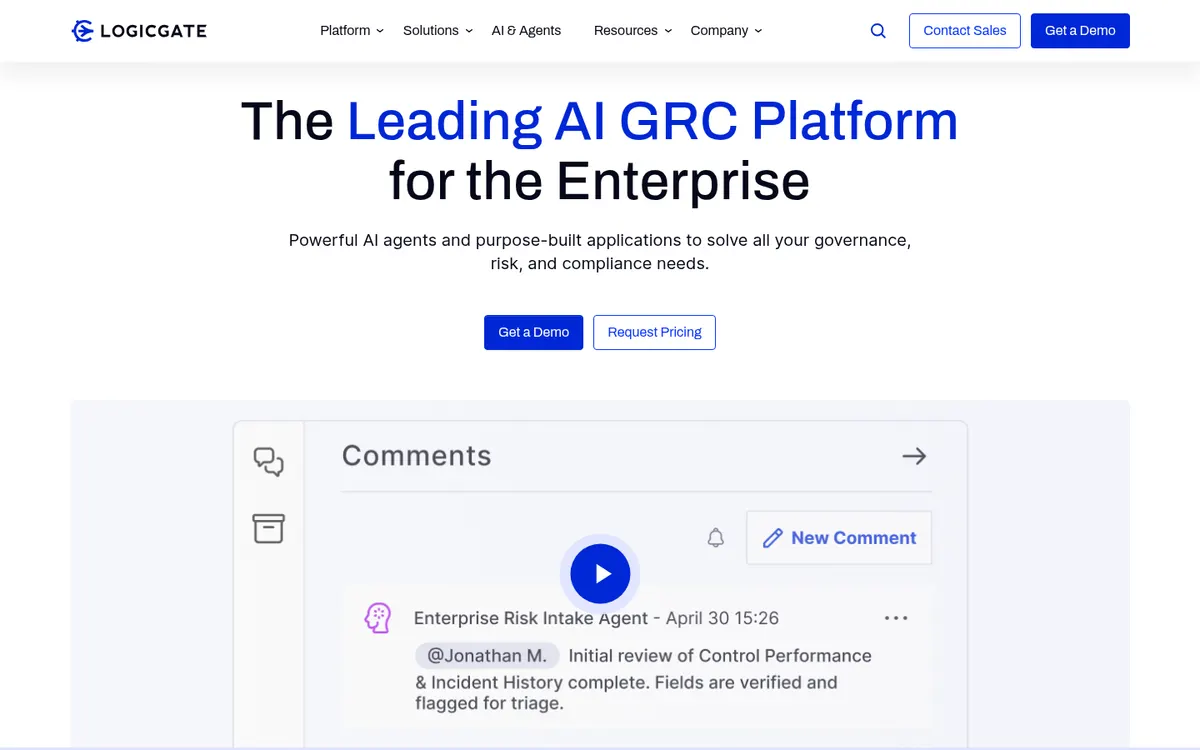
LogicGate is a platform, not a product with a finish line. Its no-code drag-and-drop builder lets business users assemble their own GRC applications, and prebuilt apps for risk management, audit and compliance give you a starting point. Enterprise risk, third-party risk and compliance can run on one platform, which is the argument for buying it instead of three point tools.
Licensing is modular, banded by application and power user. External and standard users are typically included at no extra cost, so the people answering questionnaires and completing assessments do not each carry a license. Quote-based pricing banded by module puts it well beyond a first SOC 2 budget. Configuration effort and professional services are usually part of the deal, and role configuration is trickier than in guided tools, which is the kind of thing that only shows up in week three.
The honest limitation is that nothing is prebuilt for a specific audit or certification. You are buying a toolkit that can be shaped into a SOC 2 program, not a guided route to one. That is a feature for a risk team with a mature model and a liability for a startup that wants evidence collected next month. The flexibility is real: you can build your own applications and workflows. So is the implementation project.
LogicGate fits mid-market and enterprise organizations with an existing GRC function, a defined risk taxonomy and someone who can own platform administration. It is overkill for a first certification and underspecified for a team that wants Vanta-style defaults. If your requirement list includes a risk process that does not fit any template, this is one of the few platforms that will not fight you.
What works
- No-code builder for custom GRC applications
- Standard and external users usually included
- Risk, audit and compliance on one platform
What to weigh
- Nothing prebuilt for a specific audit or certification
- Quote-based modular pricing that scales with modules
- Configuration and professional services usually required
Pick it if
You have a risk team with a process that does not fit templates and someone to administer the platform.
Skip it if
You need a SOC 2 report in the next quarter or you are working to a small-team budget.
Plate 06 of 09
Sprinto
Best for startups to mid-market wanting automation below big-three prices
Our verdict
Comparable evidence automation to the big names at a lower price band, with renewal risk to manage.
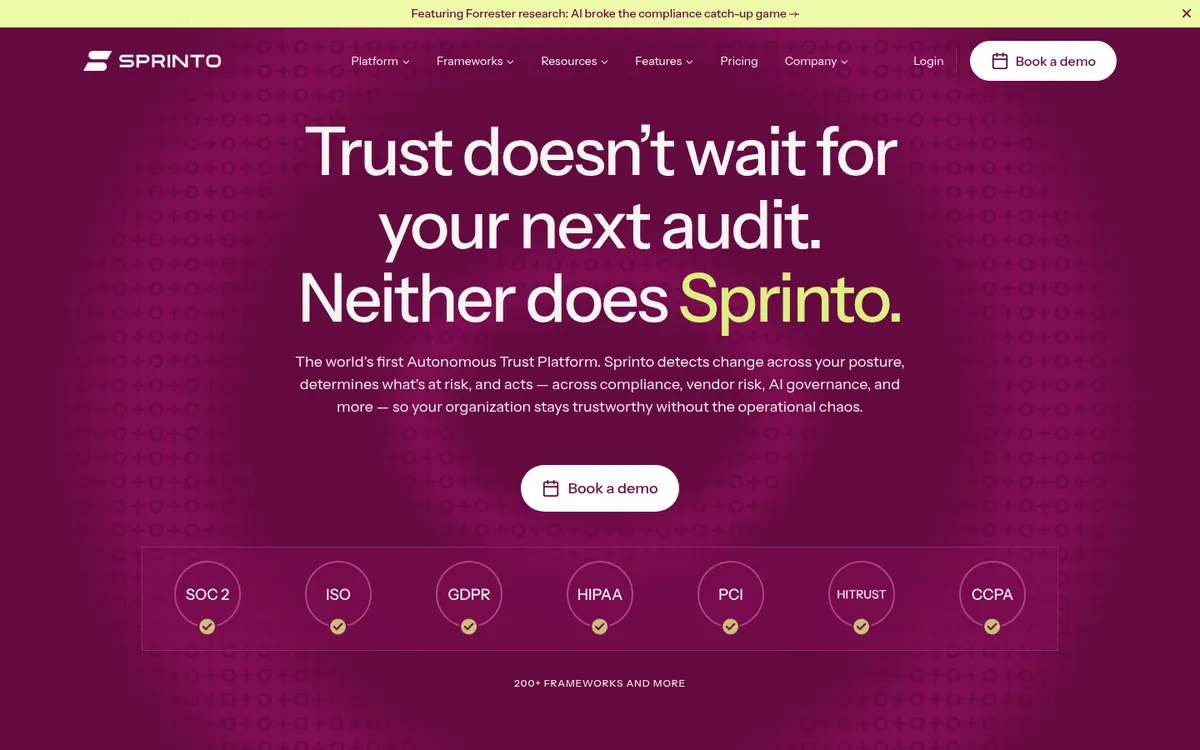
Sprinto sells the same core promise as the market leaders, continuous monitoring with automated evidence collection across 200 to 300+ integrations, at a lower price band. The framework library runs to 200-plus standards including the EU AI Act and ISO 42001 for AI governance, which is broader than most rivals at this price. Cross-framework control reuse means one piece of evidence can serve several standards.
Unlimited users on all tiers is a practical advantage. Security questionnaires arrive from sales, not from the compliance team, and per-seat pricing on questionnaire tools gets expensive fast. Concierge-style support during audits appears on paid plans, which matters for a team going through its first one. The feature set is close enough to the leaders that the buying decision usually comes down to price and support rather than capability.
Pricing is quote-only and headcount-driven, so ask for a written quote before you compare vendors. The catch is renewals: ask about increases and put a renewal cap in the contract before you sign. There is no self-serve purchase path, so evaluation means a sales call either way.
Sprinto fits startups and mid-market companies that want evidence depth close to the leaders and can live with a smaller vendor. It is a weaker fit if procurement requires a large reference base, or if you cannot get a multi-year price commitment in writing. Ask specifically what the renewal formula is and what happens to the price when headcount doubles.
What works
- Broad framework library including AI governance standards
- Unlimited users on every tier
- Lower price band than the market leaders
What to weigh
- Headcount-driven quote-only pricing
- No self-serve purchase path or trial
Pick it if
You want leader-class automation at a lower starting quote and you can lock renewal terms in writing.
Skip it if
You cannot get a renewal cap agreed or your procurement team requires a large vendor footprint.
Plate 07 of 09
Scrut Automation
Best for SMBs and mid-market wanting a risk-aligned security program
Our verdict
Builds the compliance program around your own risk model, at the cost of a guided path.
Scrut Automation takes a risk-first view. Instead of pushing a fixed checklist, it lets you define custom controls, tests and risk scoring formulas, then maps evidence to that model. AI-driven evidence validation flags gaps, and AI remediation guidance suggests the fix. For a team that has opinions about how risk should be measured, that is a meaningful difference from the template-led tools.
The framework library runs to 60-plus standards with auditor-approved policy templates, and questionnaire automation is included. Configurability is the strength: custom controls, custom workflows, custom scoring. It is also the cost. Setup complexity rises with the level of customization, and a team without a compliance owner will find the blank canvas harder than a guided wizard.
There is no published pricing and no self-serve trial, so the first step is a call. The vendor footprint is smaller than Vanta's or Drata's, which means a thinner integration and reference pool to check, and fewer peers who have already run the tool through an audit. Verify the integration you depend on before you commit, rather than assuming it exists.
Scrut fits SMBs and mid-market companies with a security leader who wants the program shaped around the business rather than around a framework's default control set. It is a poor fit for a founder doing a first SOC 2 alone with no compliance background, where a template-led tool will get you to the audit faster and cheaper.
What works
- Custom risk scoring and configurable controls
- AI evidence validation and remediation guidance
- 60-plus frameworks with auditor-approved templates
What to weigh
- No published pricing and no trial
- Customization adds setup work
- Smaller integration and reference pool
Pick it if
You have a security lead who wants the program built around your own risk model.
Skip it if
You want a guided, template-led run at a first certification or you need a trial before buying.
Plate 08 of 09
Thoropass
Best for small to mid-sized firms wanting software and audit in one contract
Our verdict
Software and audit under one contract, which simplifies accountability but narrows your choice of auditor.
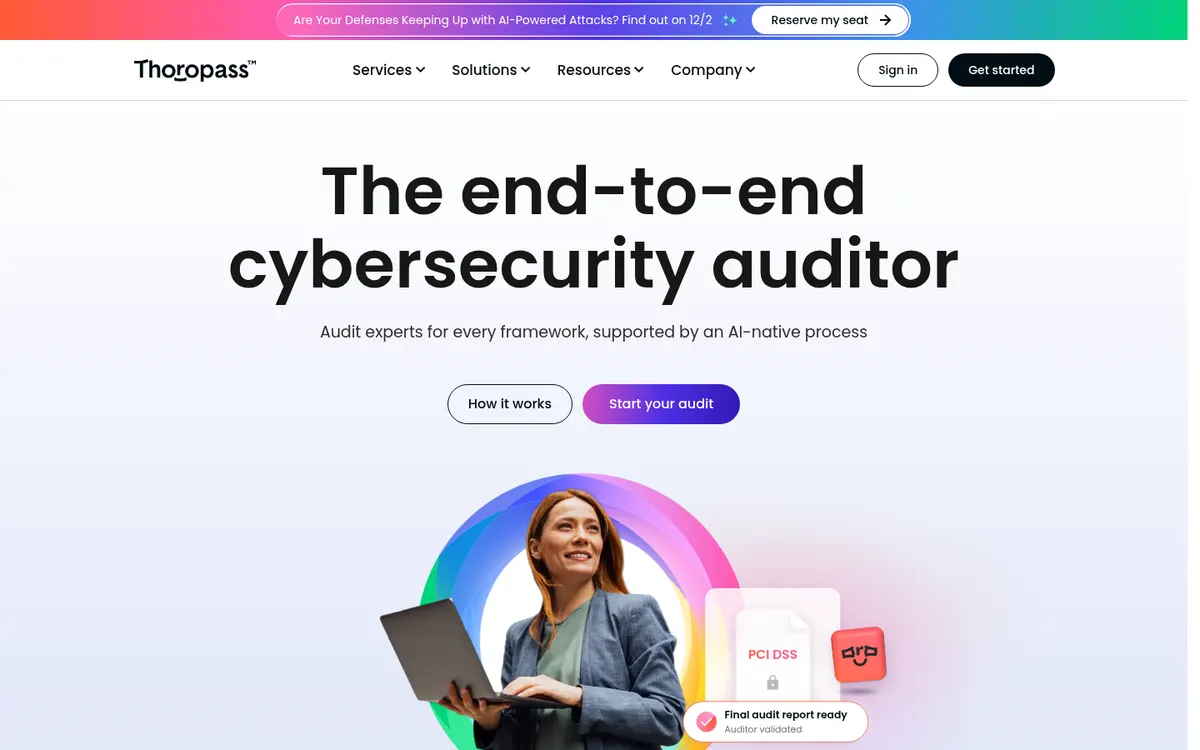
Thoropass sells the outcome rather than the tool. Platform and audit arrive under a single contract, delivered by in-house auditors rather than an outsourced accounting firm, with a dedicated compliance manager assigned to your account. For a small team that does not want to source and manage an auditor separately, that removes a real project.
The software side is guided: templates, evidence collection, continuous monitoring. It is shallower than the pure-play automation platforms, which is the honest trade. You are buying a bundled service where the audit and the software are designed to work together, not the deepest evidence engine on the market.
Pricing reflects the bundle, and renewals keep the audit bundled. That is a lot for a lean team, but compare it against a platform subscription plus a separate audit bill and the gap narrows. The savings claim against a traditional audit firm only holds if you would otherwise pay full audit rates.
Thoropass fits small to mid-sized firms that value one vendor accountable for the whole outcome and would rather not manage an auditor relationship. It is a poor fit if you already have an auditor you trust, or if you need automation depth for four frameworks and a mature control library. In that case, pair a platform with your existing firm and keep the flexibility.
What works
- Audit and platform under one contract
- Dedicated compliance managers included
- No separate auditor to source or manage
What to weigh
- All-in contracts run high for lean teams
- Automation shallower than pure-play platforms
- Less flexible if you already have an auditor
Pick it if
You want one vendor accountable for both the software and the audit and would rather not manage an audit firm.
Skip it if
You already have an auditor you trust or you need deep multi-framework automation.
Plate 09 of 09
Anecdotes
Best for mid-market to enterprise companies with mature GRC programs
Our verdict
Unlimited frameworks and deep no-code customization, priced for mature programs that already know what they need.
Anecdotes is aimed at companies that already run GRC as a discipline. Unlimited frameworks are included with no per-framework fee, so adding ISO 42001 or a customer's bespoke standard does not trigger a new line item. Given that most platforms charge per framework, that single term changes the math for anyone planning a multi-standard roadmap.
Integrations are proprietary and built in-house (180 to 200-plus of them), and data collection follows a least-privilege model, pulling only what a control actually needs. No-code customization extends to frameworks, controls, evidence and workflows, which is what mature programs ask for and what template-led tools cannot offer. Modular add-ons such as Risk Manager and Trust Center sit on top of the base.
The pricing matches the positioning: it is quote-based and modular. Add-ons stack up quickly, and a company that needs three modules is looking at a large commitment once implementation is counted. That is not a criticism of the product, it is the segment it sells into.
Anecdotes fits mid-market to enterprise teams with a defined control framework, a compliance owner and a multi-year framework plan. It is a poor first purchase for a startup: the customization is only valuable if you know what you want to configure. Smaller companies are usually better served starting on a guided tool and migrating once the program has shape.
What works
- Unlimited frameworks with no per-framework fee
- In-house integrations with least-privilege collection
- No-code customization for complex programs
What to weigh
- High entry price and stacking add-on modules
- Requires a team that already knows what to configure
Pick it if
You run a mature multi-framework program and want no per-framework fees or limits on customization.
Skip it if
You are buying your first compliance tool or you need a published price up front.
What does compliance automation and GRC software actually do?
Compliance automation software collects the evidence an auditor asks for, continuously, and maps it to a framework. GRC software does that plus the broader governance work: risk registers, policy lifecycle, vendor risk, incident tracking and custom workflows. The overlap is large, which is why the two categories get sold together, but the starting point is different. Automation tools assume you want a specific report, usually SOC 2 or ISO 27001. GRC platforms assume you already have a risk program and want software to run it.
Nothing forces a SaaS company to buy either. No law requires SOC 2. What happens is commercial: enterprise buyers put security requirements in contracts, and a SOC 2 Type II report (or ISO 27001 certificate) is the cheapest way to answer them. You can reach that report with spreadsheets and shared drives. Teams buy software because the manual route consumes an engineer's month every year and produces stale evidence between audits.
Expect the following in almost any tool in this category:
- Integrations with cloud, identity and code tools that pull configuration data automatically
- A control set mapped to one or more frameworks, with policy templates attached
- Continuous monitoring tests that flag drift between audits
- A place to store, version and share evidence with an external auditor
The practical difference between products is how much of that they do without you. A guided tool ships a default control set and tells you what is missing. A configurable platform ships a builder and expects you to define the model. Both are correct for different buyers.
Time to audit readiness usually runs from a few weeks to several months. What drives it is rarely the software: it is how much of your infrastructure was never documented, how many policies need writing, and how long it takes to get an auditor's calendar. Companies with clean cloud configuration and an owner who can spend a day a week on it move fastest.
This guide sits in the Compliance collection. Buyers weighing nearby tools often read the guides to brand protection companies and software for electrical contractors next.
How does compliance software pricing actually work?
Almost nobody in this category publishes a price. When we checked on November 25, 2026, all nine vendors routed buyers to a demo or a quote form, so the first real number arrives after a sales call. What you can compare is the billing model, because that determines what happens in year two and three.
| Model | How it bills | Typical fit | Example from this list |
|---|---|---|---|
| Headcount-based quote | Annual subscription quoted against employee count, external audit billed separately | SaaS companies from startup to mid-market | Vanta, Drata, SecureFrame, Sprinto |
| Flat rate with unlimited users | Annual flat fee on a tier, no per-seat charge | Teams where finance, HR and sales all answer questionnaires | Hyperproof |
| Modular licensing | Banded by application and power user | Enterprise risk, audit and compliance functions | LogicGate, Anecdotes |
| Bundled audit | Platform and audit under one contract, renewed together | Small firms with no auditor relationship | Thoropass |
The external audit is the line item buyers forget. It is usually billed outside the subscription, so ask for an audit quote alongside the platform quote. Thoropass folds it into the single contract, which is why its all-in figure deserves a careful comparison.
Per-framework fees are the second surprise. SecureFrame sells per-framework add-ons, while Anecdotes includes unlimited frameworks and Hyperproof maps several standards to one evidence set. If your roadmap includes three standards in two years, model that before you compare base quotes.
Renewals deserve the same attention as the first invoice. Renewal increases are common, so the year two number deserves as much attention as the first invoice. Ask for the renewal formula and a cap in writing, and get implementation fees quoted up front rather than added at signature.
Every price in this guide was read on the vendor's own pricing page on November 25, 2026. Where a vendor does not publish a figure we could confirm, the card says "See website" rather than a guess. For the arithmetic around this purchase, try the free Email campaign metrics calculator.
Which compliance tool should you shortlist?
Name the report. Decide which framework the business actually needs, usually SOC 2 Type II for US enterprise buyers or ISO 27001 for European and global deals. That single answer eliminates half the list before you talk to anyone.
Count the people. Headcount drives quotes at Vanta, Drata, SecureFrame and Sprinto. Count everyone who might need a login, including HR and finance, then compare against flat-rate tools if that number is large.
Check the integrations you depend on. List your cloud provider, identity provider, code host and ticketing system, then confirm each is supported. An unsupported source becomes manual evidence every audit cycle.
Separate software from audit. Get an audit quote alongside the software quote. At most vendors the audit is billed on top, and bundling only helps if you do not already have an auditor you trust.
Ask for year two and three. Request the renewal formula, any per-framework fees, and implementation charges in writing. A quote that looks cheap in year one can double by year three through headcount growth and framework additions.
Decide guided or configurable. If you have no compliance owner, pick a guided tool that ships defaults. If you have a risk team with a defined model, pick a configurable platform and budget for implementation services.
What do buyers get wrong when choosing compliance software?
- Buying for the audit only. A tool that gets you to the first report but cannot reuse controls for the second framework costs more over three years than one bought with the roadmap in mind.
- Ignoring the audit invoice. The subscription is not the total. External audit fees usually land separately at most vendors, and they belong in the same budget approval as the software.
- Accepting the first renewal silently. Renewal increases are common. Negotiate a cap and a written formula before signing, when you still have leverage.
- Overbuying configurability. A no-code GRC platform with quote-based pricing and a services project will not get a small startup to a SOC 2 faster than a guided tool.
- Skipping the integration check. Evidence automation rests entirely on connected systems. Verify every source you rely on is supported before you sign, because manual workarounds quietly rebuild the spreadsheet you paid to replace.
The 9 Best Compliance Software Picks for 2026: questions
What does compliance software cost per year, including the audit?
None of the nine vendors here publishes a price list, so budget for two quotes: one for the platform and one for the external audit. Pricing is on the vendor site or available from sales, and every figure should be reconfirmed directly before you budget.
How do the leading tools differ for a first SOC 2 or ISO 27001?
Guidance level is the main difference. SecureFrame and Vanta ship a default control set and walk you through gaps, which suits a team without a compliance hire. Drata assumes you can work inside your cloud console and gives you an API instead. Hyperproof and LogicGate assume a program already exists and hand you a builder rather than a checklist.
Is compliance software mandatory for a SaaS company?
No. Nothing requires you to buy software or to hold SOC 2. The pressure is commercial: enterprise buyers write security requirements into contracts and expect evidence. You can produce a SOC 2 report with spreadsheets and shared drives, but collecting evidence manually consumes engineering time every audit cycle and goes stale between audits.
How long does it take to reach audit readiness?
Usually a few weeks to several months, and the software is rarely the constraint. The timeline is driven by undocumented infrastructure, policies that still need writing, remediation of failed controls, and the auditor's own availability. Teams with an owner who can give compliance a day a week, plus clean cloud configuration, get to readiness fastest.
Where does compliance automation end and GRC begin?
Automation covers evidence collection, control monitoring and framework mapping against a target report, usually SOC 2 or ISO 27001. GRC adds risk registers, policy lifecycle, vendor risk, incident tracking and no-code workflow building. Hyperproof, LogicGate and Anecdotes lean GRC; Vanta, Drata and SecureFrame lean automation, though the lines blur as each adds modules.
Can one platform cover several frameworks from shared evidence?
Yes, and that is the main reason to move beyond a first-audit tool. Hyperproof maps SOC 2, ISO 27001 and others to one evidence set, Sprinto and Anecdotes reuse controls across frameworks, and Anecdotes includes unlimited frameworks with no per-framework fee. SecureFrame sells per-framework add-ons, so check the model before you commit.