
Contents of this guide
The shortlist
Our top 3 for software buyers

MasterControl
Validated document control
- Best for
- Large regulated manufacturers needing quality plus manufacturing in one suite
- Features
- 5 noted: Document control, CAPA, Training tracking, Audit trails, Manufacturing execution
Veeva Vault QMS
Shared Vault records
- Best for
- Life sciences companies already standardized on the Veeva Vault platform
- Features
- 4 noted: Document control, Supplier quality, GxP ready, Vault platform

ETQ Reliance
No-code configuration
- Best for
- Large manufacturers needing highly configurable multi-site quality processes
- Features
- 4 noted: No-code workflows, Risk management, Supplier quality, Multi-site
Disclosure for this guide. All 9 tools here are unpaid editorial picks. The position of a paid listing can be part of what the vendor pays for. Paid and unpaid tools are scored on the same rubric and keep their cons. Details are in the advertising disclosure.
The ledger
Index of every tool
| Tool | Free plan | Trial | Rubric | Compare | ||
|---|---|---|---|---|---|---|
| 01 | MasterControlLarge regulated manufacturers needing quality plus manufacturing in one suite | See websiteQuote-based, entry packages estimated around $25,000 per year, implementation extraNot published | No | Demo only | ||
| 02 | Veeva Vault QMSLife sciences companies already standardized on the Veeva Vault platform | See websiteQuote-based, premium enterprise pricingNot published | No | Demo only | ||
| 03 | ETQ RelianceLarge manufacturers needing highly configurable multi-site quality processes | See websiteQuote-based, priced per moduleNot published | No | Demo only | ||
| 04 |  QT9 QMSMid-market regulated manufacturers wanting an all-in-one validated QMS | See websitecustom quoteCustom quote | No | Free trial | ||
| 05 |  Greenlight GuruMedical device companies needing design controls and risk management | See websiteQuote-based, base platform estimated around $25,000 per yearNot published | No | Demo only | ||
| 06 |  QualioGrowing life sciences teams needing fast, low-complexity deployment | $25,000Foundation, annual platform subscription, billed annually, unlimited basic usersChecked Nov 25, 2026 | No | Free trial | ||
| 07 | ComplianceQuestRegulated manufacturers already standardized on Salesforce | See websiteQuote-based, priced per user and per moduleNot published | No | Demo only | ||
| 08 |  Arena QMSProduct companies wanting QMS and PLM in one system | See websiteQuote-based, tiered by users and modulesNot published | No | Free evaluation via sales approval | ||
| 09 |  IntelexEHSQ teams wanting published per-user pricing | See websiteEssentials, per user per monthNot published | No | Free trial |
Prices are the lowest paid plan the vendor shows, read on November 25, 2026. Sort by price ranks published monthly figures; tools without one go last. Pin up to three tools to compare them side by side.
How this guide was put together
Every platform here was scored against five criteria that map to what regulated buyers actually have to prove, to an auditor and to a finance team.
Compliance depth carries the most weight at 30 percent. It covers document control, CAPA, training management, electronic signatures and audit trails, plus how closely the vendor's templates track the standards a buyer gets audited against, such as ISO 13485, FDA QMSR and 21 CFR Part 11 expectations for electronic records. Configuration fit at 25 percent asks whether non-standard workflows can be modeled without custom code. Pricing clarity at 20 percent rewards vendors who publish a number and penalizes per-module quotes that cannot be budgeted until scope is final. Time to live at 15 percent covers templates, deployment model and trial access. Ecosystem fit at 10 percent looks at the surrounding stack: manufacturing execution, PLM, Salesforce and regulatory content.
Prices and plan details came from vendor pricing pages checked on November 25, 2026. Where a vendor publishes nothing, we say so and label any figure as an estimate rather than a quote. We did not convert currencies or restate a figure in a billing term the vendor does not use.
Ordering in this list is editorial. Each entry is placed for the buyer it describes, not by a weighted total, so a lower entry can still be the better purchase for a narrow use case. No Featured placement appears in this edition; when one does run, it is a paid placement and is scored against the same five criteria with the same honesty about limitations.
The full process, including how we handle corrections, is on the methodology page. Paid listings follow the advertising disclosure.
Rubric and weights
Every tool below is scored from 1 to 10 on these five criteria. The scores describe each tool; the order is an editorial call on fit for the buyer each card describes, plus the disclosed Featured position.
- 30%Compliance depthHow thoroughly the platform covers document control, CAPA, training, audit trails and the standards buyers actually get audited against.
- 25%Configuration fitWhether non-standard quality workflows can be modeled without custom code, and how much specialist effort that work takes.
- 20%Pricing clarityHow much of the cost a buyer can see before a sales call, and how predictable the total stays once users and modules are added.
- 15%Time to liveHow quickly a regulated team can move from contract to validated, audit-ready use, based on templates, deployment model and trial access.
- 10%Ecosystem fitHow well the system connects to the surrounding stack, whether that is manufacturing execution, PLM, Salesforce or regulatory content.
Plate 01 of 09
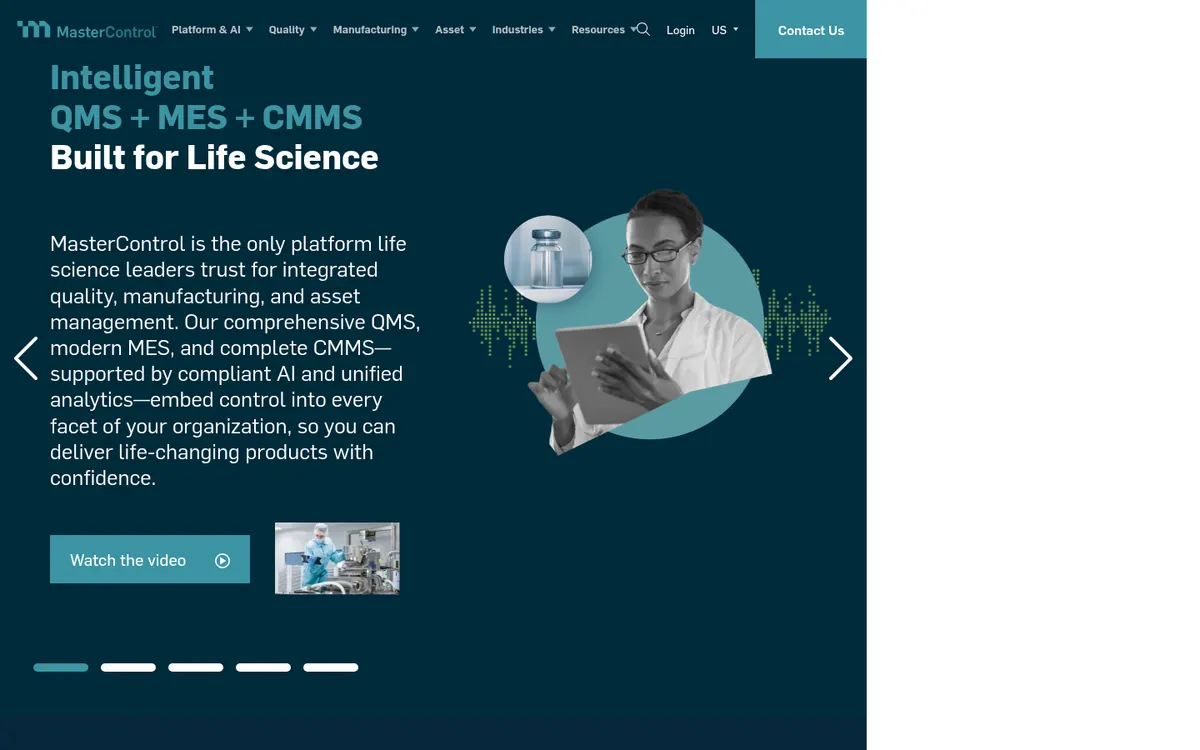
MasterControl
Best for large regulated manufacturers needing quality plus manufacturing in one suite
Our verdict
A strong enterprise choice when quality and manufacturing records must live in one validated suite, provided you can absorb the implementation.
MasterControl is an enterprise option in this list. Document control carries full version history, change control workflows route approvals, and CAPA, audit management and training qualification tracking all run on the same validated platform with electronic signatures and audit trails. Manufacturing execution ships in the same suite, so regulated manufacturers can start the search here rather than with a pure quality tool.
The practical benefit is one record chain. A deviation, the CAPA it triggers and the retraining that follows can stay linked, and training management tracks qualifications against document revisions. Audit trails answer the question an inspector asks first: who changed what, when, and under which approval. For a company facing routine FDA or notified body inspections, that continuity is the product, and it is why the platform has stayed in regulated plants for so long.
Pricing is not published. Entry packages are estimated around $25,000 per year, and implementation is extra, which matters because validation, configuration and data migration all need specialist work. Evaluation runs through a demo rather than a free trial, so a team cannot test with real records before signing. Most modules sit beyond what a small business can justify, and there is no self-serve path to a working system.
Pick it when you run multiple regulated sites, you want quality events connected to manufacturing data, and you have internal validation capacity to absorb a long rollout. Skip it if you are a small device startup that needs a working QMS quickly, because the module set, the implementation curve and the annual cost will all outrun the budget.
What works
- Document control, CAPA and training are deep and tightly linked
- Validated platform with a long regulated manufacturing track record
- Manufacturing execution sits in the same suite as quality
What to weigh
- Entry packages estimated near $25,000 per year before implementation
- Implementation and validation add substantial cost and time
- Demo only, so no trial with your own records
Pick it if
You are a multi-site regulated manufacturer that wants quality and shop-floor records in one validated system and can staff the rollout.
Skip it if
You need a working QMS in weeks on a small budget, or if a demo is the only way to evaluate before purchase.
Plate 02 of 09
Veeva Vault QMS
Best for life sciences companies already standardized on the Veeva Vault platform
Our verdict
Worth the premium only if Vault already holds your regulatory content, where shared records beat a standalone quality system.
Veeva Vault QMS is a quality application that lives inside the Vault platform, sharing a data model with clinical, regulatory and commercial applications. Document control, audit management, training management and supplier quality are all GxP-ready, and quality records sit beside regulatory submission content rather than in a separate system with its own login and its own validation file.
That architecture is the whole argument. When a submission references a specification, and a CAPA touches the same specification, both draw on one record and one audit trail. For a pharma or biotech already running Vault for regulatory affairs, quality records share the same platform and data model, and training management is GxP-ready.
Pricing is quote-based and premium, with no public price list, so buyers go through sales and the first number usually arrives after discovery. The business case weakens sharply outside the Vault ecosystem, because the value comes from sharing, and a company that only wants document control and CAPA ends up paying for breadth it will not use. Evaluation is demo only, which means the comparison against a platform with a free trial happens on the vendor's schedule rather than yours.
Pick it if you are a life sciences organization where quality and regulatory content overlap daily and Vault is already the system of record. Skip it if you are a small medical device maker or a non-life-sciences manufacturer, where the platform premium buys very little and a focused QMS would cost less and deploy faster.
What works
- Quality records share one platform with regulatory and clinical content
- GxP-ready processes with training built into the same user model
- Established regulatory track record in pharma and biotech
What to weigh
- Premium pricing available only by quote
- Weak value for companies outside the Vault ecosystem
- Demo only, with no published plan structure
Pick it if
Vault already runs your regulatory and clinical content and quality records need to reference the same documents.
Skip it if
You are not a Vault customer, or if quality is a standalone need rather than part of a broader platform strategy.
Plate 03 of 09
ETQ Reliance
Best for large manufacturers needing highly configurable multi-site quality processes
Our verdict
A highly configurable platform, aimed at multi-site manufacturers whose processes differ and who can staff the configuration work.
ETQ Reliance, now part of Hexagon, is built around no-code workflow configuration. Document control, CAPA, risk management, supplier quality and audit management are separate modules, and the configuration layer lets a quality team model approval chains, escalation rules and record relationships that do not match the vendor's defaults. Multi-site quality operations are treated as a first-class concept rather than an add-on.
For a large manufacturer whose plants run different processes, that flexibility is the point. One instance can carry a strict approval path for a site under a notified body and a lighter one for a site under a different scheme, without custom development. Risk management sits beside CAPA, so a failure mode and its corrective action keep the same context, and supplier quality records link back to the audits that qualified the supplier in the first place.
The tradeoff is cost visibility. Pricing is quoted per module, so the total depends on scope, and two vendors cannot be compared on price until both have scoped the same modules. Configuration needs specialist expertise, whether internal or through a partner, so a licensed instance is not a finished system. There is no published price and no free trial, only a demo, and Hexagon ownership means the roadmap increasingly reflects an industrial software portfolio rather than a standalone quality vendor.
Pick it if you are a multi-site manufacturer whose quality processes genuinely differ by plant and you have the configuration resource to model them. Skip it if you want a standard process out of the box, or if finance needs a firm number before the business case is approved.
What works
- No-code workflows handle non-standard quality processes without custom code
- Broad module coverage across documents, CAPA, risk and supplier quality
- Backed by Hexagon at enterprise scale
What to weigh
- Per-module quoting makes budgeting difficult
- Configuration requires specialist expertise
- Demo only, with no published starting price
Pick it if
Your sites run genuinely different quality processes and you have someone who can configure workflows rather than code them.
Skip it if
You want a standard process prebuilt, or if you cannot start a project without a firm price on paper.
Plate 04 of 09
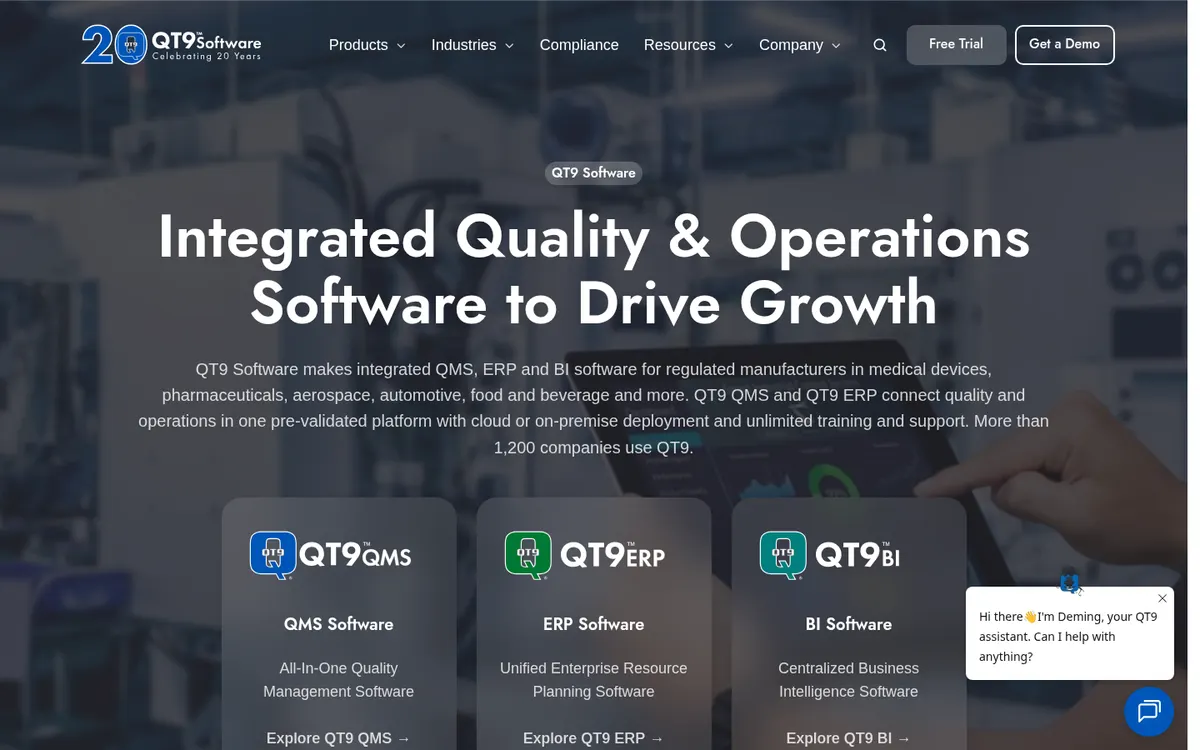
QT9 QMS
Best for mid-market regulated manufacturers wanting an all-in-one validated QMS
Our verdict
Broad module coverage, a free trial and bundled support, held back mainly by per-user costs and lower brand recognition.
QT9 QMS bundles more than 25 modules into one system, covering document control, CAPA, audit management, nonconformance, calibration tracking and training. Unlimited training and support are included, and a free trial is available before purchase, which is uncommon in this list where several vendors only offer a demo.
The breadth suits mid-market regulated manufacturers who want one validated platform instead of several point tools held together with spreadsheets. Calibration tracking next to nonconformance matters for a shop that runs both production equipment and inspection gauges, because an out-of-tolerance gauge and the nonconformance it caused are one event. Audit management shares records with CAPA, so a finding links straight back to the corrective action without a manual cross reference.
Pricing sits on the vendor site as a custom quote, so the headline figure moves with user count and module mix. Per-user charges sit on top of the base, which means a small quality team and a large quality team land in very different places for the same module set. An earlier published starting figure of $10,000 per year covering all modules could not be re-confirmed on the pricing page when we checked on November 25, 2026.
Brand recognition is lower than the enterprise platforms, so procurement teams may press harder on long-term support and roadmap. Pick it if you are a mid-market manufacturer that wants wide module coverage, a free trial and support bundled rather than sold separately. Skip it if you need a global rollout with site-specific process variants or a vendor with enterprise-scale references.
What works
- More than 25 modules in one system, including calibration
- Free trial available before purchase
- Unlimited training and support included
What to weigh
- Per-user charges sit on top of the base price
- Less brand recognition than enterprise rivals
- Pricing now runs through a custom quote
Pick it if
You are a mid-market manufacturer that wants one validated system across documents, CAPA, audits and calibration, with a trial first.
Skip it if
You need site-by-site process variants or procurement insists on an established enterprise reference base.
Plate 05 of 09
Greenlight Guru
Best for medical device companies needing design controls and risk management
Our verdict
A strong fit for medical device design controls and ISO 14971 risk, with little to offer outside that sector.
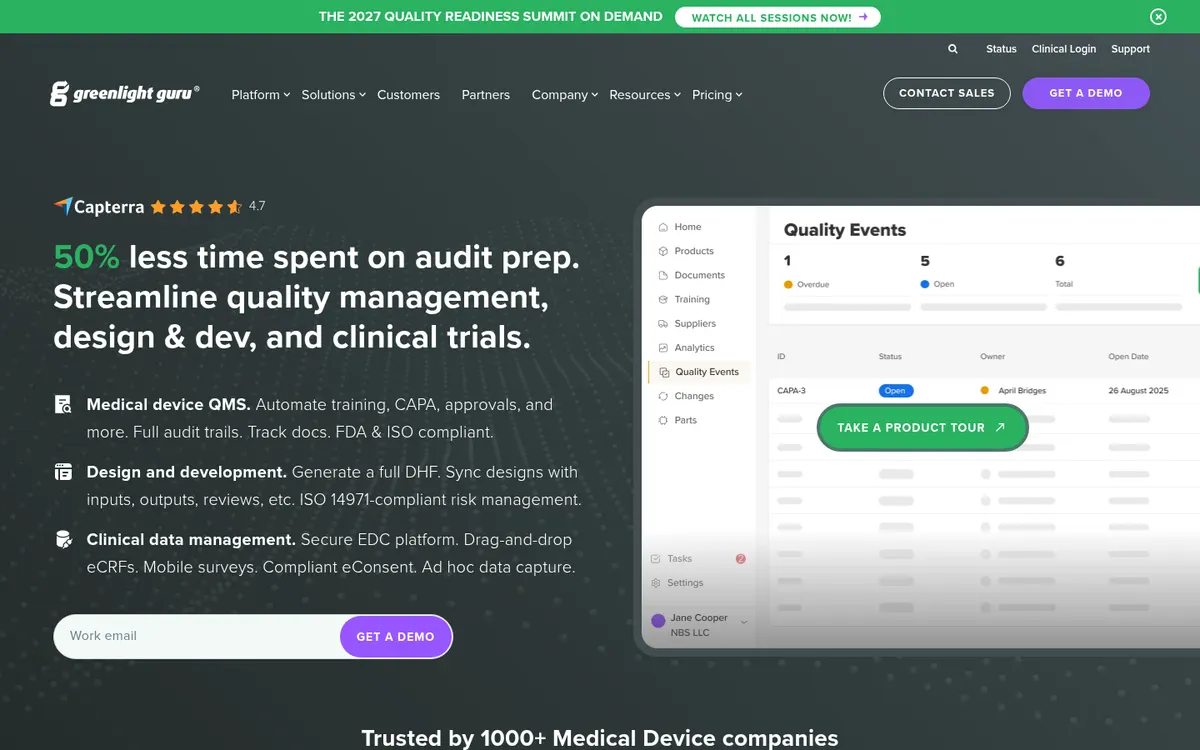
Greenlight Guru is built for medical devices rather than adapted from a generic template. Design controls, ISO 14971 risk management, document management, CAPA, audit workflows and complaint handling sit in one system aligned to FDA QMSR and ISO 13485, so the structure of the product already reflects the structure of a device audit.
Design controls and risk in the same record is the differentiator. Design controls, risk management, complaint handling and audit workflows sit in the same quality system, so the record follows the device through its lifecycle. The interface is modern, which matters when you are hiring engineers who expect current software.
Pricing is quote-based, with the base platform estimated around $25,000 per year as of late 2026 and not published anywhere on the site. Evaluation runs through a demo, not a trial. Outside medical devices the product has little to say: a food manufacturer or an electronics contract manufacturer gets medical device scaffolding they will not use, and pays for it.
Pick it if you are a device company that needs design controls and ISO 14971 risk in the same validated system as complaints and CAPA, and the audit narrative matters more than module breadth. Skip it if you operate outside medical devices, or if a base estimate near $25,000 per year before implementation is beyond what your first QMS budget can carry.
What works
- Purpose-built for medical devices rather than adapted from templates
- Design controls and ISO 14971 risk sit inside the quality system
- Modern interface that engineers will actually use
What to weigh
- Base platform estimated around $25,000 per year, not published
- Little differentiation outside medical devices
- Demo only, no self-serve trial
Pick it if
You are a medical device company and design controls, risk management and complaint handling need to live in one audit-ready record.
Skip it if
You are outside medical devices, or if you need published pricing before you can open a budget request.
Plate 06 of 09
Qualio
Best for growing life sciences teams needing fast, low-complexity deployment
Our verdict
A fast path to a usable, validated QMS for a growing life sciences team, with configuration depth as the tradeoff.
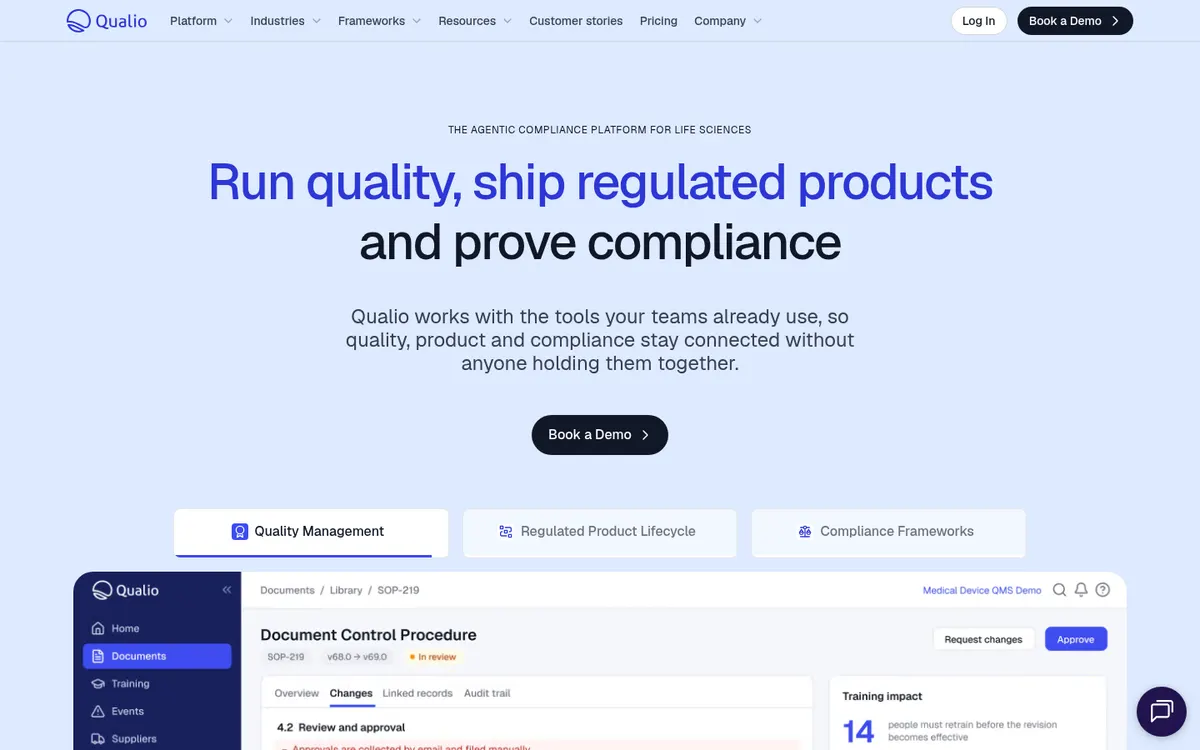
Qualio targets growing life sciences teams moving off paper and spreadsheets. It includes a built-in document editor, pre-configured compliance templates, document control, CAPA, audit readiness tooling and real-time KPI tracking. The pitch is speed, and the product is shaped around that rather than around deep customization.
The templates do a lot of the work. A team without a dedicated quality engineer can start from a structure that already reflects expected sections and approvals instead of building a document hierarchy from zero, and deployment is measured in weeks rather than quarters. The interface is friendlier than the category norm, which raises the odds that operators outside the quality department actually open it and sign records on time.
Pricing is now published at the entry level: the Foundation plan is $25,000, billed annually as a platform subscription, with unlimited basic users. That unlimited-user structure changes the math for teams that would otherwise pay per seat, and a free trial lets you test before committing. The limit is depth. Very complex quality organizations, particularly multi-site ones with process variants, will run into configuration ceilings that the enterprise platforms do not have.
Pick it if you are a growing life sciences company that needs a validated QMS in weeks, values usability over configurability, and wants a published entry price with unlimited basic users. Skip it if your processes diverge widely by site, or if you need deep manufacturing or PLM integration in the same purchase.
What works
- Published $25,000 Foundation plan with unlimited basic users
- Compliance templates cut setup work substantially
- Free trial and deployment measured in weeks
What to weigh
- Less customization depth than enterprise platforms
- Configuration ceilings appear in complex, multi-site quality organizations
- Enterprise-grade manufacturing and PLM integration is limited
Pick it if
You need a validated, usable QMS in weeks and want a published entry price without per-seat anxiety.
Skip it if
Your quality processes vary heavily by site or you need deep PLM or manufacturing integration.
Plate 07 of 09
ComplianceQuest
Best for regulated manufacturers already standardized on Salesforce
Our verdict
Strong value inside an existing Salesforce estate, weak everywhere else because the platform cost arrives separately.
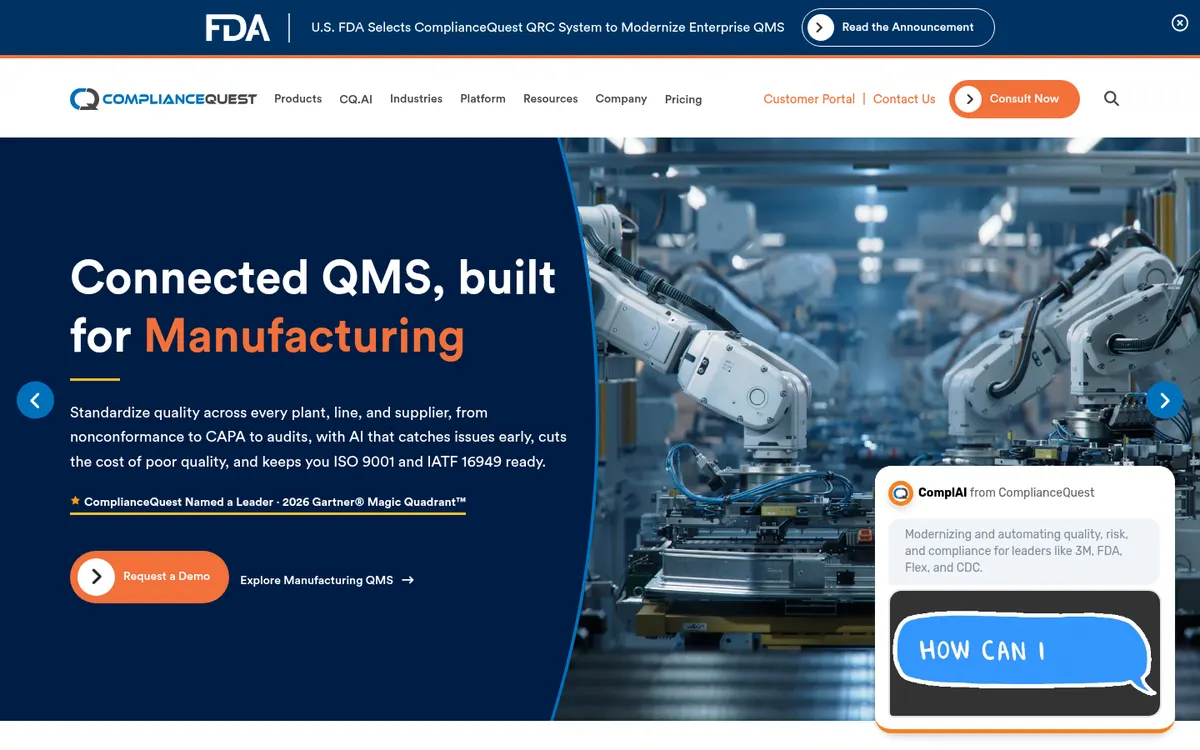
ComplianceQuest is a native build on the Salesforce platform, so records, users, permissions and reporting run on infrastructure the buyer may already own. It covers document management with AI assistance, CAPA, supplier quality, EHS management and PLM integration, plus predictive risk scoring that flags quality risks before they become events.
The native build is the reason to look. Single sign-on and the shared data model carry over, and quality records can sit in the same Salesforce org as other operational data. Combining quality with EHS and PLM means one system for incidents, corrective actions and engineering changes rather than several integrations maintained by separate teams.
Pricing is quoted per user and per module, so the Salesforce platform cost sits on top of the QMS subscription and the total depends on how many people need a full licence. Companies without a Salesforce footprint face additional implementation work, and the value proposition weakens at that point. Evaluation is demo only.
Pick it if Salesforce is already your system of record and you want quality, EHS and supplier data inside it, with the administration handled by a team you already employ. Skip it if you are not on Salesforce, or if you want a dedicated quality system that does not depend on a third-party platform licence.
What works
- Runs natively on the platform many regulated teams already use
- Unifies quality, EHS and PLM in one system
- Predictive scoring flags quality risks earlier
What to weigh
- Requires Salesforce, which adds a separate platform cost
- Per-user and per-module quoting is hard to budget
- Demo only, no trial
Pick it if
Salesforce already holds your operational data and quality records should live in the same org as complaints and supplier data.
Skip it if
You are not on Salesforce, or if adding a platform dependency to a quality purchase is a non-starter.
Plate 08 of 09
Arena QMS
Best for product companies wanting QMS and PLM in one system
Our verdict
A strong choice when design changes and quality events describe the same product data, and PLM and QMS are still separate systems.
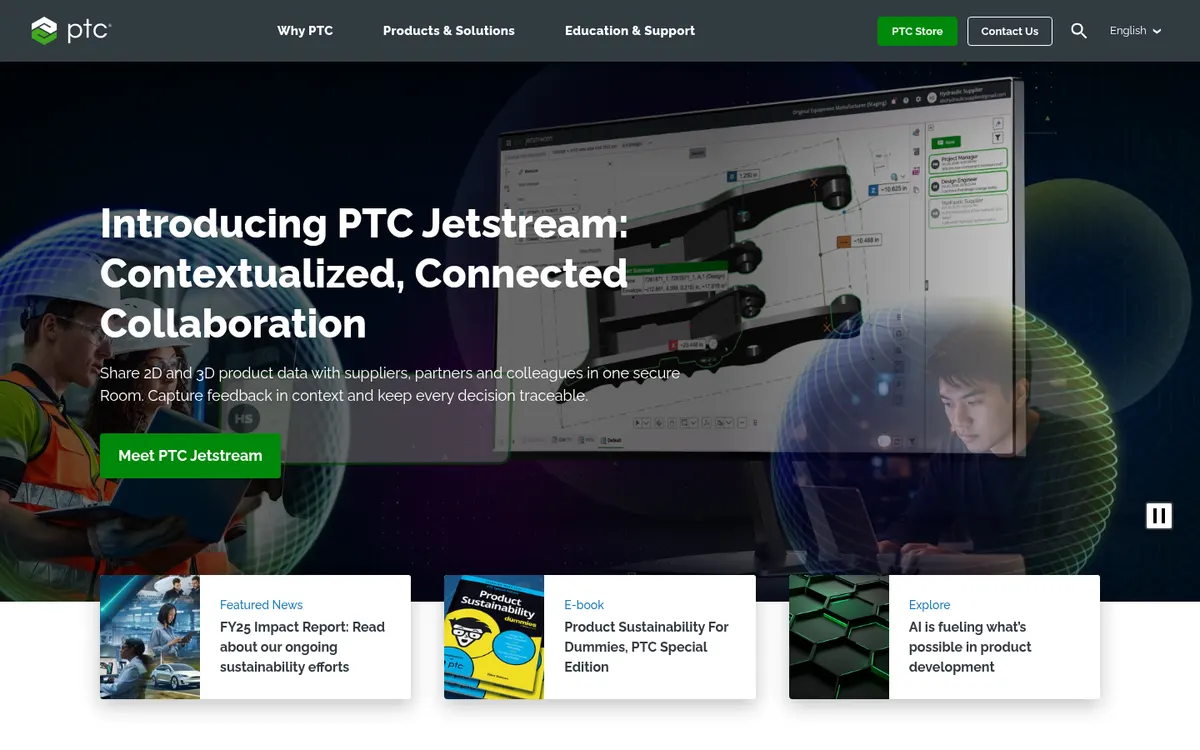
Arena QMS, part of PTC, combines quality management with product lifecycle management. Document control, CAPA, complaint handling and change order management share a system with bills of materials, so a design change and the quality record it triggers follow one workflow instead of two that meet in a spreadsheet every month.
That linkage suits hardware and electronics teams, including medical device manufacturers, where a BOM revision, a supplier change and a nonconformance can describe one event. Connecting design changes to quality records removes the reconciliation step that eats engineering time when PLM and QMS are separate, and it gives auditors a single thread from the part number to the corrective action.
Pricing is quote-based and tiered by users and modules, so the entry point depends on how much of the PLM side you adopt alongside quality. Even the evaluation period requires sales approval, which slows a bake-off against a competitor offering a self-serve trial. PTC provides backing and scale, but it also means the sales process is sized for mid-market and enterprise deals rather than a small team testing the water.
Pick it if your product data already lives in PLM and your quality events keep referencing it, particularly in device hardware or electronics where the bill of materials is the spine of the product record. Skip it if you are software-only or services-based, where PLM linkage adds cost without a matching workflow, or if you need to evaluate before talking to sales.
What works
- Quality and product lifecycle data in one system
- Strong fit for device hardware and electronics teams
- Backing and scale from PTC
What to weigh
- Tiered quote pricing with no published entry point
- Even the evaluation needs sales approval
- PLM linkage adds cost for teams without product data to connect
Pick it if
Design changes and quality events reference the same bill of materials and you want one workflow instead of two.
Skip it if
You have no PLM footprint, or if you need to trial the product without a sales conversation first.
Plate 09 of 09
Intelex
Best for EHSQ teams wanting published per-user pricing
Our verdict
A solid EHSQ combination with a per-user entry point, though quality depth trails the pure QMS platforms.
Intelex comes from the EHS side and adds quality on top. The platform covers unified EHS and quality management, configurable workflows, mobile inspections, CAPA tracking and environment, health and safety reporting, sold in tiers rather than as a single enterprise quote.
The combination is useful for manufacturers whose safety incidents and quality nonconformances share root causes. Mobile inspections let a plant walk the floor with a tablet and file findings straight into the system, and configurable workflows adapt to site practice without code. Per-user pricing, which is rare in this category, makes budgeting more predictable than a per-module quote that only lands after scoping, and a free trial means you can test the workflow model before signing.
Quality depth is the watch item. The EHS heritage shows in comparison with pure QMS platforms, particularly in document control and training management, so a life sciences buyer with heavy document obligations should test those areas specifically rather than assume parity. Advanced and Enterprise tiers move to quote-based pricing, so the per-user entry point covers the smaller Essentials scope. Essentials is listed per user per month; the $49 figure we had noted could not be re-checked on the pricing page on November 25, 2026.
Pick it if you run EHS and quality as one program, want a published per-user entry point and value mobile inspection capture. Skip it if quality records are the core of your regulatory exposure and you need the deepest document and training control available in this list.
What works
- Per-user entry pricing rather than a single opaque quote
- EHS and quality managed in one system
- Mobile inspections capture findings at the point of work
What to weigh
- Quality depth trails dedicated QMS platforms
- Advanced and Enterprise tiers revert to quote-based pricing
- Document and training control need close testing
Pick it if
Safety and quality share root causes in your plants and you want per-user pricing with mobile inspection capture.
Skip it if
Quality documentation and training are the center of your audit exposure rather than one part of an EHSQ program.
What is quality management software, and who actually needs it?
A quality management system is the set of documents, records and approvals a company uses to prove its products are made the same way every time. Quality management software holds those records: procedures and their versions, change requests, corrective and preventive actions, training records, audits, supplier approvals and complaints. The software does not create compliance on its own. It makes compliance provable, because every record carries a who, a when and an approval trail that survives an inspection.
Buyers often ask how a QMS differs from an eQMS. In practice the terms overlap. A QMS is the process and the rule set. An eQMS is the electronic system that runs it, and most vendors here sell what the market calls an eQMS while marketing it as QMS software. The distinction matters mainly in procurement, because what you are buying is a validated record system rather than a shared drive with folders.
A serious platform should cover these areas:
- Document control with version history and controlled distribution
- Change control and CAPA linked to the records they affect
- Training management tied to role and document revision
- Audit management, supplier quality and complaint handling
- Electronic signatures and audit trails that satisfy 21 CFR Part 11
That last point comes up constantly. 21 CFR Part 11 sets the conditions under which electronic records and electronic signatures are treated as equivalent to paper. If your quality records are electronic and you are FDA-regulated, you need unique user accounts, authority checks, secure audit trails and signature records that show who signed, when and why. Vendors describe their platforms as compliant, and buyers should ask for the validation documentation rather than accept the claim.
Regulated manufacturing, medical devices, pharmaceuticals, food and aerospace are the core buyers. A company with one product and one auditor a year may do better with a lightweight system and disciplined templates than with an enterprise suite it cannot configure.
This guide sits in the Software collection. Buyers weighing nearby tools often read the guides to commission software and research platforms next.
How QMS pricing works: enterprise quotes, platform fees and per-user tiers
Most quality management software is priced by quote, and the quote is usually a function of three things: which modules you license, how many users touch the system, and whether implementation and validation are bundled. Published list prices are the exception rather than the rule, which is why the few figures below matter more than they look.
| Model | How it bills | Typical fit | Example from this list |
|---|---|---|---|
| Enterprise quote | Per module or per suite, annual, implementation extra | Multi-site regulated manufacturers | MasterControl, entry packages estimated around $25,000 per year before implementation |
| Platform subscription | Annual platform fee with unlimited basic users | Growing life sciences teams | Qualio Foundation at $25,000, billed annually |
| Per-user tier | Per user per month, with higher tiers quoted | EHSQ teams with a defined user base | Intelex Essentials, priced per user per month |
| Tiered quote | Banded by users and module mix | Product companies linking PLM and quality | Arena QMS, tiered by users and modules |
The enterprise quote model makes comparison hard. Two vendors can both say quote-based and land far apart once one includes validation services and the other does not. Ask for a written scope naming modules, user bands, implementation hours and validation deliverables, and ask what the annual cost looks like in year three after expansion, not just at signature.
Per-user pricing is easier to model but punishes broad adoption. A quality system only works when operators use it, so a model that charges for every shop-floor user can push a team toward shared logins, which breaks the audit trail. Unlimited basic user tiers remove that pressure, which is why the Qualio structure matters beyond the headline number.
Watch for implementation and validation as separate line items. MasterControl lists implementation as extra. Some vendors include templates in the subscription. Neither is wrong, but the total first-year cost is what finance approves, not the subscription rate.
Every price in this guide was read on the vendor's own pricing page on November 25, 2026. Where a vendor does not publish a figure we could confirm, the card says "See website" rather than a guess. For the arithmetic around this purchase, try the free Email campaign metrics calculator.
Which QMS fits your operation: a six-step decision path
Fix the regulatory scope first. Write down every standard your next audit will test, whether that is ISO 13485, FDA QMSR, 21 CFR Part 11 or a food safety scheme, and remove any platform whose templates cannot map to them.
Split your user base. Count the people who author and approve quality records separately from the people who only read them, because per-user pricing turns that ratio into the biggest variable in your budget.
Map the adjacent systems. Decide whether quality must connect to manufacturing execution, PLM, Salesforce or regulatory content, since ecosystem fit is what separates a good tool from a good tool for you.
Request a scoped quote. Ask each vendor for a written scope naming modules, user bands, implementation hours and validation deliverables, then compare first-year and three-year totals rather than subscription rates.
Test with your own records. Load one real procedure, one real CAPA and one real audit finding into the trial or demo, and count how many steps each takes before you commit to a rollout.
Check validation support. Ask what the vendor supplies for computer system validation, whether that is documented test scripts, an installation qualification pack or a partner referral, and price that work into the decision.
Five QMS buying mistakes that cost regulated teams a year
Buying modules you will never configure. A large module suite looks like value until much of it sits unused while the team still runs calibration on a spreadsheet, so scope to the records your auditor actually asks for.
Comparing subscription rates instead of first-year totals. Implementation, validation and data migration can exceed the annual fee, and a cheap licence with a long validation project often costs more than a premium licence with templates included.
Ignoring how per-user pricing changes adoption. If a licence is needed for every shop-floor reader, teams share logins, and shared logins break the audit trail that justified the purchase in the first place.
Treating a demo as a trial. A scripted demo shows the vendor's best path through a workflow. Only your own documents and deviations reveal whether the configuration model fits how your team writes and approves records.
Assuming Part 11 compliance ships in the box. Electronic signature and audit trail features exist in most platforms, but validation documentation, user access controls and signature manifestation need to be checked against your own procedures.
Best QMS Software 2026: questions
Which QMS platforms work best for large regulated manufacturers?
MasterControl, Veeva Vault QMS and ETQ Reliance are the enterprise three. MasterControl adds manufacturing execution to the same validated suite, Veeva shares records with regulatory and clinical content on the Vault platform, and ETQ Reliance offers deep no-code configuration for multi-site process variation. All three are quote-based and demo only, so budget time for scoping before you compare numbers.
Which platform fits medical device design controls best?
Greenlight Guru, because design controls and ISO 14971 risk management are built into the quality record rather than bolted on, and the templates align with FDA QMSR and ISO 13485. Arena QMS is another option when design changes and bills of materials already live in PTC's PLM system and you want one workflow covering both quality and product data.
What does QMS software cost at enterprise, mid-market and per-user levels?
Enterprise platforms such as MasterControl and Greenlight Guru run on quotes, with entry packages estimated around $25,000 per year before implementation. Qualio publishes $25,000 on its Foundation plan, billed annually with unlimited basic users. Intelex prices its Essentials tier per user per month. Several other vendors in this list quote per module or per user without publishing a figure, so ask for a written scope.
How is a QMS different from an eQMS?
A QMS is the rule set: the documents, approvals, CAPAs and training records that prove products are made consistently. An eQMS is the software that runs those processes electronically, with version control, electronic signatures and audit trails. Most products in this list are eQMS platforms marketed as QMS software, so the terms overlap in daily use and the distinction is mainly a procurement one.
Do electronic quality records have to meet 21 CFR Part 11?
Yes, if you are FDA-regulated and your quality records are electronic. Part 11 sets the conditions for treating electronic records and signatures as equivalent to paper, covering unique user accounts, authority checks, secure audit trails and signature records that show who signed, when and why. Ask vendors for validation documentation rather than accepting a compliance claim at face value during a demo.
Which platforms offer a free trial, and which are demo only?
QT9 QMS, Qualio and Intelex offer a free trial. MasterControl, Veeva Vault QMS, ETQ Reliance, Greenlight Guru and ComplianceQuest are demo only. Arena QMS runs a free evaluation but requires sales approval before it starts, which puts it closer to the demo camp than to self-serve signup. If you need to test with real records, weight trial access heavily.