
Contents of this guide
The shortlist
Our top 3 for compliance buyers

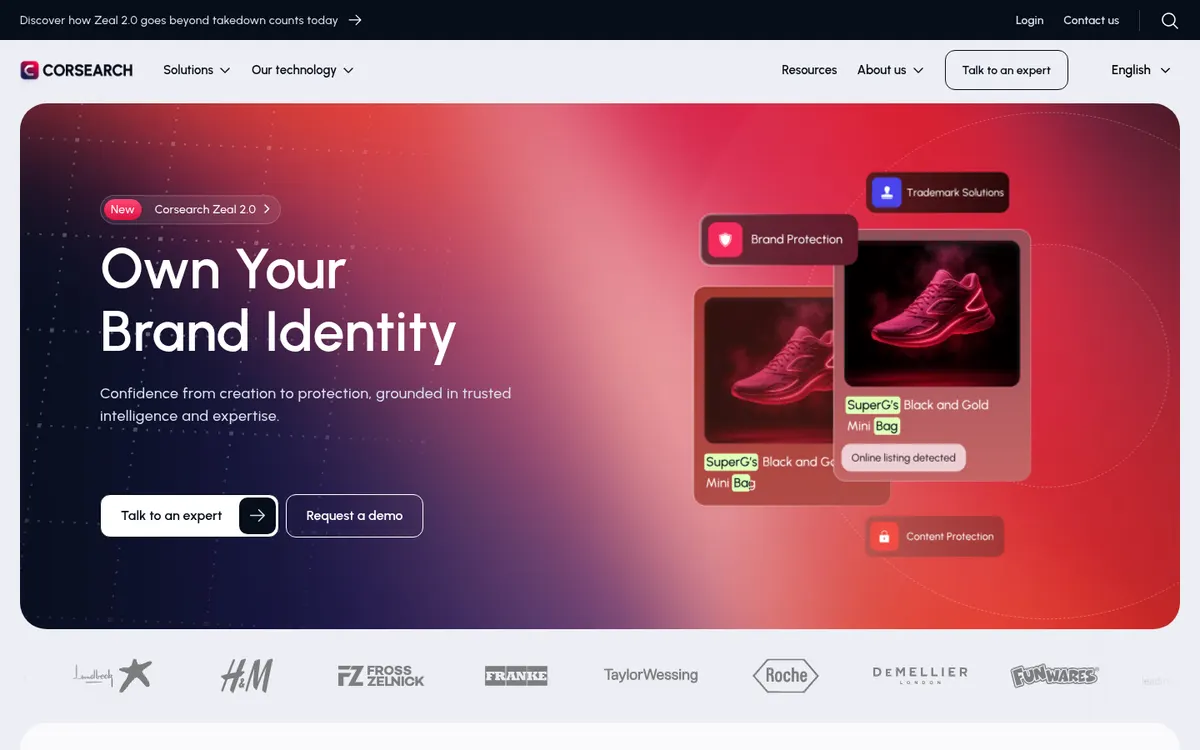
Corsearch
Full IP lifecycle
- Best for
- Legal and IP teams needing trademark plus enforcement
- Features
- 4 noted: Trademark watching, Test purchases, Analyst investigations, Global coverage
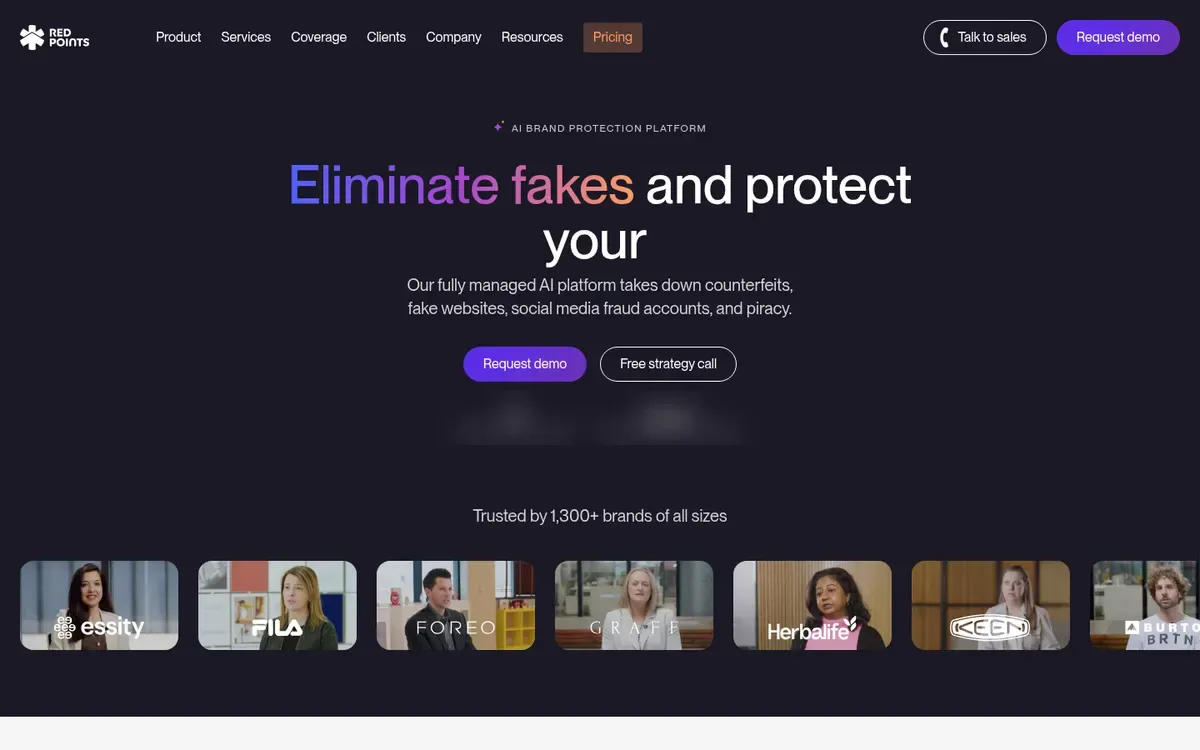
Red Points
Unlimited takedowns
- Best for
- High-volume marketplace counterfeits
- Features
- 4 noted: Unlimited takedowns, Marketplace scanning, Managed enforcement, Impact reporting

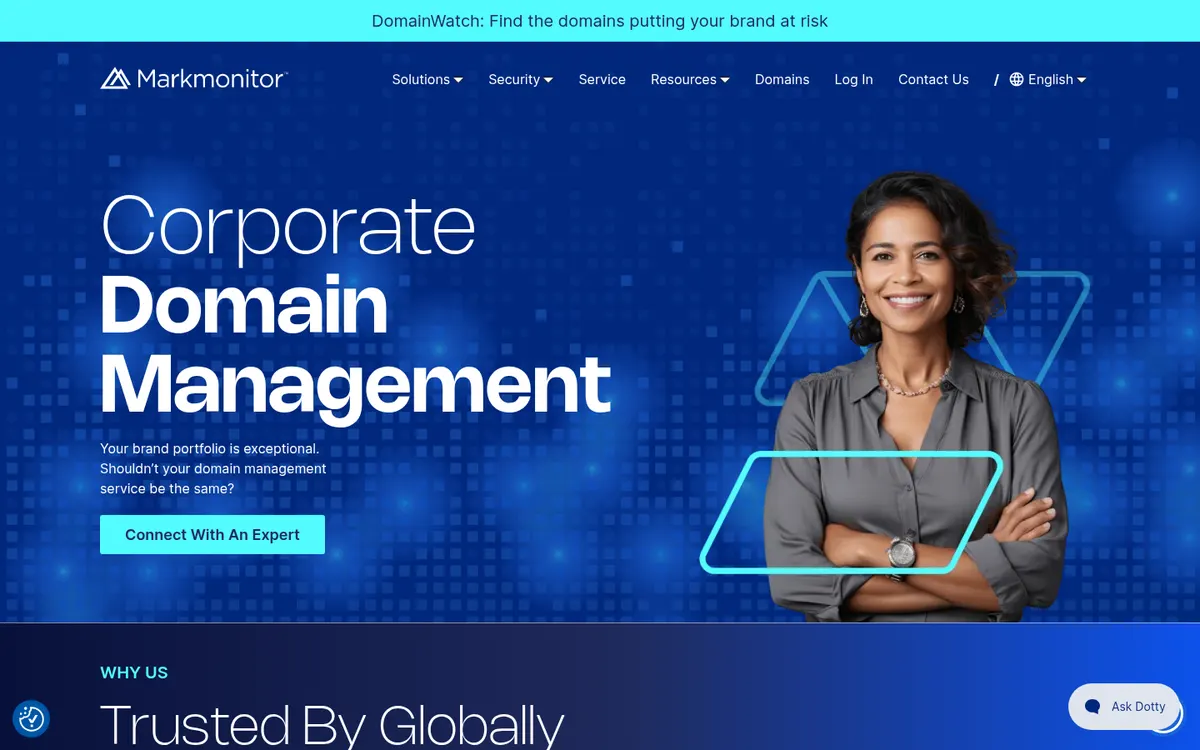
MarkMonitor
Domain portfolio control
- Best for
- Enterprise trademark and domain portfolios
- Features
- 4 noted: Domain management, Registrar services, Phishing protection, Enterprise reporting
Disclosure for this guide. All 8 tools here are unpaid editorial picks. The position of a paid listing can be part of what the vendor pays for. Paid and unpaid tools are scored on the same rubric and keep their cons. Details are in the advertising disclosure.
The ledger
Index of every tool
| Tool | Free plan | Trial | Rubric | Compare | ||
|---|---|---|---|---|---|---|
| 01 | CorsearchLegal and IP teams needing trademark plus enforcement | See websiteNot published | No | No | ||
| 02 | Red PointsHigh-volume marketplace counterfeits | See websiteNot published | No | No | ||
| 03 | MarkMonitorEnterprise trademark and domain portfolios | See websiteNot published | No | No | ||
| 04 |  MarqVisionConsumer and luxury brands with marketplace focus | See websiteNot published | No | No | ||
| 05 |  BrandShieldPhishing and executive impersonation | See websiteNot published | No | No | ||
| 06 |  OpSecProduct authentication and offline investigation | See websiteNot published | No | No | ||
| 07 | BolsterPhishing and domain abuse at speed | See websiteNot published | No | No | ||
| 08 |  ZeroFoxSocial media and external threat protection | See websiteNot published | No | No |
Prices are the lowest paid plan the vendor shows, read on November 25, 2026. Sort by price ranks published monthly figures; tools without one go last. Pin up to three tools to compare them side by side.
How this guide was put together
We scored each service against five criteria that map to how brand protection is actually bought: channel coverage, enforcement depth, pricing clarity, fit and focus, and buyer support. Channel coverage and enforcement depth carry the most weight because a service that sees abuse but cannot remove it, or removes abuse in one channel only, solves half the problem. Pricing clarity counts for less than capability, but it is scored honestly, and every vendor in this list lost points there because all eight quote by custom proposal.
Prices come from vendor pricing pages checked on November 25, 2026. In this category that check mostly returned empty pages or no public figure, and we say so per vendor rather than estimating. No number here is inferred, converted or carried over from another source. Where a vendor publishes nothing, the entry reads See website.
Fit and focus rewards services built around a specific brand problem over general platforms that add brand abuse as a module. A goods brand with marketplace counterfeits and a bank with phishing sites need different tooling, and a service that is excellent for one can be mediocre for the other. Buyer support covers the human side: analysts, legal expertise, reporting and account structures.
The Featured position on this list is a paid placement. It is scored with the same rubric as every other entry and carries the same kind of honest cons. Placement affects where an entry sits, not what we say about it.
The full process, including how we handle corrections, is on the methodology page. Paid listings follow the advertising disclosure.
Rubric and weights
Every tool below is scored from 1 to 10 on these five criteria. The scores describe each tool; the order is an editorial call on fit for the buyer each card describes, plus the disclosed Featured position.
- 25%Channel coverageHow many abuse channels the service watches, from marketplaces and domains to social, app stores and the dark web.
- 25%Enforcement depthWhether takedowns, investigations, test purchases or legal escalation are handled in house or left to the customer.
- 15%Pricing clarityHow much is knowable about cost and contract structure before a buyer commits to a sales cycle.
- 20%Fit and focusHow sharply the service is built for a defined brand problem rather than sold as a broad platform module.
- 15%Buyer supportReporting, account structures and human expertise available to the team running enforcement day to day.
Plate 01 of 08
Corsearch
Best for legal and IP teams needing trademark plus enforcement
Our verdict
The strongest single supplier for legal and IP teams that need trademark clearance, watching and online enforcement in one portfolio.
Corsearch is built around the IP portfolio rather than monitoring alone. Trademark clearance and availability searches sit next to watching of new filings for conflicts, and both sit next to online enforcement against counterfeits and brand abuse. For a legal team already managing a trademark register, that means one supplier and one relationship across the lifecycle instead of a search firm plus an enforcement vendor plus a watching service.
The enforcement side is not purely automated. Analyst-led investigations and test purchase programmes back up the detection work, which matters when a takedown needs a documented purchase to hold up with a marketplace or a court. Global trademark database coverage is broad, and the customer base skews toward large brand owners and law firms that need international reach rather than a single-market tool.
The trade-off is commercial. Pricing is quote-only with a long enterprise sales process, and no official pricing page was captured, so the price could not be verified. Buyers should expect a custom proposal shaped by portfolio size and the number of jurisdictions in scope. That process rewards a prepared buyer with a clear inventory of marks and known abuse channels.
Fit is the other limit. A brand with one narrow problem, say a single marketplace with a handful of counterfeit listings, will find the depth exceeds the need and the contract exceeds the budget. Service-led delivery also means analyst-driven timelines rather than pure automation, so a team expecting rapid takedowns should test response times during diligence before signing.
What works
- Trademark search, watching and enforcement under one roof
- Human investigators and test purchases back the automation
- Broad international trademark data coverage
What to weigh
- Quote-only enterprise pricing with a long sales process
- Depth can exceed brands with one narrow abuse problem
- Analyst-led delivery sets the pace, not pure automation
Pick it if
Your legal or IP team already runs a trademark portfolio and wants clearance, watching and enforcement from one supplier.
Skip it if
You have a single narrow marketplace problem and need a fast, cheap start.
Plate 02 of 08
Red Points
Best for high-volume marketplace counterfeits
Our verdict
The clearest commercial case for brands drowning in marketplace counterfeits, because unlimited takedowns stop cost scaling with abuse volume.
Red Points is organized around counterfeit volume on marketplaces, and the commercial model is the differentiator. Takedowns are unlimited within the plan on a flat fee, so a spike in listings does not produce a spike in cost. For a brand that files removals in volume, that changes the economics compared with per-takedown pricing, which punishes exactly the brands with the worst problem.
Detection spans thousands of marketplaces plus domains, social commerce and ads, covering counterfeit and impersonation listings across those surfaces. A managed IP operations team runs the enforcement filings, so the customer's role is review and strategy rather than paperwork. Reporting is aimed at proving revenue return, which is the argument a brand protection team needs when defending the budget to a finance owner.
The gaps are specific. Phishing depth trails security-focused rivals, so a brand whose main problem is credential theft on lookalike domains should look at BrandShield or Bolster instead. Pricing is quote-based with no public price list and the page fetch returned nothing, so pricing remains unverified. The flat model also rewards high-volume brands; a quieter brand with a thin abuse stream may simply overbuy relative to a lighter managed service.
Service quality depends on the assigned account team, which is true of every managed provider but worth testing in diligence. Ask for the named team, the escalation path and typical turnaround on a marketplace filing. Fit is strongest for consumer brands with dense marketplace exposure and enough volume to make unlimited takedowns worth paying for.
What works
- Unlimited takedowns on a flat fee, so cost does not scale with abuse
- Wide detection across marketplaces, domains, social and ads
- Managed team files the takedowns for you
What to weigh
- Quote-only pricing with no public price list
- Phishing depth trails security-focused rivals
- Quieter brands may overbuy the flat model
Pick it if
Counterfeit listings on marketplaces arrive in volume and you want removal cost decoupled from abuse volume.
Skip it if
Your main threat is phishing and credential theft rather than counterfeit goods.
Plate 03 of 08
MarkMonitor
Best for enterprise trademark and domain portfolios
Our verdict
An enterprise incumbent that earns its place on domain portfolio security and multinational account structures more than on automation.
MarkMonitor is a long-established enterprise brand protection and domain management business, and the domain side is genuinely distinctive. Corporate domain portfolio management and registrar services are core products, not add-ons, which matters for a multinational holding a large domain portfolio across markets and defensive registrations. Losing control of a domain is a more severe event than losing a listing, and portfolio security plus registrar control addresses it directly.
On the brand side, the service covers anti-counterfeiting and marketplace enforcement, phishing and fraud protection, and trademark protection services. Reporting and account structures are built for multinationals. For a company already buying domain management, consolidating brand protection into the same supplier reduces vendor count, even though it does not necessarily reduce cost.
The weaknesses are structural. Contracts and pricing assume a large enterprise brand, and no pricing page text was available to confirm a starting price, so the figure stays unverified. The platform is less automation-forward than newer AI-first rivals, so buyers who expect machine-speed detection and filing should benchmark it against MarqVision or Bolster rather than assume parity. Smaller brands will find faster and cheaper options elsewhere without much searching.
One diligence point is specific to this vendor. The sector has consolidated repeatedly, and MarkMonitor's notes advise verifying current ownership and support arrangements. Add product roadmap questions to that list: which capabilities are being invested in, and which are in maintenance. Fit is a multinational with a serious domain portfolio and the procurement patience to match.
What works
- Deep domain portfolio security and registrar services
- Combines phishing and fraud protection with marketplace enforcement
- Reporting and account structures built for multinationals
What to weigh
- Contracts and pricing assume a large enterprise brand
- Less automation-forward than AI-first rivals
- Verify current ownership and roadmap during diligence
Pick it if
You are a multinational that needs domain portfolio security and enterprise-grade reporting alongside brand enforcement.
Skip it if
You are a smaller brand that needs a fast, low-cost start with modern automation.
Plate 04 of 08
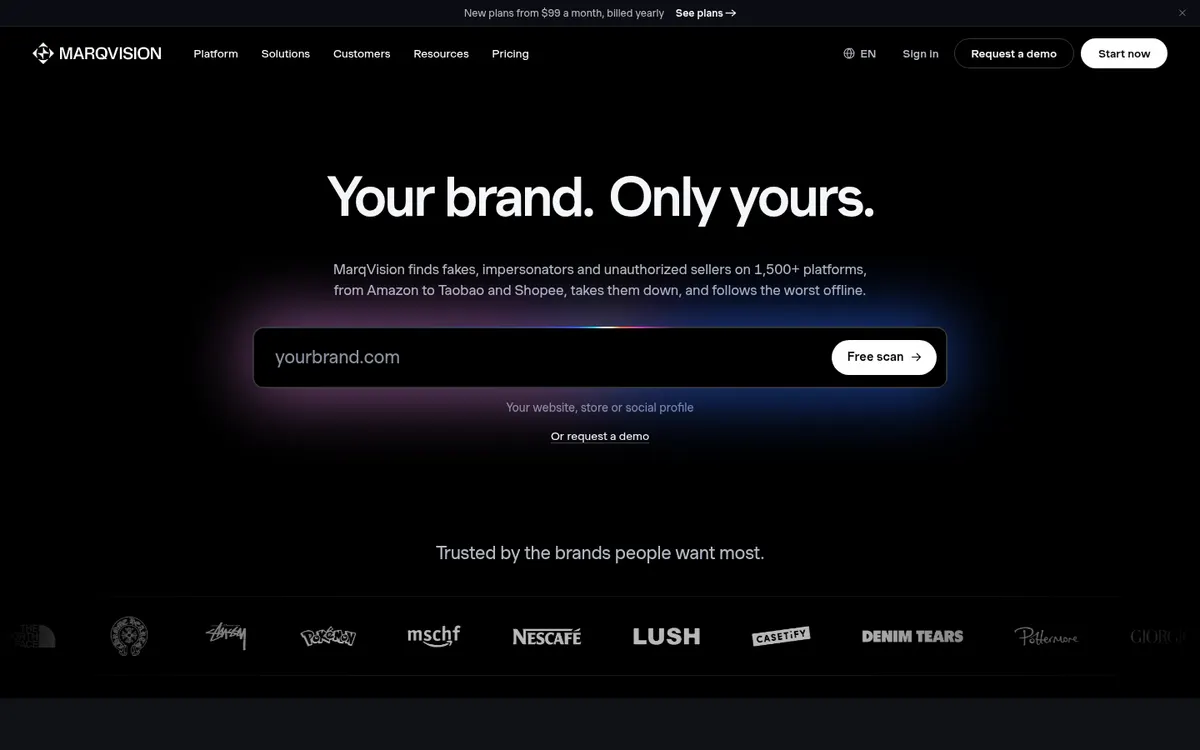
MarqVision
Best for consumer and luxury brands with marketplace focus
Our verdict
The AI-first challenger to beat for visual marketplace abuse, provided you choose the enforcement tier that matches your in-house capacity.
MarqVision's core technology is AI image-matching detection of reused product photography. That approach finds listings even when titles and seller names change, which is precisely how repeat counterfeiters evade keyword-based monitoring. For fashion, beauty and consumer goods brands whose products are identified visually, this is a materially better detection method than text matching, and it is why the vendor's focus on those categories makes sense.
Monitoring spans more than 1,500 platforms, and the plan structure gives buyers a real choice. Monitoring-only plans surface abuse and leave the filing work with the customer. Managed plans have MarqVision file takedowns. Above that, offline and legal escalation paths including litigation support address repeat counterfeiters who treat takedowns as a cost of doing business. Revenue recovery programmes connect enforcement to money, which helps justify the spend.
The limits start with buying. Pricing is custom annual with no quick self-serve start, and no captured page content means the price stays unverified. Strength is goods marketplaces; phishing depth trails security-led vendors, so a brand facing credential theft should not expect this to cover it. MarqVision is also a newer entrant, so category reference checks matter more than they would with an incumbent: ask for brands of similar size and abuse profile.
The tier decision is where buyers get it wrong. Monitoring-only looks cheaper, but it only works if you have staff who can file and follow up on removals consistently. Brands without that capacity should price the managed tier before comparing against rivals, because an apples-to-apples comparison includes the labor.
What works
- Image matching finds listings that change titles and seller names
- Choice of monitoring-only or fully managed enforcement
- Legal escalation for repeat counterfeiters
What to weigh
- Custom annual pricing with no self-serve start
- Phishing depth trails security-led vendors
- Monitoring-only tiers leave filing work with you
Pick it if
Your products are identified visually and marketplace listings reuse your photography.
Skip it if
You need phishing protection or have no staff to file takedowns on a monitoring-only plan.
Plate 05 of 08
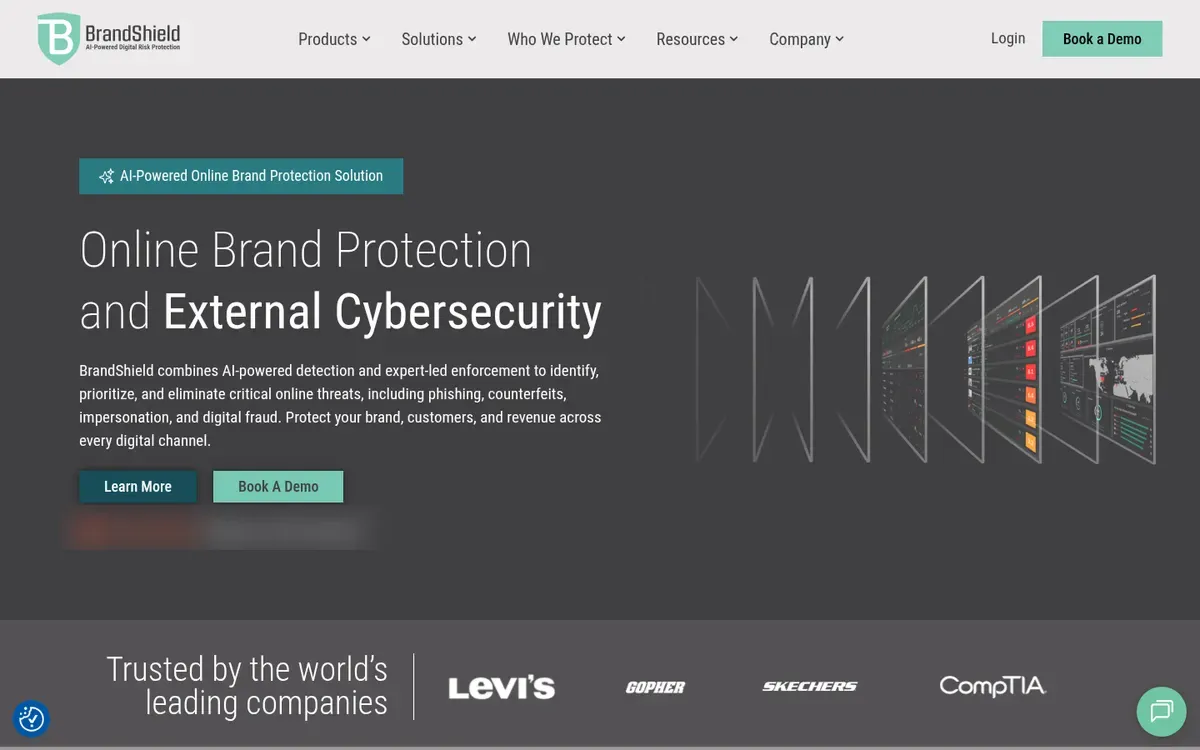
BrandShield
Best for phishing and executive impersonation
Our verdict
The security-side specialist for brands where phishing and fake executive accounts are compliance events, not marketing nuisances.
BrandShield approaches brand protection from the security angle. Phishing site detection, lookalike and typosquatted domain monitoring, fake social profile detection and executive impersonation protection are the core capabilities. For banks, insurers and healthcare brands, these incidents are compliance events with notification obligations and regulatory scrutiny, not just reputational annoyances, and the product reflects that framing.
Threat actor clustering is the feature that distinguishes the platform technically. Instead of treating each fake domain or profile as an isolated case, it links separate abuses to the same operator, so an enforcement team can pursue a campaign rather than chase symptoms. In-house IP and legal expertise supports takedowns, which shortens the path from detection to filing without handing the work to outside counsel.
The limits are clear from the same framing. Marketplace counterfeit coverage is thinner than goods-focused rivals, so a consumer brand whose abuse lives on marketplaces should look at Red Points or MarqVision. Pricing is quote-only enterprise, and the pricing page was empty, so no figure could be confirmed. Value also depends on phishing being a live threat; a brand with no meaningful impersonation problem pays for capability it will not exercise.
One diligence note applies to every vendor and this one specifically: vendor-published success figures should be checked against references from comparable organizations. Ask for a bank or healthcare reference, the detection-to-takedown timeline they see in practice, and how campaign clustering changed their workload. Fit is a regulated brand with a security team that already treats impersonation as an incident category.
What works
- Security focus on phishing, lookalikes and impersonation
- Campaign clustering links abuses to the same operator
- In-house IP and legal team supports takedowns
What to weigh
- Marketplace counterfeit coverage is thinner than goods rivals
- Quote-only enterprise pricing
- Value depends on phishing being a live threat
Pick it if
You are a bank, insurer or healthcare brand treating phishing and executive impersonation as compliance risks.
Skip it if
Your counterfeit problem is concentrated on goods marketplaces rather than phishing.
Plate 06 of 08
OpSec
Best for product authentication and offline investigation
Our verdict
The pick when counterfeits are physical and dangerous, combining authentication labels and track-and-trace with offline investigation.
OpSec is the most traditional vendor in this set, and that is the point. Security labels and holograms mark genuine goods, and track-and-trace follows physical products through the supply chain. Online monitoring and enforcement sit alongside those, but the distinguishing capability is offline investigation: teams that trace counterfeit containers and factories, not just listings, and gather evidence usable with customs and courts.
That combination is strongest where counterfeits create safety risk. Pharmaceuticals, auto parts and electronics are the obvious categories, because a fake part or pill is a hazard, not a lost sale, and enforcement needs to reach the manufacturing source rather than the storefront. Evidence chains built for customs and legal action mean the output of an investigation can be handed to authorities without rebuilding the case.
The limits follow the same logic. Physical authentication is irrelevant to a purely digital brand, and a software platform or media company would be paying for labels and track-and-trace it cannot use. The engagement model is enterprise and pricing is by quote; no page text was available to verify any published price. The online platform is also one part of a wider business, so buyers should test software depth rather than assume it matches digital-first rivals. Visibility in software comparisons is lower for the same reason.
Fit is a manufacturer facing counterfeit containers and factories, not just listings. Before signing, ask to see the online monitoring interface in detail and confirm how offline investigations are scoped, priced and staffed. The value is real where safety and supply chain are at stake, and easy to overpay for where they are not.
What works
- Decades of physical product authentication experience
- Combines online enforcement with offline investigation teams
- Evidence chains usable with customs and courts
What to weigh
- Physical authentication is irrelevant to digital-only brands
- Enterprise engagement model and quote pricing
- Software depth should be tested against digital-first rivals
Pick it if
Counterfeit physical goods create safety or supply chain risk that needs investigation beyond takedowns.
Skip it if
You are a digital-only brand with no physical product to authenticate.
Plate 07 of 08
Bolster
Best for phishing and domain abuse at speed
Our verdict
Built for security teams that measure success in hours, with automated phishing takedowns and threat data that feeds existing tools.
Bolster pitches speed as the core metric, and the reasoning is sound: a phishing page does most of its damage in its first hours, so detection-to-takedown time matters more than detection volume. Automated phishing detection and takedown are the centerpiece, with coverage across web, social, app stores and the dark web. Typosquatting and lookalike domain monitoring round out the domain side.
The integration angle is what separates it from a standalone brand tool. Structured threat data feeds can be piped into existing security tools, so the platform sits alongside a security stack rather than replacing it. That suits a security team that already has security tooling and wants brand abuse data inside it, not in another dashboard nobody checks. The natural buyer is a security team, not a brand or legal team.
The gaps are consistent with that focus. Bolster targets phishing and abuse rather than counterfeit goods enforcement, so marketplace seller intelligence is lighter than goods specialists and there are no trademark portfolio services at all. A brand team looking for clearance and watching is in the wrong place. Pricing is enterprise with no public rates, and the empty page capture leaves the price unverified.
Fit should be tested against your abuse pattern rather than assumed. Ask for the typical detection-to-takedown timeline on your channels, how the threat feed is delivered and consumed, and which takedown paths are automated versus manual. If your main problem is counterfeit goods, this is not the tool. If it is credential theft at speed and your security team owns the response, it is a strong match.
What works
- Automation aimed at shrinking detection-to-takedown time
- Threat data feeds into existing security tools
- Solid lookalike domain and typosquatting coverage
What to weigh
- Focused on phishing and abuse, not counterfeit goods
- Enterprise pricing with no public rates
- No trademark portfolio services
Pick it if
Your security team owns brand abuse response and needs fast automated phishing takedowns.
Skip it if
You need counterfeit goods enforcement or trademark portfolio services.
Plate 08 of 08
ZeroFox
Best for social media and external threat protection
Our verdict
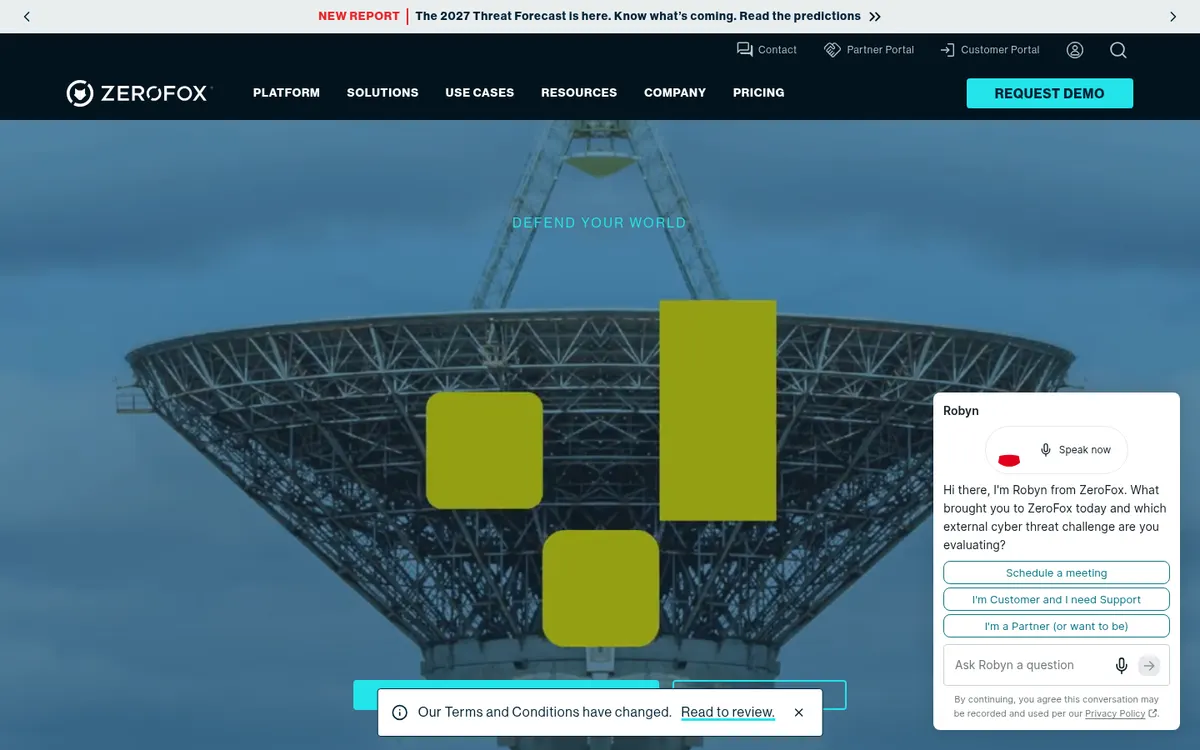
A broad external threat platform where brand protection is one module, best bought when a security team already owns the problem.
ZeroFox is a security-led platform where brand abuse is one slice of external threat management. Brand impersonation monitoring across social platforms, fake account detection and removal, executive protection, threat intelligence and dark web monitoring, and takedown services across social and digital channels form the brand-relevant surface. External attack surface coverage extends the platform beyond brand abuse entirely.
The consequence of that breadth is consolidation value. A security team that already buys separate tools for impersonation, executive risk and external attack surface can consolidate with one vendor. Threat intelligence extends beyond brand abuse, so the data has uses outside the brand protection use case, which is how a security buyer justifies the spend. Takedown services across social and digital channels are part of the platform.
The limits are the mirror image. Brand protection is one module of a wider platform, so goods enforcement depth trails specialists, and marketplace coverage should be tested against your actual abuse pattern rather than assumed. Pricing is enterprise and quote-only, and no pricing page content was retrieved, so the price is unverified. Buying also spans multiple security stakeholders, which lengthens the cycle compared with a single-team brand tool purchase.
Fit is a security team consolidating external threat tooling. If a brand or legal team will own the tool day to day, the platform's breadth becomes overhead and the specialist vendors on this list are a cleaner match. Test marketplace coverage explicitly, confirm which takedown channels are in scope, and check how the threat intelligence is delivered before committing.
What works
- Broad external platform spanning impersonation and executive risk
- Threat intelligence extends beyond brand abuse
- Takedown services across social and digital channels
What to weigh
- Goods enforcement depth trails specialist vendors
- Marketplace coverage should be tested against your pattern
- Multi-stakeholder buying lengthens the sales cycle
Pick it if
A security team wants to consolidate impersonation, executive risk and external threat tooling with one vendor.
Skip it if
A brand or legal team will run it and marketplace counterfeit depth is the priority.
What do brand protection companies actually monitor and enforce?
Brand protection companies watch the places where someone else is using your brand without permission, then act to get the abuse removed. The watching and the acting are separate capabilities, and the strongest vendor for one is often not the strongest for the other. That is why the first diligence question is not which vendor is best, but which channels your abuse actually lives in.
On the monitoring side, the common surfaces are marketplaces, where counterfeit listings appear; domains, where lookalike and typosquatted addresses are registered for phishing or resale; social platforms, where fake accounts and impersonation profiles operate; app stores, where cloned apps are published; advertising, where counterfeiters bid on your brand terms; and the dark web, where stolen credentials and counterfeit stock are traded. Coverage varies widely. A service that scans thousands of marketplaces may have thin social coverage, and a security-led platform may watch domains closely while barely touching goods listings. In this list, Red Points and MarqVision lean toward goods marketplaces, while BrandShield and Bolster lean toward domains, phishing and impersonation. OpSec adds a physical layer with authentication labels and track-and-trace.
Enforcement is the second half, and it comes in tiers:
- Monitoring only: the service surfaces abuse and you file the takedowns yourself.
- Managed filing: the vendor files removals through marketplace IP programmes and registrar or host abuse channels.
- Investigation: analysts run test purchases, gather evidence and trace operators.
- Legal escalation: repeat infringers are pursued through litigation or referred to customs and authorities.
Takedown filing usually runs through marketplace IP programmes, where a brand registers its trademarks and rights, then submits removal requests with evidence. Speed depends on the marketplace and on whether the vendor has an established account and a clean filing record. A poorly evidenced filing gets rejected and wastes a cycle, which is why test purchases and analyst documentation matter more than raw detection counts. Ask any vendor how many filings they submit a month and what their acceptance rate looks like.
This guide sits in the Compliance collection. Buyers weighing nearby tools often read the guides to 2d animation software and email deliverability services next.
Why brand protection is quoted, not listed, and how to read a proposal
The vendors here quote by custom proposal rather than publishing a price list. All eight vendors here are quote-only or unverified on price. The reasons are structural: cost depends on how many brands, marks, jurisdictions and channels are in scope, how much enforcement volume you generate, and how much human analyst and legal time the account consumes. A flat published price would be wrong for most buyers, so vendors size each account.
The practical consequence is that comparing vendors requires comparing proposals on the same scope. Ask each vendor to price the same brand list, the same channel set and the same takedown volume, and separate one-time onboarding from recurring fees. Where a vendor offers tiers, such as MarqVision with monitoring-only and managed plans, price both so the labor difference is visible.
| Model | How it bills | Typical fit | Example from this list |
|---|---|---|---|
| Flat fee with unlimited takedowns | Recurring fee by scope, removal volume not metered | High-volume marketplace counterfeits | Red Points |
| Custom annual subscription | Annual contract sized to brands and channels | Brands wanting a defined term and tier choice | MarqVision |
| Enterprise portfolio contract | Custom quote by portfolio size and jurisdictions | Legal and IP teams with trademark registers | Corsearch |
| Enterprise platform license | Custom quote spanning modules and stakeholders | Security teams consolidating tooling | ZeroFox |
| Managed service plus physical authentication | Custom quote with investigation and label components | Manufacturers with safety-critical goods | OpSec |
Two proposal traps are common. The first is comparing a monitoring-only price against a managed price, which flatters the monitoring tier until you count the in-house labor. The second is ignoring contract length and renewal terms: an annual commitment with auto-renewal can cost more over time than a slightly higher rate you can exit.
Finally, treat the absence of a public price as a signal about the sales process, not about quality. Enterprise vendors quote because their buyers expect a proposal. Budget for a sales cycle and a security or legal review before signature, and ask what onboarding includes, because time spent registering rights with marketplaces is time you are paying for but not yet enforcing.
Every price in this guide was read on the vendor's own pricing page on November 25, 2026. Where a vendor does not publish a figure we could confirm, the card says "See website" rather than a guess. For the arithmetic around this purchase, try the free Email campaign metrics calculator.
How to choose a brand protection service in six steps
Map your abuse by channel. Pull recent manual reports and note where incidents occurred: marketplaces, domains, social, app stores or ads. The channel with the most incidents should drive the shortlist, because coverage is uneven across vendors.
Decide who files takedowns. If you have staff to file and follow up consistently, a monitoring-only tier can work. If not, price managed enforcement from the start, since an unfiled detection has no value.
Check the enforcement path per channel. Ask how removals are filed on your key channels, what evidence is required, and how long a typical removal takes. Test purchases and analyst documentation should be part of the answer for goods.
Separate goods risk from security risk. Counterfeit listings and phishing demand different tooling. If both matter, decide whether one vendor covers both adequately or whether two specialists are cheaper than one generalist.
Put every vendor on the same scope. Give each the same brand list, channels and expected takedown volume, and ask for onboarding, recurring fees and contract length as separate lines. Compare totals, not headline rates.
Check references and ownership. Ask for a reference with your abuse profile and size, and confirm current ownership, support arrangements and roadmap. The sector consolidates, so verify rather than assume continuity.
Mistakes that waste a brand protection budget
- Buying detection without a filing plan. A dashboard full of counterfeit listings is worthless if nobody files removals. Confirm who acts on detections before signing, and count the labor if it is your team.
- Choosing on detection counts alone. Vendors cite platform counts and listing volumes, but what matters is accepted takedowns and time to removal. Ask for the enforcement numbers, not the scanning numbers.
- Assuming one vendor covers goods and phishing. Marketplace specialists are thinner on credential theft, and security platforms are thinner on counterfeit goods. Test coverage against your real incident history before consolidating.
- Skipping the reference call. Category reference checks matter most with newer entrants and with vendors whose ownership has changed. Ask for a brand with comparable volume and the same top channel.
- Signing an annual contract before a pilot. A short paid pilot on your worst channel shows real detection and removal speed. Without one, you are buying a demo and hoping the account team delivers.
Best Brand Protection Companies for 2026: questions
Which channels do brand protection services monitor and how do they enforce?
Coverage can include marketplaces, domains, social platforms, app stores, ads and the dark web, though depth varies by vendor. Enforcement ranges from monitoring only, where you file, to managed filing, analyst investigations with test purchases, and legal escalation for repeat infringers. Ask each vendor which channels are in scope and how removals are filed on your key channels.
Why do most brand protection providers quote instead of publishing prices?
Because cost depends on scope: brands, marks, jurisdictions, channels, takedown volume and analyst time. A published rate would be wrong for most buyers. All eight vendors in this list are quote-only or unverified on price, so compare proposals on identical scope and separate onboarding from recurring fees to get a real comparison.
How does takedown filing work through marketplace IP programmes?
A brand registers its trademarks and rights with the marketplace's IP programme, then submits removal requests with evidence for each listing. The vendor or your team files, the marketplace reviews, and the listing is removed or rejected. Acceptance depends on evidence quality and account history, which is why documented test purchases help and rejected filings waste a cycle.
What is the difference between trademark watching and online brand protection?
Trademark watching monitors new trademark filings for conflicts with your marks, a legal and registry process. Online brand protection monitors marketplaces, domains and social platforms for counterfeits and impersonation, then enforces removal. Corsearch covers both in one portfolio; other vendors here focus on online enforcement, so a legal team may need both.
When should a brand move from manual reporting to a paid service?
When manual reporting stops scaling: incidents arrive faster than you can file, or staff time on removals exceeds the cost of a service. Volume is the trigger, not brand size. If you file a low volume of removals each month, manual reporting plus a monitoring-only tier may be enough.
Can one vendor cover counterfeits and phishing at the same time?
Sometimes, but expect a trade-off. Red Points and MarqVision lead on goods marketplaces and are thinner on phishing; BrandShield and Bolster lead on phishing and are thinner on goods. ZeroFox and MarkMonitor span both as part of wider platforms. If both threats are material, test each vendor on your weaker channel before consolidating.