
Contents of this guide
The shortlist
Our top 3 for finance buyers

Addepar
Custodian data depth
- Best for
- Complex single and multi-family offices needing deep reporting
- Features
- 5 noted: Custodian feeds, Alternatives, Attribution, API ecosystem, Addison AI
FundCount
Accounting-grade ledger
- Best for
- Family offices needing accounting-grade books and consolidated reporting
- Features
- 5 noted: Multicurrency GL, Partnership accounting, Multi-book, Waterfalls, Look-through

QPLIX
Ownership modeling
- Best for
- European and cross-border families with intricate ownership structures
- Features
- 5 noted: Multi-custodian, Entity modeling, Guideline monitoring, Forecasting, API access
Disclosure for this guide. All 8 tools here are unpaid editorial picks. The position of a paid listing can be part of what the vendor pays for. Paid and unpaid tools are scored on the same rubric and keep their cons. Details are in the advertising disclosure.
The ledger
Index of every tool
| Tool | Free plan | Trial | Rubric | Compare | ||
|---|---|---|---|---|---|---|
| 01 | AddeparComplex single and multi-family offices needing deep reporting | See websiteQuote-based, pricing scales with assets on platform, modules and data feedsNot published | No | No | ||
| 02 | FundCountFamily offices needing accounting-grade books and consolidated reporting | See websiteSingle Family Office, per year, publishedNot published | No | No | ||
| 03 | QPLIXEuropean and cross-border families with intricate ownership structures | See websiteQuote-based, custom pricing, no published listNot published | No | No | ||
| 04 |  MasttroLarge multi-jurisdictional family offices wanting flat-license wealth consolidation | See websiteFlat annual license, modules and complexity, third-party estimates $50,000 to $250,000+ per year, unverifiedNot published | No | No | ||
| 05 | Eton Solutions (AtlasFive)Large offices seeking software plus outsourced back-office operations | See websiteQuote-based, enterprise sales processNot published | No | No | ||
| 06 |  FINARTIS (Prospero)Offices wanting an integrated front-to-back wealth suite | See websitePerpetual license plus yearly maintenance, or SaaS monthly fee, no published listNot published | No | No | ||
| 07 |  AltooPrivacy-focused families and small offices consolidating Swiss-hosted assets | See websiteQuote-based, yearly module license plus per-bank data-hygiene feeNot published | No | No | ||
| 08 |  WealthArcExternal asset managers and family offices needing cloud portfolio tools | See websiteQuote-based, onboarding fee plus annual subscription based on AuM and portfolio countNot published | No | No |
Prices are the lowest paid plan the vendor shows, read on November 25, 2026. Sort by price ranks published monthly figures; tools without one go last. Pin up to three tools to compare them side by side.
How this guide was put together
We ranked these eight tools by fit for family office accounting work. The rubric gives a repeatable way to compare products, but the order is editorial: each entry describes the buyer it fits best, and this edition has no Featured placement. When the format includes a Featured slot, it is a paid placement and is scored with the same rubric.
Accounting depth carries 25 percent because the book of record must handle multicurrency ledgers, partnerships, trusts and investment accounting. Reporting and consolidation also carries 25 percent, since family offices rarely stop at a trial balance. Integration coverage gets 20 percent for custodian feeds, bank connections and APIs. Implementation fit gets 15 percent because a long deployment is a real cost for small teams. Pricing transparency gets 15 percent, with credit for published starting figures and clear billing drivers.
We checked vendor pricing pages on November 25, 2026 and recorded starting prices in the exact form shown. Several pages returned no pricing text; in those cases the entry says pricing is on the vendor site or quote-based, and we did not guess a number. We kept published plan terms only where the vendor supplied them. We did not convert currencies or infer discounts. We also used vendor-supplied product facts, such as deployment options, implementation ranges and module scope, and flagged third-party estimates as unverified when they appeared in the source material.
The result is a buying list, not a scoreboard. Use the scores to compare specific criteria, then choose the entry that matches your entity count, custodians, reporting needs and tolerance for implementation work.
The full process, including how we handle corrections, is on the methodology page. Paid listings follow the advertising disclosure.
Rubric and weights
Every tool below is scored from 1 to 10 on these five criteria. The scores describe each tool; the order is an editorial call on fit for the buyer each card describes, plus the disclosed Featured position.
- 25%Accounting depthDepth of general ledger, multicurrency and partnership accounting for family entities.
- 25%Reporting consolidationConsolidation, look-through and multi-entity reporting across custodians and structures.
- 15%Implementation fitTypical time to deploy and the operational lift for a family office team.
- 15%Pricing transparencyWhether starting prices, plan terms and billing drivers are public and clear.
- 20%Integration coverageCustodian feeds, bank connections, APIs and third-party data coverage.
Plate 01 of 08
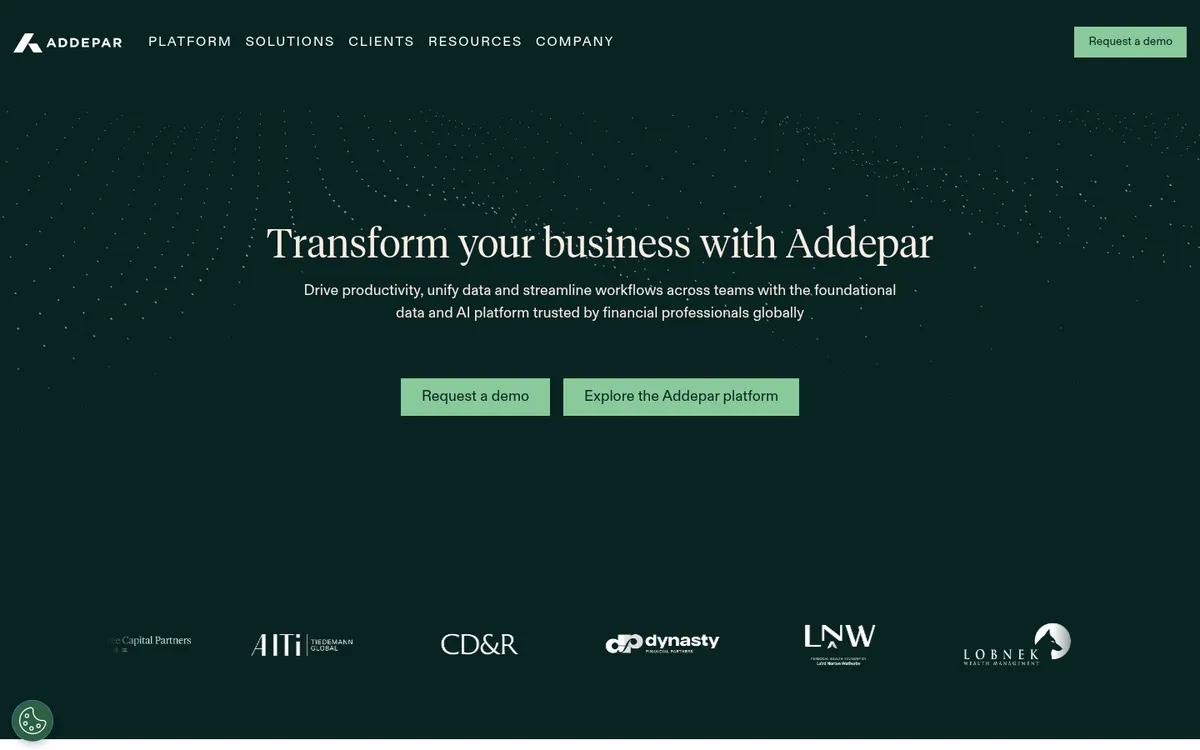
Addepar
Best for complex single and multi-family offices needing deep reporting
Our verdict
Addepar is the reporting backbone for complex family offices, but it is not a stand-alone accounting system.
Addepar is a reporting-first platform for complex single and multi-family offices. It aggregates custodian data, covers alternative investments, calculates performance attribution and produces flexible client reports. Multi-entity portfolio reporting lets an office view several structures in one place, while the API ecosystem connects planning, accounting and data tools. Addepar also launched Addison AI in 2026 and raised a $230 million Series G, so product investment is visible and continuing.
The strength is data depth. Custodian feeds and alternative-investment coverage matter when a family holds private funds, real estate and direct deals alongside public securities. Performance attribution and reporting flexibility help an office answer questions from principals and advisers without rebuilding spreadsheets. The API ecosystem is broader than most peers here, which makes Addepar easier to connect to a separate book of record.
The limits are important. Addepar is not an accounting system of record, so most offices pair it with separate accounting and planning tools. Pricing is quote-based and scales with assets on platform, modules and data feeds. No pricing page could be fetched on November 25, 2026, so the quote model stands unconfirmed. Implementation takes 60 to 90 days on clean books and up to a year on complex ones. Among the most expensive options in the category, it needs a real budget and internal project ownership.
Fit Addepar if you run a complex family office and need deep reporting, custodian aggregation and alternative-investment coverage today. Skip it if you need a single system to close the books, or if your entity and custodian footprint is simple enough for a lighter tool.
What works
- Deep custodian and alternatives coverage
- Strong attribution and reporting
- Broad API ecosystem
What to weigh
- No accounting system of record
- Opaque, high quote-based pricing
- Long implementation on complex books
Pick it if
You need a reporting layer that can handle complex, multi-entity portfolios and alternative investments.
Skip it if
You need one system to close the books or a published price before a sales call.
Plate 02 of 08
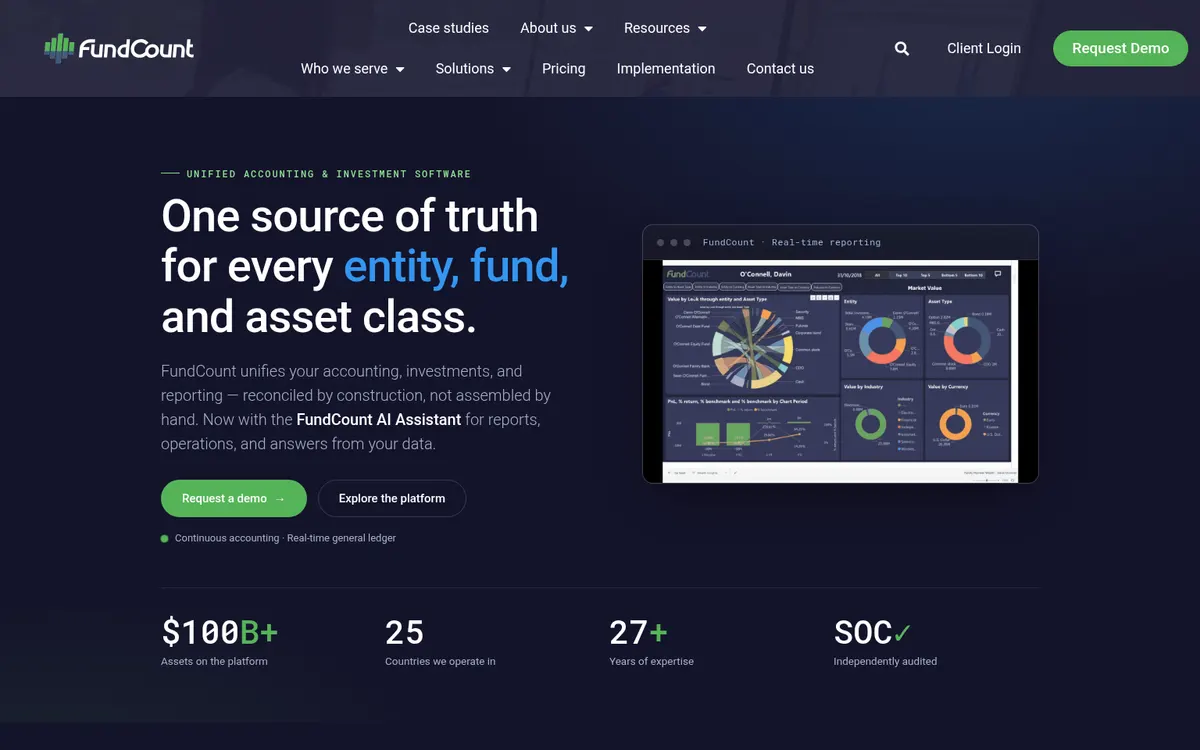
FundCount
Best for family offices needing accounting-grade books and consolidated reporting
Our verdict
FundCount fits offices that want accounting-grade books and consolidated reporting, provided they can live with an institutional interface.
FundCount is an accounting core for family offices that need a real general ledger and consolidated reporting. It lists a multicurrency general ledger, partnership accounting and investment accounting for equities, derivatives, private equity, real estate and debt. Multi-book accounting supports IFRS and GAAP, while nested-entity auto-reconciliation, contribution and distribution tracking, series and waterfall tracking and look-through reporting cover the work that follows a capital event.
The fit is the office that has outgrown a generic small-business ledger. FundCount can hold the books for multiple entities, investments and partnership structures, then report across them. Look-through views help principals and advisers see underlying exposure without exporting to spreadsheets. The accounting core is the reason to shortlist it, not a dashboard or a client portal.
The trade-offs are clear. The interface is institutional and dated, and the product feels built for back-office specialists rather than occasional users. Pricing rises with entities, users, funds and assets. FundCount's single-family-office pricing is on the vendor site, but our November 25, 2026 page check returned no pricing text, so ask for a written quote. No starting figure could be confirmed for any vendor in this comparison. Final pricing varies by entities, users, funds and assets.
Pick FundCount if accounting-grade books, multicurrency consolidation and look-through reporting are the core requirement. Skip it if interface polish matters more than ledger depth, or if your office is too small to justify an institutional accounting core.
What works
- Multicurrency GL and partnership accounting
- Multi-book IFRS and GAAP reporting
- Look-through consolidated views
What to weigh
- Dated institutional interface
- Price rises with entities, users and assets
- Published figure unconfirmed on November 25, 2026
Pick it if
You need a real accounting core for multiple entities, partnerships and investment books.
Skip it if
Your team needs a modern interface or your books are simple enough for a lighter ledger.
Plate 03 of 08
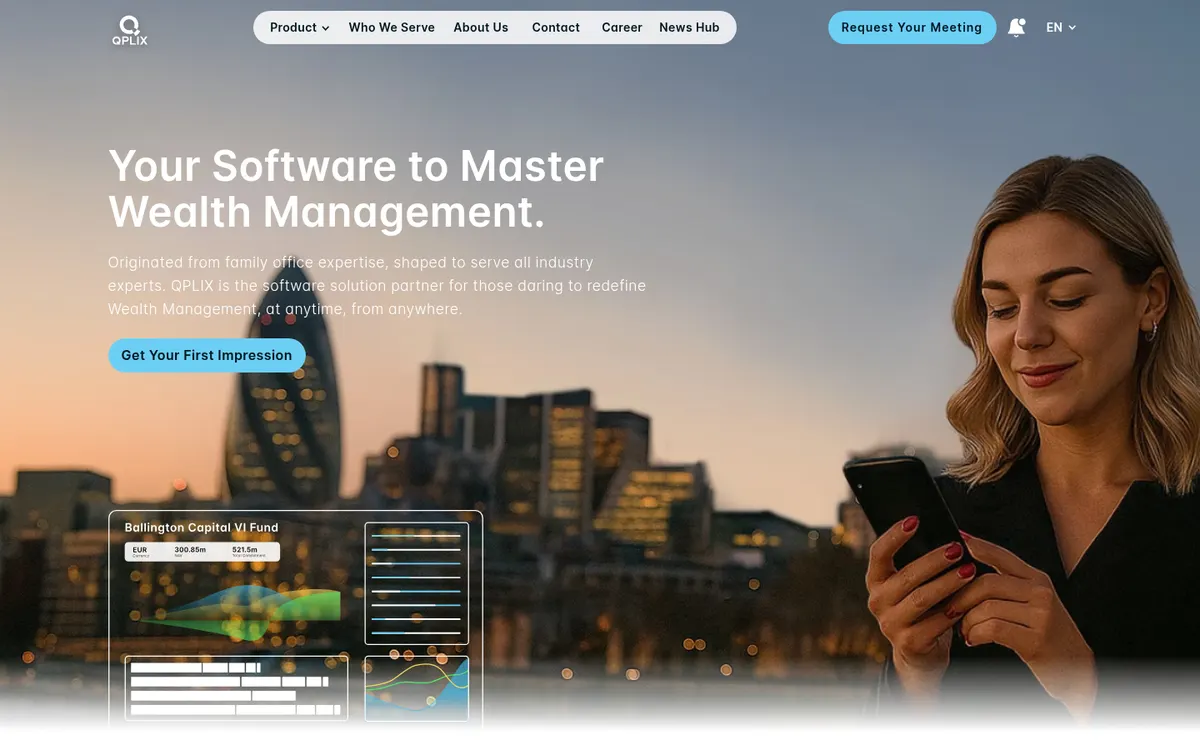
QPLIX
Best for european and cross-border families with intricate ownership structures
Our verdict
QPLIX suits European and cross-border families that need granular ownership modeling and multi-custodian consolidation.
QPLIX is built for European and cross-border families with intricate ownership structures. It consolidates accounts across multiple custodians, rolls up total wealth in multiple currencies and models ownership and entities in granular detail. Investment guideline monitoring, forecasting, distribution analysis and API access for banks and advisers round out the platform. The focus is total wealth rather than a single portfolio.
The ownership and entity modeling is the differentiator. A family with layered trusts, holding companies and operating businesses needs to see who owns what, in which jurisdiction and in which currency. QPLIX supports that view, then lets banks and advisers connect through API access. Investment guideline monitoring adds a control layer that reporting-only tools often leave to spreadsheets. That control layer is useful when investment policy statements must be enforced across entities. That makes it a strong fit for a family with a private office and advisers across several countries.
The limits are geographic and commercial. QPLIX is German-built, and its European data coverage is stronger than its US custodian coverage. US-based offices should confirm native feeds for every custodian before committing. Pricing is quote-based with custom pricing and no published list, so budgeting requires a sales conversation. There is no free plan and no trial. Implementation scope depends on entity depth and the number of custodians and currencies.
Pick QPLIX if you are a European or cross-border family with complex ownership and want multi-custodian, multi-currency consolidation. Skip it if your assets sit mainly with US custodians, or if you need a public price list before you will take a sales call.
What works
- Granular ownership and entity modeling
- Strong European custodian coverage
- API access for banks and advisers
What to weigh
- No public pricing
- Thinner US custodian coverage
- Custom scoping required
Pick it if
You need total-wealth consolidation and ownership modeling across European and cross-border structures.
Skip it if
Your custodians are mostly US-based or you need published pricing before a sales conversation.
Plate 04 of 08
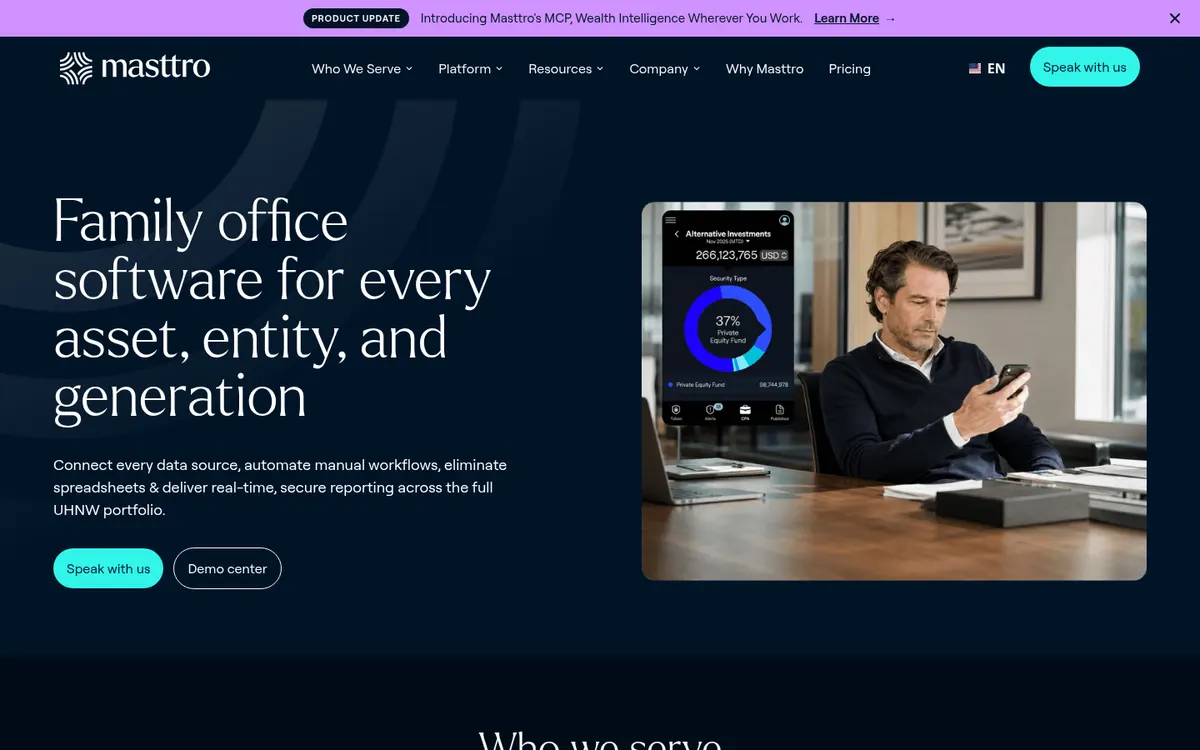
Masttro
Best for large multi-jurisdictional family offices wanting flat-license wealth consolidation
Our verdict
Masttro fits large multi-jurisdiction offices that want flat-license wealth consolidation and can absorb a long implementation.
Masttro is a wealth consolidation platform built inside a family office, and it fits large multi-jurisdictional offices that want a flat-license model. It models entities across jurisdictions, supports a flat annual license independent of AUM, offers client-held encryption keys and hosts data in a Tier 4 Swiss data center. The license is modular, and the architecture is client-owned.
The flat license is the commercial hook. Families with growing assets do not want a subscription that rises every time the portfolio crosses a threshold. Masttro separates price from AUM, then charges for modules and complexity. The vendor reports 400-plus family offices in 40-plus countries, which suggests experience with multi-jurisdiction structures. Swiss hosting and client-held keys appeal to privacy-focused principals.
The trade-offs are implementation and integration. Complex structures commonly take 6 to 9 months to implement, so internal project capacity matters. The integration ecosystem is smaller than Addepar's, which may matter if you need a wide set of data partners. List pricing is opaque until sales engagement, and the plan note points to a flat annual license based on modules and complexity. No published figure is available, so ask for a written quote that covers modules and complexity.
Pick Masttro if you run a large multi-jurisdiction office, want pricing that does not scale with AUM and value Swiss hosting. Skip it if you need a fast deployment, a broad integration marketplace or a published price before sales contact.
What works
- Flat license independent of AUM
- Multi-jurisdiction entity modeling
- Swiss hosting and client-held keys
What to weigh
- 6 to 9 month implementation
- Smaller integration ecosystem
- Opaque list pricing
Pick it if
You want wealth consolidation with a flat annual license and Swiss data controls for a complex family structure.
Skip it if
You need quick deployment or a wide integration marketplace.
Plate 05 of 08
Eton Solutions (AtlasFive)
Best for large offices seeking software plus outsourced back-office operations
Our verdict
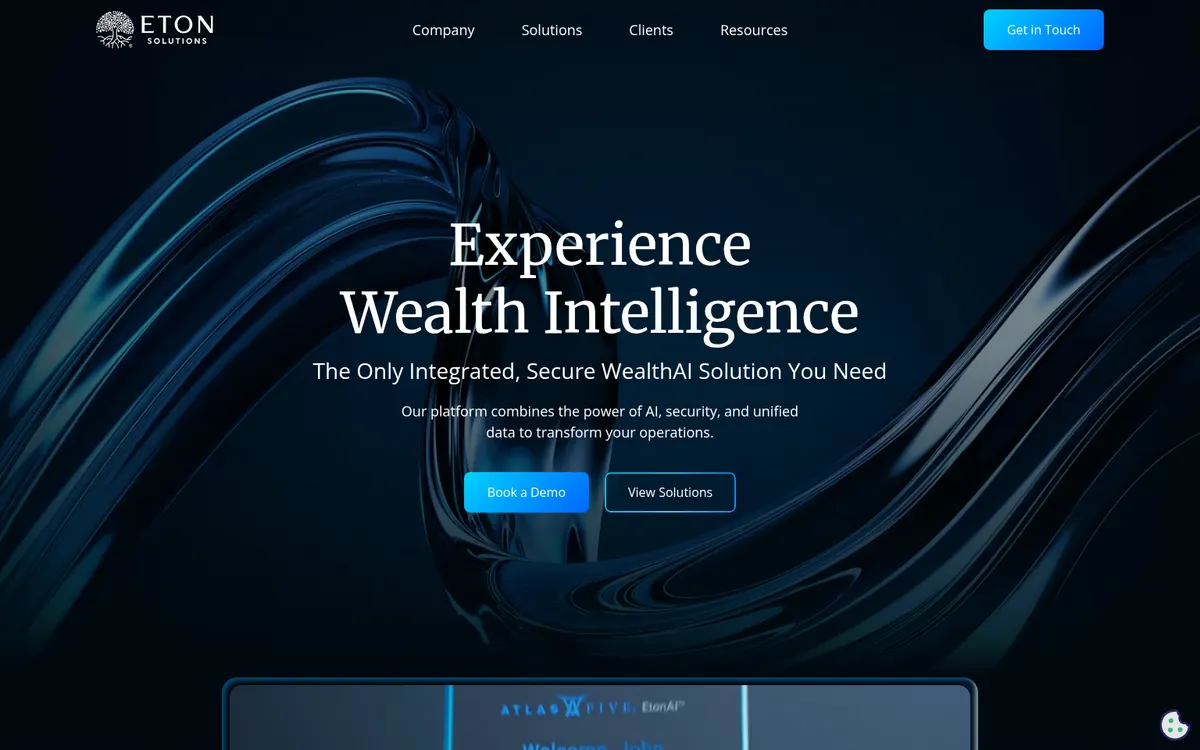
Eton Solutions fits large offices that want accounting software plus outsourced back-office operations from one vendor.
Eton Solutions sells AtlasFive as a front-to-back platform plus an outsourced Administrative Family Office service. AtlasFive is the software layer; Administrative Family Office is the service layer. The software covers accounting, entity management, trust workflows, fund workflows and reporting, with serverless architecture and audit controls. The service targets families from $25 million in assets and deploys in about 30 days. That combination is unusual: one vendor for software and back-office operations.
The fit is a large office that wants fewer vendors and more operational support. If the family is growing, or the current team is stretched, Eton can take on administrative work while providing the system of record. Trust and fund workflows matter for families with fiduciary structures and investment entities. Audit controls and serverless architecture are relevant for offices with strict governance. For a single-family office with trusts, funds and several entities, that can reduce handoffs between the book of record and the people doing the work.
The limits are commercial and operational. Pricing is quote-based through an enterprise sales process, and no pricing page could be fetched on November 25, 2026. The platform is overkill for small or simple offices. Outsourcing also changes the operating model, so the family must be comfortable with a vendor handling administrative work. Confirm which tasks move to Eton and which stay in-house, including approvals, payments and reporting sign-off. Ask for a clear split between software scope, service scope and data ownership.
Pick Eton Solutions if you want accounting, entity management and outsourced back-office operations from one vendor, and you can handle an enterprise sales cycle. Skip it if you want a self-managed tool for a small office or a published price.
What works
- Software plus outsourced operations
- Trust and fund workflows
- Audit controls and serverless architecture
What to weigh
- Enterprise sales process
- No published pricing
- Overkill for small offices
Pick it if
You want one vendor for the accounting platform and an outsourced administrative family office team.
Skip it if
You want a simple self-managed tool or a published price list.
Plate 06 of 08
FINARTIS (Prospero)
Best for offices wanting an integrated front-to-back wealth suite
Our verdict
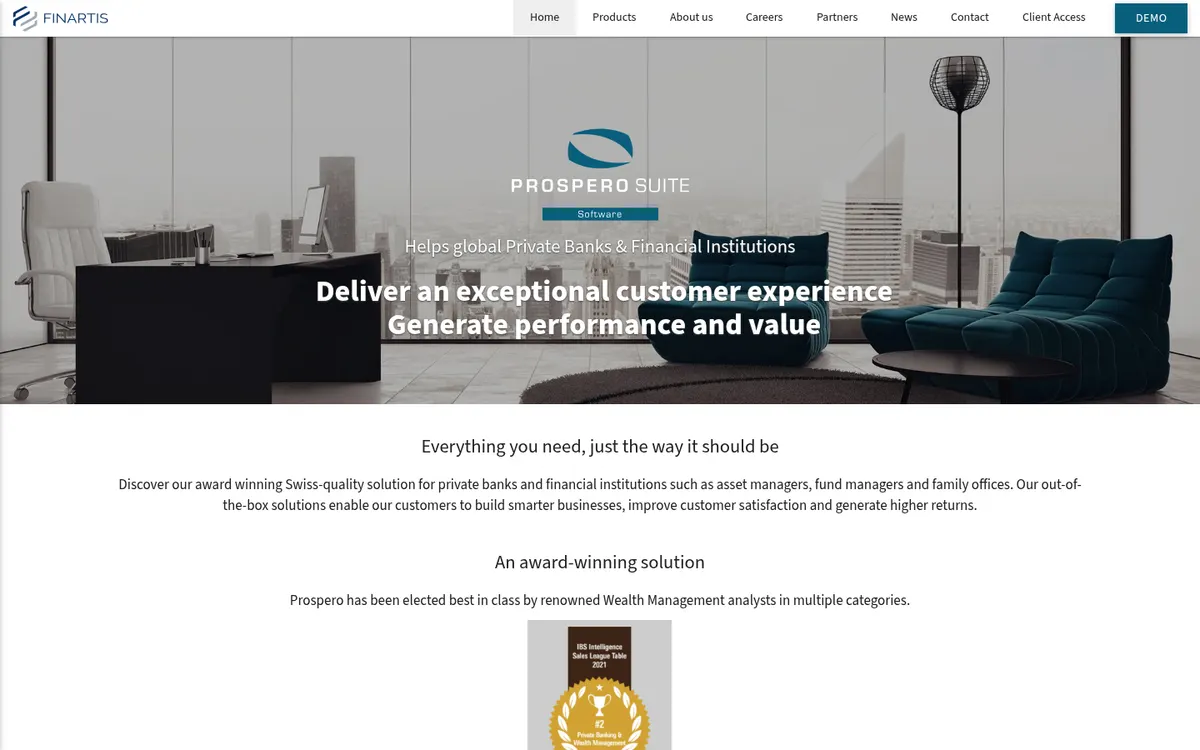
FINARTIS suits offices that want an integrated front-to-back suite and can handle a legacy interface and custom pricing.
FINARTIS offers Prospero as an integrated front-to-back wealth management suite. It covers transaction processing, financial accounting, reporting, fund administration and asset management, with perpetual self-hosted or vendor-hosted deployment and a SaaS option. The vendor has operated since 1986 and sells to wealth managers, fund administrators and family offices that want one suite rather than several point tools.
The appeal is breadth and deployment choice. A perpetual on-premise license can suit an office that wants to own the stack and run it inside its own controls. A SaaS option suits an office that wants vendor hosting. Transaction processing and financial accounting sit next to fund administration and asset management, so the same platform can support multiple workflows. For a family office with fund entities, that integration can reduce reconciliation work. The suite is broad enough that scoping matters as much as feature count.
The limits are age and clarity. The interface and deployment model feel legacy, and independent coverage is scarce. Pricing is not published: the plan note lists a perpetual license plus yearly maintenance, or a SaaS monthly fee. No list price is published, so treat any figure you see outside a written quote as unverified. Module scope and multi-entity accounting need clarification before signing, especially if you run several entities or currencies. Ask for a live walkthrough of the general ledger, not only the reporting module.
Pick FINARTIS if you want an integrated front-to-back suite, a perpetual license option and Swiss vendor tenure. Skip it if you need a modern interface, transparent list pricing or a narrowly focused accounting core.
What works
- Integrated front-to-back suite
- Perpetual or SaaS deployment
- Vendor tenure since 1986
What to weigh
- Legacy interface and deployment
- No published pricing
- Module scope needs clarification
Pick it if
You want one suite for wealth management, fund administration and accounting with a perpetual license option.
Skip it if
You need a modern interface, clear list pricing or a narrow accounting tool.
Plate 07 of 08
Altoo
Best for privacy-focused families and small offices consolidating Swiss-hosted assets
Our verdict
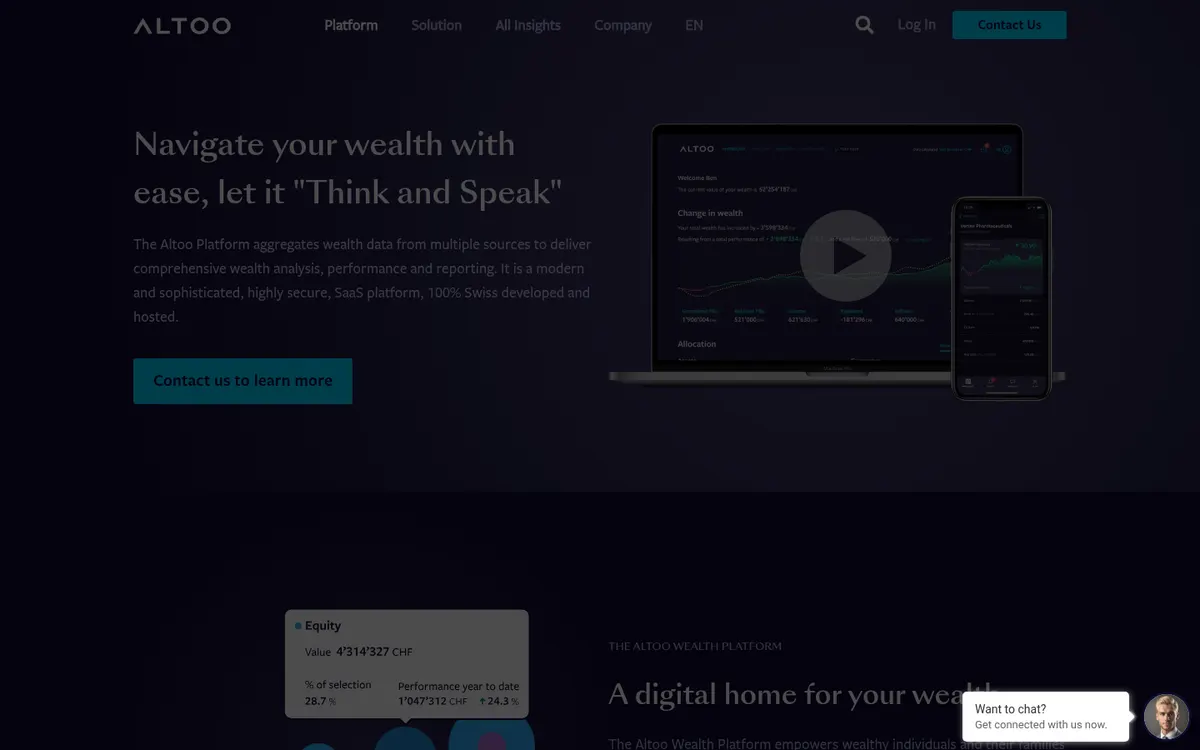
Altoo fits privacy-focused families and small offices that want Swiss-hosted consolidation including non-bankable assets.
Altoo is a Swiss-hosted consolidation platform for privacy-focused families and small offices. It runs in a private cloud, manages encryption in-house and consolidates bankable assets while tracking non-bankable assets such as art and collectibles. It supports multiple bank relationships and sells yearly module licenses. The design is aimed at families that want a private data vault rather than a public-market dashboard.
The pricing model is distinctive: a yearly module license plus a per-bank data-hygiene fee. That means cost follows banking relationships and modules, not net worth. For a family with a handful of banks and a mix of financial and non-financial assets, the model can be easier to budget than an AUM-based subscription. Swiss hosting and in-house encryption are the privacy features to test in a demo. The product is strongest when the family values discretion and a simple operating model.
The limits are scale and coverage. Altoo is a smaller vendor with less ecosystem coverage than Addepar or QPLIX. Bank support must be confirmed before signing, and there is no published pricing page. Onboarding takes 4 to 8 weeks. The platform is not a full institutional accounting core, so an office with complex partnership accounting or fund waterfalls should check scope carefully. Ask which banks are native, which need files and who cleans the data each month. Confirm the per-bank fee in writing because data hygiene work varies by institution.
Pick Altoo if you are a privacy-focused family or small office, want Swiss hosting and need to consolidate bankable and non-bankable assets. Skip it if you need deep partnership accounting, a large integration marketplace or a published price list.
What works
- Swiss-hosted private cloud
- Covers non-bankable assets
- Pricing by banks and modules
What to weigh
- No published pricing
- Smaller ecosystem coverage
- Bank support must be confirmed
Pick it if
You want a private Swiss-hosted view of bankable and non-bankable assets without AUM-based pricing.
Skip it if
You need deep partnership accounting or a large integration ecosystem.
Plate 08 of 08
WealthArc
Best for external asset managers and family offices needing cloud portfolio tools
Our verdict
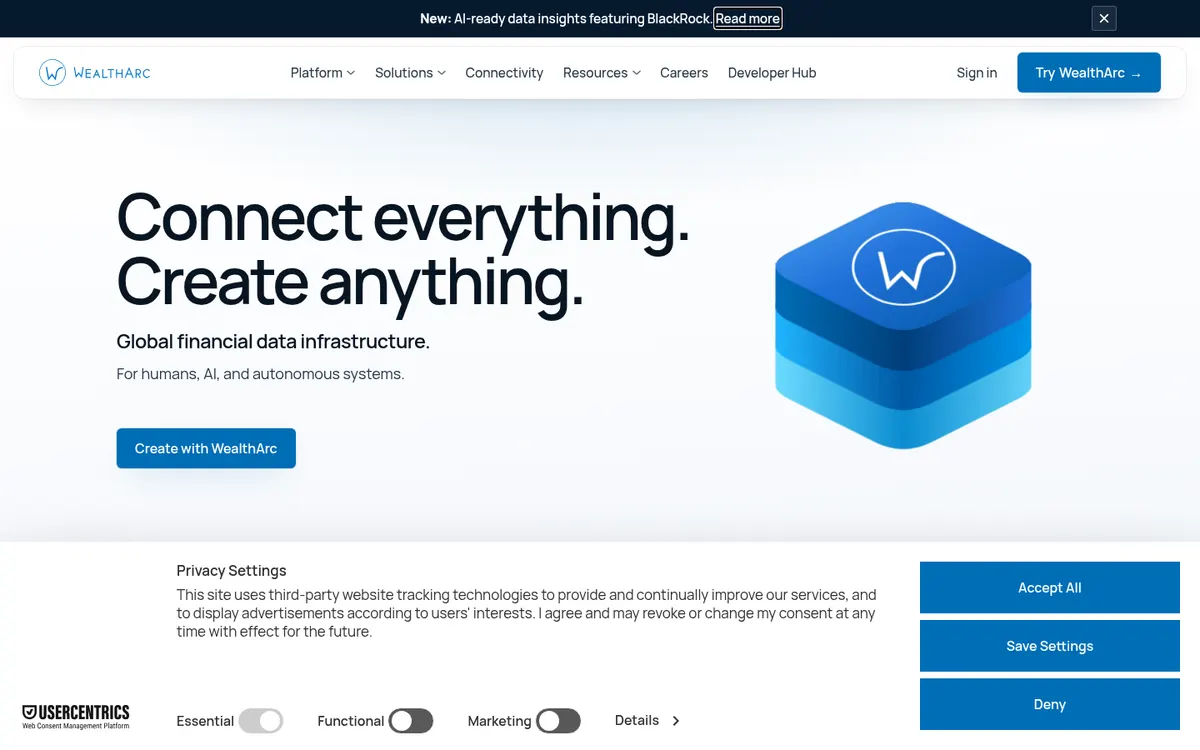
WealthArc fits external asset managers and family offices that want cloud portfolio tools and fast activation.
WealthArc is a cloud-native portfolio management platform for external asset managers and family offices. It bundles portfolio management, governance, KYC, CRM and reporting into two editions, WA Essentials and WA Exclusive. Activation can take days because the product is cloud-native, and the vendor offers a proof-of-concept period. That makes it one of the faster tools to test in this comparison.
The bundle is the selling point. A smaller office may not want separate systems for portfolio management, client records, KYC and reporting. WealthArc puts those functions in one cloud workspace, with two editions for different office sizes. The proof-of-concept period lets a buyer test data loading, reporting and workflow before a full commitment. For an external asset manager, the combination of CRM and portfolio tools can reduce manual handoffs. It is not an accounting system of record.
The commercial limits matter. Pricing is quote-based, with an onboarding fee plus an annual subscription based on assets under management and portfolio count. That AuM-based model penalizes growth, and the portfolio-count component needs to be confirmed in writing. No pricing page could be captured on November 25, 2026. US custodian coverage is less proven than the Swiss and European footprint.
Pick WealthArc if you are an external asset manager or family office that wants cloud portfolio tools, bundled KYC and CRM, and fast activation. Skip it if you need deep accounting for complex entities or want pricing that does not rise with AuM.
What works
- Cloud-native fast activation
- Bundled KYC, CRM and reporting
- Two editions plus proof of concept
What to weigh
- AuM-based subscription
- No published pricing
- US custodian coverage less proven
Pick it if
You want portfolio management, KYC, CRM and reporting in one cloud workspace with a short proof of concept.
Skip it if
You need a full accounting system of record or pricing that does not scale with assets.
What Does Family Office Accounting Software Actually Do?
Family office accounting software is the book of record for a family's entities, investments and transactions. It is not the same as a reporting or consolidation platform. The accounting system closes the books, records journal entries, tracks cost basis and produces statements that an auditor or tax adviser can use. The reporting platform pulls custodian data, calculates performance, shows exposure and builds client reports. Many family offices need both, which is why Addepar and QPLIX appear here alongside FundCount and Eton Solutions.
The accounting layer earns its keep when the family has multiple entities. A single family office may run trusts, LLCs, partnerships, operating companies and investment vehicles across several currencies. The software must handle intercompany transactions, capital contributions, distributions, ownership percentages and partnership allocations. FundCount, for example, lists a multicurrency general ledger, partnership accounting and multi-book accounting under IFRS and GAAP. Eton Solutions lists accounting, entity management, trust workflows and fund workflows. Those are accounting jobs, not dashboard jobs.
The reporting layer answers a different question: what does the family own, what did it earn and how much risk is concentrated where? It aggregates custodian feeds, covers alternatives and produces look-through views. Addepar is reporting-first, with custodian data aggregation, performance attribution and flexible client reporting. That makes it valuable for complex offices, but it does not remove the need for a book of record. A reporting platform can be the view layer while a separate system closes the books.
A family office often outgrows QuickBooks when:
- It closes more than one entity or currency and needs consolidation.
- It tracks partnership capital, series, waterfalls or investment lots.
- It needs look-through reporting across custodians and alternative assets.
- It needs audit controls and a clear trail across entities.
Small offices can use lighter tools, but the decision should follow entity count, custodian coverage and reporting depth, not headcount alone.
This guide sits in the Finance collection. Buyers weighing nearby tools often read the guides to 1099 filing software and law firm accounting software next.
How Does Family Office Accounting Software Pricing Work?
Pricing is mostly quote-based, and the number depends on assets, entities, users, modules and data feeds. Every vendor here points buyers to the website for pricing, and no starting figure could be confirmed on November 25, 2026. Expect a scoping call and a written quote.
| Model | How it bills | Typical fit | Example from this list |
|---|---|---|---|
| Asset-based quote | Scales with assets, modules and data feeds | Complex family offices | Addepar |
| Published annual license | Single Family Office, per year | Offices wanting a known entry point | FundCount |
| Custom quote | No published list | Cross-border ownership | QPLIX |
| Flat annual license | Modules and complexity | Large multi-jurisdiction offices | Masttro |
| Enterprise quote | Quote-based sales process | Large offices adding outsourcing | Eton Solutions (AtlasFive) |
| Perpetual plus maintenance or SaaS | Perpetual license plus maintenance, or SaaS monthly | Self-hosted or vendor-hosted suite | FINARTIS (Prospero) |
| Module plus bank fee | Yearly module license plus per-bank data-hygiene fee | Privacy-focused families | Altoo |
| Onboarding plus AuM subscription | Onboarding fee plus AuM and portfolio count | External asset managers | WealthArc |
Price the scope, not the logo. Ask for a quote that lists entities, users, custodians, bank connections, modules, data feeds and implementation. FundCount's plan note points to a single-family-office annual license, while Masttro uses a flat annual license based on modules and complexity. FINARTIS offers perpetual licensing plus yearly maintenance or a SaaS monthly fee. Altoo bundles a yearly module license with a per-bank data-hygiene fee. WealthArc adds an onboarding fee to an annual subscription based on assets under management and portfolio count. Addepar, QPLIX, Eton Solutions and Masttro keep list pricing off the public page, so the reliable number is the one you get in writing.
Do not compare a flat license with an AuM subscription without modeling growth. A flat license can look expensive at the start and cheaper later; an AuM subscription can look cheap at the start and rise as assets grow. Ask what happens when you add an entity, a user, a bank or a fund.
Every price in this guide was read on the vendor's own pricing page on November 25, 2026. Where a vendor does not publish a figure we could confirm, the card says "See website" rather than a guess. For the arithmetic around this purchase, try the free 1099 filing cost calculator.
How Should a Family Office Choose Accounting Software?
- Define the book of record. Decide whether you need a full general ledger, a reporting layer or both. Addepar is reporting-first, while FundCount and Eton Solutions lead with accounting.
- Map entities and currencies. List every trust, LLC, partnership, fund and operating company, plus the currencies and ownership layers. This scope drives QPLIX and Masttro complexity and most implementation timelines.
- Check custodian and bank coverage. Confirm native feeds for every institution you use. Ask for a named list, not a demo. Altoo and WealthArc both require bank or custodian coverage checks before signing.
- Test reporting and look-through. Bring one real quarter of data and ask for consolidated statements, performance attribution, exposure and ownership views. Reporting depth is where Addepar and QPLIX separate from lighter tools.
- Price the full scope. Request written quotes covering entities, users, modules, data feeds, onboarding and support. FundCount publishes a starting point, but final quotes rise with entities, users, funds and assets.
- Run a proof of concept. Give two vendors the same data and a fixed deadline. WealthArc offers a proof-of-concept period; use it to test activation, reporting and data hygiene before committing.
What Mistakes Should Family Offices Avoid?
The most common mistakes are buying a reporting layer as an accounting system, skipping custodian checks and accepting vague scope. Each one adds cost after signature.
- Buying reporting as accounting. Addepar and QPLIX are strong reporting platforms, but a reporting-first tool does not close the books. Keep a book of record and connect the two.
- Skipping custodian checks. Coverage varies by region and institution. Confirm native feeds for every bank and custodian you use, or budget for manual data work every month.
- Ignoring entity growth. A structure that fits today can break after one trust or fund launch. Ask how the license handles new entities, currencies, users and portfolios.
- Accepting vague module scope. FINARTIS and Eton Solutions sell broad suites. Put included modules, accounting scope, reporting and support in writing before you sign.
- Underestimating implementation. Addepar can take 60 to 90 days on clean books and up to a year on complex ones. Masttro commonly takes 6 to 9 months. Plan for the work.
Best Family Office Accounting Software 2026: questions
What drives the price of family office accounting software?
Most family office accounting software is quote-based, and the price depends on assets, entities, users, modules and data feeds. In this set, Addepar scales with assets on platform, Masttro uses a flat annual license based on modules and complexity, Altoo charges a yearly module license plus a per-bank data-hygiene fee, and WealthArc adds an onboarding fee to an AuM-based subscription.
How does a reporting platform differ from an accounting system of record?
A reporting platform aggregates custodian data, calculates performance and builds views; an accounting system of record closes the books, records journal entries and handles ledgers, capital and audit trails. Addepar is reporting-first, while FundCount and Eton Solutions list accounting cores. Complex offices often run both and connect them.
What signals that a family office has outgrown QuickBooks?
A family office outgrows QuickBooks when it must consolidate multiple entities or currencies, track partnership capital and waterfalls, handle investment lots, or produce look-through reporting across custodians. At that point, a multicurrency general ledger and entity model matter more than a familiar interface. The trigger is complexity, not headcount.
How long should a family office expect implementation to take?
Implementation ranges from days to a year. WealthArc says cloud-native activation can take days. Altoo onboarding takes 4 to 8 weeks. Eton Solutions deploys its Administrative Family Office in about 30 days. Addepar takes 60 to 90 days on clean books and up to a year on complex ones. Masttro commonly takes 6 to 9 months.
Can a small family office get by without an enterprise platform?
Not always. A small office with simple books may do better with a lighter accounting tool and a separate reporting layer. Enterprise platforms make sense when entity count, multicurrency books, alternatives or custodian complexity rise. Altoo and WealthArc target smaller or privacy-focused operations, while Addepar and Eton Solutions fit larger, more complex offices.
Which tools in this list publish a starting price?
FundCount describes a single-family-office plan billed per year, but our November 25, 2026 page check returned no pricing text, so no figure could be confirmed. Every vendor in this set shows 'See website' or quote-based pricing. Treat any number you see without a vendor page or written quote as unverified, including third-party estimates.