
Contents of this guide
The shortlist
Our top 3 for blockchain buyers
Chainstack
Flat per-request units
- Best for
- High-volume Ethereum workloads needing per-request billing and compliance
- Features
- 4 noted: Per request billing, Global nodes, SOC 2 Type II, Archive and trace

Alchemy
Prebuilt data APIs
- Best for
- Production apps that want reliability plus developer tooling
- Features
- 4 noted: 100+ networks, NFT API, Webhooks, 99.99% SLA
Infura
Ethereum track record
- Best for
- Ethereum and major Layer 2 teams wanting proven infrastructure
- Features
- 4 noted: Ethereum focus, MetaMask ready, IPFS, Layer 2 coverage
Disclosure for this guide. Chainstack is a paid Featured listing in this guide and is labelled wherever it appears. The other 7 tools are unpaid editorial picks, and no vendor saw this guide before it was published. The position of a paid listing can be part of what the vendor pays for. Paid and unpaid tools are scored on the same rubric and keep their cons. Details are in the advertising disclosure.
The ledger
Index of every tool
| Tool | Free plan | Trial | Rubric | Compare | ||
|---|---|---|---|---|---|---|
| 01 | ChainstackFeaturedHigh-volume Ethereum workloads needing per-request billing and compliance | Growth $49/mo monthlyChecked Nov 25, 2026 | Yes (Developer: 3M requests, 25 RPS) | No separate trial, free Developer plan | ||
| 02 | AlchemyProduction apps that want reliability plus developer tooling | Pay as You Go, $0.52 per 1M CUChecked Nov 25, 2026 | Yes (Free: 30M CU per month, 15 RPS) | No separate trial, free plan | ||
| 03 | InfuraEthereum and major Layer 2 teams wanting proven infrastructure | Developer $50/moChecked Nov 25, 2026 | Yes (Core) | Free tier with 3M daily credits; no separate trial | ||
| 04 |  QuickNodeMulti-chain teams that need speed and wide network coverage | Build $34/mo billed annuallyChecked Nov 25, 2026 | No (free trial only) | 1 month free, 10M credits, no card required | ||
| 05 |  AnkrCost-sensitive multi-chain apps that tolerate some archive limits | Pay as you go from $10 (100M API credits)Checked Nov 25, 2026 | Yes (Freemium) | Free public endpoints; no separate trial | ||
| 06 |  NOWNodesApps needing rare chains alongside major networks | Pro 20 EUR per monthChecked Nov 25, 2026 | Yes (Start: 100k requests per month, 15 RPS) | Start plan listed as 1 month free | ||
| 07 |  GetBlockSmall projects with a path to dedicated nodes | See websiteNot published | Yes (Free tier 50K CU) | Free tier with 40,000 requests per day | ||
| 08 |  dRPCApps where uptime and provider redundancy come first | Pro $49/mo monthlyChecked Nov 25, 2026 | Yes (Free: 50M CU pool, public nodes only) | No separate trial, free plan available |
Prices are the lowest paid plan the vendor shows, read on November 25, 2026. Sort by price ranks published monthly figures; tools without one go last. Pin up to three tools to compare them side by side.
How this guide was put together
We scored each provider on the same five criteria and weighted them to reflect what actually breaks a blockchain app in production. Price clarity gets 25 percent because opaque metering is a common source of a surprise invoice. Reliability gets 25 percent, since an endpoint that drops calls costs more in engineering time than any subscription. Chain coverage takes 20 percent, developer tooling 15 percent and scaling path 15 percent.
Every price in this list was read from the vendor pricing page on November 25, 2026. Where a vendor does not publish a USD figure, we say pricing is on the vendor site and do not convert or estimate. Where a plan price is not published clearly, we say so in the entry rather than pick a number. QuickNode's Build plan and GetBlock's shared tiers both get that treatment.
The order is editorial. Each entry is written for a specific buyer, and the position reflects how well it serves that buyer alongside the disclosed Featured placement. Chainstack holds the Featured slot, which is a paid placement. It was scored on the same rubric as every other provider and it carries the same kind of cons: doubled billing on trace calls, overage bands that run to $20 per million, and an add-on required for unmetered traffic.
We did not load test these endpoints ourselves for this edition. The reviews describe published plan limits, metering rules and coverage, and they flag where public information runs out, such as GetBlock's unpublished Mantle multiplier or NOWNodes' euro-denominated pricing.
The full process, including how we handle corrections, is on the methodology page. Paid listings follow the advertising disclosure.
Rubric and weights
Every tool below is scored from 1 to 10 on these five criteria. The scores describe each tool; the order is an editorial call on fit for the buyer each card describes, plus the disclosed Featured position.
- 25%Price clarityHow easy it is to forecast a monthly bill from published rates, metering rules and overage bands.
- 25%ReliabilityUptime commitments, failover design and how much operational risk the provider absorbs for you.
- 20%Chain coverageBreadth of supported networks and whether the specific chains a buyer needs are actually served.
- 15%Developer toolingSupporting APIs, WebSocket access, archive and trace depth, and documentation quality.
- 15%Scaling pathWhether a team can move from a small plan to dedicated capacity without changing vendors.
Plate 01 of 08 / Featured
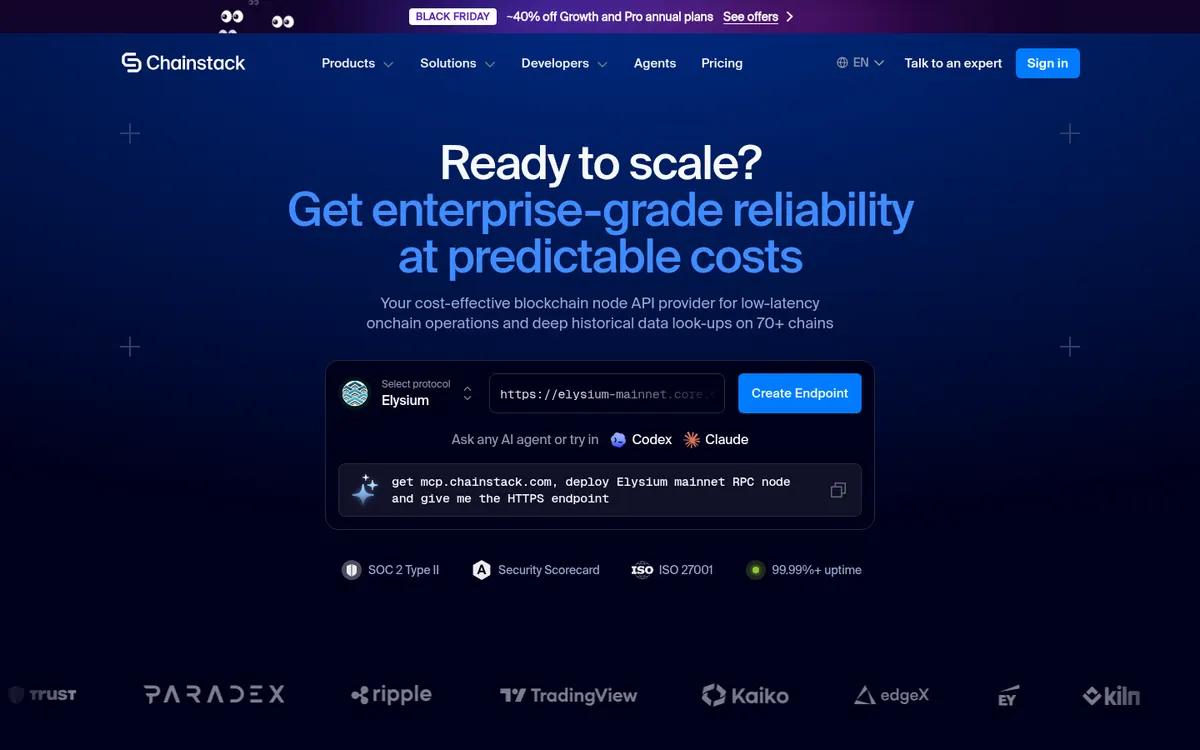
Chainstack
Best for high-volume Ethereum workloads needing per-request billing and compliance
Our verdict
Best fit for high-volume Ethereum teams that want per-request billing they can forecast and compliance paperwork they can hand to auditors.
Chainstack targets high-volume Ethereum teams that want predictable billing. Recent-state calls cost one request unit with no method weighting, so a balance check and a heavier call are priced the same. That removes modeling work common to compute-unit and credit systems, and it is why this entry is Featured.
Elastic Global Nodes route to the nearest available location and fail over when a node degrades. Archive, debug and trace APIs are included from Growth upward. SOC 2 Type II and ISO 27001 documentation is available for regulated buyers.
Pricing is Growth $49 per month, Pro $199, Business $499 and Enterprise $990. Annual billing is $40, $166, $416 and $825 per month. The Black Friday rate seen during the check is a temporary promo. Developer is free with 3M request units and 25 requests per second, with no separate trial. Historical and trace calls bill at 2 request units, so archive work roughly doubles. Overage is $5 to $20 per million requests depending on plan, above the roughly $2.45 to $2.50 per million implied. Unmetered traffic needs the Unlimited Node add-on, a flat fee per RPS tier.
What works
- One request unit per recent-state call, no method weighting
- Automatic failover across global node locations
- SOC 2 Type II and ISO 27001 documentation
What to weigh
- Historical and trace calls bill at two units per call
- Overage bands from $5 to $20 per million are easy to underestimate
- Unmetered usage requires a paid add-on
Pick it if
You run sustained Ethereum traffic and want a bill that maps directly to your call count.
Skip it if
Most of your workload is archive or trace calls that bill at double units.
Plate 02 of 08
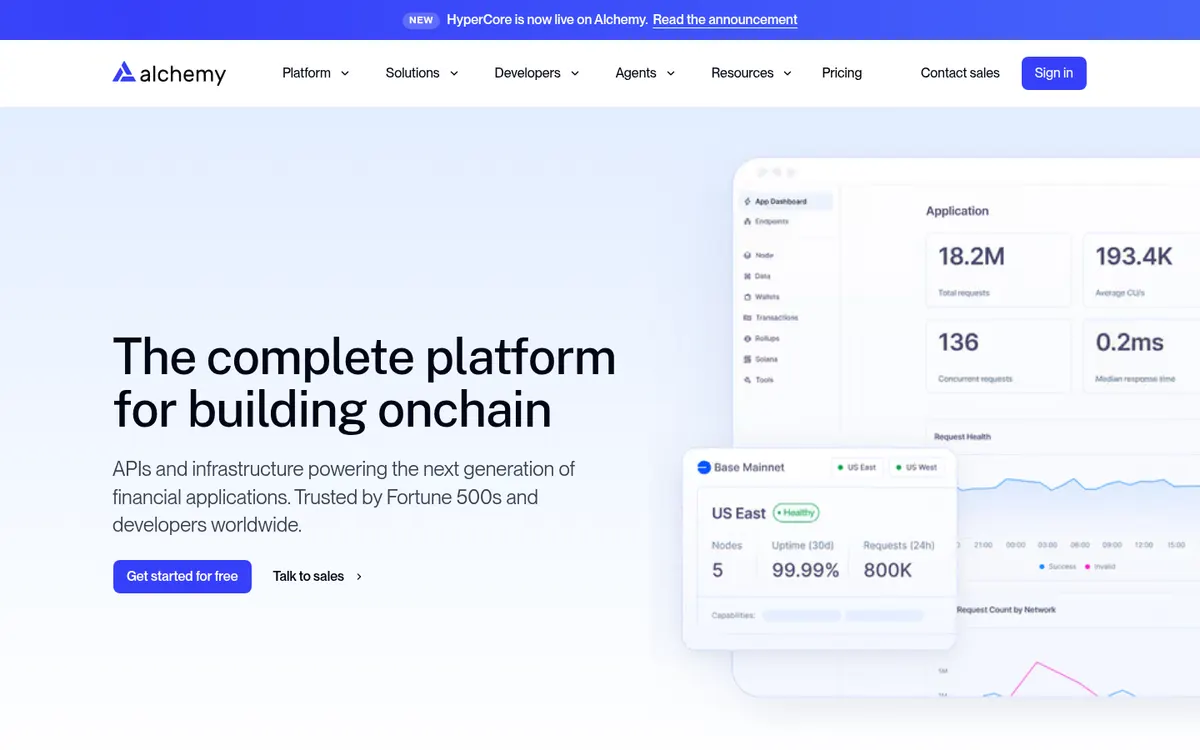
Alchemy
Best for production apps that want reliability plus developer tooling
Our verdict
Best for product teams that want one vendor covering nodes, NFT data, transfers and notifications instead of stitching three services together.
Alchemy suits production teams that would rather buy a platform than wire a node and indexers. It ships NFT, transfer and webhook APIs plus analytics tooling. Coverage runs to 100 or more networks, so a multi-chain product can often stay with one vendor.
Paid tiers carry a 99.99% uptime SLA, and the platform serves full archive data alongside account-state data. The free tier gives 30M compute units per month at 15 requests per second, enough to build and test against mainnet without a card.
Pricing is usage based at $0.52 per 1M compute units with no monthly base fee, so there is no fixed monthly figure. The catch is metering. Alchemy assumes roughly 27 compute units per request, and the metered rate past the free allowance is $0.525 per 1M units. A log-heavy workload with wide eth_getLogs filters bills above a simple request count, so model your traffic mix. Breadth is the sell and the risk: prebuilt surface area, but compute-unit accounting takes an afternoon to model. Raw JSON-RPC teams pay for unused tooling. Teams replacing three vendors for NFTs, transfers and notifications usually come out ahead on cost and integration time.
What works
- Prebuilt NFT, transfer and webhook APIs
- 99.99% uptime SLA on paid tiers
- Coverage of 100 or more networks
What to weigh
- Compute-unit pricing grows fast on log-heavy traffic
- Costs need modeling at roughly 27 units per request
- Free tier capped at 30M compute units per month
Pick it if
You want node access plus ready-made data APIs under one contract.
Skip it if
You only need raw RPC calls and want a bill you can read at a glance.
Plate 03 of 08
Infura
Best for ethereum and major Layer 2 teams wanting proven infrastructure
Our verdict
Best for Ethereum and major Layer 2 teams that value a long track record and MetaMask integration over the widest possible chain list.
Infura is the safe, unglamorous choice for Ethereum and major Layer 2 work. It has operated in the ecosystem longer than most rivals, integrates with MetaMask, and covers Polygon, Arbitrum and other large Layer 2s. Teams that want an endpoint configured once and forgotten land here.
IPFS support is included, and archive access is available on paid tiers. The free Core plan runs on 3M daily credits. Developer is $50 per month with 15M daily credits, Team is $225 per month, and Developer is the paid entry point for archive data. For teams already inside Ethereum tooling, integration is short.
Credits reset daily, not monthly. That suits steady traffic but is awkward for batch jobs that spike one day and idle the next, because unused credits do not roll over. Archive behind paid plans pushes historical work off the free tier quickly. The honest limit is network breadth: the chain list trails the widest competitors, and WebSocket support is partial. If your roadmap is Ethereum plus top Layer 2s, neither is a problem. For newer or smaller chains, confirm the network on the coverage page before designing around Infura, because the answer is not always yes.
What works
- Long operating history in the Ethereum ecosystem
- Default endpoint behind MetaMask
- IPFS storage included
What to weigh
- Network count trails broader competitors
- Credits reset daily and do not roll over
- Archive access gated to paid plans
Pick it if
Your stack is Ethereum and the top Layer 2s and you want a vendor with a long track record.
Skip it if
You need 70 or more chains or rely on WebSocket streaming everywhere.
Plate 04 of 08
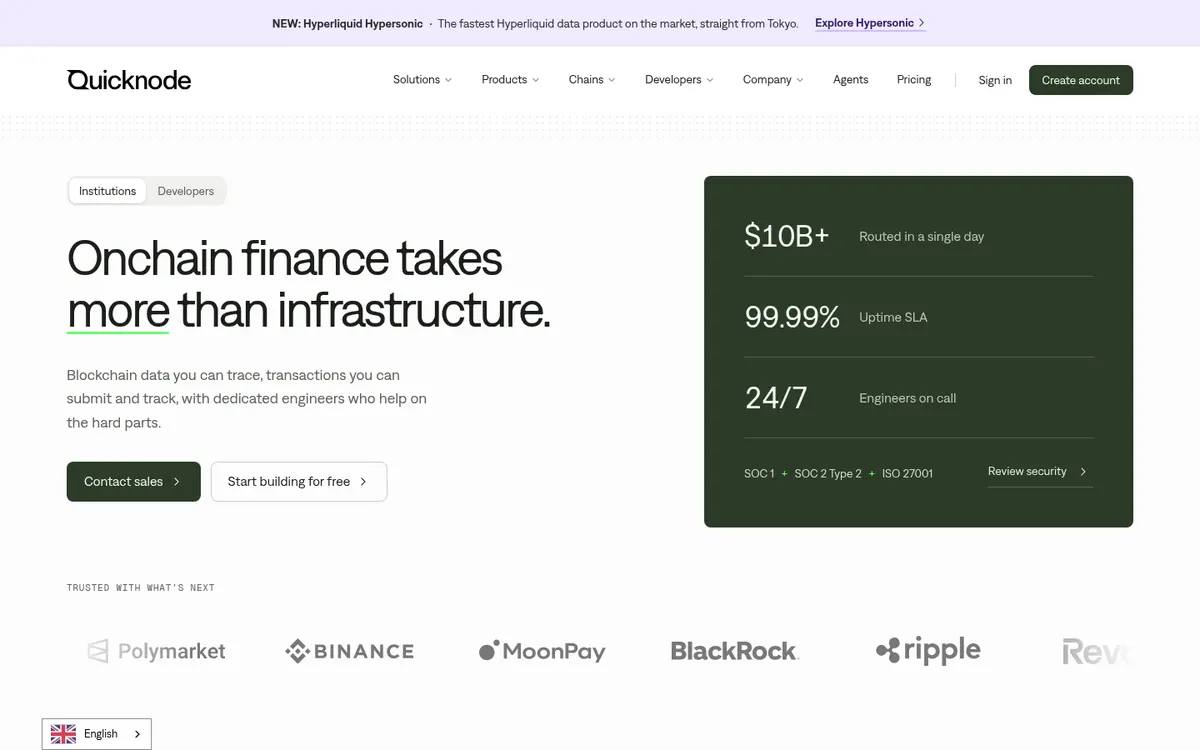
QuickNode
Best for multi-chain teams that need speed and wide network coverage
Our verdict
Best for multi-chain teams chasing latency, with the caveat that there is no free plan and credit math needs modeling first.
QuickNode is the pick for multi-chain teams that care about latency. Coverage runs to 70 or more networks on global multi-region infrastructure, with WebSocket and streaming support for real-time work such as watching mempools or pushing state updates to a front end. If your product feels slow, node location is usually part of the reason.
There is no permanent free plan. Evaluation is a one month trial with 10M credits and no card, enough to benchmark real traffic but not to run a hobby project indefinitely. The Build plan is $34 per month on annual billing and $49 month to month. Check your own call mix rather than a headline credit count.
The Marketplace carries add-ons, including smart load balancers. Those are the practical answer for teams running Solana or BNB Chain at volume, where a balancer across endpoints cuts the cost of redundancy compared with paying for redundant capacity twice. Two caveats remain. Compare Build on the same billing term, and with no free tier every environment, including staging, carries a cost, so budget for non-production usage that free plans elsewhere would absorb.
What works
- Low latency across multiple regions
- Broad coverage of 70 or more networks
- Marketplace add-ons including smart load balancers
What to weigh
- No permanent free plan, trial only
- Build plan quoted at both $34 and $49 per month
- Credit math needs modeling before you commit
Pick it if
You serve users across regions and need WebSocket streaming on many chains.
Skip it if
You need a free tier for staging or side projects.
Plate 05 of 08
Ankr
Best for cost-sensitive multi-chain apps that tolerate some archive limits
Our verdict
Best for cost-sensitive multi-chain apps reading recent state, provided they can live without deep archive history on every chain.
Ankr is the budget option for multi-chain traffic where archive depth is not binding. Coverage runs to 75 or more networks, free public endpoints help quick starts, and usage is sold in credits starting around $10 per 100M on pay as you go. For teams driven by raw throughput, that rate is low in this list.
The node layer is decentralized, spreading risk across operators. On BNB Chain, an Erigon upgrade cut archive storage and sync time, a real benefit for archive-heavy BNB workloads. Premium tiers apply rate-limit multipliers, so the requests-per-second ceiling is not the same at every price point.
Cost per unit is the headline for high-volume recent-state traffic. The advantage narrows on archive calls, because archive depth varies by chain and on some chains is limited, not enough to replay a week of history or audit past activity. Documentation is the other gap: an uptime SLA is not clearly documented, which matters for regulated products or SLA-backed contracts. Ankr fits teams wanting minimum spend on raw throughput and accepting looser guarantees. It does not fit teams needing deep history on every chain or a contractual uptime commitment.
What works
- Low unit cost for high-volume traffic
- Free public endpoints for quick starts
- Decentralized node network adds resilience
What to weigh
- Archive depth varies and is short on some chains
- Uptime SLA not documented in some guides
- Rate-limit multipliers on premium tiers
Pick it if
You want the lowest cost per call and mostly read recent chain state.
Skip it if
You need guaranteed archive history on Solana or a contractual uptime SLA.
Plate 06 of 08
NOWNodes
Best for apps needing rare chains alongside major networks
Our verdict
Best for apps that need privacy coins or long-tail chains that mainstream providers skip, with thin request allowances on the cheap tier.
NOWNodes wins on breadth: 120 or more networks include Bitcoin, Ethereum, BNB Smart Chain, Solana and Polygon alongside rarer chains such as Monero, Zcash and Dogecoin. For privacy coins or long-tail chains, it is one of few providers covering them without a second contract and billing relationship.
WebSocket access is available on 30 or more networks, while Blockbook and archive access vary by network. Dedicated nodes come with configurable regions, priority support and no predefined rate cap, the tier to consider once shared endpoints become the bottleneck.
The Start plan is free with 100k requests per month at 15 requests per second and is listed as one month free. Paid entry is Pro at EUR 20 per month for 1M requests. No USD figure is published, so cost depends on the exchange rate, and 1M requests is thin for production. Feature depth is uneven: RPC, WebSocket, Blockbook and archive support differ by network, and interface quality varies. The brand is smaller than the largest rivals, showing in documentation and support depth rather than endpoint availability. That is a fair trade for rare-chain coverage, less so for one consistent experience across ten networks.
What works
- Very wide chain coverage including privacy coins
- WebSocket support across a large network subset
- Dedicated nodes carry no predefined rate cap
What to weigh
- Pro tier at EUR 20 per month covers only 1M requests
- Feature depth and interface quality vary by network
- No USD pricing published
Pick it if
Your roadmap includes privacy coins or long-tail chains that other providers skip.
Skip it if
You need a single consistent feature set across every network or high request volume on a small budget.
Plate 07 of 08
GetBlock
Best for small projects with a path to dedicated nodes
Our verdict
Best for small projects that want a shared node now and a dedicated node later, if they can get a written quote first.
GetBlock is a reasonable start for small projects that expect to grow into dedicated infrastructure. Coverage runs to 50 or more networks, shared nodes are the entry product, and dedicated nodes sit at higher tiers, so you can move up without changing vendors or rewriting your integration.
Every tier carries 99.9% uptime and 24/7 support, which is unusual at the low end. The free tier allows 40,000 requests per day, or 50K compute units depending on which page you read, and is the right way to evaluate before paying.
Pricing is why this entry sits low. Shared pricing is not published clearly, and the Mantle multiplier is unpublished, so that chain cannot be budgeted from public information. No single number exists for a buyer to plan against. The pricing slider during the check showed a Black Friday rate for one tier only, so even the published figure needed qualification. Ask for a written quote before a volume commitment, and ask how Mantle calls are weighted. The product is sound for small multi-chain projects, and the shared-to-dedicated upgrade path is the strongest argument for it. The smaller ecosystem than larger competitors and the opaque multiplier math are the arguments against.
What works
- Clear upgrade path from shared to dedicated nodes
- 99.9% uptime and 24/7 support at every tier
- Free tier suits hands-on evaluation
What to weigh
- Shared plan pricing showed only a sale rate on our check date
- Mantle multiplier unpublished, so budgeting is guesswork
- Smaller ecosystem than larger competitors
Pick it if
You want a cheap shared node now with a documented route to dedicated capacity.
Skip it if
You need published, predictable pricing before you can sign anything.
Plate 08 of 08
dRPC
Best for apps where uptime and provider redundancy come first
Our verdict
Best for apps where a provider outage is more expensive than a higher per-request rate, especially teams that have been burned before.
dRPC sells redundancy. Requests are distributed across multiple node providers, so a single provider outage does not take your app down. Stated uptime is 99.99%, and full archive access comes through aggregation rather than a dedicated node you run and monitor yourself.
The free plan is a 50M compute unit pool limited to public nodes, and public nodes advertise 210M compute units per month, a generous allowance for evaluation and low-traffic side projects. Paid entry is Pro at $49 per month, and pay as you go is $6 per 1M requests. Archive history without operating a node saves engineering time.
That $6 per 1M is the honest weakness. Against Chainstack's implied $2.45 to $2.50 per million and Ankr's credit rate, dRPC costs more per call at volume. You pay for routing and redundancy, a deliberate trade. Teams that have lost a weekend to an outage consider it cheap insurance. Routing adds a debugging step: a failing call has more places to go wrong, and tracing means working through aggregation rather than a single node log. The brand is newer with a shorter track record, which matters for institutional procurement. dRPC fits apps where downtime costs more than requests.
What works
- Multiple providers behind one endpoint
- Archive access without running a node
- Free plan with a 50M compute unit pool
What to weigh
- Pay as you go at $6 per 1M requests is expensive at volume
- Newer brand with a shorter track record
- Routing layer complicates debugging
Pick it if
A single provider outage would cost you more than a higher per-call price.
Skip it if
You are optimizing cents per million calls on steady, high-volume traffic.
What does a blockchain RPC provider actually do for an app?
A blockchain RPC provider runs and maintains nodes on the networks your app uses, then exposes them over HTTP and WebSocket so you do not have to run that hardware yourself. Your application sends a JSON-RPC call, the provider answers it from a synced node, and you get state reads, transaction submission and event logs back. Remote procedure call is the protocol; the provider is the operator behind it.
The work they absorb is larger than it sounds. A node has to stay synced, survive forks and reorgs, keep archive history if you ask for it, and hold up under traffic spikes. Doing that in house means disk, bandwidth, monitoring and someone on call at 3am. Providers turn all of that into a line item on a card.
What you actually buy falls into four buckets:
- Raw RPC access for reads and writes on one or more networks
- Archive, debug and trace calls for history and transaction replay
- Enhanced APIs for NFTs, token transfers and webhooks
- Operational guarantees such as uptime targets, regions, rate limits and compliance documents
Coverage is where providers diverge most. Some focus on Ethereum and the largest Layer 2 networks. Others list 120 or more chains including privacy coins such as Monero and Zcash. A provider covering 70 networks is not better than one covering 40 if your three networks appear on the shorter list, so check the specific chains before anything else.
Metering is the second divergence. Vendors sell requests, request units, compute units, credits or compute unit pools, and the units do not translate cleanly between them. You will see $0.52 per 1M compute units next to $49 per month for a request-based plan and EUR 20 per month for 1M requests. Those numbers describe different things.
Pricing also differs on whether history is included. Archive access is gated to paid plans at Infura, included from the Growth tier at Chainstack, and varies by network at NOWNodes. If your product reads old state, that single detail can outweigh every other line in the comparison.
This guide sits in the Blockchain collection. Buyers weighing nearby tools often read the guides to email finder tools for sales teams and free email blast software next.
How blockchain RPC pricing works, and which unit you are really buying
RPC pricing is not a single number to compare. Vendors sell four different units, and the unit you buy determines how your bill moves when traffic changes.
Per request and request units. One unit per call, sometimes doubled for historical or trace calls. Chainstack charges one request unit for recent-state calls and two for historical and trace calls, with overage from $5 to $20 per million depending on plan.
Compute units. A weighted measure where heavier methods cost more. Alchemy bills $0.52 per 1M compute units on pay as you go, with the metered rate past the free allowance at $0.525 per 1M.
Credits with a monthly pool. A monthly allowance that resets on a schedule. QuickNode's Build plan is $34 per month on annual billing and $49 month to month, with a one month 10M credit trial.
Credits with a daily reset. The same idea on a 24 hour cycle. Infura's Developer plan is $50 per month for 15M daily credits, and unused credits do not roll into a monthly pool.
Tiered subscription plus dedicated nodes. Shared plans by request allowance, dedicated nodes above. GetBlock pricing is on the vendor site, with dedicated nodes at higher tiers.
| Model | How it bills | Typical fit | Example from this list |
|---|---|---|---|
| Per request unit | One unit per recent-state call, two for historical and trace | Predictable high-volume Ethereum traffic | Chainstack Growth at $49 per month, overage $5 to $20 per million |
| Compute units | Weighted units per call, about 27 assumed per request | Teams using prebuilt APIs and analytics | Alchemy pay as you go at $0.52 per 1M CU |
| Daily resetting credits | Fixed daily allowance, no rollover | Steady traffic on major networks | Infura Developer at $50 per month for 15M daily credits |
| Monthly credits | Monthly allowance by plan tier | Multi-chain teams benchmarking | QuickNode Build at $34 per month on annual billing |
| Tiered subscription | Included request allowance, dedicated nodes above | Small projects with a growth path | GetBlock pricing is on the vendor site |
Two rules follow. First, convert every quote into your own monthly call mix, weighted by your heaviest methods, before you compare anything. Second, check whether archive history is included or gated, because that decides which tier you actually buy.
Prices here were read from vendor pricing pages on November 25, 2026. Where a vendor does not publish a USD figure, such as NOWNodes at EUR 20 per month for Pro, no conversion is offered.
Every price in this guide was read on the vendor's own pricing page on November 25, 2026. Where a vendor does not publish a figure we could confirm, the card says "See website" rather than a guess. For the arithmetic around this purchase, try the free Rpc request estimator.
A six step path from prototype to production RPC
Audit your call mix first. Pull a week of logs and separate recent-state reads from archive, trace and log queries. Chainstack bills trace calls at two units and Alchemy assumes about 27 units per request, so unweighted counts mislead.
Set a monthly ceiling before you shop. Decide what an outage costs you and what a surprise invoice would do to your runway. That answer rules out most plans immediately, including the cheap tier that only covers 1M requests.
Shortlist by chain coverage, not reputation. Confirm every chain you ship to appears on the coverage page, including testnets. NOWNodes covers 120 or more networks, while Infura and GetBlock sit in the 40 to 50 range.
Check the paperwork if you sell to enterprises. SOC 2 Type II and ISO 27001 documentation at Chainstack, or a 99.99% SLA at Alchemy and dRPC, may be a procurement requirement rather than a preference. Ask before you build.
Run a real traffic test, not a demo. Point a staging copy of your app at two candidates for a week and compare latency, error rates and the projected bill at your actual call mix, weighted by method.
Plan the failover path before launch. Decide whether you will run two vendors directly or buy redundancy through one contract, as dRPC does. Write the switching runbook while the system is calm.
Five RPC buying mistakes that show up on the first invoice
Comparing headline prices across metering models. A $10 credit pack and a $49 monthly plan measure different things. Convert both to a cost per million calls using your own method mix before drawing any conclusion.
Ignoring overage bands. Chainstack's overage runs $5 to $20 per million depending on plan, which is well above the implied rate of its allowances. Overage is where budgets break, not the base subscription.
Treating a free plan as a production plan. Infura's 3M daily credits reset daily, QuickNode has no free tier at all, and GetBlock's free allowance is 40,000 requests per day. Free tiers are for evaluation, not launch week.
Skipping archive depth checks per chain. Coverage counts hide the detail. Ankr's archive depth is limited on some chains, which is fine for a dashboard and useless for an audit trail.
Buying a dedicated node too early. Dedicated capacity is the right answer at sustained high throughput, but shared endpoints handle most apps. NOWNodes and GetBlock both let you upgrade later without changing vendors.
Best RPC Providers for Blockchain Apps 2026: questions
What does a blockchain RPC provider actually do?
It runs nodes on the networks you care about and exposes them over HTTP and WebSocket so your app can read state and broadcast transactions without operating hardware. You send a JSON-RPC call such as eth_call or eth_getLogs, the provider routes it to a synced node, and returns the result. Providers add archive history, failover, rate limits and tooling on top of that base service.
Which provider is cheapest for raw request volume?
Ankr has a low published unit cost in this list, with pay as you go from about $10 per 100M credits. Chainstack lands around $2.45 to $2.50 per million calls on its plans, which is also low. dRPC charges $6 per 1M requests, a higher per-call rate than the request-unit plans here. Cheapest per call is not cheapest overall once archive calls or rate limits push you to a bigger plan.
Alchemy or Infura: how do I choose between them?
Pick Alchemy if you want prebuilt APIs for NFTs, transfers and notifications plus coverage of 100 or more networks and a 99.99% SLA on paid tiers. Pick Infura if you are Ethereum and major Layer 2 focused and want a long track record plus MetaMask integration. Alchemy meters compute units at $0.52 per 1M; Infura starts at $50 per month for 15M daily credits.
Do I need a dedicated node or is a shared endpoint enough?
A shared endpoint is enough until rate limits, archive depth or isolation requirements start costing you. Move to a dedicated node when you need guaranteed throughput, a specific region or data isolation. NOWNodes sells dedicated nodes with configurable regions and no predefined rate cap, and GetBlock treats dedicated nodes as the growth tier above shared plans. A dedicated node is not always necessary.
Why can't I compare compute units, credits and request counts across vendors?
Because each vendor weights methods differently. Alchemy assumes roughly 27 compute units per request and bills $0.525 per 1M units past the free tier, so a log-heavy call costs far more than a balance check. Chainstack bills one request unit for recent state and two for historical or trace calls. Convert every quote into your own weighted monthly mix before comparing.
Should I run more than one RPC provider at the same time?
Usually yes for production. Two providers behind a load balancer or failover rule cost less than one bad outage. dRPC builds that redundancy into a single contract by spreading requests across multiple underlying node providers, and QuickNode's marketplace sells smart load balancers for the same job. Running two vendors yourself gives more routing control but doubles integration work.