
Contents of this guide
The shortlist
Our top 3 for software buyers

ThinkReservations
Guest messaging automation
- Best for
- US B&Bs and inns wanting PMS, marketing and guest messaging
- Features
- 5 noted: Guest messaging, Branded website, Email marketing, Gift certificates, Upsells

ResNexus
All-in-one website bundle
- Best for
- Innkeepers wanting website, booking engine and PMS from one vendor
- Features
- 5 noted: Website design, Email marketing, Point of sale, Cart recovery, Channel manager

Little Hotelier
OTA reach via SiteMinder
- Best for
- Small inns wanting an easy all-in-one from SiteMinder
- Features
- 5 noted: Booking engine, Channel manager, OTA connections, Assisted setup, 30-day trial
Disclosure for this guide. All 9 tools here are unpaid editorial picks. The position of a paid listing can be part of what the vendor pays for. Paid and unpaid tools are scored on the same rubric and keep their cons. Details are in the advertising disclosure.
The ledger
Index of every tool
| Tool | Free plan | Trial | Rubric | Compare | ||
|---|---|---|---|---|---|---|
| 01 | ThinkReservationsUS B&Bs and inns wanting PMS, marketing and guest messaging | See websitecustom quoteCustom quote | No | Demo only | ||
| 02 | ResNexusInnkeepers wanting website, booking engine and PMS from one vendor | See websitecustom quoteCustom quote | No | Demo only | ||
| 03 | Little HotelierSmall inns wanting an easy all-in-one from SiteMinder | $179Pro, per month, excludes tax, 3 months freeChecked Nov 25, 2026 | No | 30-day free trial | ||
| 04 |  CloudbedsB&Bs and boutique properties planning to grow their channel mix | See websitecustom quoteCustom quote | No | Demo only | ||
| 05 |  WebRezProIndependent properties wanting one flat, published price | $100minimum monthly, $10 per unit per monthChecked Nov 25, 2026 | No | Demo only | ||
| 06 |  SirvoySolo hosts and tiny B&Bs testing software for the first time | €11Starter, per month, billed yearly, free tier includedChecked Nov 25, 2026 | Yes (free tier for 1 unit) | 14-day free trial, no credit card | ||
| 07 |  HotelogixSmall properties wanting a full PMS at a budget per-room price | See websiteNot published | No | Demo only | ||
| 08 | RoomKeyPMSIndependent hotels and larger B&Bs wanting guided, contract-based setup | See websiteNot published | No | Demo only | ||
| 09 |  Beds24Hands-on owners wanting pay-as-you-go with no contract or commissions | See websiteNot published | No | Free trial (length not published) |
Prices are the lowest paid plan the vendor shows, read on November 25, 2026. Sort by price ranks published monthly figures; tools without one go last. Pin up to three tools to compare them side by side.
How this guide was put together
We scored nine products against five criteria that decide whether a bed and breakfast can run on them day to day, then ordered the list for the buyer each entry describes.
Innkeeping fit carries 25 percent: whether the product was designed for a small property with distinct rooms, packages and repeat guests. Pricing clarity carries another 25 percent, because a published rate is easier to budget against than a quote, and that difference shapes the decision more than any single feature. Guest marketing carries 20 percent, covering automated messages, review requests and upsells. Channel coverage carries 15 percent, weighted by OTA breadth. Ease of setup takes the final 15 percent, covering trials, assisted onboarding and time to go live.
Prices and plan details were read from vendor pricing pages on November 25, 2026 and are quoted as published, in the currency shown. Where a vendor publishes no rate, the entry says so and gives no estimate. Plan notes such as room-count scaling or a monthly minimum come from the same pages.
The Featured listing is a paid placement. It was scored on the same five criteria and its cons sit alongside everyone else's. Placement affects whether an entry appears, not how it scores.
We did not test the products hands-on. Feature lists, limits and support claims come from vendor product and pricing pages. Treat the scores as a starting point for a demo, not a verdict on your property.
The full process, including how we handle corrections, is on the methodology page. Paid listings follow the advertising disclosure.
Rubric and weights
Every tool below is scored from 1 to 10 on these five criteria. The scores describe each tool; the order is an editorial call on fit for the buyer each card describes, plus the disclosed Featured position.
- 25%Innkeeping fitWhether the product was designed for a small property with distinct rooms, packages and repeat guests rather than a chain or a single rental.
- 25%Pricing clarityHow much of the cost you can see and plan before a sales call, including published rates, minimums and contract terms.
- 20%Guest marketingAutomated messages, review requests, email campaigns and upsells that turn a first stay into a return booking.
- 15%Channel coverageBreadth of OTA connections and named integrations, weighted by which channels a typical B&B actually lists on.
- 15%Ease of setupTrials, assisted onboarding and how quickly a two-person team can be live without a consultant.
Plate 01 of 09
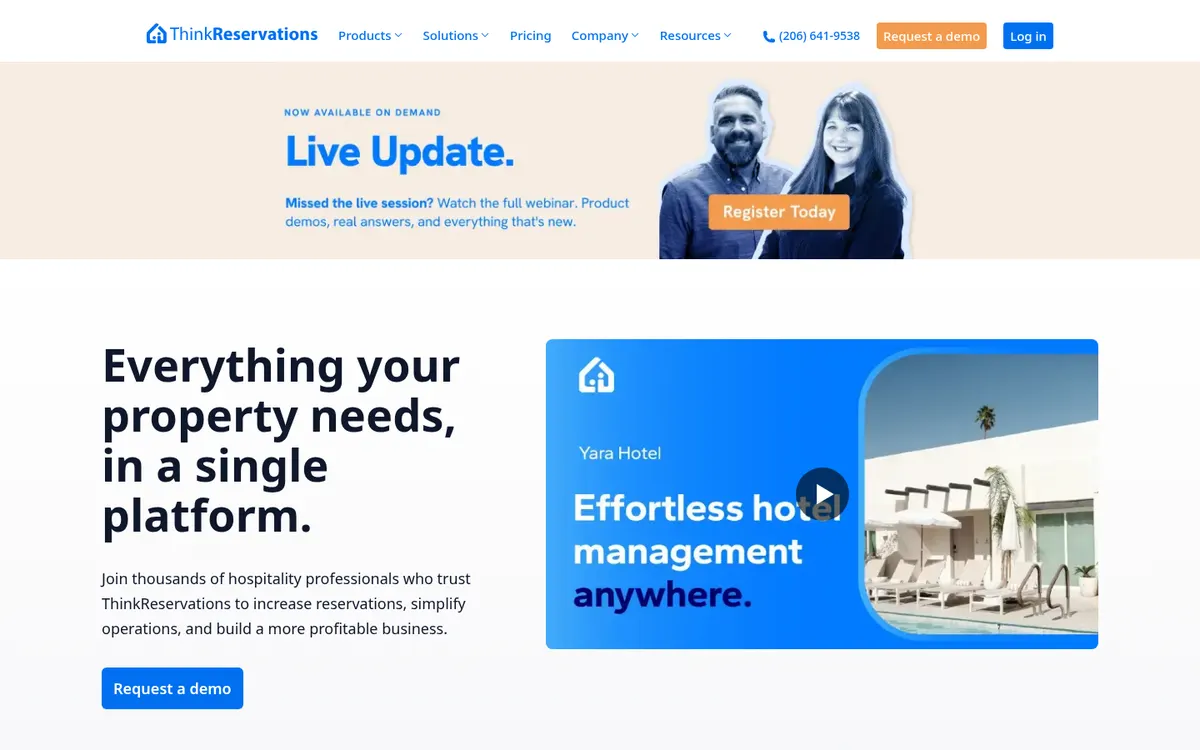
ThinkReservations
Best for US B&Bs and inns wanting PMS, marketing and guest messaging
Our verdict
A strong fit for US inns that want reservations, a branded website and guest marketing under one login.
ThinkReservations is aimed at US inns and B&Bs that sell a small number of distinct rooms and depend on direct bookings, packages and repeat guests. The reservation calendar sits alongside a branded website, so room descriptions, rate plans and the booking engine all come from one vendor instead of a booking tool bolted onto a site you maintain elsewhere.
Guest communication is the strongest part. Automated messages cover confirmations, pre-arrival details and post-stay review requests, and pre-arrival upsells let you add flowers, a late checkout or a dinner booking to a reservation already made. Gift certificate tools handle the printed and posted side that many inns still run. A channel manager keeps availability aligned with the OTAs you use, and email marketing lives in the same login, so past guests can be mailed without exporting a list.
Pricing is quote only. The pricing page offers a request-a-quote path and no figures, so budgeting means booking a demo and getting a written quote based on your room count. A dedicated account manager and onboarding are included, which helps if you are migrating in the middle of a season, when every rate plan has to be rebuilt and remapped.
The limits are worth weighing. There is no self-serve trial, so you cannot test the calendar with your own rates before you commit. Channel coverage is narrower than the large multi-channel platforms, which matters if you list on several regional OTAs as well as Booking.com and Expedia. For an inn that wants reservations, a website and guest marketing from one team, that is a fair trade. For a property that lives on distribution, it is not.
What works
- Guest messaging and upsells built in
- Website and reservations from one vendor
- Account manager and onboarding included
What to weigh
- No published pricing
- No self-serve trial
- Narrower channel coverage than large platforms
Pick it if
You run a US inn and want reservations, a website and guest marketing from one vendor.
Skip it if
You need deep channel distribution across many OTAs or a self-serve trial before you commit.
Plate 02 of 09
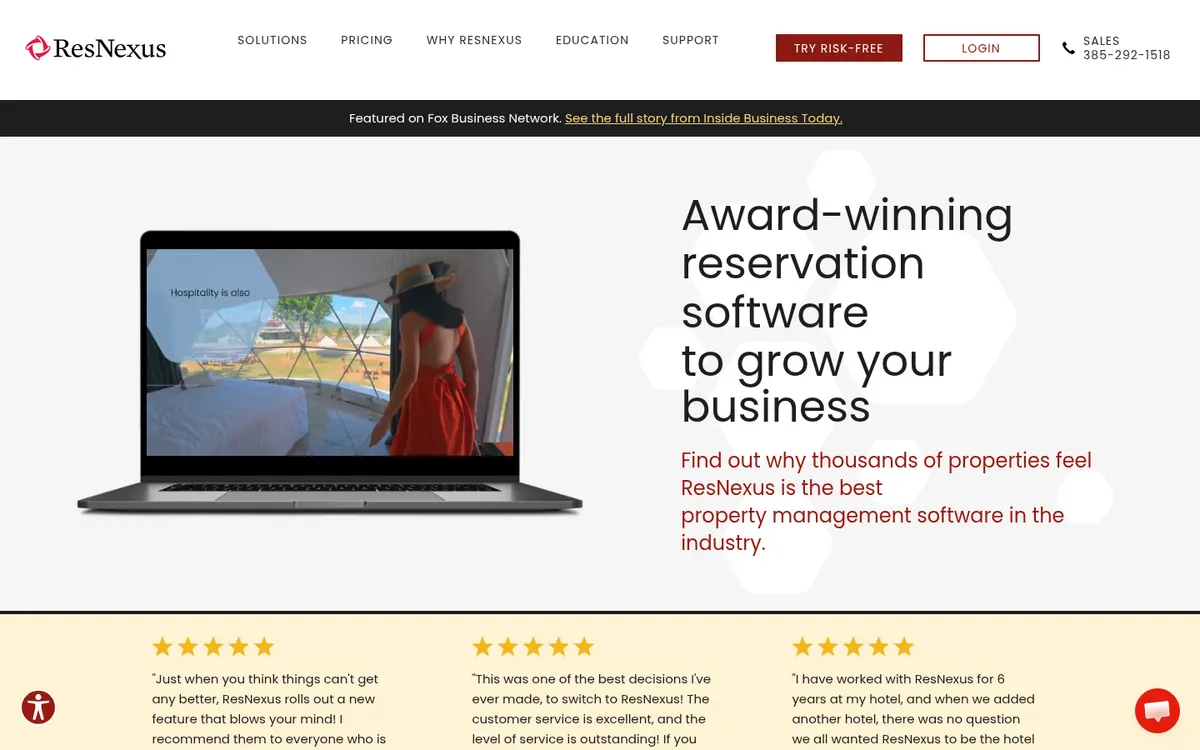
ResNexus
Best for innkeepers wanting website, booking engine and PMS from one vendor
Our verdict
Best for innkeepers who would rather buy a website, PMS and email marketing as one bundle than stitch three vendors together.
ResNexus sells a done-for-you website together with a property management system, which is the main reason innkeepers pick it. Instead of buying a booking engine and building a site around it, you get page design, the reservation system, email marketing and point of sale from one vendor, with gift shop and package sales handled in the same place.
When the website is part of the bundle, the booking engine is already wired to the content, so room pages and rate plans do not need a second integration project. Cart abandonment recovery chases guests who started a booking and stopped, email marketing keeps past guests warm, and the point of sale covers gift shop and package add-ons at the desk. Channel management syncs availability outward. Support has a good reputation among US inns, and the vendor offers to match a property's current software price, which is worth putting against your existing bill.
Pricing is custom and not published. Rates depend on unit count and seasonality, so a five-room inn and a twenty-room inn get different quotes. There are no setup fees and no long-term contract, which lowers the risk of trying it, but you still need a sales conversation before you know the number and can compare it with anything else.
The trade-off is weight and cost. This is a fuller stack than a calendar plus channel manager, and it is priced accordingly, so a host running two or three rooms may pay for modules they never open. The all-in-one bundle is the reason to choose it. If you already have a website you like, or you sell almost entirely through OTAs, the case weakens considerably and a lighter tool will cost less.
What works
- Website design, PMS and POS in one bundle
- No setup fees and no long-term contract
- Offers to match your current software price
What to weigh
- Custom pricing is not published
- Heavier and pricier than a calendar plus channel setup
Pick it if
You want a new website, a PMS and email marketing bought together from one vendor.
Skip it if
Your website is already working and you only need a calendar and channel manager.
Plate 03 of 09
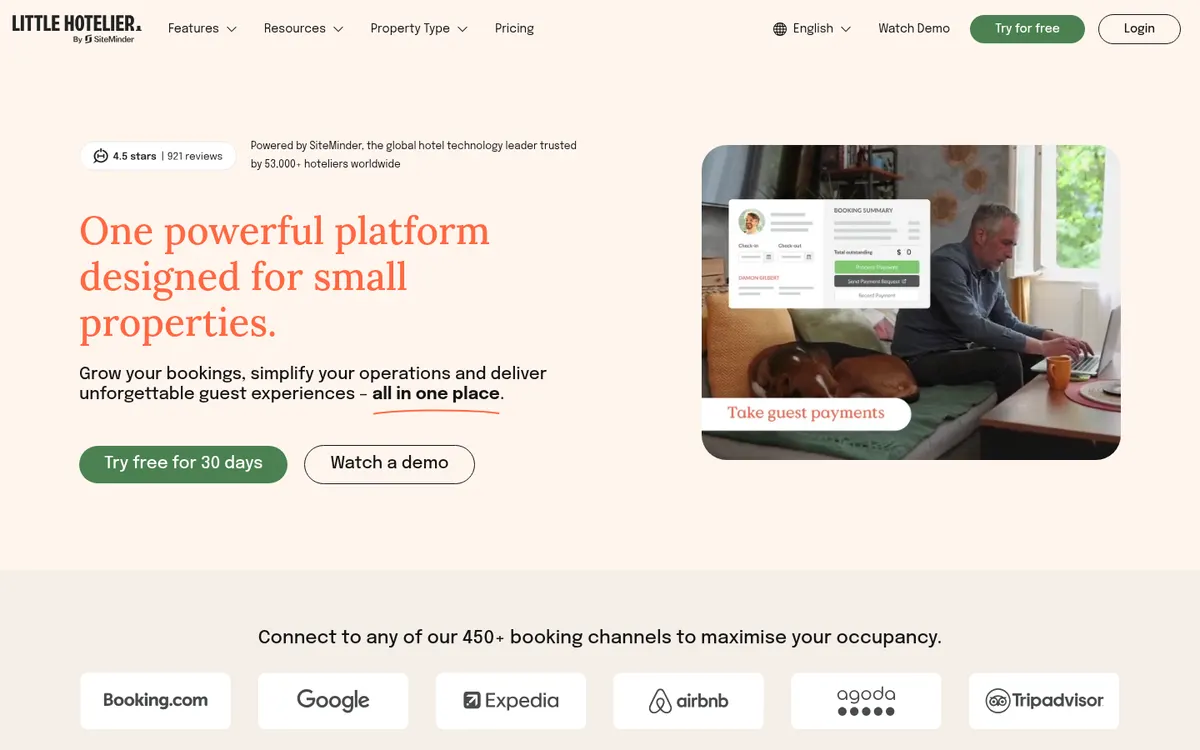
Little Hotelier
Best for small inns wanting an easy all-in-one from SiteMinder
Our verdict
The simplest all-in-one here for a small inn, with a real published price, a 30-day trial and SiteMinder's OTA reach.
Little Hotelier is the small-property product from SiteMinder, and it is the easiest all-in-one here to price. The Pro plan is $179 per month, excluding tax, with three months free, and there is a 30-day free trial so you can run your own rooms through it before paying. Pricing is set by room count, which keeps the entry point modest for a five-room inn but means the number moves as you add rooms.
The product covers a PMS, booking engine, channel manager and reservation management. The channel manager draws on SiteMinder's 300-plus OTA connections, a broad OTA network and the main reason a small inn would pick it over a cheaper calendar. Assisted setup is included and pitched at owners without a tech background, so rate plans and room types get configured with help rather than from a help article.
What you do not get is guest marketing. There are no built-in email campaigns, so review requests, seasonal offers and repeat-guest mailings need another tool and a mailing list you own. Reporting is basic on the lower tiers, and phone support is only on the higher tiers, which is a real consideration for a property with no front-desk IT person and no patience for ticket queues.
Distribution, not marketing, is the point of this product. If your problem is double bookings and OTA admin, it solves that quickly and at a price you can see in advance. If your problem is filling rooms in the shoulder season, you will still need a mailing list and a plan. Test reporting depth on the tier you can afford before you sign.
What works
- Published $179 monthly price
- 300-plus OTA connections through SiteMinder
- 30-day free trial
What to weigh
- No built-in email campaigns
- Reporting is basic on lower tiers
- Phone support only on higher tiers
Pick it if
Your main pain is OTA admin and double bookings and you want a price you can see up front.
Skip it if
Seasonal email campaigns and deep reporting are central to how you fill rooms.
Plate 04 of 09
Cloudbeds
Best for B&Bs and boutique properties planning to grow their channel mix
Our verdict
A broad platform with excellent channel reach, best for properties that expect to add channels and integrations over time.
Cloudbeds is the broadest platform in this list, and that breadth is both the pitch and the problem. It covers PMS, channel manager, a commission-free booking engine, payment processing and reporting, with a 400-plus integration marketplace behind it. A B&B with five rooms will use only a fraction of that. A boutique property adding distribution, payments and reporting across several buildings will use a lot more.
Payments and reporting are included on every plan, which is not universal at this level, and the commission-free booking engine means direct bookings do not carry a platform commission. Tiered plans are meant to scale with property size, so you can start narrow and add modules as the channel mix grows. The integration marketplace is large, useful if you already run a specific point of sale, accounting package or revenue tool that has to talk to the calendar.
Pricing is quote only. Every tier shows a request-a-quote path, so there is no price list to budget against and no way to compare tiers without a sales call. There is also no self-serve trial, so evaluation runs through a demo with a salesperson who has to be told your room count, your channel mix and your payment setup before the number means anything.
For a small inn, feature depth can overwhelm. Expect a setup project and a learning curve before the calendar feels natural, and expect to switch off modules you never asked for. For a property that expects to add channels, payment options and integrations over two or three years, that same depth is the reason to buy. Go in with a written quote and a short list of modules you actually need.
What works
- 400-plus integration marketplace
- Commission-free booking engine
- Payments and reporting on every plan
What to weigh
- No published prices on any tier
- No self-serve trial
- Feature depth can overwhelm a small inn
Pick it if
You plan to grow your channel mix and need integrations with other systems.
Skip it if
You run five rooms and want a price and a working calendar in the same week.
Plate 05 of 09
WebRezPro
Best for independent properties wanting one flat, published price
Our verdict
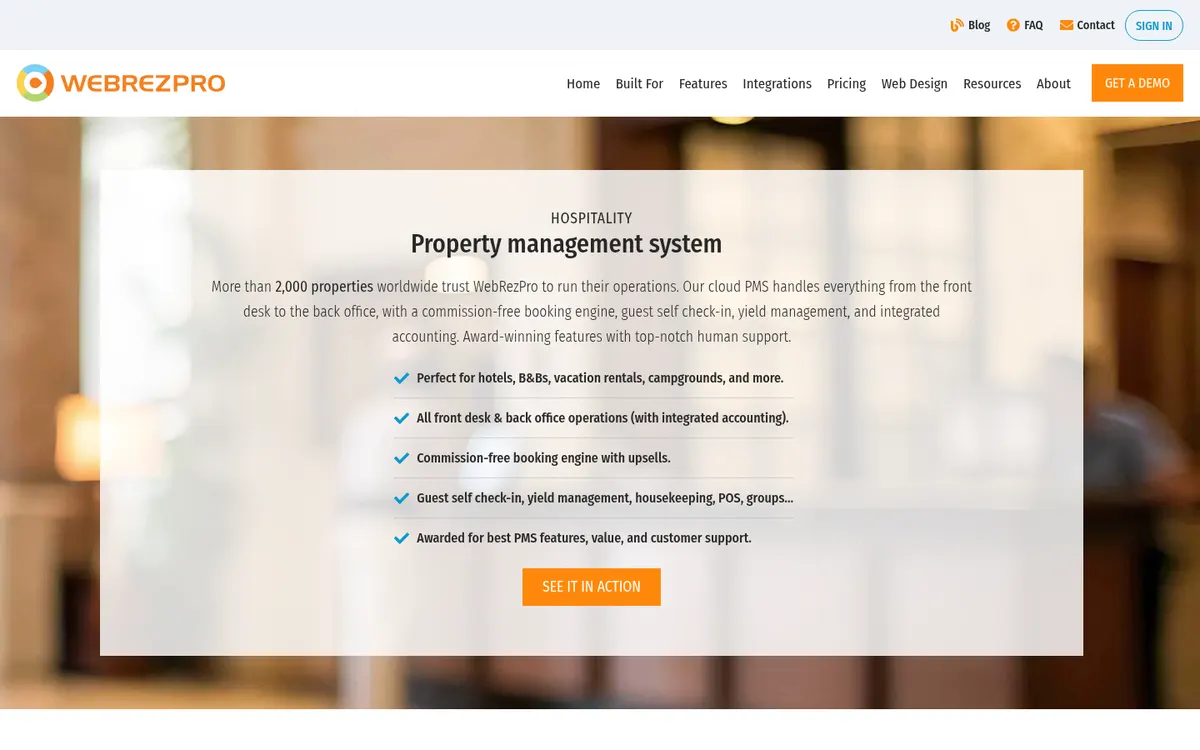
The pick for owners who want a published flat price, unlimited users and no commission on direct bookings.
WebRezPro is the pick for owners who are tired of quote-only pricing. It publishes $10 per unit per month with a $100 monthly minimum, charges no setup fee, and you can cancel on 30 days notice. There are no per-seat charges and unlimited users are included, so seasonal staff and a co-owner do not add to the bill as the team grows.
The feature set fits an independent property: PMS, booking engine, housekeeping, group management, gift vouchers and integrated accounting. No commission is taken on direct website bookings, so a booking made through your own site costs nothing beyond the subscription. A dedicated account manager and onboarding specialist are included, and phone and email support are complimentary rather than a paid add-on tier.
The pricing structure has a clear downside. The $100 minimum means a very small inn pays the same as a property with ten units, which is steep against per-room competitors at the low end. Above ten units the per-unit rate starts to look reasonable: a fifteen-room property paying $150 per month gets unlimited users and no direct-booking commission for that figure, which is easy to model before you call anyone.
The interface is mature and looks dated next to newer platforms. Expect a functional, form-driven design rather than a modern dashboard, and budget a few days for the team to adjust. Nothing about that affects the accounting, channel sync or guest records. If you value a published price, a plain contract and unlimited users over visual polish, this is the most predictable option in the list.
What works
- Transparent $10 per unit with a $100 minimum
- Unlimited users at no extra cost
- No commission on direct website bookings
What to weigh
- $100 minimum is steep for a very small inn
- Interface looks dated next to newer platforms
Pick it if
You want a published flat price, unlimited users and a short notice period.
Skip it if
You run three rooms and per-room pricing would cost you far less.
Plate 06 of 09
Sirvoy
Best for solo hosts and tiny B&Bs testing software for the first time
Our verdict
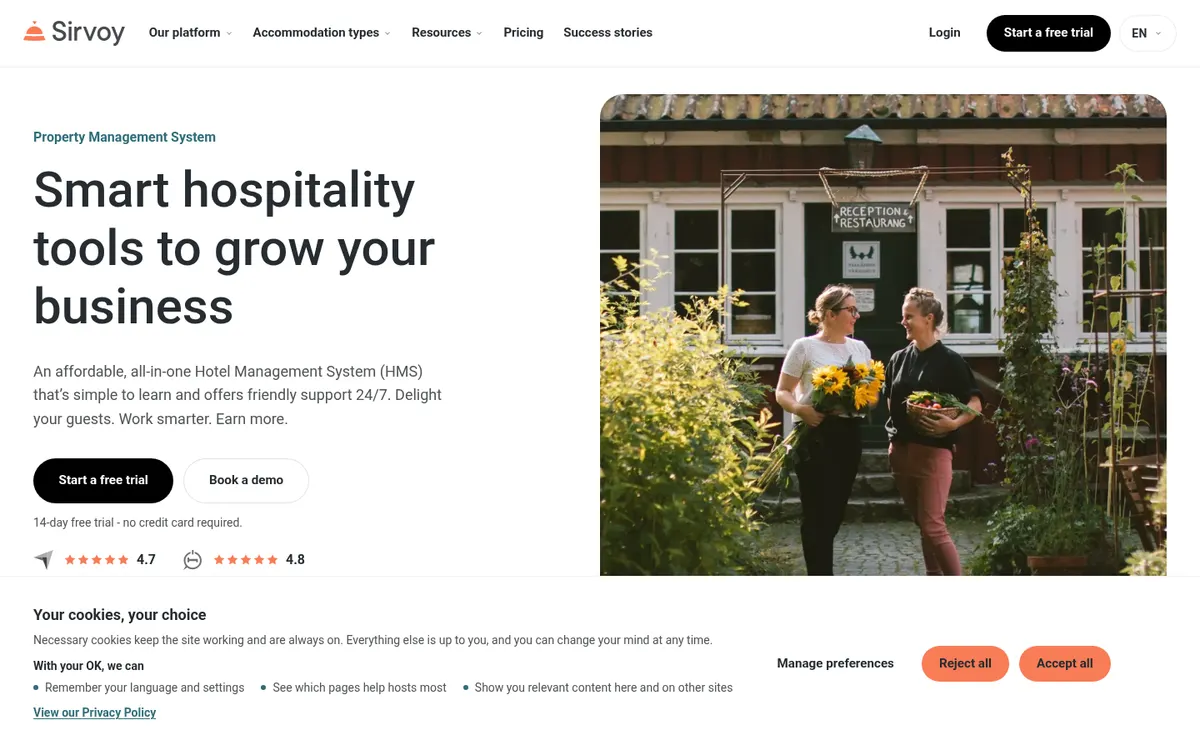
The cheapest credible start for a one-room host, with a free tier and a no-card trial before you commit.
Sirvoy is the lowest credible entry point in this list. The Starter plan starts at €11 per month billed yearly, and there is a free tier for one unit, so a host with a single rental can use the calendar and booking engine without paying anything. A 14-day free trial with no credit card covers the paid plans and takes minutes to start.
The product is a booking engine, calendar, rate management, guest details, payments, housekeeping and a channel manager that connects to Booking.com, Airbnb and Expedia. There are no setup fees and no contracts, so leaving is straightforward and the risk of trying it is close to zero. For a host moving off spreadsheets, that combination covers the essentials in an afternoon rather than a month, and the interface does not assume you have run hotel software before.
Pricing scales by room count, so the entry rate is not the rate you will pay at ten rooms. Advanced revenue controls for seasonal pricing and packages are limited, which shows up when you try to build multi-night minimums or package rules across dates. The integration list is short at 21, so a point of sale, accounting tool or CRM you already use may not connect, and each one is worth checking before you commit a season.
This is a first purchase, not a forever platform. A single-room host or a tiny B&B testing whether software is worth it gets a real product for almost nothing. A property with eight rooms, seasonal rates and package pricing will outgrow it, and moving later means exporting guest history and rebuilding rate plans somewhere else.
What works
- €11 per month entry price with a free tier
- No setup fees and no contract
- 14-day trial without a credit card
What to weigh
- Limited seasonal pricing and package controls
- Only 21 integrations
- Room-based scaling raises costs as you grow
Pick it if
You have one to three rooms and want to test real software without a contract.
Skip it if
You need complex seasonal packages or connections to specific back-office tools.
Plate 07 of 09
Hotelogix
Best for small properties wanting a full PMS at a budget per-room price
Our verdict
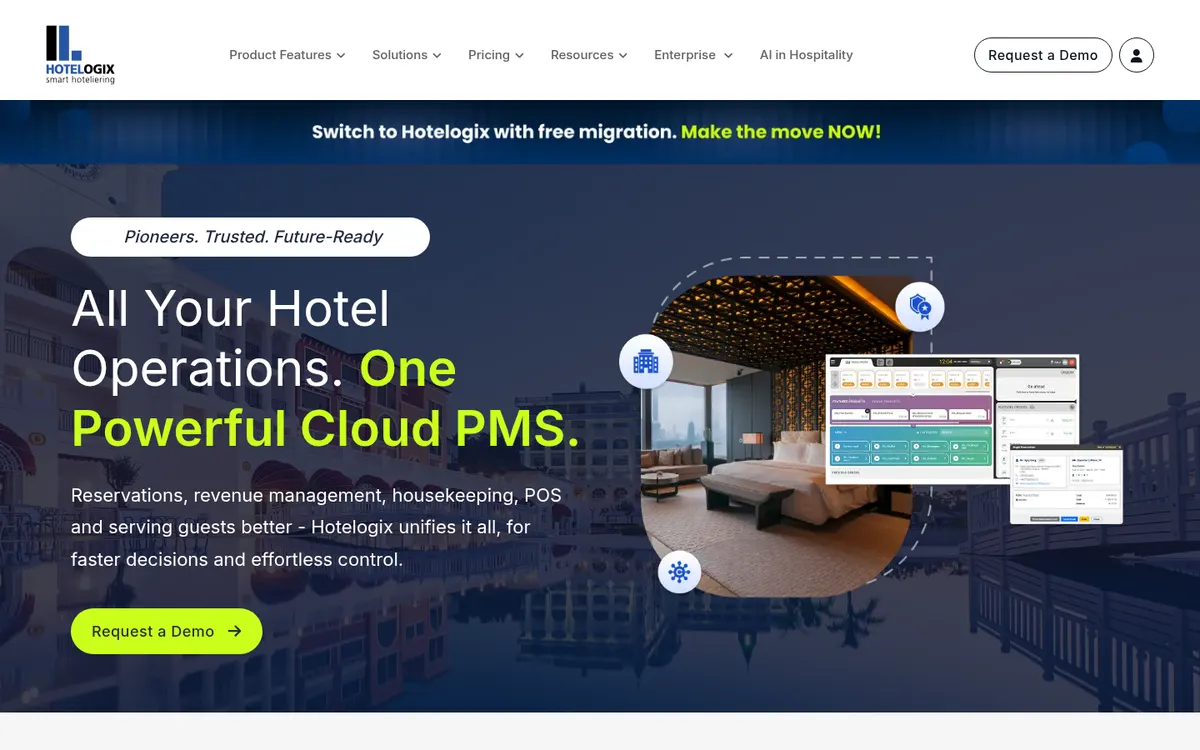
A budget cloud PMS with mobile apps and multi-currency support, held back by quote-only pricing and thin integrations.
Hotelogix is a cloud PMS built for small properties, with front desk, channel manager, booking engine, mobile apps, multi-language and multi-currency support. The mobile apps are the practical differentiator: an owner can check arrivals, adjust rates and see occupancy from a phone, which suits a property without a staffed desk overnight or a manager who lives off-site.
Multi-currency and multi-language support matter more than they sound for a B&B taking international direct bookings, and both are included rather than sold as an add-on. The channel manager and booking engine cover the basics of distribution, and the front desk module handles the arrival, billing and departure cycle a small property actually runs. The integration list is thin, so a specialised point of sale, accounting or CRM stack may not connect, and each one is worth confirming in writing before you sign anything.
Pricing is not published. There is no public price list and no self-serve trial, so evaluation requires a sales conversation and a demo. Without a published figure, there is nothing to compare against the flat rates from WebRezPro or the $179 from Little Hotelier until you have a written quote in hand at your own room count, with the contract term stated.
Support response times are flagged as slow, which is worth testing during the demo by asking how a weekend outage is handled and who answers. The value case rests on a per-room quote, so ask for a quote at your actual room count, confirm the term, and get the answer on support hours in writing before you migrate a live calendar.
What works
- Mobile apps for managing the property remotely
- Multi-language and multi-currency support
- Front desk, channel manager and booking engine together
What to weigh
- No published pricing
- No self-serve trial
- Thin integration list and slow support reported
Pick it if
You want a per-room quote and need multi-currency support plus mobile management.
Skip it if
You want to see a price and run a trial without a sales cycle.
Plate 08 of 09
RoomKeyPMS
Best for independent hotels and larger B&Bs wanting guided, contract-based setup
Our verdict
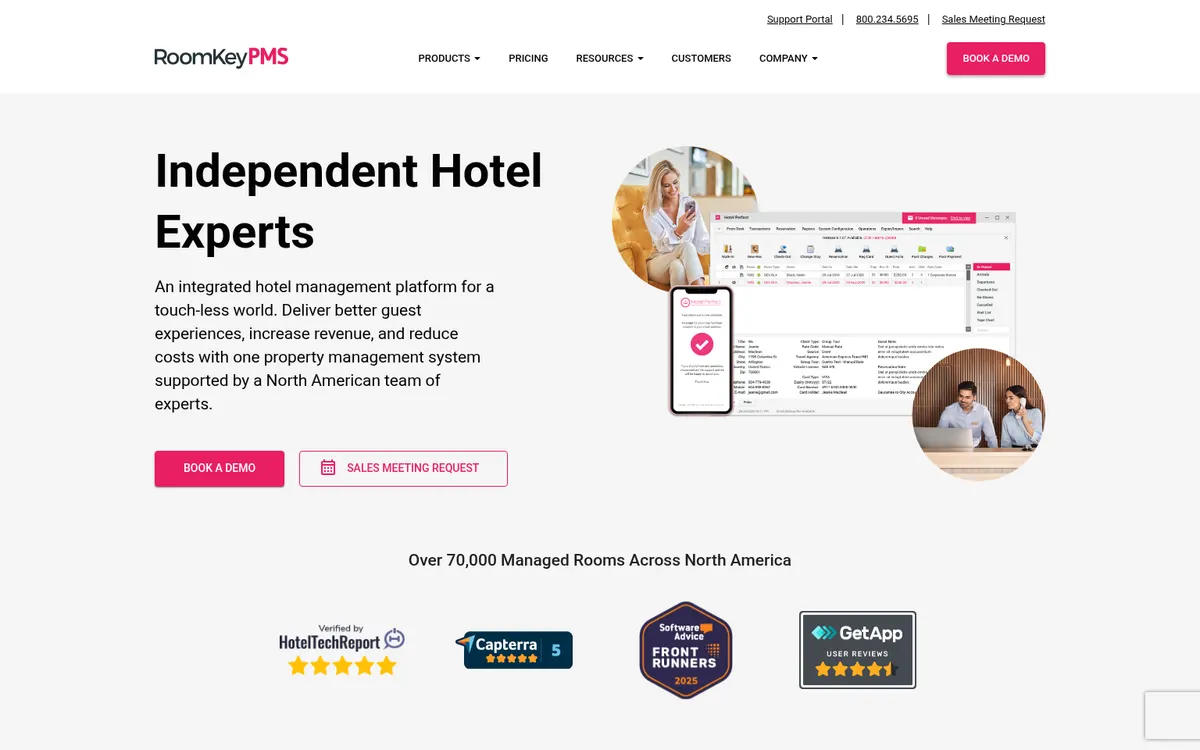
A guided, contract-based PMS for independent hotels and larger inns that want onboarding help rather than self-serve signup.
RoomKeyPMS is a cloud PMS aimed at independent hotels and larger B&Bs, with front desk operations, reservations, housekeeping, billing and guest messaging. The booking engine is mobile-optimized, which matters because a growing share of direct bookings start on a phone and a desktop-only engine loses those guests quietly at the payment step.
The vendor's approach is guided rather than self-serve: a demo and onboarding with a team, not a signup form and a knowledge base. For an owner replacing a system mid-season, that support is worth paying for, because rate plans, tax rules and channel mappings all have to be rebuilt. For a technically confident host who wants to configure alone on a Sunday, it is friction. A team of hoteliers sits behind the product, which shows in the workflow design around arrivals and departures.
Pricing is quote-based with no public price list, so any per-room figure you see quoted elsewhere is unverified and only a planning proxy. Treat it as a range to test, not a budget line, and ask for the quote at two room counts so you can see how the rate steps. There is no self-serve trial, so evaluation happens through the demo and whatever sandbox the vendor will open for you.
Two things to check in the demo. First, whether the depth fits your property: this can feel heavy for a very small B&B with four rooms and one person on reception. Second, platform support on Mac and mobile, where occasional limitations are reported. If you run a larger inn with staff and want hand-held setup, both are manageable. If you are a two-room host, they are reasons to look at Sirvoy.
What works
- Guided demo and onboarding
- Guest messaging included
- Mobile-optimized booking engine
What to weigh
- Quote-based pricing with no self-serve trial
- Can feel heavy for very small properties
- Occasional Mac and mobile limitations reported
Pick it if
You run a larger inn and want onboarding help to rebuild rates and channels.
Skip it if
You have four rooms and want a price and a trial today.
Plate 09 of 09
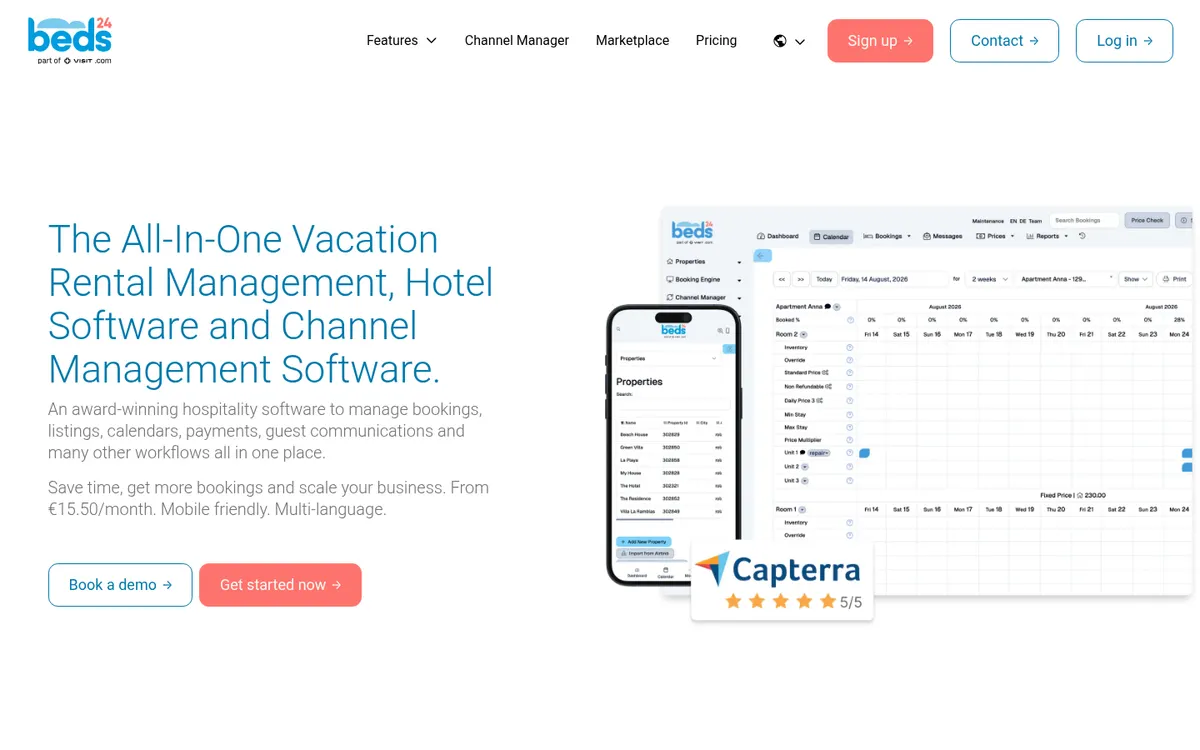
Beds24
Best for hands-on owners wanting pay-as-you-go with no contract or commissions
Our verdict
A pay-as-you-go channel manager for hands-on owners who want broad OTA coverage with no commissions or contracts.
Beds24 is a channel manager and booking system sold on a pay-as-you-go basis. There are no contracts and no booking commissions; instead you top up an account balance and it is consumed as you use the system. Billing is in euros. For an owner who resents a monthly subscription through the quiet months, that model is genuinely different from everything else in this list.
Channel coverage is broad, including the major OTAs, and channel mapping and rate plan configuration are exposed rather than hidden behind defaults. Deep customization is the selling point: you can build rate structures and mappings that simpler tools will not allow, including per-channel rules and derived rates. A free trial exists, though its length is not published, so confirm the term before you start configuring anything you would have to rebuild.
The cost of that flexibility is that you must know what you are doing. The interface assumes hospitality software knowledge, and there is no one designing your rate plans for you. Usage-based billing is also harder to budget than a flat fee, because the bill follows your volume and mapping changes rather than a fixed room count, and a busy month costs more than a quiet one.
For a hands-on owner with a few rooms and steady OTA volume, the combination of no commission and no contract is attractive, and the channel coverage will match platforms charging far more. For anyone who wants a published monthly number and a vendor who sets things up, this is the wrong end of the market. Read the balance and top-up mechanics carefully before you commit a season to it.
What works
- No contracts and no booking commissions
- Broad OTA channel coverage
- Deep rate and mapping customization
What to weigh
- Usage-based billing is harder to budget
- Interface assumes hospitality software knowledge
Pick it if
You are comfortable configuring channels yourself and want no commission or contract.
Skip it if
You want a fixed monthly price and a vendor who builds the setup for you.
What does bed and breakfast software actually do?
A bed and breakfast software stack is the set of tools that takes a room from availability to a settled bill. In a small property the same system usually does four jobs: it holds the reservation calendar, it sells rooms through your own website, it keeps availability accurate across the OTAs, and it records the guest so the next stay is easier to sell.
The core piece is the property management system, or PMS, which is the calendar plus guest records plus billing. Around it sit three optional but common parts: a booking engine that quotes and takes payment on your own site, a channel manager that pushes rates and availability to Booking.com, Expedia, Airbnb and others, and guest marketing tools that handle confirmations, pre-arrival messages and review requests.
Three patterns show up across the vendors here:
- All-in-one suites bundle a website, PMS and email marketing, usually at a custom quote.
- Distribution-first tools lead with the channel manager and booking engine and treat marketing as someone else's job.
- Lightweight subscriptions give a tiny property a calendar and booking engine for a low monthly fee, with fewer controls.
Two rules of thumb help. A channel manager is worth paying for once you list on two or more OTAs, because manual calendar updates are how double bookings happen. Guest marketing is worth paying for once repeat and direct bookings are a meaningful share of revenue, because the OTA commission on the same room usually costs more than the software does.
Most B&Bs run two or three products rather than one. The common split is a PMS with a booking engine, a channel manager if the PMS does not include one, and a separate email tool. Buying one suite that covers all three reduces logins and support calls, but it often gets expensive at the low end, where a four-room inn pays for modules built for forty rooms.
Whatever you choose, keep the guest list portable. Export rights, data formats and notice periods matter more than most feature comparisons, because the cost of leaving a vendor is the real lock-in.
This guide sits in the Software collection. Buyers weighing nearby tools often read the guides to commission software and research platforms next.
How pricing works for bed and breakfast software
Pricing in this category follows a handful of models, and only a few of them give you a number before you talk to sales.
The published models are the easiest to plan around. WebRezPro publishes $10 per unit per month with a $100 monthly minimum and no setup fee. Little Hotelier publishes $179 per month on the Pro plan, excluding tax, with three months free and a 30-day trial. Sirvoy publishes €11 per month on Starter billed yearly, with a free tier for one unit. Everything else here runs on a quote or a prepaid balance.
Quotes are where budgets go wrong. A custom quote usually depends on unit count, seasonality and the modules you take, which means the same product can cost very different amounts at a five-room inn and a fifteen-room inn. Ask for the quote in writing with the contract term and the notice period stated, then compare two room counts to see how the rate steps.
| Model | How it bills | Typical fit | Example from this list |
|---|---|---|---|
| Flat rate with minimum | $10 per unit per month, $100 monthly minimum | Owners who want a predictable bill | WebRezPro |
| Room-count subscription | $179 per month on Pro, excludes tax | Small inns wanting an all-in-one | Little Hotelier |
| Yearly subscription with free tier | €11 per month billed yearly, free tier for one unit | Solo hosts and tiny properties | Sirvoy |
| Custom quote | Quoted per property, by unit count and seasonality | Inns buying a website and PMS bundle | ResNexus, ThinkReservations, Cloudbeds |
| Per-room quote, unpublished | Quoted per room per month | Budget PMS buyers | Hotelogix, RoomKeyPMS |
| Usage-based balance | Prepaid account balance in euros, no contract | Hands-on owners with variable volume | Beds24 |
Two other costs sit outside the subscription: setup, which some vendors waive, and the commission you pay on OTA bookings, which no PMS removes. Check whether direct bookings carry a commission too, since WebRezPro and Cloudbeds both advertise none on their own booking engines.
Every price in this guide was read on the vendor's own pricing page on November 25, 2026. Where a vendor does not publish a figure we could confirm, the card says "See website" rather than a guess. For the arithmetic around this purchase, try the free Email campaign metrics calculator.
How do you choose a B&B system in one afternoon?
Count what you actually sell. List rooms, units and packages, then note how many OTAs you list on and how many bookings arrive by phone or walk-in. Those numbers decide whether you need a channel manager at all.
Anchor a budget on the published prices. Use $179 per month for Little Hotelier, $100 minimum for WebRezPro and €11 for Sirvoy as reference points, then ask the quote-only vendors to beat them at your room count.
Book three demos, not one. Run the same scenario in each: a two-night weekend booking with an add-on and a cancellation. Count the clicks and ask what the trial covers before you commit to a migration date.
Check the guest data terms. Ask for the export format, whether history and notes come with it, and what notice period applies. Get the answer in writing before you sign, not after.
Test channel sync on one OTA first. Map a single low-risk channel, watch it for a week, and only then widen to the rest. Double bookings in month one are the usual migration failure.
Decide on marketing separately. If review requests and repeat-guest email matter, confirm the suite includes them or budget for a separate email tool and a list you own.
Mistakes to avoid when buying B&B software
Buying a channel manager you do not need. If you list on one OTA and take most bookings by phone, a clean calendar and booking engine will do. Add distribution when a second channel appears.
Budgeting from a headline rate. Room-count pricing and per-unit minimums move the number. A €11 Starter plan at one unit is not the price at ten rooms, so ask for a quote at your own count.
Assuming the website is included. Some suites design and host the site; others only supply a booking engine you embed. Confirm who owns the domain and the page content before you sign.
Skipping the data export question. Guest history and notes are the hardest thing to rebuild elsewhere. Ask for the export format and notice period in writing rather than on a call.
Migrating in peak season. A move takes weeks of rate rebuilding and channel remapping. Schedule it for a quiet month and keep the old system readable until the first month of bookings settles.
Best Bed and Breakfast Software 2026: questions
When does a small B&B need a channel manager?
A small B&B needs a channel manager once it lists on two or more OTAs, because manual calendar updates are how double bookings happen. With one channel and mostly direct bookings, a booking engine and calendar are enough to start. Sirvoy, Little Hotelier and Beds24 all include a channel manager rather than selling it as a separate product.
What does B&B software cost for a property with 5 to 15 rooms?
Expect a wide spread. The published anchors are $179 per month on Little Hotelier's Pro plan excluding tax, and a $100 monthly minimum with WebRezPro at $10 per unit. Sirvoy starts at €11 per month billed yearly and scales by room count. Quote-only vendors need a demo, so ask for written figures at your own room count before comparing.
How do I handle phone, walk-in and repeat reservations in one system?
Enter every booking in the PMS calendar rather than on paper, so availability stays true across channels. Most systems here let staff create a reservation at the desk and take payment there, and guest records carry history for repeat stays. Ask in the demo how fast a walk-in can be entered, and time it.
Which B&B software offers a free plan or a free trial?
Sirvoy has a free tier for one unit plus a 14-day trial with no credit card. Little Hotelier offers a 30-day free trial. Beds24 has a free trial of unpublished length, so confirm the term. ThinkReservations, ResNexus, Cloudbeds, WebRezPro, Hotelogix and RoomKeyPMS run demos only, with no self-serve trial.
Is website design included in B&B software?
Sometimes. ResNexus includes done-for-you website design in its bundle, and ThinkReservations pairs its reservation system with a branded website. Most others supply a booking engine you embed in a site you own and host elsewhere. Confirm who owns the domain and the page content before you sign anything.
How do I export guest data if I leave a vendor?
Ask before you sign, not after. Request the export format, whether guest history and notes come with it, and the notice period on the contract. WebRezPro runs on 30 days notice, ResNexus states no long-term contract, and Sirvoy has no contract, so those are the easier exits to plan.