
Contents of this guide
The shortlist
Our top 3 for software buyers

Kyriba
Enterprise cash positioning
- Best for
- Large enterprises with dedicated treasury teams
- Features
- 4 noted: Cash positioning, SWIFT connectivity, Fraud controls, FX module

Trovata
Multi-bank normalization
- Best for
- Mid-market to enterprise teams managing cash across multiple banks
- Features
- 4 noted: Multi-bank feeds, Unlimited users, ERP sync, AI alerts

Tesorio
Receivables automation
- Best for
- Mid-market B2B firms with heavy invoice volume and collections teams
- Features
- 3 noted: Collections AI, Cash application, AR forecasting
Disclosure for this guide. All 9 tools here are unpaid editorial picks. The position of a paid listing can be part of what the vendor pays for. Paid and unpaid tools are scored on the same rubric and keep their cons. Details are in the advertising disclosure.
The ledger
Index of every tool
| Tool | Free plan | Trial | Rubric | Compare | ||
|---|---|---|---|---|---|---|
| 01 | KyribaLarge enterprises with dedicated treasury teams | See websiteNot published | No | No | ||
| 02 | TrovataMid-market to enterprise teams managing cash across multiple banks | See websiteNot published | Not specified (see website) | See website | ||
| 03 | TesorioMid-market B2B firms with heavy invoice volume and collections teams | See websiteNot published | No | No | ||
| 04 |  FloatSMBs and growing companies on Xero or QuickBooks Online | £99Small Business, per month, Growth is £199 per month and Scale £295 per month billed monthlyChecked Nov 25, 2026 | No free plan; 14-day free trial | 14-day free trial, no credit card required | ||
| 05 |  PulseFreelancers and micro-businesses wanting a simple cash view | $29Pulse Basics, per monthChecked Nov 25, 2026 | No free plan; 30-day free trial | 30-day free trial, credit card required at signup | ||
| 06 |  DryrunMid-market finance teams and fractional CFOs wanting manual forecast control | See websiteNot published | No free plan; 14-day free trial | 14-day free trial, no credit card required | ||
| 07 |  AgicapEuropean SMBs and mid-market firms with several bank accounts | See websitecustom quoteCustom quote | No free plan; expert-guided trial | Expert-guided trial lasting a few days | ||
| 08 |  CentimeUS mid-market companies wanting AP/AR automation with forecasting built in | See websiteNot published | No | No | ||
| 09 |  ObolGrowth-stage companies and fractional CFO or advisory firms | See websiteNot published | No | No |
Prices are the lowest paid plan the vendor shows, read on November 25, 2026. Sort by price ranks published monthly figures; tools without one go last. Pin up to three tools to compare them side by side.
How this guide was put together
Every tool was scored against the same five criteria and the weights are shown above so you can re-weight them for your own situation. Cash positioning and forecast depth carry half the total because that is the work buyers do every week. Bank connectivity covers direct APIs, open banking, SWIFT, sFTP and statement imports, since a tool that cannot reach your accounts is a spreadsheet with a nicer chart. Pricing clarity rewards published rates and marks down quote-only cycles. Implementation fit asks whether the vendor's stated customer size and rollout model match the tool's actual weight.
Prices come from vendor pricing pages and were checked on November 25, 2026. Where a vendor publishes no rate, the entry says so and no number is estimated. Two entries changed at that check: Float now quotes pounds sterling starting at £99 per month, and Pulse lists a $29 per month entry plan. Where an earlier figure could not be re-verified, we say that rather than repeat it.
The order is editorial. Each position reflects fit for the specific buyer described in that entry, not a weighted total. Featured placements, where they appear, are paid, and a Featured vendor is scored with the identical rubric and carries the same kind of cons as every other entry. Recheck every commercial term with the vendor before you sign, because quote-based pricing changes with bank count, entity count and module selection.
The full process, including how we handle corrections, is on the methodology page. Paid listings follow the advertising disclosure.
Rubric and weights
Every tool below is scored from 1 to 10 on these five criteria. The scores describe each tool; the order is an editorial call on fit for the buyer each card describes, plus the disclosed Featured position.
- 25%Cash positioningHow completely the tool shows balances across banks, entities and currencies in real time.
- 25%Forecast depthWhether the tool builds usable projections from your own data, with scenarios and timing assumptions.
- 20%Bank connectivityCoverage and speed of direct APIs, open banking, SWIFT, sFTP feeds or statement imports.
- 15%Pricing clarityWhether rates are published, what drives the bill, and how much sales process stands between you and a number.
- 15%Implementation fitHow well the rollout effort and the vendor's target customer size match the buyer described.
Plate 01 of 09
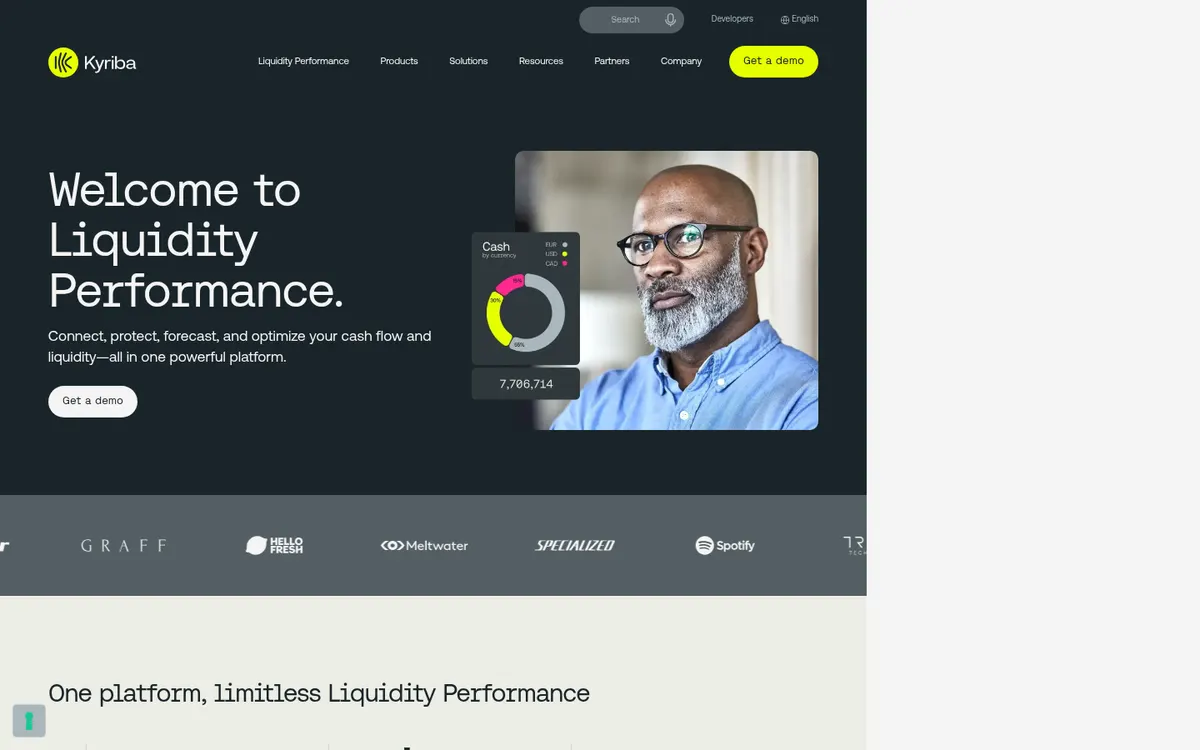
Kyriba
Best for large enterprises with dedicated treasury teams
Our verdict
The deepest treasury suite here, real value for a large treasury team and too heavy for everyone else.
Kyriba is a full treasury suite rather than a cash-flow app, and it is priced and staffed accordingly. The core is real-time cash positioning across banks, entities and currencies, with payments automation and payment fraud controls sitting on the same data. FX and investment management are separate modules, as is bank relationship and account management. Connectivity runs through SWIFT and APIs, and Kyriba runs the bank onboarding work itself, which is the part most finance teams underestimate when they compare quotes.
The strength is consolidation. One platform replaces several treasury point tools, and it holds up in structures with many entities and currencies where a spreadsheet breaks at the first intercompany transfer. AI-driven automation is applied across treasury workflows.
The cost side is real. Kyriba publishes no pricing page and offers no trial, so you cannot evaluate it without a sales process. Implementations run from several weeks to months, and the vendor sells modular quote-based contracts with add-ons on annual terms. It suits organizations around 1,000 employees and up, where treasury is its own department with its own headcount. For a 50-person company with three bank accounts, the suite carries modules you will never switch on.
Prices here are unverified. No pricing page was available on the 25 November 2026 check, so the record could not be confirmed. Budget for a services-led rollout, get the module list and the services scope in writing, and reconfirm commercial terms directly with the vendor before signing. Ask which modules sit in the base quote and which are add-ons, because that split drives the annual figure.
What works
- Replaces several treasury point tools
- Handles multi-currency, multi-entity structures
- Vendor runs the bank onboarding
What to weigh
- No published pricing and no trial
- Rollouts take weeks to months
- Too heavy and costly for small firms
Pick it if
You run a large multi-entity treasury function that needs positioning, payments and FX controls in one contract.
Skip it if
You need a cash view this month and have no appetite for a services-led implementation.
Plate 02 of 09
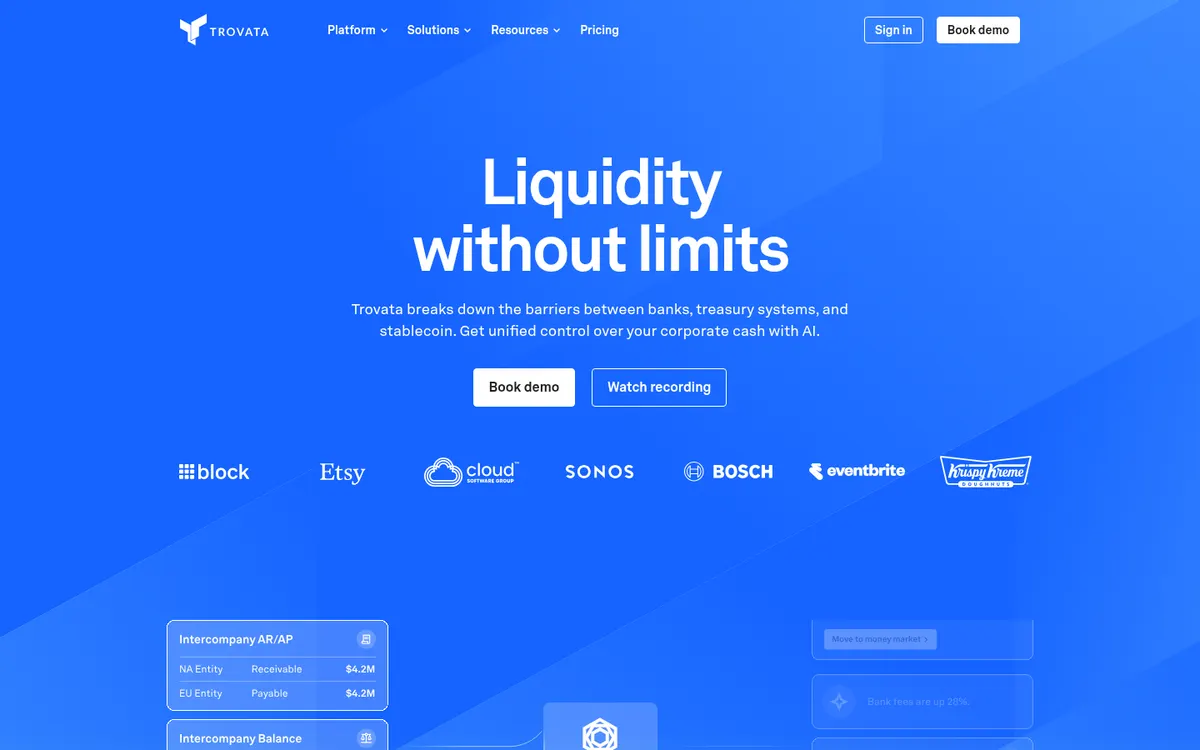
Trovata
Best for mid-market to enterprise teams managing cash across multiple banks
Our verdict
The pragmatic multi-bank cash view for mid-market teams that want connectivity without building a treasury department.
Trovata sits between a spreadsheet and a treasury suite, and it earns that spot with connectivity. It pulls bank data through direct APIs, SWIFT and sFTP, normalizes the formats and puts every account into one cash view. Setup does not need IT involvement, which is unusual at this level. The base package includes one bank connection and storage for up to one million transactions, and there is no user limit on accounts, so a widely shared finance team does not pay per seat.
On top of the cash view there are AI agents for variance analysis and anomaly alerts, plus native ERP integrations with NetSuite, Sage Intacct, Oracle Fusion and SAP. Keeping ERP records synchronized with bank activity is the practical benefit: reconciliation starts from a smaller gap. Optional enterprise treasury management modules extend it toward full treasury territory.
Limits are mostly commercial. Pricing is not public and rises with connection count and modules, so the quote depends on how many banks you actually run. Bank onboarding still takes a few weeks even though it does not consume IT time. The base plan covers one bank connection, which is thin for a firm that opened accounts at four institutions during its growth years.
No pricing page was available on the 25 November 2026 check, so nothing could be confirmed. Confirm per-connection costs and module add-ons before a pilot converts to a paid term, and ask what happens to transaction storage once you pass the first million. Ask too whether the connection fee is charged once per bank or once per account, since that changes the annual figure materially.
What works
- Bank setup without IT involvement
- No per-user limit on accounts
- ERP stays in sync with bank data
What to weigh
- Pricing rises with each connection
- Bank onboarding takes a few weeks
- Base plan covers one bank only
Pick it if
You manage cash across several banks and want one normalized view without a full treasury rollout.
Skip it if
You need payments execution or your bank list runs past what the quote covers.
Plate 03 of 09
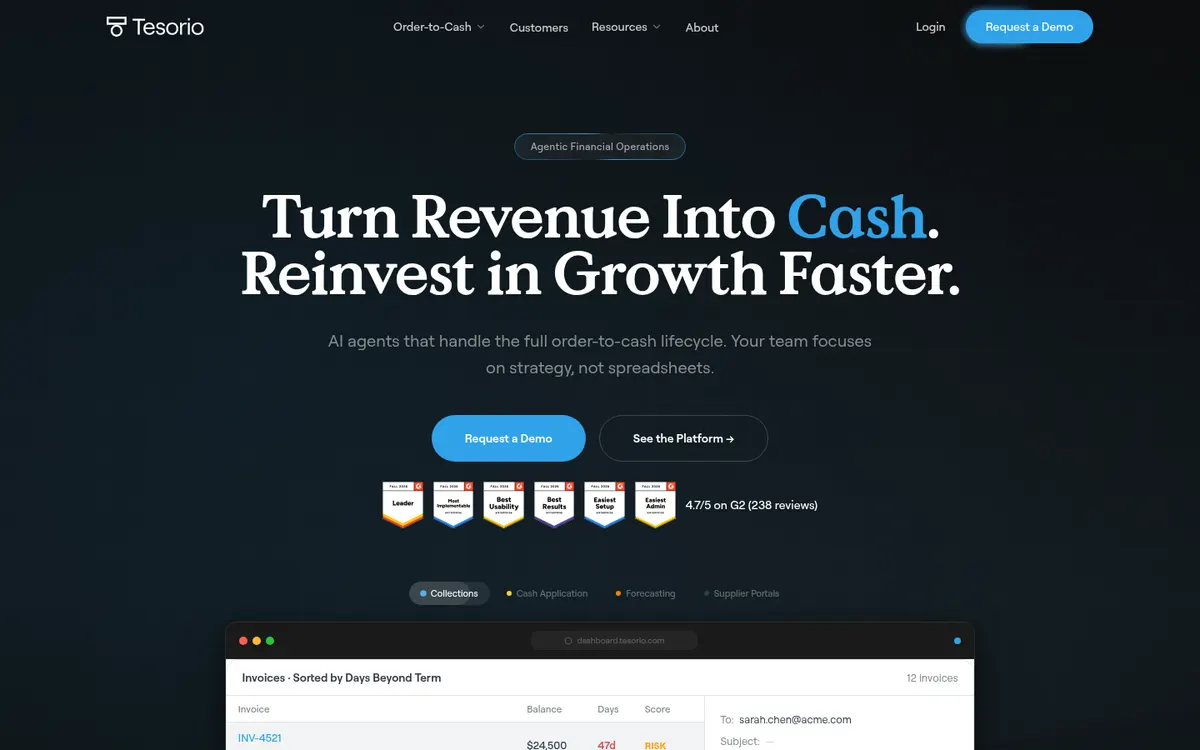
Tesorio
Best for mid-market B2B firms with heavy invoice volume and collections teams
Our verdict
A collections engine with forecasting attached: buy it for late payments, not for bank-wide cash positioning.
Tesorio solves a specific cash problem: customers who pay late. It is accounts receivable software with forecasting attached, not a treasury platform. The collections workflow ranks outreach so the team works the invoices most likely to move, AI agents handle dunning and follow-ups, and automated cash application posts payments against the right invoice, with the vendor citing auto-match rates above 95 percent. Order-to-cash reporting and collections analytics come with it.
The forecasting module feeds receivables into a cash view, which is genuinely useful for a B2B firm where cash is stuck in the receivables ledger rather than in the bank account. What it does not do is position cash across all your banks. There is no bank-wide cash positioning, no FX, and no payments execution. If your constraint is collections, that trade-off is fine. If your constraint is knowing what is where on a Monday morning, this is the wrong tool.
Controls are decent for a finance tool: SOC 1 and SOC 2 compliance with audit trails, and tiered packaging across Team, Business and Enterprise. Buying is sales-led, with custom quotes and an enterprise-style cycle that assumes a procurement process. There is no free plan and no trial, so evaluation happens inside the sales conversation. Ask about implementation scope and how the cash application rules are configured.
No pricing page was available on the 25 November 2026 check, so no figure could be confirmed. Ask what the auto-match rate depends on (invoice volume, customer naming conventions, payment formats) and get the implementation scope in writing before the pilot. Confirm too how the tool handles partial payments and short pays, which are where matching rules usually fail.
What works
- Targets late customer payments
- Automation reduces days sales outstanding
- Audit trails and SOC coverage
What to weigh
- No bank-wide cash positioning
- No FX or payment execution
- Quote-only, enterprise-length sales cycle
Pick it if
Your cash problem is customers paying 60 days late and you want collections work prioritized automatically.
Skip it if
You need balances across six banks or any form of payments execution.
Plate 04 of 09
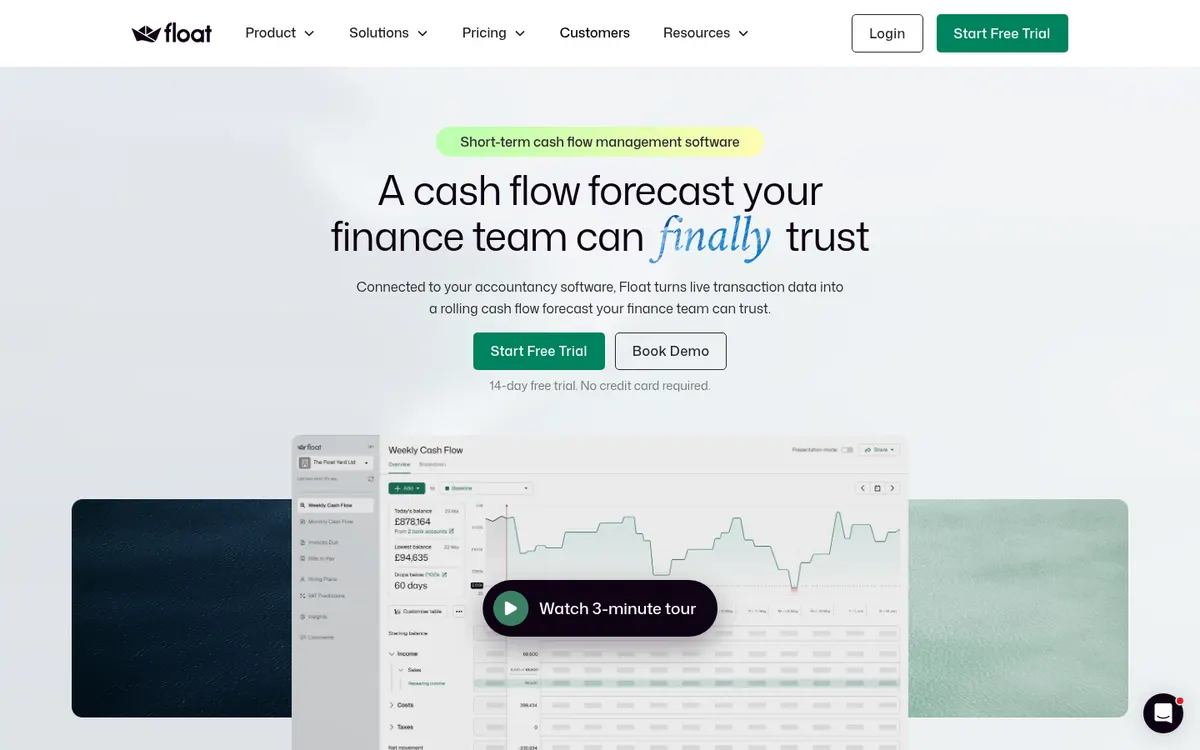
Float
Best for SMBs and growing companies on Xero or QuickBooks Online
Our verdict
The clearest published pricing on this list, and the fastest forecast for anyone already on Xero or QuickBooks.
Float turns accounting data into a cash-flow timeline you can read. It syncs with Xero and QuickBooks Online, pulls live invoices, bills and bank data, and lays it out on a visual forecast. A working forecast can be live in minutes rather than in a project, which is the main reason small teams pick it. Weekly cash summary emails keep owners informed without anyone opening the app.
Pricing is published, which is rare on this list. Small Business is £99 per month, Growth is £199 per month, and Scale is £295 per month billed monthly. A 14-day free trial requires no credit card. Scenario modeling has no cap on the number of scenarios, and Scale adds multi-entity consolidation for up to five entities. Budget versus actual reporting and role-based permissions are part of the package.
The limits follow from the design. It is forecasting only: no payments, no reconciliation, and no bank-wide cash positioning beyond what the accounting file already holds. Only Xero and QuickBooks Online are supported today, with Sage Intacct merely planned, so a firm on NetSuite or Dynamics is out of scope. Annual plans are not refundable after 30 days, which matters if you buy before a bank migration.
Pricing was checked on 25 November 2026 and the current page quotes pounds sterling starting at £99 per month for Small Business. Confirm which tier matches your revenue and entity count before you commit, and check the vendor page again after the check date, since tiers and currency have changed before. If you run more than five entities, ask how consolidation works above the Scale ceiling.
What works
- Forecast live in minutes from accounting data
- Published pricing across three tiers
- Unlimited what-if scenarios
What to weigh
- Only Xero and QuickBooks Online supported
- No payments or reconciliation
- Annual plans not refundable after 30 days
Pick it if
You run Xero or QuickBooks Online and want a scenario-ready cash forecast without a sales call.
Skip it if
Your ledger is NetSuite, SAP or Dynamics, or you need payments and reconciliation in the same tool.
Plate 05 of 09
Pulse
Best for freelancers and micro-businesses wanting a simple cash view
Our verdict
Cheap, plain and manual: a starting point for solo owners who will not connect an accounting system.
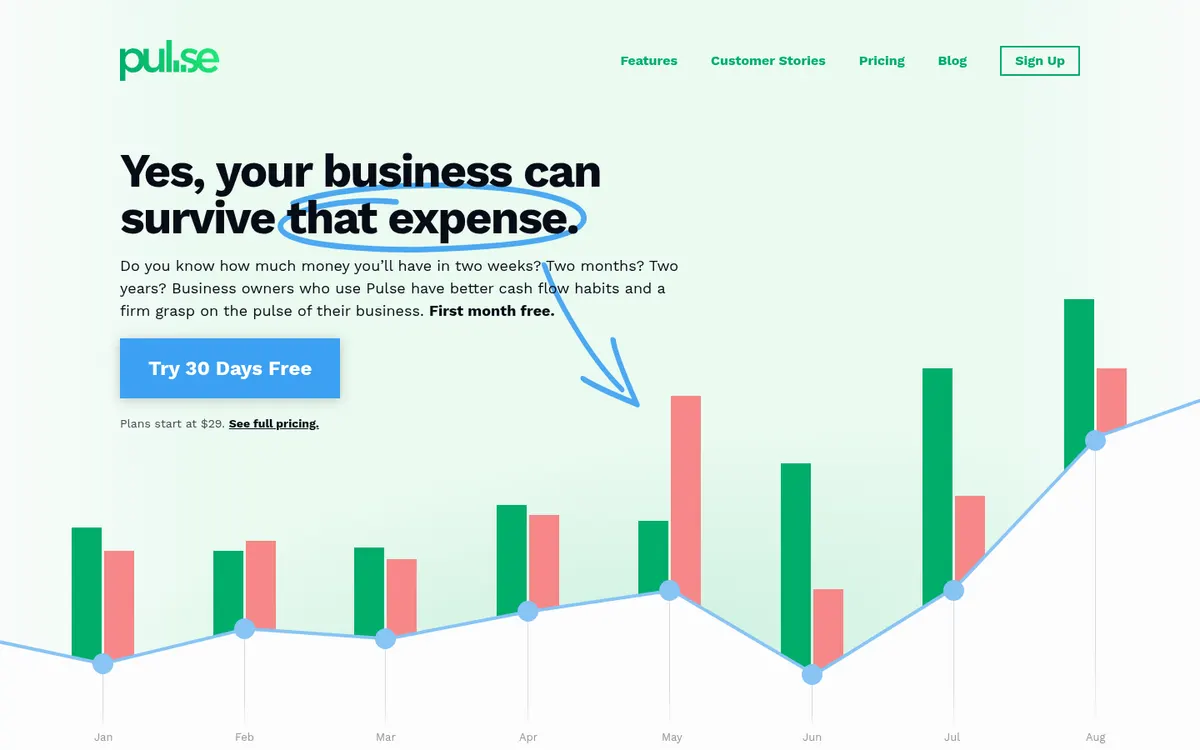
Pulse is the simplest tool on this list, and that is the point. It gives a freelancer or micro-business a visual dashboard of money in and money out, with manual entry and tracking rather than automatic bank feeds. The interface is plain language, setup takes minutes, and the weekly cash view is aimed at owners who are not finance people. It suits the owner who wants one screen and no integrations.
Pricing is published and low: Pulse Basics is $29 per month, billed month to month with no long-term contract. Cancellation happens from the billing page at any time. The 30-day free trial requires a credit card at signup and converts automatically to a paid subscription, so set a reminder before day 30 if you are only testing. Excel and CSV exports make it easy to hand figures to a lender or an investor.
The trade-offs are the flip side of the simplicity. Manual entry is much heavier than tools that sync with accounting data, and it drifts the moment you skip a week. There is no multi-entity support, which rules out anyone running a second company or a holding structure. Nothing here handles payments, reconciliation or FX. For a one-person consultancy with predictable invoices, none of that is a loss.
The price was recorded at $29 per month on the 25 November 2026 check, and plan amounts beyond the entry tier were not readable in the source data. Confirm the live pricing page before budgeting, and check what the trial converts to before you enter card details.
What works
- Minimal setup and plain interface
- Cancel from the billing page
- Exports ready for lenders
What to weigh
- Heavy manual entry
- No multi-entity support
- Trial auto-converts to a paid plan
Pick it if
You are a solo owner with steady invoices and want a simple cash view without connecting software.
Skip it if
You already run Xero or QuickBooks, since syncing tools will do the same job with less typing.
Plate 06 of 09
Dryrun
Best for mid-market finance teams and fractional CFOs wanting manual forecast control
Our verdict
Forecast control for finance people who want to set every assumption themselves, with a learning curve to match.
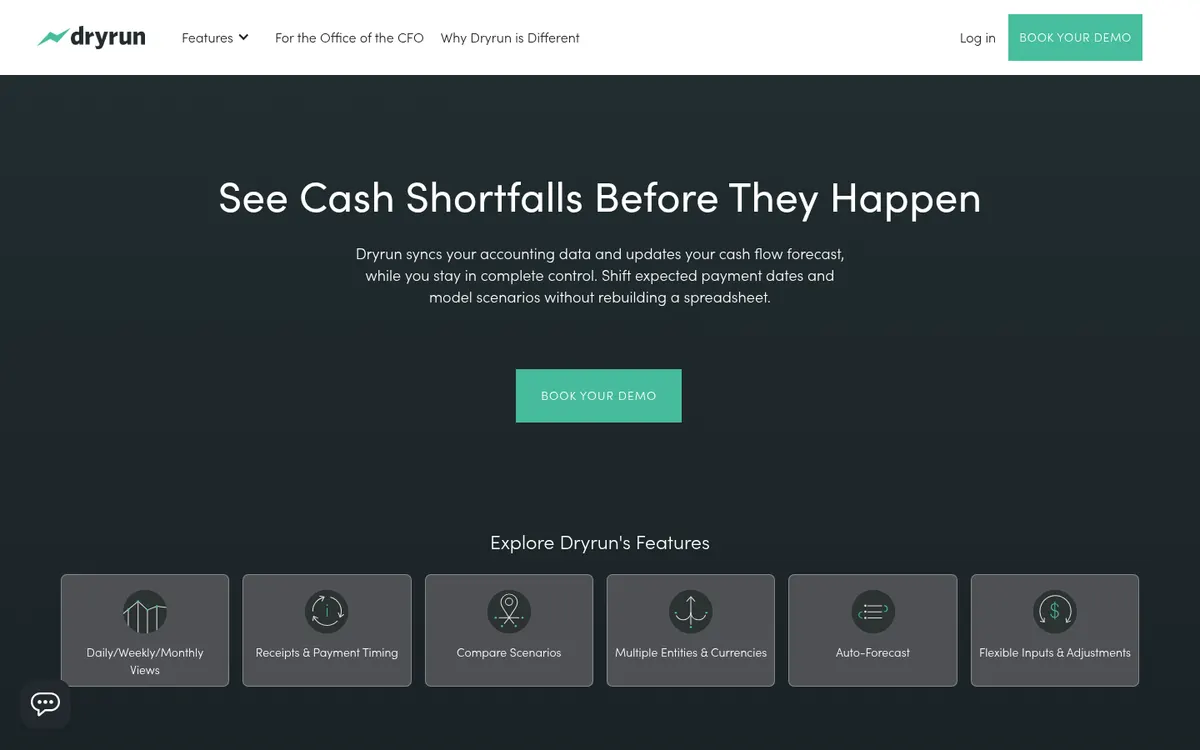
Dryrun is for people who do not trust an algorithm with their forecast. Every invoice can be overridden with an expected collection date, and client and vendor payment-lag rules let you encode how each counterparty actually behaves. Scenario comparison runs side by side, and you can switch between daily, weekly and monthly views depending on the decision in front of you.
The integration list is broad for an SMB-priced tool: QuickBooks Online, Xero, Sage Intacct and Dynamics 365, with CRM connections on the Pro tier. That makes it a reasonable fit for fractional CFOs and advisory firms that inherit whatever accounting system a client already runs. Higher tiers add seats and the CRM links that private-equity and advisory users tend to need, and forecasting stays manual by design, so the output is only as good as the assumptions the owner sets.
The cost of that control is learning curve. Automated forecasters get you to a first draft faster; Dryrun expects you to build the assumptions properly. The Business plan covers only one user, which surprises teams that assume a plan named Business includes several seats. Billing is annual, unused portions are not refunded, and cancellation goes through the vendor rather than a button.
There is no free plan, but the 14-day trial requires no credit card, so you can test the modeling approach without a commitment. Pricing was not confirmed on the 25 November 2026 check because the page returned nothing, so treat any figure you have seen as unverified and get the quote in writing, including the number of seats and the tier needed for CRM links.
What works
- Line-item control over collection dates
- Broad accounting and ERP integrations
- Side-by-side scenario comparison
What to weigh
- Steeper learning curve
- Business plan covers one user
- Annual billing with no partial refunds
Pick it if
A CFO or advisor owns the forecast and wants to override every collection date by hand.
Skip it if
You want the forecast to build itself, or you need several seats on a lower tier.
Plate 07 of 09
Agicap
Best for european SMBs and mid-market firms with several bank accounts
Our verdict
European bank coverage is the reason to buy, and the 12-month minimum is the reason to check twice.
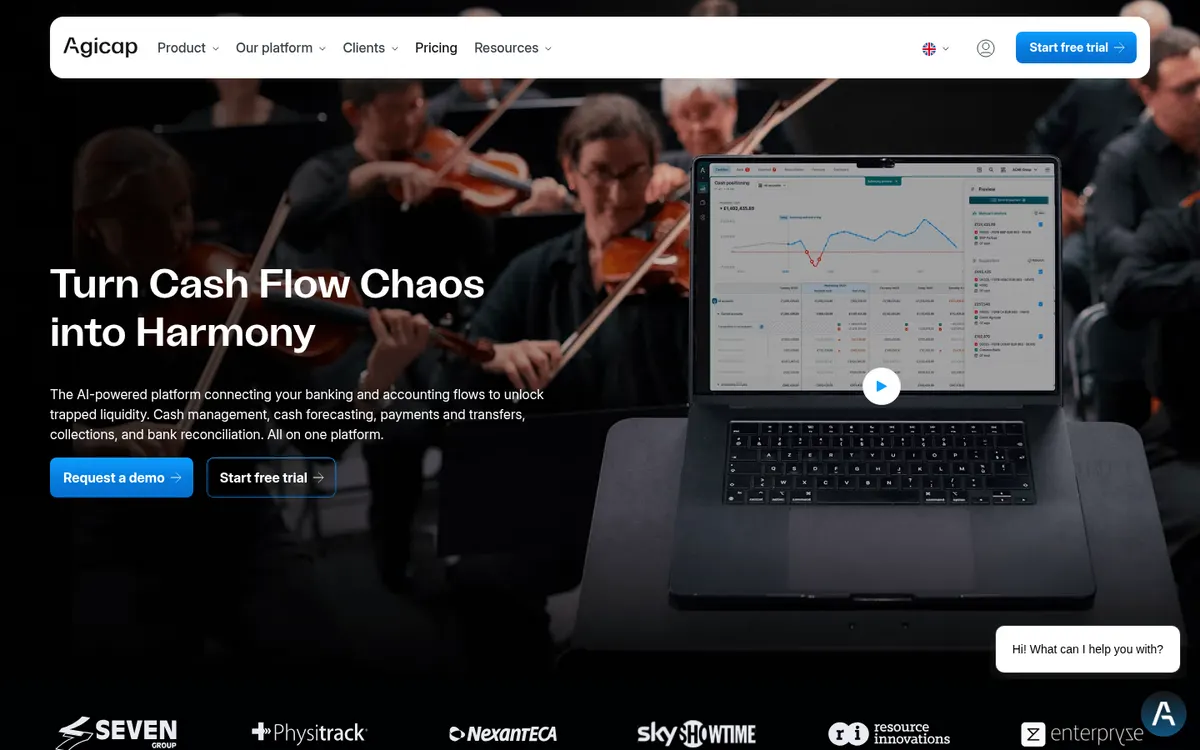
Agicap is built around bank connectivity, and in Europe that coverage is the selling point. It syncs automatically with more than 300 banks through open banking APIs, so a company with accounts scattered across institutions ends up with one real-time cash position without custom integration work. Multi-company consolidation and multi-currency monitoring are part of the core, which matters for groups running several legal entities. Setup is guided rather than DIY, which suits finance teams without an IT project slot.
The platform pairs forecasting with a collections module called Get Paid, so receivables chasing and cash planning sit in the same place. Integrations cover Xero, NetSuite, SAP Business One, Sage and Odoo. For a European SMB or mid-market firm, the combination of wide bank coverage and a receivables workflow is the reason to shortlist it over a US-first tool.
Pricing is quote-only and depends on bank account count and turnover, so there is no list price to budget against. The contract carries a 12-month minimum subscription with cancellation only before renewal, which is a real constraint if your banking setup changes mid-term. The trial is expert-guided and lasts a few days rather than being self-serve, so evaluation costs calendar time. US bank coverage needs checking before a non-European buyer commits.
No public figure existed on the 25 November 2026 check; pricing is generated through a needs form and a quote request. Before you sign the minimum term, confirm in writing that every bank you use is on the supported list, and ask what happens if you add accounts mid-contract. Ask also whether the 12-month term renews automatically and what notice period applies.
What works
- 300-plus banks via open banking
- Automatic multi-entity consolidation
- Forecasting plus collections in one place
What to weigh
- No public pricing
- 12-month minimum subscription
- US bank coverage needs checking
Pick it if
Your accounts sit with several European banks and you want consolidation plus collections in one platform.
Skip it if
Your banks are outside Europe, or a 12-month minimum does not fit your funding timeline.
Plate 08 of 09
Centime
Best for US mid-market companies wanting AP/AR automation with forecasting built in
Our verdict
AP, AR and a 13-week forecast in one package, priced for US mid-market firms that want all three.
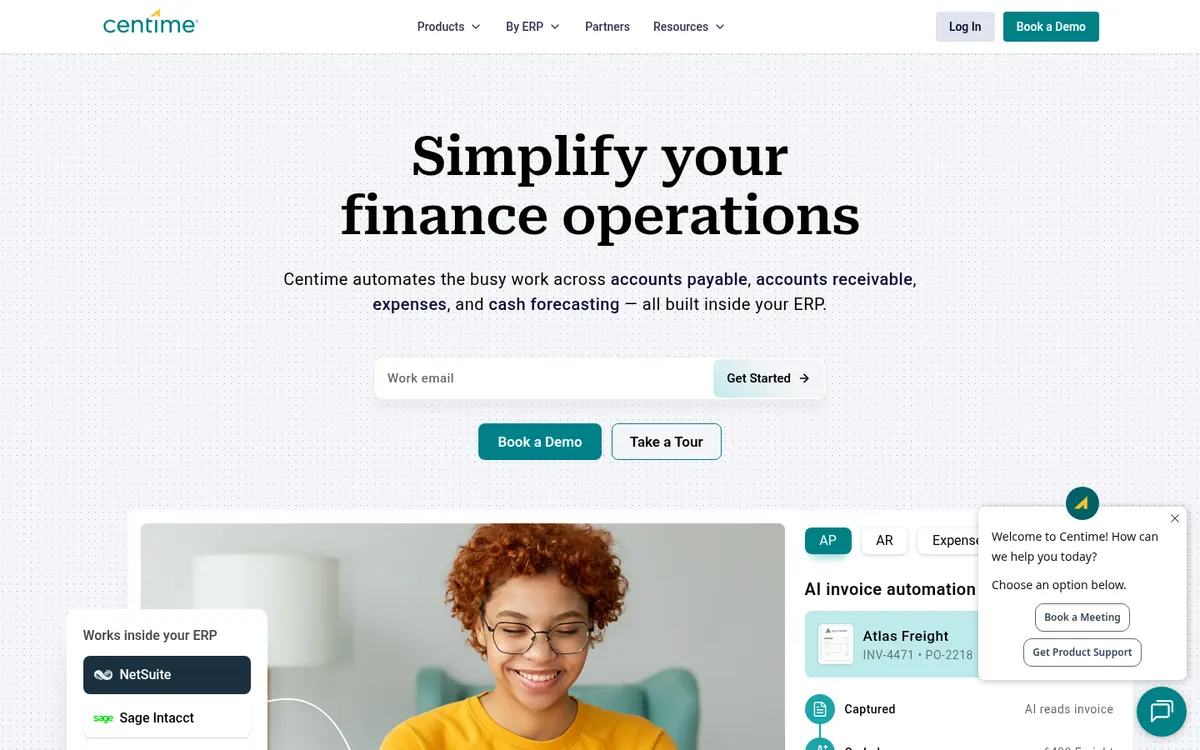
Centime sells automation, not just a forecast. Accounts payable, accounts receivable and expense management are the core products, and a rolling 13-week cash forecast is bundled on top because the data is already there. That is the structural argument: the forecast derives from actual AP and AR activity instead of a spreadsheet someone updates on Fridays. For a company where payables and receivables already run through spreadsheets and a banking portal, that consolidation is the product.
There is also a high-yield business checking account option, and the deposit economics can offset part of the subscription, which is worth quantifying rather than dismissing. One vendor and one success manager cover payables, receivables and forecasting, so there is no integration project between three systems. Billing is volume-based on invoices captured and collected.
The fit is narrow by design. It targets US companies in roughly the 10 million to 200 million USD revenue range, which means it is heavy for a business that only wants forecasting. Everything is quote-based through a sales-led process, with no free plan and no trial, so you cannot see the product without a demo and a scoping call. Expect the price point to reflect three products, not one.
No pricing page was available on the 25 November 2026 check, so nothing could be confirmed. Ask for the volume assumptions behind the quote, since invoice counts drive the bill, and read the deposit account conditions carefully if the offset is part of your business case. Reconfirm terms with the vendor on or after 25 November 2026.
What works
- Forecast built from AP and AR activity
- One vendor for payables and receivables
- Deposit account can offset cost
What to weigh
- Fully quote-based pricing
- Heavy for forecasting-only needs
- Built for US mid-market revenue bands
Pick it if
You are a US mid-market firm already planning to automate both payables and receivables.
Skip it if
Forecasting is the only gap, or you are outside the US revenue bands it targets.
Plate 09 of 09
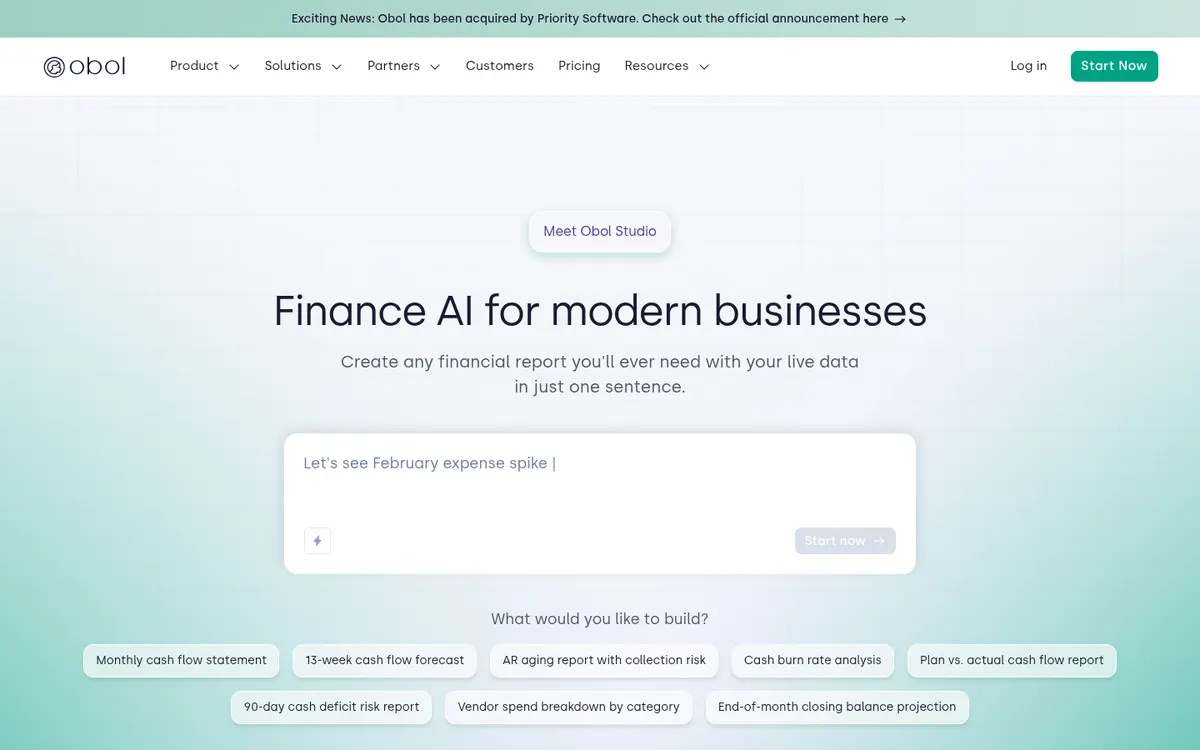
Obol
Best for growth-stage companies and fractional CFO or advisory firms
Our verdict
Month-to-month treasury positioning for growth-stage firms and advisory practices, priced without a trial.
Obol targets the gap between simple SMB forecasters and heavy treasury suites. The Live Cash Hub gives real-time cash positioning across accounts, AI-powered anomaly detection flags movement that looks wrong, and scenario planning covers the what-if work. The connectivity layer is a proprietary API infrastructure for banks and ERPs, which is the part that determines whether onboarding takes days or months. For a growth-stage company with three or four banks, that is the right level of ambition.
The commercial model is the differentiator. Studio runs month to month, and you can cancel or upgrade at any time, which is unusual against annual treasury contracts that lock a finance team in for 12 months. Pro and Enterprise+ tiers are custom-quoted. For a fractional CFO practice spreading one subscription across several clients, that flexibility matters more than a feature list. Month-to-month terms also make it easier to walk away if bank coverage disappoints.
The risks are age and opacity. Obol was founded in 2022, so the public track record is thin compared with established vendors. There is no free tier and no trial, which means full price risk from day one with nothing to test first. Higher tiers are quoted privately, so budgeting beyond Studio requires a conversation.
No pricing page was available on the 25 November 2026 check, so the entry price you may have seen could not be confirmed. Ask for a scoped pilot or a written exit clause if a trial is off the table, and confirm which banks are already live on the proprietary API layer rather than promised.
What works
- Month-to-month Studio subscription
- Sits between SMB tools and treasury suites
- Advisory firms can serve multiple clients
What to weigh
- No trial and no free tier
- Founded in 2022 with a thin public record
- Higher tiers quoted privately
Pick it if
You want treasury-grade positioning on a month-to-month term, or you advise several clients at once.
Skip it if
You need to test with your own banks before paying, or you want a vendor with a long track record.
What does cash management software actually do?
Cash management software answers three different questions, and vendors often answer only one of them. Cash positioning asks where the money is right now: balances across every bank account, entity and currency, consolidated into one number. Cash-flow forecasting asks what the balance will be in four, eight or thirteen weeks if invoices land the way you expect. Reconciliation asks whether the records match reality, matching bank lines to ledger entries and flagging the gaps.
Most tools on this list are strong in one and weak elsewhere. Kyriba, Trovata, Agicap and Obol do positioning well because they connect to banks directly. Float, Dryrun and Pulse forecast without positioning much at all. Tesorio and Centime attack the receivables and payables side, which changes the forecast because it changes when cash actually arrives.
Bank connectivity is where the real differences hide. Four routes matter:
- Direct APIs, where the vendor has a signed agreement with each bank.
- Open banking, common in Europe, where a licensed intermediary exposes account data.
- SWIFT and sFTP, used by corporates with many banking relationships and file-based processes.
- Statement uploads, which work everywhere and scale badly.
One consequence worth internalizing: forecasting tools sit alongside accounting software rather than replacing it. Xero, QuickBooks, NetSuite and Sage hold the ledger; the forecasting tool reads it and adds timing assumptions. That is why Float supports only two accounting systems and Dryrun lists four. If your ledger is not on a vendor's list, the tool cannot help you regardless of features.
Cash management software also does not replace your bank. Payments may be initiated from a treasury suite, but balances, holds and fees still live with the bank, and the software's accuracy depends on how often it pulls. Expect a few weeks of onboarding for any direct bank connection, and treat a demo that shows instant connectivity as a demo of a sandbox.
This guide sits in the Software collection. Buyers weighing nearby tools often read the guides to commission software and research platforms next.
Why do most cash management vendors hide their prices?
There is no single pricing model in this category. Two vendors publish rates, seven quote after a scoping call, and the split tracks company size rather than feature count. Published subscription pricing exists at the small end because the buyer is the owner and there is no procurement process. Quote-based selling appears at the top because the price depends on bank connections, entity count, module selection and services.
| Model | How it bills | Typical fit | Example from this list |
|---|---|---|---|
| Published tiers | Monthly per workspace | SMBs on Xero or QuickBooks | Float, £99 per month on Small Business |
| Flat entry plan | Month to month | Freelancers and micro-businesses | Pulse, $29 per month on Pulse Basics |
| Modular quote | Annual contract plus add-ons | Large enterprise treasury | Kyriba |
| Connection and module quote | Annual, priced per bank link | Multi-bank mid-market | Trovata |
| Turnover-based quote | 12-month minimum | European SMB and mid-market | Agicap |
| Volume-based | Per invoice captured and collected | US mid-market AP and AR | Centime |
| Custom tiers | Month to month or custom | Growth-stage and advisory | Obol |
Three patterns to watch. Per-connection pricing means the bill grows every time you open an account, which is common in multi-bank tools. Volume pricing ties the bill to invoice counts, which suits a company with predictable receivables but penalizes growth. Minimum terms matter as much as the number: Agicap carries a 12-month minimum, Float's annual plans are not refundable after 30 days, and Dryrun bills annually with no refunds on unused portions.
Trials are the other variable. Float, Pulse and Dryrun offer free trials, Pulse requires a card and auto-converts, and Agicap's trial is expert-guided rather than self-serve. Kyriba, Tesorio, Centime and Obol offer no trial, so your evaluation is a demo and a scoping call. If you cannot test with your own bank data, at least get the module list and the seat count in writing.
Ask each vendor for the annual figure at your actual bank and entity count, not at the minimum configuration, and ask what triggers a re-quote.
Every price in this guide was read on the vendor's own pricing page on November 25, 2026. Where a vendor does not publish a figure we could confirm, the card says "See website" rather than a guess. For the arithmetic around this purchase, try the free Email campaign metrics calculator.
Which of these nine tools belongs on your shortlist?
- Name the job. If you cannot see balances across banks, shortlist Kyriba, Trovata, Agicap or Obol. If late customer payments are the constraint, start with Tesorio. If payables and receivables both need automating, look at Centime.
- Count your banks and systems. Every direct connection adds onboarding time and usually cost, and a base plan may cover only one bank. A firm on Xero with a single account should not pay for SWIFT connectivity it will never use.
- Weigh pricing transparency against your patience. Float and Pulse publish rates you can budget from today. The other seven require a scoping call, and enterprise vendors add procurement, so expect a sales cycle before you hold a comparable number.
- Test with your own data. A trial on sample data proves nothing. Load your own bank statements or connect one real account, then check whether the cash position matches what your bank shows on the same day.
- Read the tail of the contract. Minimum terms, refund rules and renewal clauses matter more than the headline rate. Agicap's 12-month minimum and Pulse's auto-converting trial are the two clearest examples here.
- Reconfirm the number in writing on the day you sign. Quote-based vendors price on bank count, entities, modules or invoice volume, and those inputs change. Get the year-one total, including services, not the subscription line alone.
What goes wrong when buyers choose cash management software
- Buying treasury software for a forecasting problem. Kyriba and similar suites are built for departments with dedicated treasury staff. A 40-person company that needs a 13-week cash view will pay for modules it never opens.
- Assuming a bank connection is instant. Trovata still takes a few weeks to onboard banks even though setup needs no IT involvement. Plan your go-live around that, not around the demo.
- Ignoring seat and entity ceilings. Dryrun's Business plan covers one user and Float's consolidation stops at five entities on Scale. Both limits appear in the plan note and surprise buyers after signing.
- Letting a card-required trial run. Pulse's 30-day trial converts automatically to a paid subscription. Set a calendar reminder for day 28, because cancellation has to happen before billing, not after.
- Treating a receivables tool as a cash platform. Tesorio and Centime centre on the AR or AP side and add forecasting. Tesorio does not offer bank-wide cash positioning, so do not buy it expecting that.
Best Cash Management Software 2026: questions
How does cash-flow forecasting differ from full treasury cash management?
Forecasting projects future balances from invoices, bills and timing assumptions. Full treasury cash management also positions today's cash across every bank, entity and currency, often adding payments, fraud controls and FX. Tools such as Float and Dryrun forecast well and do little positioning, while Kyriba, Trovata, Agicap and Obol do positioning as a core job. Decide which of the two questions you actually need answered before you compare feature lists.
Which tools publish prices and which are quote-only?
Two of the nine publish rates: Float at £99 per month on Small Business, and Pulse at $29 per month on Pulse Basics. The other seven, Kyriba, Trovata, Tesorio, Dryrun, Agicap, Centime and Obol, quote after a scoping call. Quote-only vendors price on bank connections, entities, modules or invoice volume, so the number you receive depends on the scope you describe to them.
What does an annual cash management budget look like?
There is no single range, and most vendors here will not give you one without a scoping call. The only published anchors are Float at £99 to £295 per month depending on tier and Pulse at $29 per month. Enterprise suites such as Kyriba are quote-based and include a services-led rollout, so the year-one figure covers implementation as well as the license. Ask for the year-one total, not the subscription line.
How do these tools connect to banks?
Four routes appear here: direct APIs where the vendor holds an agreement with each bank, open banking through a licensed intermediary (common in Europe, with Agicap citing more than 300 banks), SWIFT and sFTP for corporate file transfers, and statement uploads. Float and Pulse skip bank connections entirely and read accounting data from Xero or QuickBooks Online instead. Check which route covers your own banks before anything else.
What should you test in a trial if your banks are not supported?
Test the import path first: whether you can upload a statement file and get a usable cash position without a live connection. Then ask the vendor, in writing, for the onboarding timeline for your specific banks and whether those banks are live or only planned. Float, Pulse and Dryrun all offer free trials, so use those days to test the fallback rather than the demo data.
Which contract terms should you check before signing?
Check the minimum term, the refund policy and how cancellation works. Agicap carries a 12-month minimum with cancellation only before renewal, Float's annual plans are not refundable after 30 days, and Dryrun bills annually with no refunds on unused portions and requires contacting the vendor to cancel. Pulse's trial auto-converts to a paid subscription, so set a reminder before day 30.