
Contents of this guide
The shortlist
Our top 3 for software buyers

AppFolio
One shared interface
- Best for
- Growing residential and commercial portfolios wanting an all-in-one modern suite
- Features
- 5 noted: AI leasing assistant, Mixed portfolio, Built-in accounting, Online payments, Maintenance coordination

Buildium
Published tier pricing
- Best for
- Small to mid-size managers with mostly residential portfolios
- Features
- 5 noted: No-card trial, Resident portals, Owner reporting, Bookkeeping, Maintenance tracking

Yardi Breeze
No onboarding fees
- Best for
- Cost-conscious managers who want published per-unit pricing
- Features
- 5 noted: Per-unit pricing, $200 commercial floor, Tenant administration, Owner reporting, Annual agreement
Disclosure for this guide. All 8 tools here are unpaid editorial picks. The position of a paid listing can be part of what the vendor pays for. Paid and unpaid tools are scored on the same rubric and keep their cons. Details are in the advertising disclosure.
The ledger
Index of every tool
| Tool | Free plan | Trial | Rubric | Compare | ||
|---|---|---|---|---|---|---|
| 01 | AppFolioGrowing residential and commercial portfolios wanting an all-in-one modern suite | See websiteCustom quote onlyNot published | No | Demo only | ||
| 02 | BuildiumSmall to mid-size managers with mostly residential portfolios | $65Essential, per month, scales with unit countChecked Nov 25, 2026 | No | 14-day free trial, no credit card required | ||
| 03 | Yardi BreezeCost-conscious managers who want published per-unit pricing | $1Breeze Residential, per unit per month, $100 monthly minimum, annual agreementChecked Nov 25, 2026 | No | No | ||
| 04 |  EntrataLarge multifamily operators and enterprise portfolios | See websiteCustom quote, modular pricingNot published | No | Demo only | ||
| 05 |  MRI SoftwareEnterprises with complex, mixed-asset portfolios | See websiteCustom quoteNot published | No | No | ||
| 06 |  PropertywareSingle-family rental portfolios with dispersed properties | $1Basic, per unit per month, $250 monthly minimum plus implementation feeChecked Nov 25, 2026 | No | Limited-access free trial | ||
| 07 |  RentRediSelf-managing landlords who want one flat price | $12Annual plan, per month total, billed annually, unlimited properties and tenantsChecked Nov 25, 2026 | No | No | ||
| 08 |  DoorLoopSmall managers wanting a full suite at a predictable price | $2.50DoorLoop One, per unit per month, minimum spend and units applyChecked Nov 25, 2026 | No | Free trial, 24 hours |
Prices are the lowest paid plan the vendor shows, read on November 25, 2026. Sort by price ranks published monthly figures; tools without one go last. Pin up to three tools to compare them side by side.
How this guide was put together
We scored eight tools on five criteria that decide commercial purchases, weighted by what costs buyers the most when they get it wrong. Commercial lease depth carries 26 percent: it asks whether the product handles CAM reconciliation, percentage rent, expense stops and the lease structures that separate commercial work from residential. Pricing clarity carries 22 percent, because a vendor that will not publish a number cannot be compared without a sales call. Accounting and reporting carries 20 percent, onboarding and trial carries 16 percent, and scale fit carries 16 percent.
Every price in this list was checked against vendor pricing pages on November 25, 2026. Where a vendor publishes a price list, the entry shows that rate with the plan name and billing term attached: $65 per month on Buildium Essential, $1 per unit per month on Yardi Breeze Residential with a $100 monthly minimum, $2.50 per unit per month on DoorLoop One. Where no pricing page was captured, the entry reads See website and we did not guess a number. Confirm any quote directly with the vendor.
Featured placements are paid. They are scored with this same rubric, they carry the same honest cons, and the label tells you when a placement is commercial rather than editorial. The order you see follows fit for the buyer each entry describes, not a calculated total.
Two limits are worth stating. Vendor pages change between checks, so confirm the current rate before you sign. And commercial lease depth is hard to prove from a marketing page, which is why every verdict here points at the specific test to run in a demo or trial.
The full process, including how we handle corrections, is on the methodology page. Paid listings follow the advertising disclosure.
Rubric and weights
Every tool below is scored from 1 to 10 on these five criteria. The scores describe each tool; the order is an editorial call on fit for the buyer each card describes, plus the disclosed Featured position.
- 26%Commercial lease depthWhether the product handles CAM reconciliation, percentage rent, expense stops and the lease structures that separate commercial work from residential.
- 22%Pricing clarityHow easily a buyer can find a real number before a sales call, from a published price list to a quote-only record.
- 20%Accounting and reportingDepth of tenant ledgers, property accounting, owner statements and reporting for multi-entity portfolios.
- 16%Onboarding and trialHow much testing and implementation support a buyer gets before and after signing, including trial length and fees.
- 16%Scale fitWhether the pricing model and feature depth match small, mid-size or enterprise unit counts without paying for unused capacity.
Plate 01 of 08
AppFolio
Best for growing residential and commercial portfolios wanting an all-in-one modern suite
Our verdict
Best all-in-one for growing mixed portfolios, provided you can absorb a quote-only price and an onboarding project.
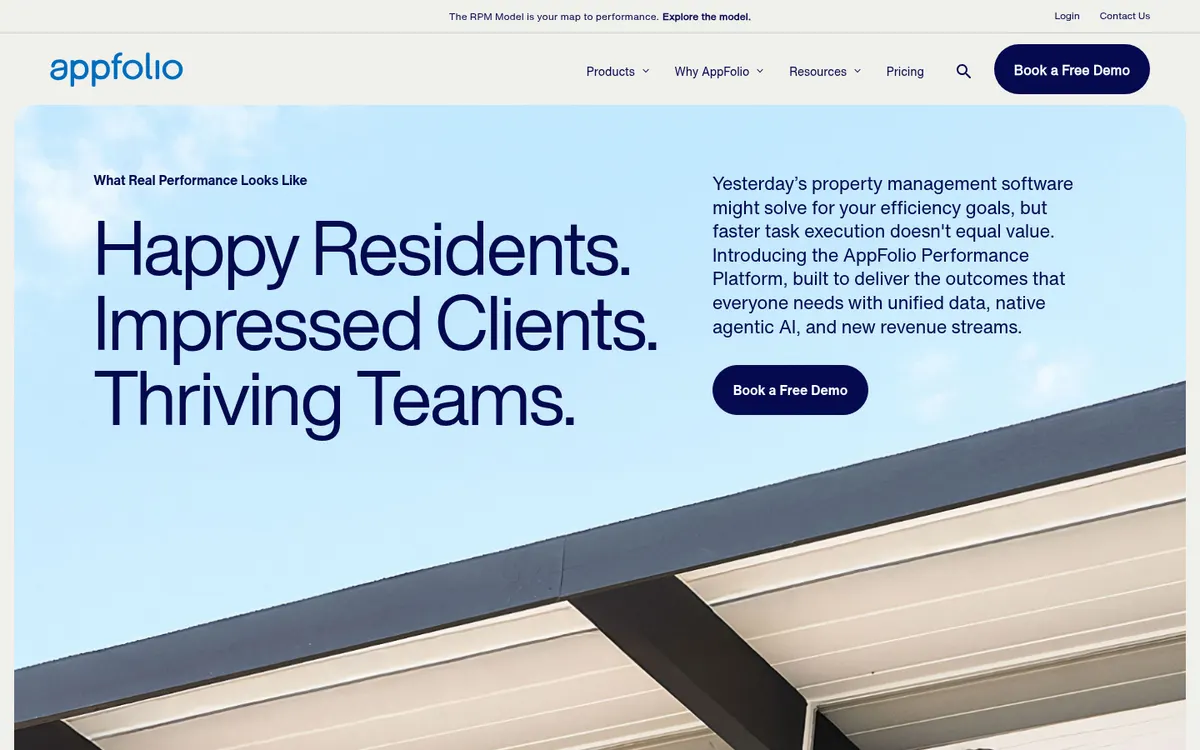
AppFolio puts leasing, maintenance, online payment collection and accounting on one interface, and managers and tenants work in that same shared view. The AI leasing assistant answers after-hours inquiries, which matters when a commercial tenant's facilities question lands at 9pm and nobody is watching the inbox. Commercial lease management sits alongside residential in the same product, so a mixed book does not need two logins, two sets of reports or a spreadsheet bridge between them.
Pricing is the friction. AppFolio publishes no price list: the record here is a custom quote only, marked See website, and no pricing page was captured when this list was checked on November 25, 2026. There is no free plan and no self-serve trial, so evaluation runs through a live demo with a sales team. AppFolio does not publish pricing, so treat the written quote as the only number that counts. Implementation and onboarding are separate costs that land in the first year.
That combination suits growing portfolios that expect to keep adding units and want one modern suite instead of best-of-breed parts stitched together. It is heavy for a landlord with a handful of units, who would pay for depth nobody opens. Managers with complicated CAM structures should also ask for a live demonstration of reconciliations and percentage rent before signing, because the product's center of gravity is still residential leasing volume.
What works
- One interface for leasing, maintenance, payments and accounting
- Handles residential and commercial leases in the same system
- AI assistant covers after-hours inquiries without staff
What to weigh
- Custom quote only, so no public number to budget against
- Implementation and onboarding add to first-year cost
- Too heavy and too expensive for very small landlords
Pick it if
You run a growing mixed portfolio and want one modern suite rather than four integrations.
Skip it if
You need a published price or a self-serve trial before you will talk to sales.
Plate 02 of 08
Buildium
Best for small to mid-size managers with mostly residential portfolios
Our verdict
Best for mostly residential books that want published tier pricing and a no-card trial to test the ledger.
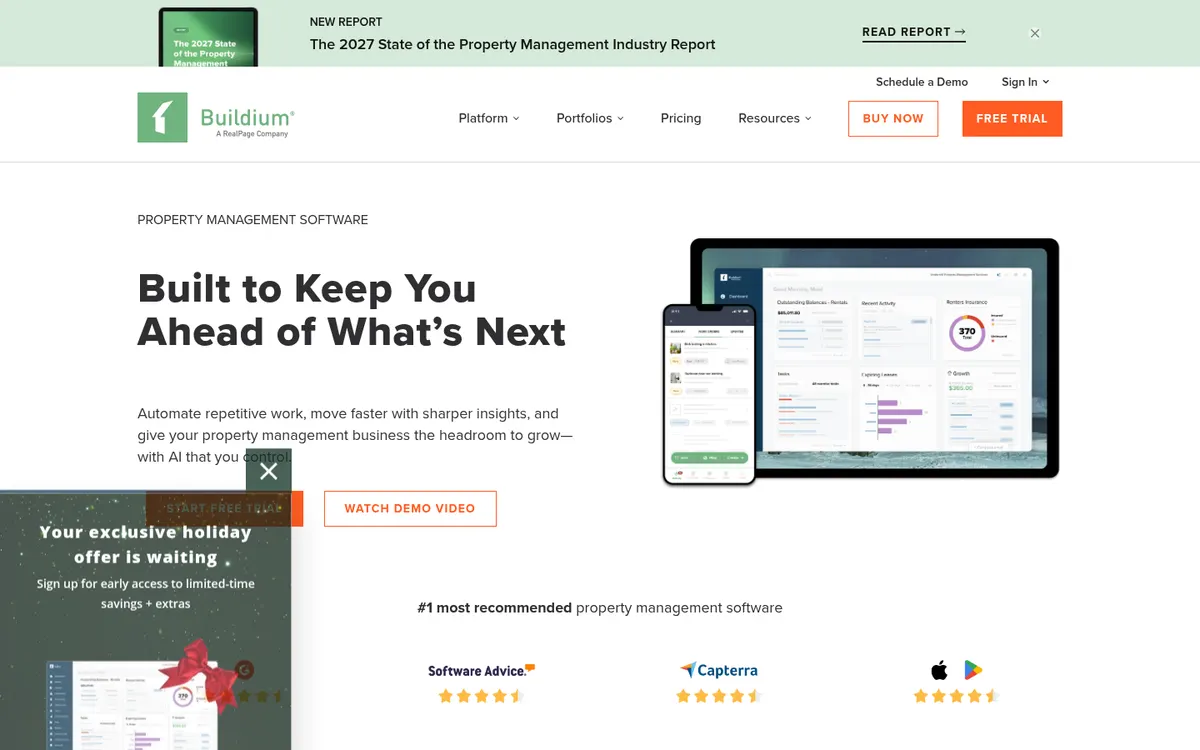
Buildium publishes its prices, which is rarer than it should be in this category. The Essential plan starts at $65 per month and scales with unit count, with Growth and Premium tiers above it running to several hundred dollars a month depending on the book. A 14-day free trial requires no credit card, so a small manager can load real leases and watch the accounting behave before talking to sales.
The feature set covers leasing and applicant workflows, bookkeeping, maintenance tracking, resident portals and owner-facing reporting. For a mostly residential book with a few retail or office suites attached, that is a coherent package at a predictable entry price, and the tier structure means you can start small and step up as units arrive rather than negotiating an enterprise contract on day one. The trial is genuinely useful for testing whether the ledger behaves the way your bookkeeper expects.
Where it thins out is commercial complexity. CAM reconciliation and percentage rent support need verification against your actual leases, because the residential center of gravity shows in how workflows are shaped. RealPage ownership points the roadmap toward enterprise buyers, so smaller operators should watch how much attention the lower tiers keep getting over time.
Buildium fits small to mid-size managers whose portfolios are mostly residential and who value a published price over deep commercial lease machinery. If your leases carry operating expense stops, base year adjustments and percentage rent clauses, run those exact documents through the trial before committing, and confirm the entry price still applies to your unit count.
What works
- Published Essential, Growth and Premium tiers
- 14-day free trial with no payment card required
- Leasing, accounting, maintenance and portals in one place
What to weigh
- Feature set leans residential, so commercial clauses need testing
- CAM reconciliation and percentage rent support need verification
- RealPage ownership steers the roadmap toward enterprise buyers
Pick it if
Your book is mostly residential and you want a published price plus a real trial.
Skip it if
Your leases lean on CAM pools and percentage rent and you need those proven on day one.
Plate 03 of 08
Yardi Breeze
Best for cost-conscious managers who want published per-unit pricing
Our verdict
Best when you want to calculate the bill yourself and can live without a trial or deep commercial features.
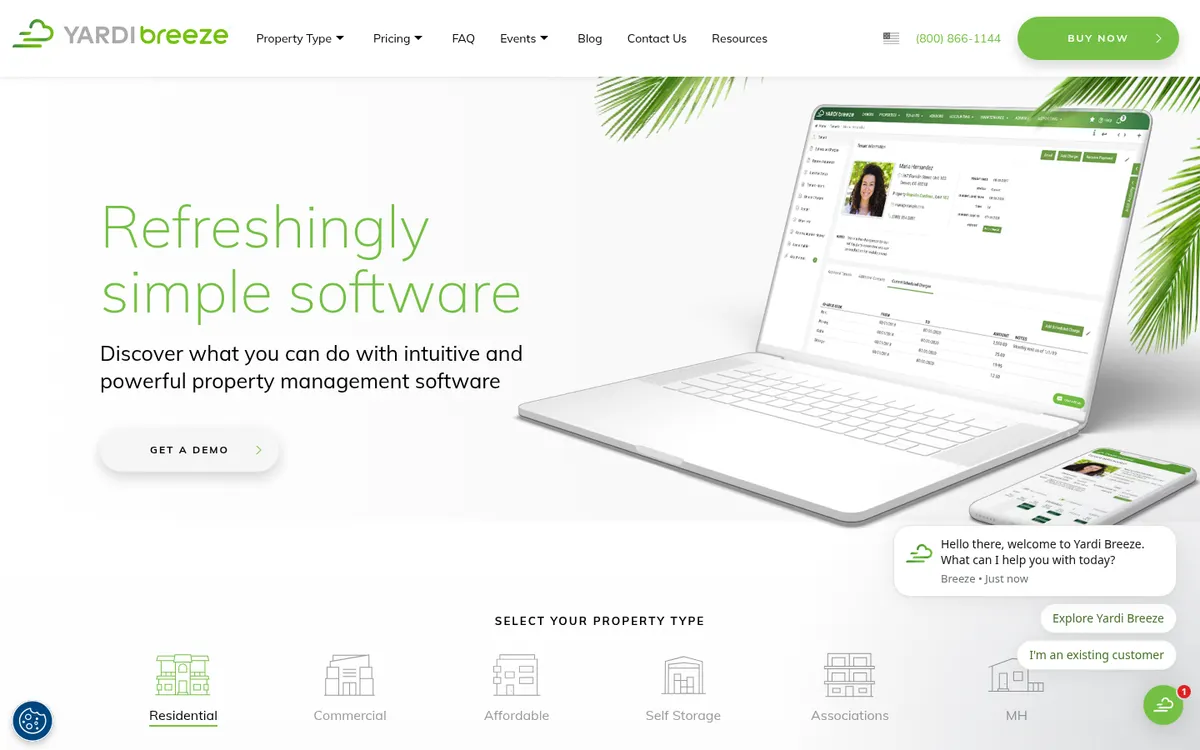
Yardi Breeze is the rare property platform where you can calculate the bill before a sales call. Breeze Residential lists at $1 per unit per month with a $100 monthly minimum on an annual agreement, and the commercial edition lists at $2 per unit per month with a $200 floor. A 200-unit commercial portfolio therefore lands at $400 monthly. No onboarding fees are invoiced, which removes the first-year surprise that quote-only vendors spring after the contract.
The product covers property accounting, tenant and lease administration and owner reporting, and it comes from a vendor with an established enterprise brand behind it. For a manager who wants a defensible budget line and a system that handles the basics without a scoping project, the arithmetic is the appeal.
Two limits matter. There is no trial, so evaluation is demo-led, and you commit on the strength of a walkthrough rather than your own data. Feature depth trails the larger suites, which shows up when lease structures get complicated and workarounds start accumulating.
Minimums also dominate small portfolios. Fifty units on the commercial edition still pay $200, which works out at $4 per unit rather than $2, so the floor does more work than the rate. Yardi Breeze fits cost-conscious managers who want published per-unit pricing and can live with a lighter feature set. Skip it if you need a trial period, or if your portfolio is small enough that the minimum turns a cheap rate into an expensive one.
What works
- Per-unit pricing published, so you can budget before a call
- No onboarding fees on the invoice
- Commercial-specific edition with its own rate
What to weigh
- No trial at all, so evaluation is demo-led
- Feature depth trails larger suites on complex leases
- Monthly minimums punish small portfolios
Pick it if
You want a published per-unit rate and no onboarding invoice to explain to a client.
Skip it if
You will not sign an annual agreement without testing the system on your own leases first.
Plate 04 of 08
Entrata
Best for large multifamily operators and enterprise portfolios
Our verdict
Best for large multifamily operators buying modules at scale, and a weak fit for office or industrial books.
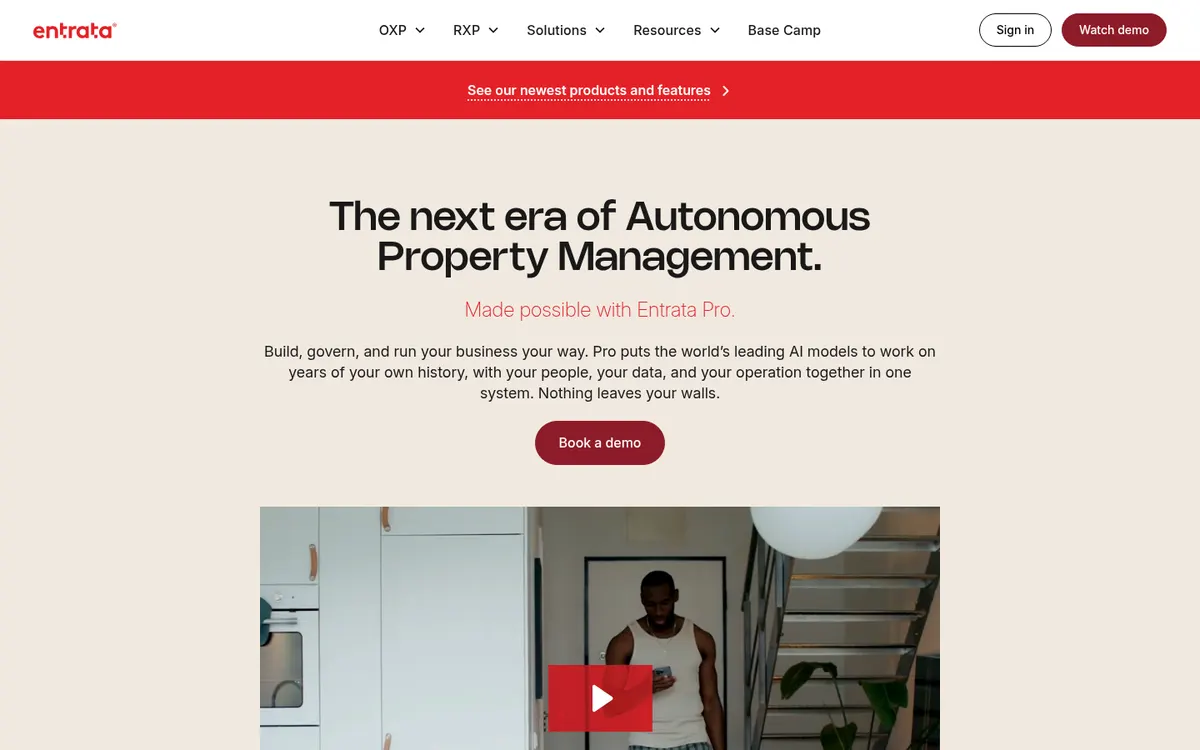
Entrata is built for large multifamily operators. Marketing and lead management, leasing workflows, resident lifecycle management and accounting sit in one platform, sold as modules so a big operator can buy the pieces it will actually run. It scales to thousands of units, and the reporting is aimed at owners and operators managing at that level rather than at a single building.
Pricing is custom and modular, marked See website here because no pricing page was captured on November 25, 2026. The vendor quotes each deal, so request a written quote for your unit count. There is no free plan and no trial, so evaluation is a live demo followed by a project-style implementation.
The commercial fit is secondary. Office, retail and industrial portfolios are not the product's center, and the lease structures common in commercial work, including CAM pools, expense stops and percentage rent, should be demonstrated rather than assumed. Sales and onboarding cycles are long, which suits an enterprise buying committee and frustrates a 40-unit operator who wants to sign this month.
Entrata fits large multifamily operators and enterprise portfolios that want depth across marketing, leasing and resident lifecycle, and it rewards buyers with the volume to justify modular pricing. Skip it if your book is mostly office or industrial, if you cannot commit to a project-length rollout, or if you need a published number before the first call.
What works
- Deep multifamily coverage from marketing to resident lifecycle
- Modular structure lets large operators buy only what they run
- Proven at very high unit counts
What to weigh
- Custom modular pricing with no public rate to plan against
- Office, retail and industrial books are a secondary fit
- Long sales and onboarding cycles
Pick it if
You operate thousands of multifamily units and want modules rather than a fixed bundle.
Skip it if
Commercial office or industrial leases dominate your portfolio.
Plate 05 of 08
MRI Software
Best for enterprises with complex, mixed-asset portfolios
Our verdict
Best for complex mixed-asset enterprises where ownership structures and investment reporting outrank interface polish.
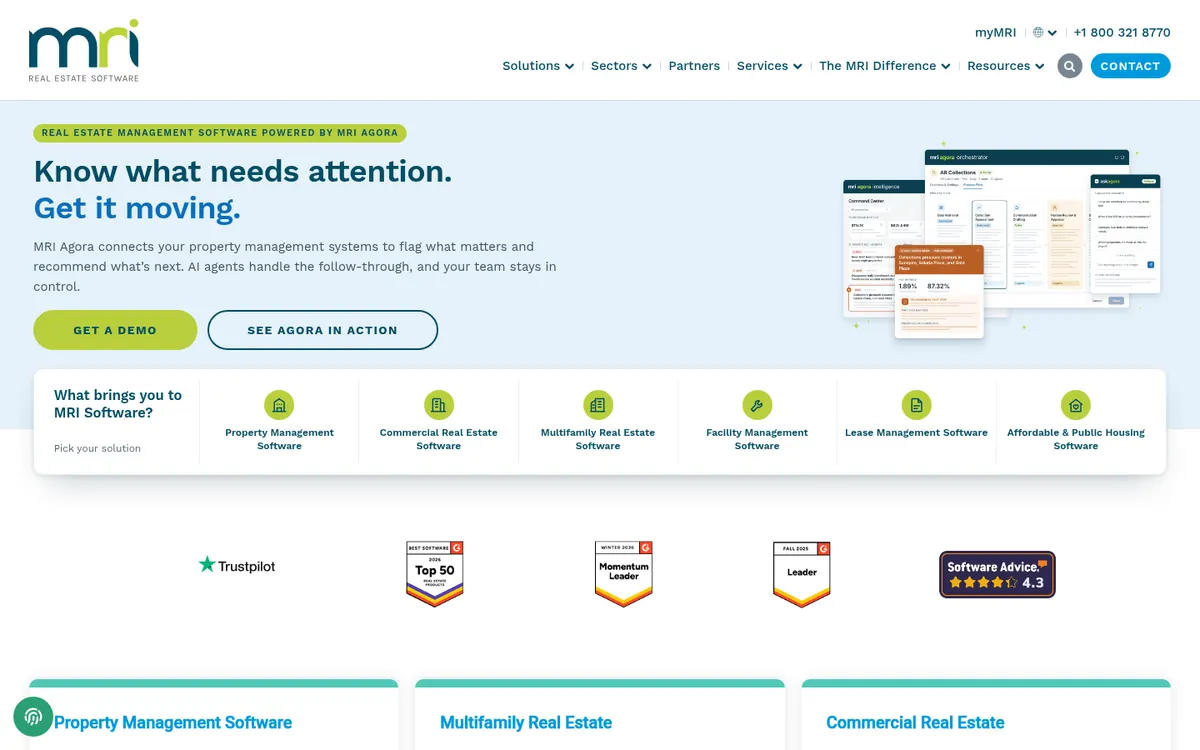
MRI Software has built property software since 1971, and the breadth shows. Financial management and investment management sit alongside operational modules, with support for mixed asset types, complex ownership structures and demanding reporting. There are multifamily, commercial and HOA modules, which means one system can carry a portfolio that spans categories instead of forcing a split between platforms.
The depth is the point. Layered ownership structures, consolidated reporting across asset classes and investment-level analysis go beyond what operational rivals attempt. For an enterprise with a complicated legal entity tree, that capability is the difference between a single source of truth and a spreadsheet shadow system that every reconciliation depends on.
The costs are real. Pricing is quote only, marked See website, and no pricing page was captured when this list was checked, so there is no public number to plan against. Sales cycles are long, implementation is a project in its own right, and the interface shows its age in places. There is no free plan and no trial, so the first look is a demo run by a solutions team.
Small portfolios will pay for capability they never open, and the learning curve will outlast the patience of a two-person office. MRI fits enterprises with complex, mixed-asset portfolios where financial and investment reporting matters as much as rent collection. Skip it if you manage a few dozen units, or if a modern interface and a fast start matter more than analytical depth.
What works
- Very deep commercial, financial and investment functionality
- Handles mixed assets and layered ownership structures
- Modules for multifamily, commercial and HOA in one vendor
What to weigh
- Quote-only enterprise pricing with long sales cycles
- Implementation is a project of its own
- Interface shows its age and the system is overkill for small books
Pick it if
Your entity structure is complicated and investment reporting sits at the center of the job.
Skip it if
You want a modern interface and a working system within a month.
Plate 06 of 08
Propertyware
Best for single-family rental portfolios with dispersed properties
Our verdict
Best for scattered-site single-family rentals, and a poor choice once commercial leases enter the portfolio.
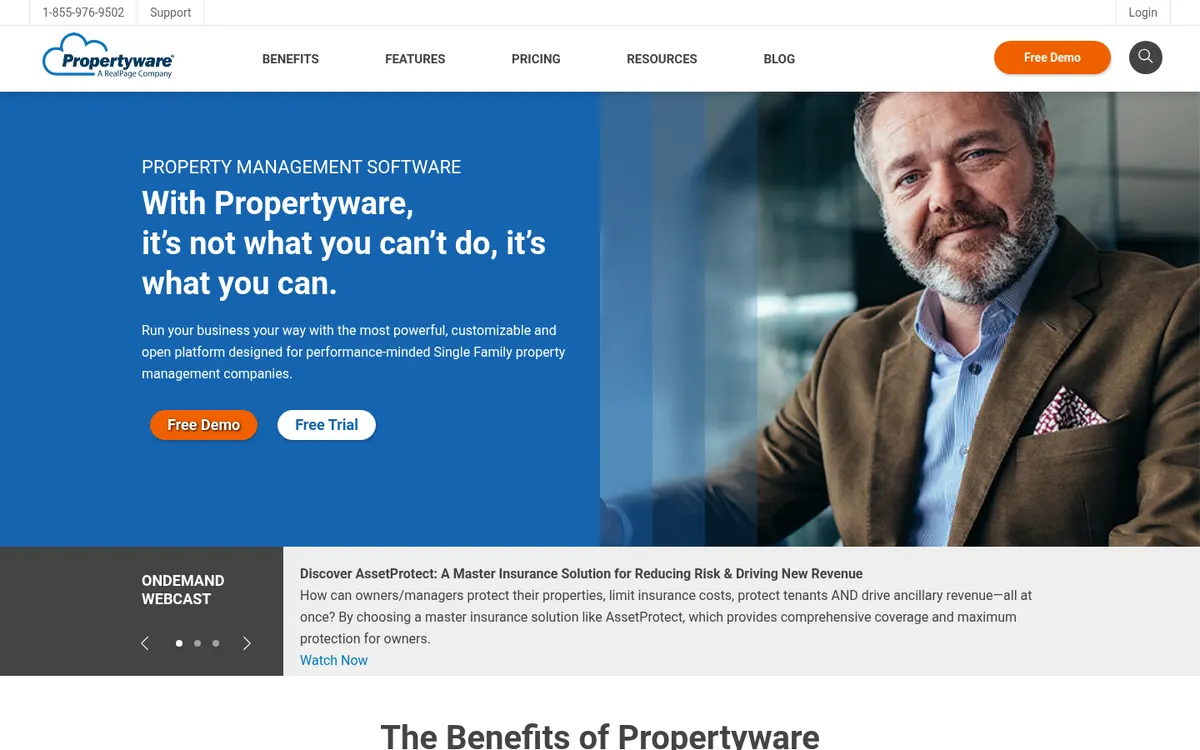
Propertyware is built for scattered-site single-family rentals: houses spread across a metro where maintenance coordination and owner statements matter more than a leasing lobby. It handles maintenance across dispersed properties, online rent collection, resident portals and owner statements, and it publishes Basic, Plus and Premium tiers rather than hiding behind a quote.
Pricing starts at $1 per unit per month on Basic with a $250 monthly minimum, plus a one-time implementation fee equal to two months of subscription. A limited-access free trial exists, which is more than several tools on this list offer. RealPage ownership brings rental industry integrations, which helps if the rest of your stack already runs on that side of the market.
Commercial is the weak spot. Commercial lease structures are a poor fit, and managers with a mixed book should confirm commercial capability before buying rather than after the migration. The minimum also dominates small portfolios: at $250 a month, a 60-unit book pays over $4 per unit, which erodes the headline rate quickly and makes the entry tier look cheaper than it is.
Propertyware fits single-family rental operators with dispersed properties and enough units to absorb the floor and the implementation fee. Skip it if commercial leases are a meaningful share of revenue, or if your portfolio is small enough that the minimum does the pricing rather than the rate.
What works
- Purpose-built for scattered-site single-family rentals
- Published Basic, Plus and Premium per-unit tiers
- Limited-access free trial available
What to weigh
- Commercial lease structures are a weak fit
- Implementation fee equal to two months of subscription
- $250 minimum dominates small portfolios
Pick it if
You manage dispersed single-family homes and want per-unit pricing you can see up front.
Skip it if
Commercial leases are a real part of the book, or if the $250 floor breaks the math.
Plate 07 of 08
RentRedi
Best for self-managing landlords who want one flat price
Our verdict
Best flat-rate entry point for self-managing landlords, with the shallowest commercial depth on this list.
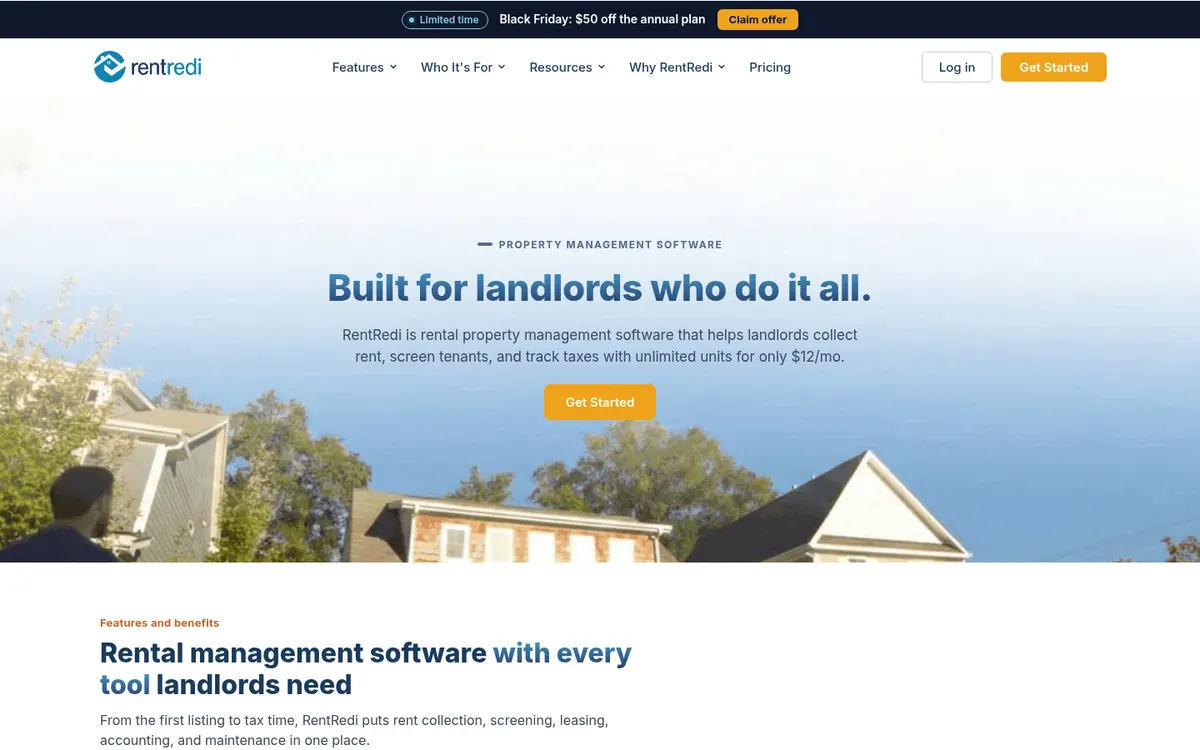
RentRedi charges one flat rate instead of doing per-unit math. Annual billing is $12 per month in total, with unlimited properties, tenants and team members, and month-to-month billing is $29.95. There is no minimum and no unit ladder, which puts it among the lowest entry costs in the category at small scale.
The feature set covers what a self-managing landlord needs: online rent collection, tenant screening, maintenance requests, lease and document storage, and mobile apps for tenants and landlords. Because properties and team members are both unlimited, adding a unit costs nothing and adding a helper costs nothing either, which is unusual in a category built on unit bands and seat fees.
Two limits follow from that positioning. It is aimed at self-managing landlords rather than professional managers, so accounting and reporting depth will not carry a management company with owner distributions and trust accounting. Commercial feature depth is basic. There is no free plan and no trial, though a 30-day money-back guarantee applies, which is a different kind of safety net than a test drive with your own data.
RentRedi fits self-managing landlords who want one flat price and unlimited properties, and it works well as a first system for a handful of units. Skip it if you manage commercial leases with CAM reconciliation, or if you need accounting built for a management business rather than a personal portfolio.
What works
- One flat rate with no per-unit math or minimums
- Unlimited properties, tenants and team members included
- 30-day money-back guarantee on the annual plan
What to weigh
- Aimed at self-managing landlords, not professional managers
- Commercial lease depth is basic
- No trial, so you commit before you test
Pick it if
You self-manage a small portfolio and want one predictable bill.
Skip it if
You run a management company with trust accounting or CAM reconciliations.
Plate 08 of 08
DoorLoop
Best for small managers wanting a full suite at a predictable price
Our verdict
Best small-team suite at a flat band, held back by a 24-hour trial and a shorter track record.
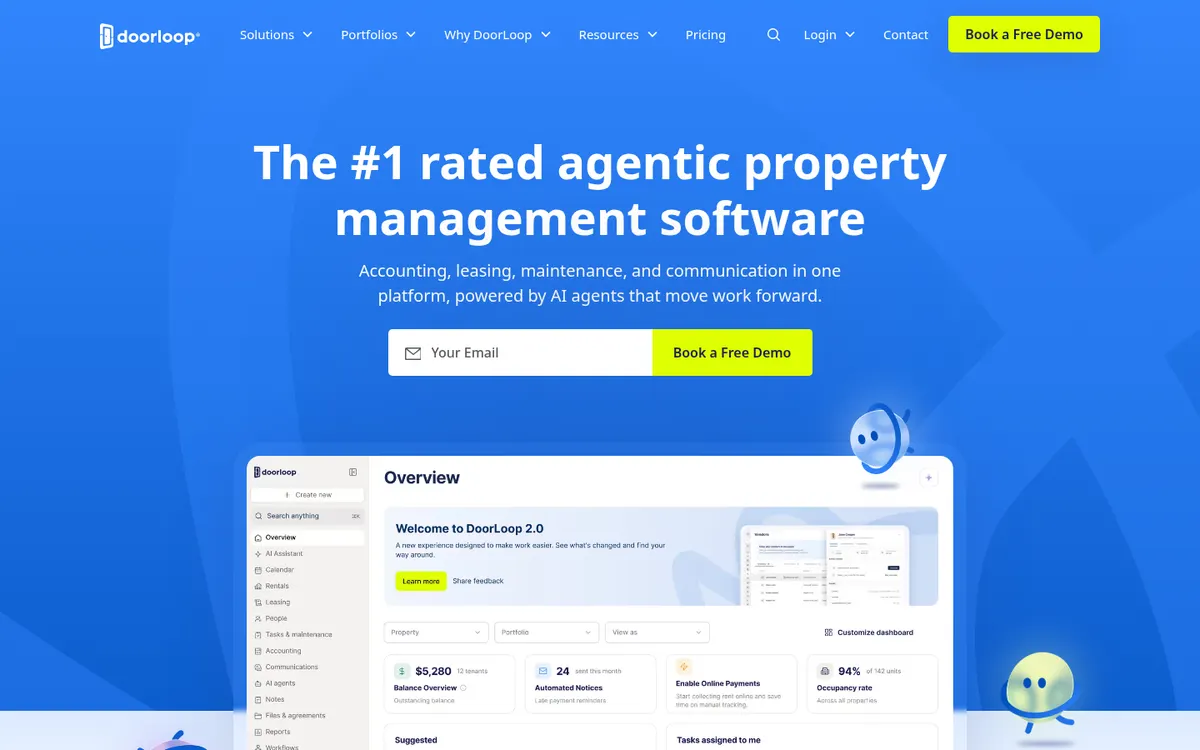
DoorLoop bundles a full suite at every plan level: accounting, rent collection, maintenance management, tenant portals and owner portals. Plans are published rather than quoted, and the entry plan is DoorLoop One at $2.50 per unit per month, with minimum spend and unit counts applying.
The flat structure is the selling point at small scale. Flat pricing for up to 20 units beats per-unit minimums when the portfolio is small, because you are not paying a floor designed for 200-unit operators. The interface is clean and current, which shortens training for a small team and makes it easier to hand a portal to an owner who logs in twice a quarter.
Two caveats. The free trial runs 24 hours, which is barely enough time to load a lease abstract, let alone test CAM reconciliation, so write a scripted evaluation before starting it. Pricing steps up across unit bands, so growing portfolios should map those bands before signing. DoorLoop is also a newer vendor with a shorter track record than the established names here, which matters if you want references from a decade of operation.
DoorLoop fits small managers who want a complete suite at a predictable price and can work within the 20-unit bands. Skip it if you need a long trial, or if you are large enough that the unit bands push the cost above a per-unit competitor.
What works
- Full suite included at every plan level
- Flat bands for up to 20 units beat per-unit floors
- Clean, current interface that trains fast
What to weigh
- 24-hour trial leaves little room to evaluate
- Pricing steps up across unit bands
- Newer vendor with a shorter track record
Pick it if
You manage a small portfolio and want accounting, portals and maintenance in one flat band.
Skip it if
You need more than a day to test, or if your unit count pushes you past the 20-unit bands.
What does commercial property management software handle that residential tools do not?
Commercial property management software tracks leases, rent, recoverable expenses and tenant work for property leased to businesses rather than to households, and the difference from residential tools sits in how leases are structured and how money is recovered.
Start with the lease. A commercial lease carries dates, renewal options, escalation schedules, expense stops, base years and sometimes percentage rent. Software has to store those terms in a way that bills correctly every month and trues up at year end. A residential lease mostly needs a rent amount, a term and a deposit, which is why apartment-first platforms can look complete and still fail on an office lease.
CAM reconciliation is the test most buyers run first. Operating expenses are pooled, allocated by each tenant's pro rata share, compared against what was collected, then billed or credited as a true-up. Percentage rent is the retail version of the same problem: a tenant pays base rent plus a share of sales above a breakpoint, and the system has to track sales reports and calculate the overage.
The rest is operational. Ledgers need to be readable per tenant and per property. Owner statements need to show income, expenses and distributions in a format the owner accepts without rework. Work orders need to route to the right vendor with the right approval limit.
- Lease administration: terms, options, escalations, expense recovery clauses
- Accounting: tenant ledgers, property ledgers, CAM pools, percentage rent
- Operations: work orders, vendor coordination, preventive maintenance
- Reporting: owner statements, budget against actual, portfolio rollups
Most small portfolios run this on spreadsheets and survive. The system earns its price when CAM pools, audited owner statements or a handful of retail percentage rent clauses start consuming hours every month. Until then, a flat plan or a well-kept spreadsheet is a defensible choice.
This guide sits in the Software collection. Buyers weighing nearby tools often read the guides to commission software and research platforms next.
How billing models change what commercial property management software costs
Five billing models appear on this list, and the model matters more than the feature list when you compare costs. Normalize everything to a monthly figure at your own unit count before you decide anything.
| Model | How it bills | Typical fit | Example from this list |
|---|---|---|---|
| Flat monthly | One price covers unlimited or capped properties | Self-managing landlords and very small books | RentRedi at $12 per month on annual billing, unlimited properties and tenants |
| Per unit with a floor | Rate times unit count, with a monthly minimum | Managers who can forecast growth | Yardi Breeze Residential at $1 per unit per month, $100 monthly minimum |
| Tiered by unit count | Plan level rises as units are added | Small to mid-size managers | Buildium from $65 per month on Essential, scaling with unit count |
| Per unit plus implementation | Per-unit rate plus a one-time onboarding charge | Single-family rental operators | Propertyware at $1 per unit on Basic, $250 minimum, implementation fee equal to two months of subscription |
| Custom quote | Vendor prices each deal after scoping | Enterprises and multifamily operators | AppFolio, Entrata and MRI Software, all marked See website |
Flat pricing wins below a threshold. RentRedi charges $12 per month on annual billing for unlimited properties and tenants, and DoorLoop runs flat bands covering up to 20 units, so a small book pays a small bill. Pass the band or the feature ceiling and the math flips.
Per-unit pricing with a floor appears more than once here, and the floor is what surprises buyers. Yardi Breeze Commercial lists $2 per unit per month with a $200 floor, and Propertyware starts at $1 per unit on Basic with a $250 monthly minimum. At low unit counts the minimum, not the rate, sets the bill.
Tiered pricing gives you a published ladder. Buildium starts at $65 per month on Essential and scales with unit count through Growth and Premium, reaching several hundred dollars a month at higher unit counts, so you can plan the step up.
Quote-only pricing covers AppFolio, Entrata and MRI Software, and no pricing page was captured for them on November 25, 2026. Compare those tools on lease depth and reporting, then request a written quote at your own unit count.
Every price in this guide was read on the vendor's own pricing page on November 25, 2026. Where a vendor does not publish a figure we could confirm, the card says "See website" rather than a guess. For the arithmetic around this purchase, try the free Email campaign metrics calculator.
How to choose commercial property management software in six steps
Map units and lease types. List every property, unit count and lease type before you look at software. A 40-unit office book and a 400-unit apartment book need different tools, and mixing them pushes you toward enterprise pricing you cannot use.
Write three lease tests. Pull the messiest clauses you actually administer, usually CAM reconciliation, percentage rent and an expense stop, and turn them into a script. Every demo should run that script rather than the vendor's showcase data.
Filter by pricing model. If you cannot schedule a demo this month, drop the quote-only tools (AppFolio, Entrata, MRI Software) from the shortlist early. If you need a published number to open a budget line, start with Buildium, Yardi Breeze or DoorLoop.
Check the floor, not the headline. Multiply your units by the per-unit rate, then compare against the monthly minimum. Yardi Breeze Commercial at 50 units bills $200, not $100, and Propertyware's $250 floor does the same at small scale.
Book the trial and load real data. Buildium gives 14 days with no credit card, DoorLoop gives 24 hours and Propertyware gives limited access. Load one real lease abstract, one ledger and one owner statement, then check the outputs against your spreadsheet.
Price the first year, not the first month. Add implementation and onboarding to the subscription before comparing totals. Propertyware charges a one-time fee equal to two months of subscription, and AppFolio's onboarding adds to first-year cost.
Mistakes that cost commercial buyers money
Buying residential software and assuming commercial will follow. Tools built for houses and apartments rarely model CAM pools or percentage rent without workarounds. Test your own commercial clauses in the trial, not a demo dataset the vendor prepared.
Comparing headline rates without minimums. A $1 per unit rate with a $250 floor is $5 per unit at 50 units. Do the multiplication against your real unit count before you treat any rate as cheap.
Leaving migration out of the plan. Lease abstracts, historical ledgers and owner statement formats are where implementations slip. Ask which fields move, who validates them and when cutover happens, and put that work in the budget.
Treating a 24-hour trial as an evaluation. A single day is enough to click around and not enough to test a reconciliation. Write the test script in advance or ask for an extended sandbox before you commit to a year.
Ignoring who owns the roadmap. Buildium sits under RealPage ownership, which points its roadmap toward enterprise buyers, and Propertyware shares that ownership. Ask how much development the tier you are buying has seen in the last two years.
Best Commercial Property Management Software 2026: questions
What does commercial property management software cost in 2026?
It depends on the billing model rather than the feature list. Flat plans start at $12 per month on annual billing (RentRedi, with unlimited properties and tenants), per-unit plans start at $1 per unit per month (Yardi Breeze Residential and Propertyware Basic), and AppFolio, Entrata and MRI Software quote each deal, so no public number exists to compare.
How is commercial lease management different from residential?
The difference sits in the money clauses. Commercial leases commonly carry CAM reconciliation, operating expense stops, base year adjustments and percentage rent, all of which need to be modeled, billed and trued up. Residential leases mostly need a rent amount, a term and a deposit. That is why tools built for houses and apartments need verification before you trust them with a retail or office lease.
Is software worth it for a small commercial portfolio?
Often not at the enterprise end, and sometimes yes at the flat end. A small portfolio paying a $200 to $250 monthly minimum spends $2,400 to $3,000 a year before implementation fees, which can exceed the value of the automation. A flat plan at $12 per month is easier to justify. Add software when leases, CAM pools or owner reporting start consuming hours each month.
How do lease abstracts, ledgers and owner statements get migrated during onboarding?
Ask for a written migration plan before signing, listing which fields move, who validates them and when cutover happens. Lease abstracts, historical ledgers and owner statement formats are common places where implementations break, because every vendor's data model differs. Propertyware charges an implementation fee equal to two months of subscription, and AppFolio's onboarding adds to first-year cost, so migration is a budget line, not a footnote.
At what unit count does flat pricing stop beating per-unit pricing?
It depends on the floor as much as the rate. RentRedi stays flat at $12 per month on annual billing for unlimited properties, DoorLoop covers up to 20 units per plan, and Yardi Breeze Commercial charges $2 per unit with a $200 floor. The crossover arrives when units times rate passes the flat plan, or when the features you need only exist above the flat tier.
Which tools here offer a trial, and how long is it?
Buildium offers a 14-day free trial with no credit card required, Propertyware offers a limited-access free trial, and DoorLoop offers a free trial of 24 hours. RentRedi has no trial but a 30-day money-back guarantee. AppFolio, Yardi Breeze, Entrata and MRI Software are demo only or have no trial, so evaluation there runs through a sales walkthrough.