
Contents of this guide
The shortlist
Our top 3 for software buyers

Rent Manager
Park-level accounting
- Best for
- Mid-to-large operators with 50-plus lots needing deep accounting
- Features
- 4 noted: Lot rent billing, Park-level financials, Open API, Field inspections

ManageAmerica
Utility sub-metering
- Best for
- Owners running only manufactured home communities wanting a native vendor
- Features
- 4 noted: Utility sub-metering, Resident AutoPay, Park-native, Offline meter reads

AppFolio Property Manager
Scale and portals
- Best for
- Mid-to-large managers of several parks or mixed 50-plus-unit portfolios
- Features
- 4 noted: AI leasing, Owner portals, Work orders, Integrations
Disclosure for this guide. All 8 tools here are unpaid editorial picks. The position of a paid listing can be part of what the vendor pays for. Paid and unpaid tools are scored on the same rubric and keep their cons. Details are in the advertising disclosure.
The ledger
Index of every tool
| Tool | Free plan | Trial | Rubric | Compare | ||
|---|---|---|---|---|---|---|
| 01 | Rent ManagerMid-to-large operators with 50-plus lots needing deep accounting | See websiteNot published | No, free live demo | Demo only | ||
| 02 | ManageAmericaOwners running only manufactured home communities wanting a native vendor | See websiteNot published | No | No | ||
| 03 | AppFolio Property ManagerMid-to-large managers of several parks or mixed 50-plus-unit portfolios | See websiteNot published | No | No | ||
| 04 |  Buildium20-to-several-hundred-lot parks wanting solid books without minimums | $65Essential, per month, up to 40 unitsChecked Nov 25, 2026 | No | 14-day free trial, no credit card | ||
| 05 |  DoorLoopSmall-to-mid parks up to 100-plus lots wanting a polished all-in-one | $2.50DoorLoop One, per unit per month, minimum spend and units applyChecked Nov 25, 2026 | No | No free trial reported | ||
| 06 |  Rentec DirectBudget-conscious owners of 10 to 100 lots needing trust accounting | $25Rentec Starter, flat monthly rate, up to 10 properties and tenantsChecked Nov 25, 2026 | No | 2-week free trial | ||
| 07 |  InnagoSelf-managing owners of 10 to 100 lot parks wanting to digitize free | FreeAll listed features included, no setup fee, no contractChecked Nov 25, 2026 | Yes, perpetually free | Not applicable, perpetually free | ||
| 08 |  LotlyPark owners wanting a manufactured-housing-native tool with transparent pricing | $1.25Starter, per occupied unit per month, 1 to 249 units, vacant lots freeChecked Nov 25, 2026 | No, vacant lots are free | See website |
Prices are the lowest paid plan the vendor shows, read on November 25, 2026. Sort by price ranks published monthly figures; tools without one go last. Pin up to three tools to compare them side by side.
How this guide was put together
Every tool here was scored against the same five criteria: park-specific fit, rent billing, accounting depth, field operations and price clarity. Park-specific fit asks whether lot rent, vacant lots and sub-metered utilities are native workflows or something you bend into shape. Rent billing covers recurring lot charges, late fees and online collection. Accounting depth looks at double-entry books, reconciliation, owner statements and reporting. Field operations covers work orders, inspections and meter reads. Price clarity rewards published rates and penalizes quote-only gates that slow comparison.
Prices and plan details were read from vendor pricing pages and checked on November 25, 2026. Where a vendor publishes no price list, the entry says pricing is on the vendor site instead of guessing a number. Per-unit and minimum figures a vendor does not publish are treated as quote-only, not stated as fact.
Fit drives the order. Each entry names the buyer it serves, so a tool built for a 900-lot portfolio sits where it does because of that buyer, not because a weighted total placed it there. A Featured position is a paid placement, and the featured vendor is scored with the same rubric and carries the same kind of honest cons as every other entry. Placement does not change the criteria, the weights or the limits listed.
Read the review for the buyer matching your lot count, then check the fee schedule before a trial ends. Transaction fees, per-document eSignature charges and texting costs routinely move the real monthly figure above the sticker price.
The full process, including how we handle corrections, is on the methodology page. Paid listings follow the advertising disclosure.
Rubric and weights
Every tool below is scored from 1 to 10 on these five criteria. The scores describe each tool; the order is an editorial call on fit for the buyer each card describes, plus the disclosed Featured position.
- 25%Park-specific fitWhether lot rent, vacant lots and resident-owned homes are native objects rather than apartment workflows bent into shape.
- 20%Rent billingRecurring lot charges, automated late fees, autopay and online collection in one loop.
- 20%Accounting depthDouble-entry books, bank reconciliation, owner statements and reporting an owner or lender will accept.
- 15%Field operationsWork orders, inspections, meter reads and violation logging usable from a phone on site.
- 20%Price clarityPublished rates and predictable fees versus quote-only gates and undisclosed transaction charges.
Plate 01 of 08
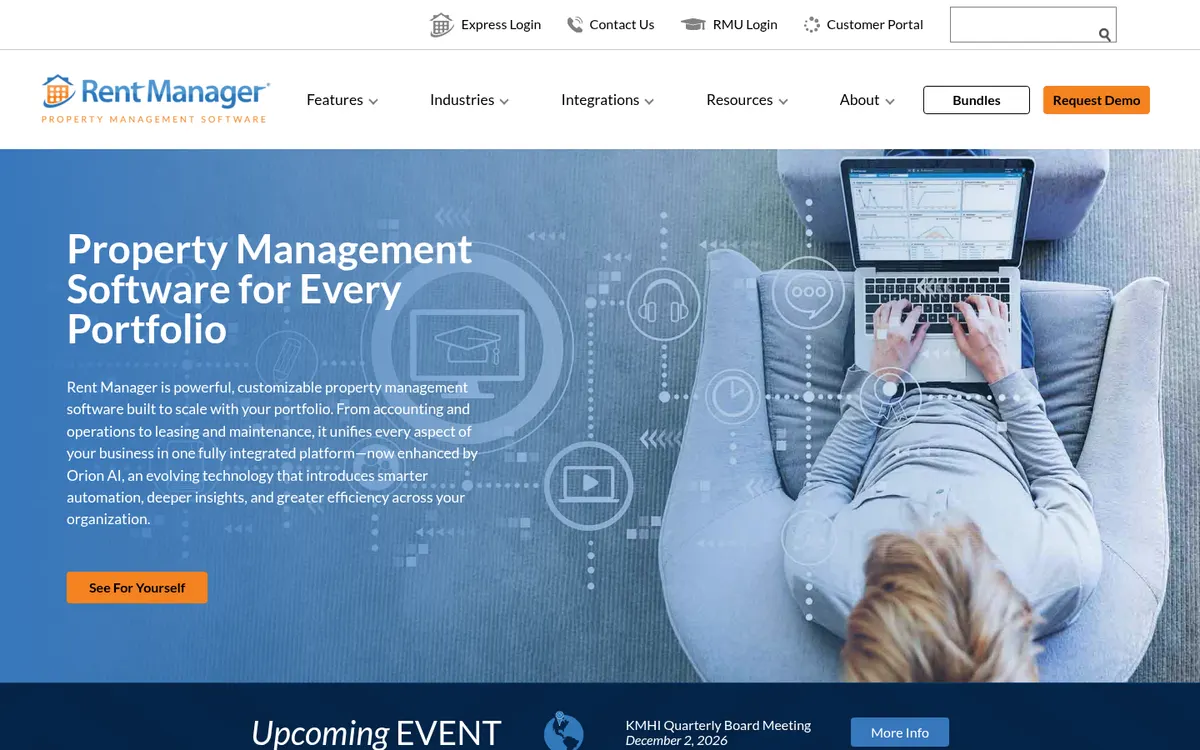
Rent Manager
Best for mid-to-large operators with 50-plus lots needing deep accounting
Our verdict
The deepest accounting system here, built for operators who need park-level books, audit trails and field tools in one place.
Rent Manager is the deepest accounting system on this list, and it is the first tool to shortlist once a park has outgrown spreadsheets and a single checkbook. The vendor names manufactured housing and RV parks explicitly, so lot rent, late fees and recurring charges run as native workflows rather than a lease type you force into shape. It fits mid-to-large operators with 50-plus lots. A single 30-lot park pays for reporting it will never open.
The accounting core is double-entry with bank reconciliation and 1099 tools, and each property keeps its own statements with audit trails. There are 450-plus built-in reports, plus an open API and an integrations marketplace for owners who roll park-level financials up without manual spreadsheet work. Field tools cover mobile work orders, inspections, meter reading and violations, so a manager walking lots can log a violation and attach it to the resident record in one pass. Online ACH and card payments handle collection, and owner portals publish per-property statements.
Pricing is on the vendor site and quote-only, so there is no price list to line up against competitors. A live demo replaces a free plan or trial. A one-time implementation fee sits on top of the subscription, along with add-on fees, so ask for a written quote that covers the first year.
The honest limits: a steep learning curve, occasional crashes reported by users, and a quote process that slows side-by-side comparison. Smaller single-park owners often find flat-rate tools cheaper for the same core workflows. Get a written two-year quote before you commit.
What works
- Explicit support for manufactured housing and RV parks
- 450-plus report library plus an open API
- Mobile inspections, meter reads and violations
What to weigh
- Steep learning curve and occasional crashes reported
- Add-on fees sit on top of the subscription
- Quote-only pricing plus a one-time implementation fee
Pick it if
You run 50-plus lots and need park-level financials, audit trails and an open API.
Skip it if
You have one small park and want a flat monthly number you can budget without a quote cycle.
Plate 02 of 08
ManageAmerica
Best for owners running only manufactured home communities wanting a native vendor
Our verdict
The manufactured-housing specialist, and the cleanest answer when sub-metered water and electric recovery drives your lot rent economics.
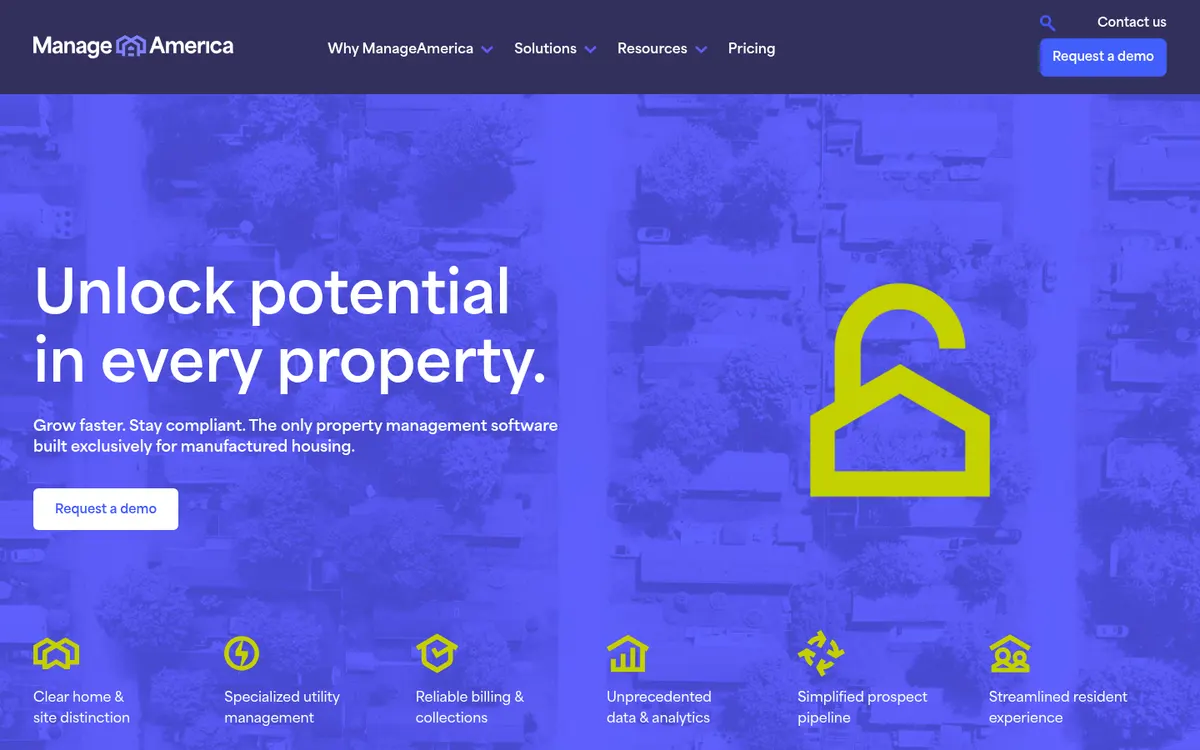
ManageAmerica is the specialist. The vendor has spent roughly 25 years on manufactured housing communities and nothing else, and that focus shows in the part of the workflow general tools handle badly: sub-metered water and electric charges posted straight to resident ledgers. If utility recovery is a real line in your lot rent economics, this is the shortest path to getting the numbers right without a spreadsheet running alongside the software.
Utility charges flow from meter reads into resident ledgers as pass-through amounts, and mobile meter reading works offline, which matters on a large site with patchy signal. Lot rent billing carries automated late fees, the resident portal covers AutoPay and payment history, and online payments are included. Maintenance and field assessment tools round out the operational side, so a manager can log an issue from the lot rather than from the office.
Pricing is on the vendor site and quote-only. There is no free plan and no free trial, so evaluation runs through a demo and reference calls with existing customers. That quote-only model is the main friction: you cannot line ManageAmerica up against a published rate without sitting through a sales cycle first, and comparison shopping becomes a scheduling exercise.
The limits are about evidence rather than capability. The public review record is thin, so peer validation is hard to find, and owner and investor reporting depth is not publicly documented. Before signing, ask for a sample owner packet and a statement showing how a water charge, a late fee and a vacant lot each appear on one ledger. Owners running only manufactured home communities, with no apartment or commercial mix, get the cleanest fit. Mixed portfolios often choose a broader platform and build utility recovery as a workaround.
What works
- Roughly 25 years focused only on manufactured housing
- Native sub-metered utility billing with pass-through charges
- Resident portal with AutoPay and payment history
What to weigh
- Quote-only pricing slows side-by-side comparison
- Thin public review record limits peer validation
- Owner and investor reporting depth not publicly documented
Pick it if
You run manufactured home communities only and re-bill water and electric to residents.
Skip it if
You need apartment or commercial support, or if a documented reporting suite matters to your lender.
Plate 03 of 08
AppFolio Property Manager
Best for mid-to-large managers of several parks or mixed 50-plus-unit portfolios
Our verdict
A scale platform for multi-park and mixed portfolios, with leasing automation and accounting that small single parks cannot reach on price.
AppFolio Property Manager is built for scale, and that is both the pitch and the problem. Mid-to-large managers running several parks, or a mixed portfolio of 50-plus units, get leasing automation, a full accounting suite and strong tenant and owner portals in one system. A single park with 40 lots sits below the reported floor and would pay for capacity it cannot use.
The feature set is broad: AI leasing assistance with marketing syndication, maintenance work-order tracking with vendor management, owner portals with customizable financials, recurring lot rent billing with late fees and online payments, and an integrations marketplace. Managers who also run apartments or commercial space keep everything in one ledger rather than stitching a park system to a separate accounting package, which is where the real time savings show up at month end.
Pricing is quote-only. Core and Plus are priced per unit, but the vendor quotes rates rather than publishing them, so ask for a written quote. The 50-plus-unit focus is what disqualifies most small parks before a demo even starts, and per-unit cost climbs on higher tiers.
The limits worth naming are commercial. A 50-plus-unit focus puts it out of reach for one small park, and quote-only pricing makes comparison work. Get a written quote that models two years of projected growth, because the per-unit math changes as you add lots. Fit it to portfolios that will cross 100 units within a couple of years, not to a park that is happy at 60.
What works
- Scales from about 50 units to thousands
- Leasing automation and accounting in one system
- Strong tenant and owner portals
What to weigh
- Priced for 50-plus-unit portfolios with no public price list
- Per-unit cost climbs on higher tiers
- Quote-only pricing
Pick it if
You manage several parks or a mixed 50-plus-unit portfolio and want leasing plus accounting in one place.
Skip it if
You run a single small park, since the reported minimum and floor dominate your cost.
Plate 04 of 08
Buildium
Best for 20-to-several-hundred-lot parks wanting solid books without minimums
Our verdict
The value pick for parks that want full books, both portals and no unit minimum, from $65 per month for 40 units.
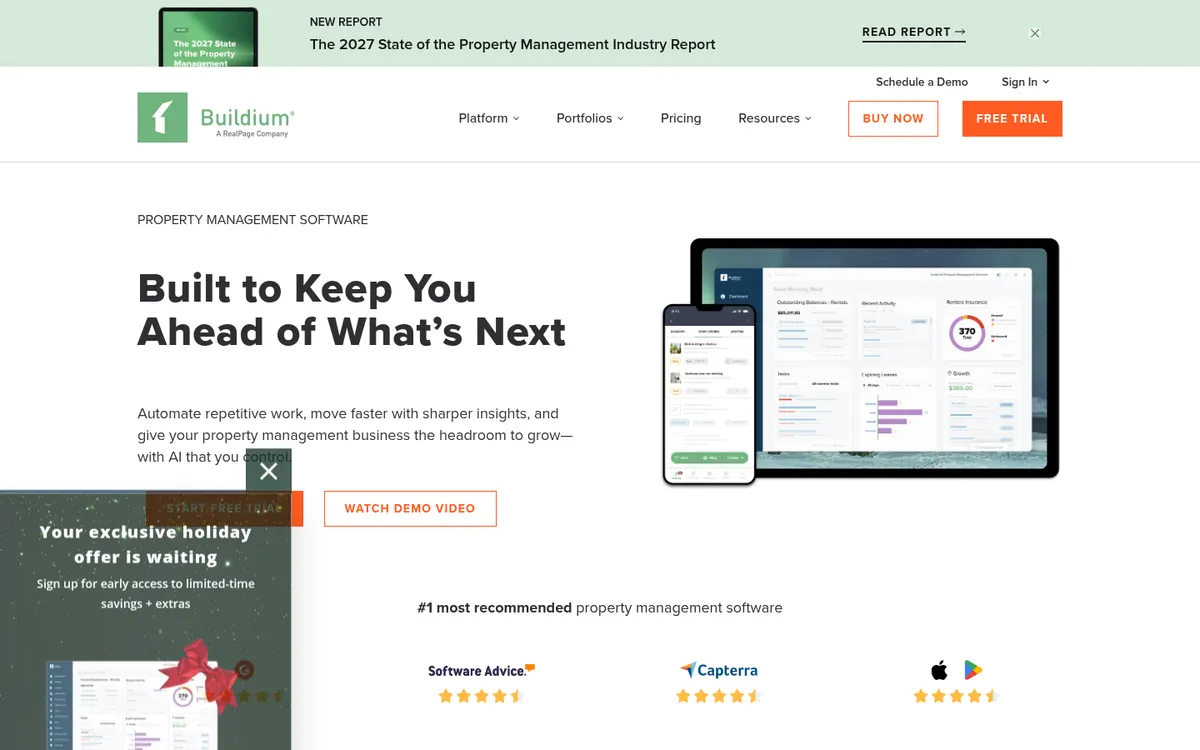
Buildium is the value pick for parks that want solid books without a unit minimum. It runs from a single 20-lot park to several hundred lots on the same platform, with recurring lot rent billing, late fees and autopay, built-in work orders, bank reconciliation and both tenant and owner portals included. The accounting suite is the reason to choose it: reconciliation, eSignatures and owner financial reporting all come with the core product rather than a premium add-on.
Online payments, in-platform messaging across both portals and an open API on the Premium tier cover the operational basics. The interface is approachable for a small office, and staff who have used other rental software generally settle in quickly without a long training curve.
Pricing starts at $65 per month on Essential for up to 40 units, with a 14-day free trial and no credit card required. Tiers step up through Growth from $192 and Premium from $400 per month as unit count rises. The catch is the fee schedule: payment processing fees, bank setup fees and add-on charges on lower tiers push the real monthly figure above the sticker. A park collecting 120 payments a month should do that multiplication before the trial ends.
The other limit is tier gating. Open API access, advanced automation and priority support are restricted to Premium, so a growing park may need to upgrade for reasons unrelated to lot count. Fit it to a park with 20 to several hundred lots that wants standard property accounting with both portals, and can live without sub-metered utility billing, which Buildium does not offer natively. Parks recovering water charges should look at ManageAmerica or Lotly instead.
What works
- No unit minimum, so it fits one small park or thousands of lots
- Full accounting suite with reconciliation and eSignatures
- Both tenant and owner portals included
What to weigh
- Payment processing fees on the entry tier plus bank setup fees
- Extra add-on charges on lower tiers
- Open API and priority support restricted to Premium
Pick it if
You want full double-entry books, both portals and no unit minimum at a published price.
Skip it if
You re-bill sub-metered utilities, which Buildium does not handle natively.
Plate 05 of 08
DoorLoop
Best for small-to-mid parks up to 100-plus lots wanting a polished all-in-one
Our verdict
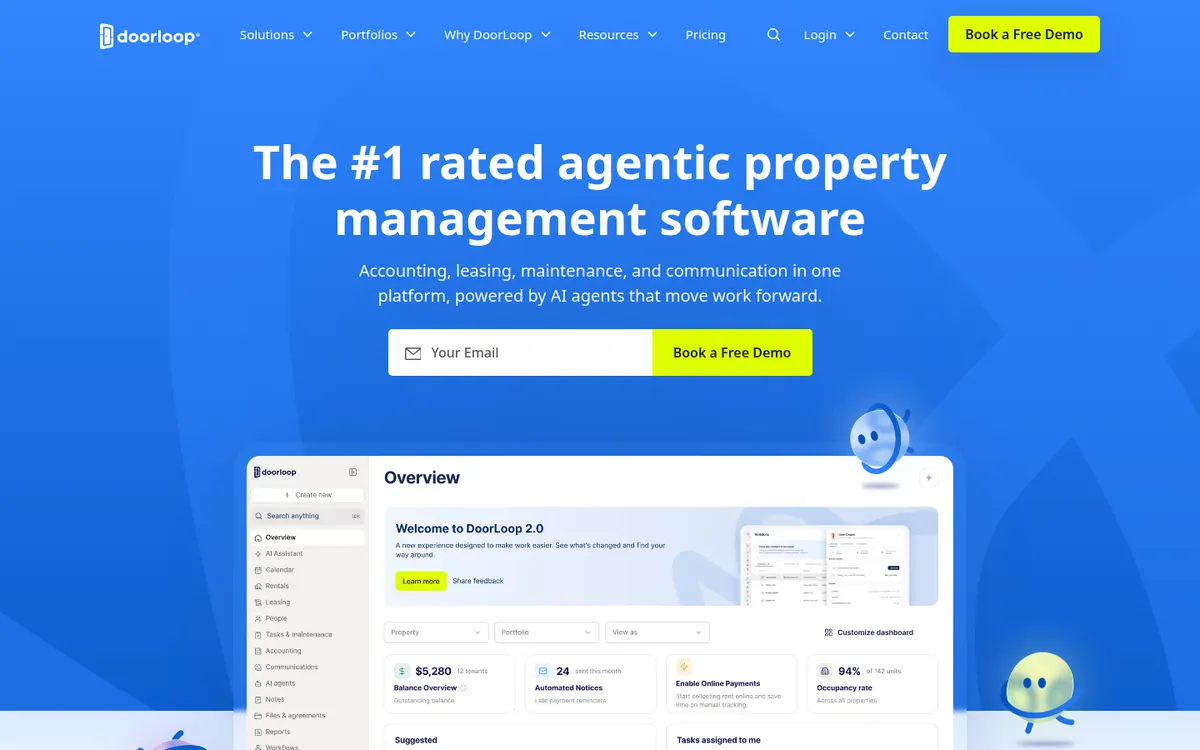
The most polished all-in-one here, with published per-unit pricing and an interface staff learn fast.
DoorLoop is the polish play. Its interface is modern and fast, and staff tend to adopt it without a long training curve, which is worth real money in a small office where one manager handles leasing, collections and maintenance. Recurring lot rent billing with late fees and autopay, tenant portals, a work-order portal for staff and contractors, owner reporting with statements, and accounting, leasing and maintenance all sit in one place instead of three.
Pricing is published, which is refreshing on this list. DoorLoop One runs $2.50 per unit per month with a minimum spend and unit count applying, so a very small park should confirm the floor before assuming the per-unit math holds at 12 lots. Pro runs $189 monthly or $149 annually, and Premium $239 monthly or $209 annually, with pricing scaling by unit count. Annual discounts are real, and the platform has no unit minimum.
The limits are all in the fee layer. Rent collection carries merchant fees, eSignatures cost $3 per document on Starter, and texting is charged separately. API access and integrations are Premium only, which matters if you plan to sync accounting or pull data into a warehouse. None of these are unusual, but together they move the monthly number.
No free trial is documented, so the demo is your evaluation window. Fit it to small-to-mid parks up to 100-plus lots that want one polished system and will actually use the portals. A 30-lot park that mostly needs lot rent and a ledger may find flat-rate Rentec Direct or free Innago cheaper for the same outcomes. Ask for a written fee estimate covering a normal month of payments before you sign.
What works
- Modern, fast interface that staff adopt quickly
- Published pricing with annual discounts and no unit minimum
- Accounting, leasing, maintenance and portals unified
What to weigh
- Merchant fees on rent collection plus $3 per document eSignatures on Starter
- API and integrations limited to Premium
- Cost rises with unit count above included allotments
Pick it if
You want one polished platform with published per-unit pricing and staff who will live in the portals.
Skip it if
Your monthly transaction volume is high, since merchant and per-document fees add up.
Plate 06 of 08
Rentec Direct
Best for budget-conscious owners of 10 to 100 lots needing trust accounting
Our verdict
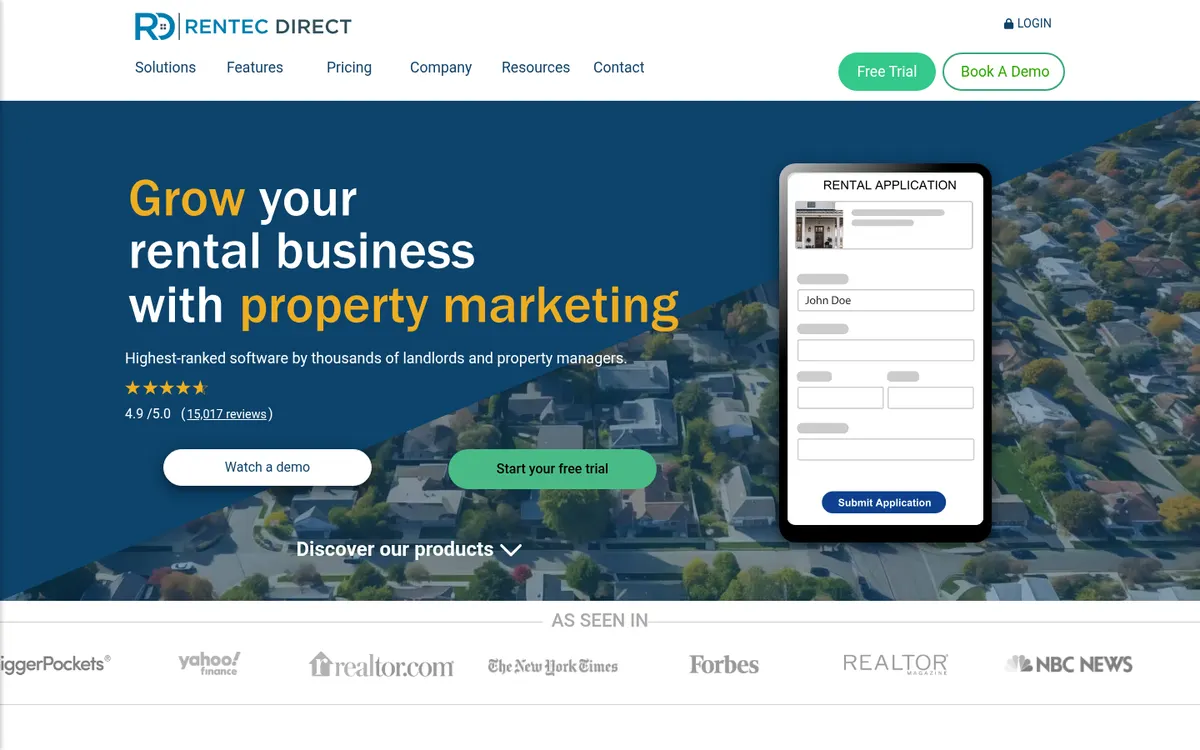
The budget workhorse under 50 lots, with a flat $25 entry, free ACH on higher tiers and a large cash payment network.
Rentec Direct is the budget workhorse and the easiest recommendation under 50 lots. Starter is a flat $25 per month for up to 10 properties and tenants, with recurring lot rent billing, late fees and reminders, income and expense tracking, no setup fees, no contracts and unlimited tenants, properties and users. A two-week free trial lets you test it against your actual rent roll before paying anything.
The Pro and PM plans start from $50 per month and scale per unit. Free ACH collection arrives on Pro and PM, along with maintenance request tracking, and the cash payment network covers 20,000-plus locations, which matters for resident bases that still pay at a store counter. Trust accounting and an owner portal sit on the PM tier at a price point where most competitors charge premium tier rates for the same pair. Free onboarding and US-based support are bundled rather than sold as add-ons.
The limits are age and ecosystem. The interface looks dated next to DoorLoop, the mobile experience lags newer tools, and the integration ecosystem is thin. There is also no downgrade path from Pro or PM back to Starter, so upgrading is a one-way door and a park that grows then shrinks keeps paying.
Fit it to budget-conscious owners of 10 to 100 lots who need trust accounting and free ACH more than they need a modern UI. A park with heavy cash collection and a small office gets the most value here. If your residents all pay online and your manager works from a phone, spend the difference elsewhere.
What works
- Flat $25 entry with no setup fees, contracts or user limits
- Free ACH on Pro and PM plus a 20,000-location cash network
- Trust accounting and owner portal at a low price point
What to weigh
- Dated interface with a thin integration ecosystem
- Mobile experience lags newer tools
- No downgrade path from Pro or PM back to Starter
Pick it if
You run 10 to 100 lots, take a lot of cash payments and want trust accounting cheaply.
Skip it if
Your staff work mostly from phones or you need integrations with other systems.
Plate 07 of 08
Innago
Best for self-managing owners of 10 to 100 lot parks wanting to digitize free
Our verdict
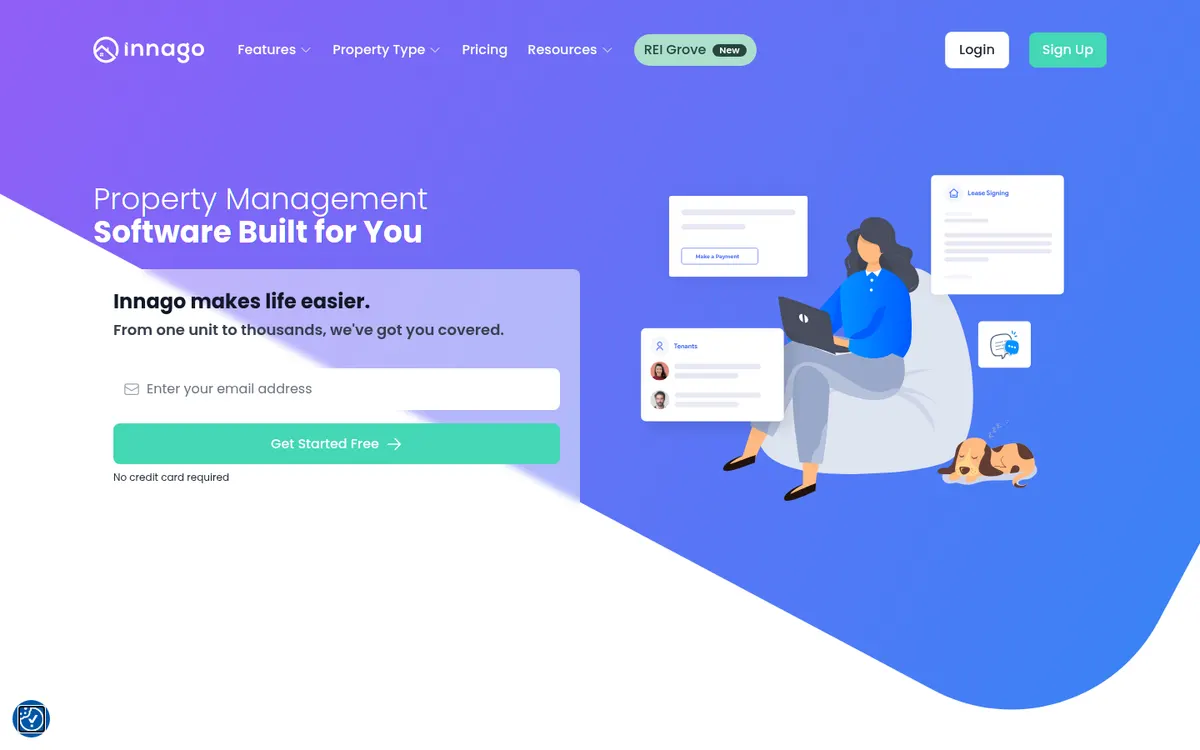
Free for landlords, simple enough for a self-managing owner, and limited on accounting, utility billing and investor reporting.
Innago is free, and that is the whole argument. Landlords and managers pay nothing for the platform: listings and applications, lease management, rent collection by ACH and card, maintenance requests through the tenant portal, recurring lot rent billing with late fees, reporting and a QuickBooks sync. For a self-managing owner replacing spreadsheets and paper checks, that is a genuine step up at zero software cost and no setup fee or contract.
The model is transaction-funded. Revenue comes from tenant-paid transaction fees, and landlords can optionally absorb ACH and card costs, which changes the effective price. The interface is simple enough that an owner-operator with a day job can run it without training, and the tenant portal does most of the collection work for you.
The limits show up as you grow. Accounting is basic, without full double-entry books, so multi-entity owners and anyone preparing investor reporting will outgrow it. There is no sub-metered utility billing and no lot-specific workflow beyond standard recurring charges, which is the gap that pushes parks with water and electric recovery toward ManageAmerica or Lotly. Owner and investor reporting is thin.
Fit it to self-managing owners of 10 to 100 lot parks who mostly need to collect rent online, track maintenance and keep a clean record for taxes. If you have an accountant asking for a trial balance, or a lender asking for per-property statements, budget for one of the paid tools instead. Free is a real answer here, but only for a narrow set of buyers.
What works
- No software cost for landlords and managers
- Simple interface suited to self-managing owners
- QuickBooks integration for bookkeeping
What to weigh
- Basic accounting without full double-entry books
- No sub-metered utility billing or lot-specific workflows
- Thin owner and investor reporting
Pick it if
You self-manage a small park, want rent collected online and have no investor reporting needs.
Skip it if
You need double-entry books, utility pass-through billing or lender-ready statements.
Plate 08 of 08
Lotly
Best for park owners wanting a manufactured-housing-native tool with transparent pricing
Our verdict
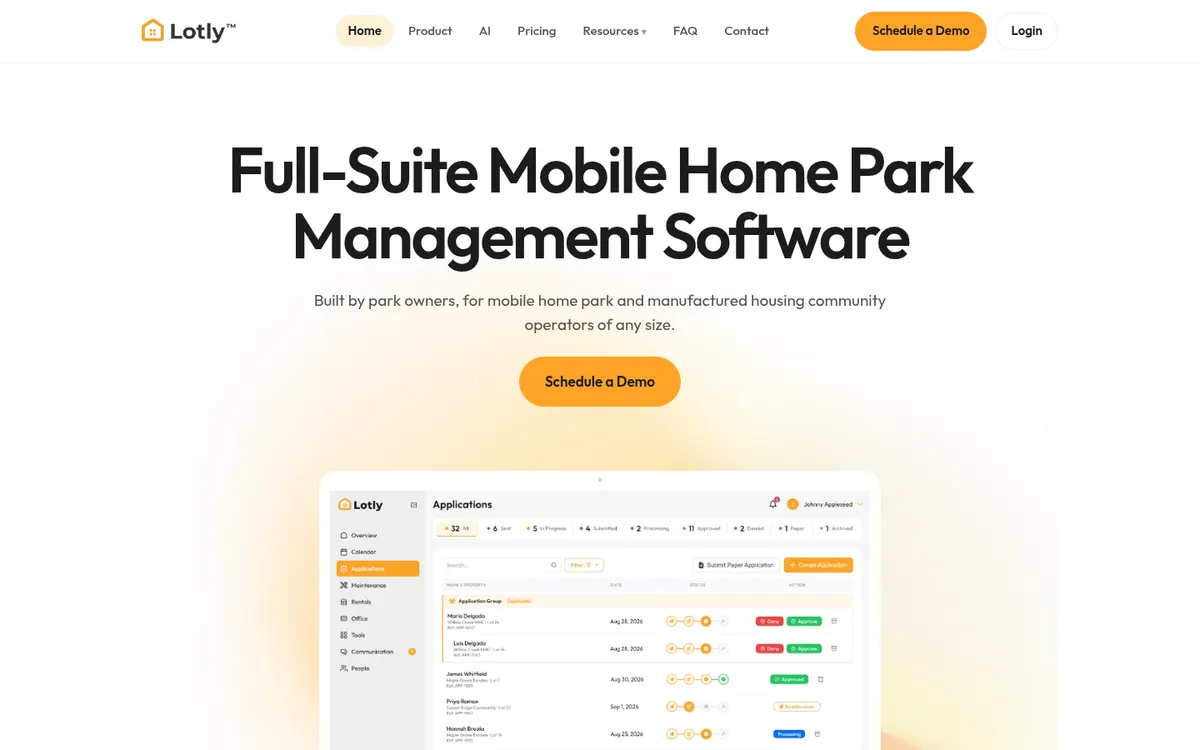
A park-native product that bills only occupied lots, starting at $1.25 per occupied unit per month with vacant lots free.
Lotly is the newest park-native option here, and it prices the way park owners think. Billing runs per occupied unit at $1.25 per month for 1 to 249 units, drops to $1.00 for 250 to 999 and $0.75 above 1,000, and vacant lots are free. A 60-lot park at 90 percent occupancy lands near $68 per month. There is no setup fee, and annual billing saves 5 percent.
The workflow is built around lot-based billing rather than apartments. Utility meter readings are pulled from provider hardware, automated rate plans and pass-through fees post to resident ledgers, and lot rent billing carries late fees. Maintenance scheduling and resident ledgers round it out. For a park that currently recovers water through a spreadsheet maintained by one person, the automation is the reason to look, because it removes the monthly reconciliation scramble.
The limits are maturity. It is a young niche product with a limited public track record, so reference calls matter more than usual and you should ask specifically about parks your size with the same utility setup. There is no flat-rate pricing option, which means a park with heavy vacancy pays less but a park at high occupancy without utility recovery may prefer a flat tier from Buildium or Rentec Direct. Owner and investor reporting depth is not publicly documented.
Fit it to park owners who want a manufactured-housing-native tool with transparent per-lot pricing, especially where sub-metered utilities are a real cost line. Skip it if you need a long operating history, deep investor reporting or a flat monthly number you can budget without tracking occupancy. Run the demo against your own meter data.
What works
- Built solely for mobile home parks
- Vacant lots carry no charge
- Utility sub-metering automation posts charges to ledgers
What to weigh
- Young niche product with a limited public track record
- No flat-rate pricing option
- Owner and investor reporting depth not publicly documented
Pick it if
You want park-native billing, vacant lots free and utility charges posted to ledgers automatically.
Skip it if
You need a long track record or deep investor reporting before you switch systems.
What does mobile home park management software actually do?
Mobile home park management software runs the operating loop of a park: billing lot rent, collecting it, tracking balances, logging maintenance and reporting to owners. What separates it from general rental software is what gets billed. A park rents land, not buildings, so the core object is the lot, and often a home that sits on it and may be owned by the resident rather than the park. That changes late fee rules, move-in paperwork, utility recovery and how vacancy is counted.
Three park-specific jobs drive most buying decisions. Lot rent billing with late fees runs on a schedule tied to each lot, and a vacant lot usually bills nothing. Sub-metered water and electric recovery posts pass-through charges to the resident ledger, and only a few tools here do that natively. Resident-owned homes mean you track a tenant and a home separately, with different rules over who pays for what.
The rest of the stack is familiar property management work:
- Recurring charges, autopay and ACH or card collection
- Work orders, inspections and violation logging
- Owner statements and per-property financials
- Resident portals for payments, history and maintenance requests
General rental software can run a park, but someone ends up maintaining spreadsheets for utility pass-through or lot-based billing. Park-native tools avoid that at the cost of thinner accounting or a shorter track record. The practical test is whether the system bills an occupied lot, a vacant lot and a sub-metered water charge without a workaround. Clear those three and the rest of the decision is reporting depth and price. Fail them and you are buying a workaround with a login page.
This guide sits in the Software collection. Buyers weighing nearby tools often read the guides to commission software and research platforms next.
How does pricing work across park management platforms?
Most parks should expect to pay between $25 and $400 per month for software, with the low end covering flat-rate tools for small rent rolls and the high end covering per-unit platforms at several hundred lots. Three of the eight tools here publish no price list at all, which makes a written quote the first step rather than the last.
Two billing models dominate. Flat tiers charge a set monthly fee by band, so cost is predictable as long as you stay inside the band. Per-unit models charge by lot or occupied unit, which scales smoothly but treats vacancy differently depending on the vendor. Lotly charges occupied units only, so vacant lots cost nothing, while apartment-first per-unit platforms generally do not make that distinction.
Then come the transaction and add-on fees that rarely appear in the headline number. Buildium adds payment processing fees plus bank setup fees on top of the subscription. DoorLoop charges merchant fees on rent collection, $3 per document for eSignatures on Starter, and separate texting charges. Innago charges landlords nothing and funds the platform from tenant-paid transaction fees, though landlords can absorb those costs if they choose.
Model implementation, per-transaction payment cost, per-document eSignature charges, texting and any premium tier needed for an open API before you sign. A one-time implementation fee can roughly double first-year cost, and Premium tier gating means a growing park may upgrade for API access rather than lot count.
| Model | How it bills | Typical fit | Example from this list |
|---|---|---|---|
| Quote-only | Custom quote, often with a minimum | 50-plus lots with complex books | Rent Manager (pricing on vendor site) |
| Quote-only niche | Custom quote, no trial | Manufactured housing only | ManageAmerica (pricing on vendor site) |
| Quote-only, per unit | Per-unit quote for larger portfolios | Multi-property portfolios | AppFolio (pricing on vendor site) |
| Tiered flat | Flat monthly fee by unit band | 20 to several hundred lots | Buildium ($65 per month up to 40 units) |
| Per unit | Per unit per month, plans by tier | Up to 100-plus lots | DoorLoop ($2.50 per unit per month) |
| Flat entry | Flat fee, higher tiers per unit | 10 to 100 lots | Rentec Direct ($25 per month, up to 10 properties) |
| Free with transaction fees | No software fee, tenant-paid fees | Self-managing owners | Innago (Free) |
| Per occupied unit | Per occupied unit, vacant lots free | Park-native billing | Lotly ($1.25 per occupied unit, 1 to 249 units) |
Every price in this guide was read on the vendor's own pricing page on November 25, 2026. Where a vendor does not publish a figure we could confirm, the card says "See website" rather than a guess. For the arithmetic around this purchase, try the free Email campaign metrics calculator.
How should a park owner choose a system, step by step?
Work from your own lot count and utility setup outward, because those two facts eliminate more tools than any feature list will.
Count lots and vacancy first. A 40-lot park and a 400-lot park do not buy the same product. Vacancy changes per-unit math, and Lotly charges occupied units only while other platforms bill differently.
Decide whether utility recovery is in scope. If you re-bill water and electric to residents, shortlist ManageAmerica or Lotly, which post meter readings and pass-through charges straight to resident ledgers.
Match the billing model to your size. Under 50 lots, flat rates like Rentec Direct at $25 per month usually beat per-unit pricing. Above 100 lots, per-unit plans scale more predictably as you add lots.
Confirm the accounting depth your owners need. Double-entry books, reconciliation, 1099s and audit trails point to Rent Manager, Buildium or AppFolio. A simple income and expense record points to Innago.
Test collection and field work in a demo. Walk a real month: one lot rent charge, one late fee, one water pass-through, one work order. Ask where each item lands on the ledger and the owner statement.
Model two years, not one month. Add implementation, transaction fees, per-document eSignature charges, texting and any premium tier you will need for API access, then compare against your current cost of chasing paper checks.
Which buying mistakes cost park owners the most?
Most costly decisions here are about fees and fit rather than missing features, so read the schedule before the brochure.
Buying on sticker price alone. The headline number rarely survives contact with transaction fees. Buildium adds payment processing fees on its entry tier, and DoorLoop charges merchant fees plus $3 per document for eSignatures on Starter.
Assuming a unit minimum will not apply to you. AppFolio is built for 50-plus-unit portfolios and quotes pricing rather than publishing a price list. A 40-lot park can spend a full sales cycle discovering it is priced out.
Leaving the utility question until after signing. If you re-bill water and electric, generic recurring charges will not post pass-through amounts to resident ledgers. Only a couple of tools here do it natively.
Paying for Premium a year early. Open API access and advanced automation sit on Premium tiers at Buildium and DoorLoop. Buy the tier you will use this year, then upgrade when an integration actually ships.
Running a trial without your real rent roll. Load 20 real lots with a late fee, a vacant lot and a payment before you judge. A demo dataset hides exactly the edge cases that decide whether staff keep using it.
Best Mobile Home Park Management Software 2026: questions
What monthly price range should a park expect across these tools?
Plan on $25 to $400 per month, with the low end covering flat-rate tools for small rent rolls. Rentec Direct starts at $25 per month flat, Buildium at $65 per month for up to 40 units, and Lotly at $1.25 per occupied unit. Quote-only vendors such as Rent Manager, ManageAmerica and AppFolio can land higher once minimums and implementation fees are included.
Which options suit a park under 50 lots?
Rentec Direct, Innago and Lotly fit best. Rentec Direct gives you a flat $25 per month with trust accounting on its PM tier, Innago costs nothing for landlords, and Lotly charges only occupied units at $1.25 each. Buildium also works with no unit minimum at $65 per month, though its transaction fees matter at low volume.
Do we need park-specific software, or will general property management tools work?
General tools can run lot rent, but they usually cannot bill sub-metered water and electric to resident ledgers without a workaround. Buildium, DoorLoop and Rentec Direct handle standard recurring charges well. If utility recovery is a real cost line, ManageAmerica or Lotly avoid the spreadsheet that otherwise runs alongside your software.
How do lot rent billing, late fees and online payments work in practice?
You set a recurring charge per lot with a due date, and the system applies late fees on a schedule you define. Residents pay by ACH or card through a portal, and payments post against the ledger automatically. Costs vary: Rentec Direct includes free ACH on Pro and PM, while Buildium adds payment processing fees on its entry tier.
Which tools support online payments, and how do ACH costs compare?
All eight handle online collection, but the cost sits in different places. Rentec Direct gives free ACH on Pro and PM, Innago charges landlords nothing and funds itself from tenant-paid transaction fees, DoorLoop adds merchant fees on rent collection, and Buildium also adds payment processing fees on its entry tier.
How is maintenance request and work-order tracking handled?
Residents submit requests through a portal and staff or contractors close them out on a phone. Rent Manager adds inspections, meter reading and violations to the same mobile workflow. Buildium and DoorLoop include work orders with contractor access, Rentec Direct offers request tracking on Pro and PM, and Lotly covers maintenance scheduling.