
Contents of this guide
The shortlist
Our top 3 for software buyers

Manatal
AI at low cost
- Best for
- Small and mid-size agencies wanting AI enrichment and candidate CRM
- Features
- 5 noted: AI enrichment, Semantic search, Talent pools, Campaign outreach, Open API

Bullhorn
Partner marketplace
- Best for
- Larger agencies needing a full recruitment operating system and integrations
- Features
- 4 noted: Resume parsing, 300+ partner apps, Career portals, LinkedIn integration

Vincere
Temp desk coverage
- Best for
- Agencies running permanent, contract, and temporary desks in one workflow
- Features
- 4 noted: Temp and contract, Timesheets, Pay and Bill, Rolling contracts
Disclosure for this guide. All 8 tools here are unpaid editorial picks. The position of a paid listing can be part of what the vendor pays for. Paid and unpaid tools are scored on the same rubric and keep their cons. Details are in the advertising disclosure.
The ledger
Index of every tool
| Tool | Free plan | Trial | Rubric | Compare | ||
|---|---|---|---|---|---|---|
| 01 | ManatalSmall and mid-size agencies wanting AI enrichment and candidate CRM | $15Professional, per user per month, billed annuallyChecked Nov 25, 2026 | No | 14-day free trial, no credit card | ||
| 02 | BullhornLarger agencies needing a full recruitment operating system and integrations | $99Starter, per user per monthChecked Nov 25, 2026 | No | No; demo offered | ||
| 03 | VincereAgencies running permanent, contract, and temporary desks in one workflow | See websiteNot published | No | No; demo offered | ||
| 04 |  Recruit CRMSmall and mid-size agencies needing built-in timesheets and billing | $49Pro, per user per monthChecked Nov 25, 2026 | No | 30-day free trial | ||
| 05 | Zoho RecruitBudget-focused agencies, especially teams already using Zoho apps | FreeFree edition with 1 active job, Standard US$25 per recruiter per month billed annuallyChecked Nov 25, 2026 | Yes; 1 active job | 15-day free trial; 45-day money-back guarantee | ||
| 06 |  LoxoAgencies wanting AI agents for sourcing, screening, and outreach at scale | $149Core, per user per month, billed annuallyChecked Nov 25, 2026 | No | 7-day free trial, no credit card | ||
| 07 |  CrelateUS mid-market agencies needing deep customization and client portals | $85Essentials, per user per month, paid annually, up to 2 users and 20k contactsChecked Nov 25, 2026 | No | Free trial | ||
| 08 |  JobAdderAgencies wanting a SEEK-owned ATS with broad job board distribution | See websitecustom quoteCustom quote | No | No; demo offered |
Prices are the lowest paid plan the vendor shows, read on November 25, 2026. Sort by price ranks published monthly figures; tools without one go last. Pin up to three tools to compare them side by side.
How this guide was put together
Every tool on this list was assessed against the same five criteria: agency fit (25%), price clarity (20%), pipeline depth (20%), AI sourcing (20%), and billing tools (15%). Agency fit asks whether the product is built for desks that place candidates for clients, including contract and temporary work, rather than for in-house hiring teams. Price clarity rewards vendors who publish a seat price a buyer can budget from without a sales call. Pipeline depth covers the ATS and CRM mechanics: parsing, talent pools, client records, workflows, and reporting. AI sourcing measures how much matching, enrichment, and agent work is included rather than sold separately. Billing tools looks at timesheets, pay and bill rates, and invoicing.
Scores were set from vendor documentation, published plan limits, and the feature boundaries between tiers, not from demo scripts. Prices and plan details were read from vendor pricing pages on November 25, 2026. Where a vendor publishes nothing, or publishes only in one currency, the entry says so instead of guessing. Vincere and JobAdder publish no normalized starting figure, and the upper Bullhorn and Crelate tiers are quote only, so that absence is treated as a finding rather than a gap to fill with an estimate.
Any listing marked Featured is a paid placement. It is scored with the same rubric, carries the same kind of cons, and can sit below cheaper or better-fitting tools. The order is editorial: it reflects fit for the buyer each entry describes, together with that disclosed Featured position.
The full process, including how we handle corrections, is on the methodology page. Paid listings follow the advertising disclosure.
Rubric and weights
Every tool below is scored from 1 to 10 on these five criteria. The scores describe each tool; the order is an editorial call on fit for the buyer each card describes, plus the disclosed Featured position.
- 25%Agency fitHow well the product serves agency desks, permanent, contract, and temporary, rather than in-house hiring teams.
- 20%Price clarityWhether a published seat price or a clear plan structure lets a buyer budget before a sales call.
- 20%Pipeline depthThe ATS and CRM mechanics: parsing, talent pools, client records, workflows, and reporting.
- 20%AI sourcingHow much matching, enrichment, and agent work is included in the plan rather than sold separately.
- 15%Billing toolsTimesheets, pay and bill rates, and invoicing for contract and temporary placements.
Plate 01 of 08
Manatal
Best for small and mid-size agencies wanting AI enrichment and candidate CRM
Our verdict
Cheapest route into AI-assisted agency recruiting, provided 15 open jobs and 10,000 candidates cover your desk.
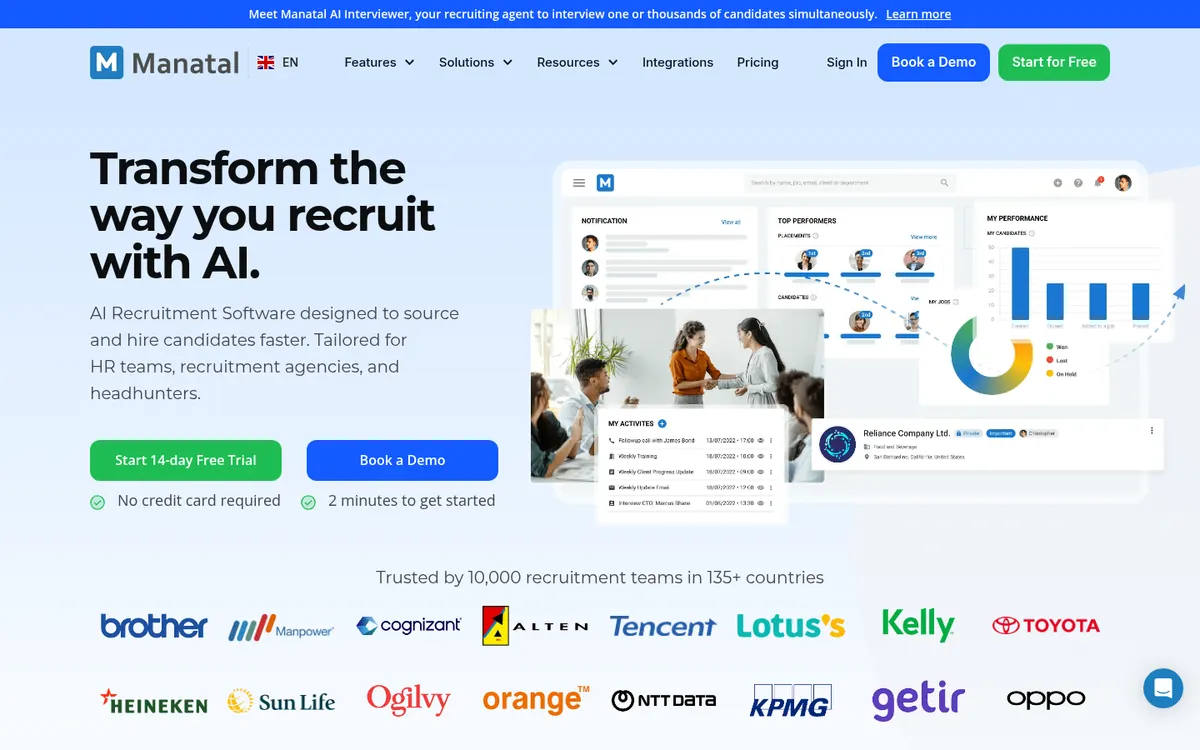
Manatal opens this list on price and capability together. It puts AI enrichment, recommendations, and semantic search behind the lowest seat price in the pack. Professional costs $15 per user per month on annual billing and $19 month-to-month, and both include the AI layer rather than selling it as an add-on. Sourcing reaches 10 or more platforms, and the CRM is organized around talent pools, so a candidate from a closed role stays reachable for the next one. Campaign-style outreach supports repeat outreach instead of one-off emails.
The limits are the trade. Professional caps an account at 15 open jobs and 10,000 candidates, which fits a small desk but stalls a team running many live roles. Everything that looks like infrastructure costs more: API access, SSO, Zapier, and the candidate portal all sit on Enterprise Plus, so check the vendor site for that plan's price. An agency that needs its ATS wired into finance software or a data warehouse should budget for that upgrade before signing a year.
It fits small and mid-size agencies doing permanent and contract placements where speed matters more than configurability. The 14-day trial needs no credit card, which is enough time to load a candidate database and test semantic search against your own records rather than a demo set. Manatal's argument is that AI should be table stakes, and at this price the argument holds up.
Watch the caps, not the headline price. A desk that runs more than 15 open jobs will hit the ceiling quickly, and the workaround is an upgrade, which is not free.
What works
- AI enrichment, recommendations, and semantic search at $15 per user
- Talent pools and campaigns built for repeat agency outreach
- 14-day trial without a credit card
What to weigh
- Professional caps you at 15 open jobs and 10,000 candidates
- API access, SSO, Zapier, and the candidate portal need Enterprise Plus
Pick it if
You run a compact agency desk and want real AI matching inside a low seat price.
Skip it if
You run more than 15 concurrent jobs or need API access on the entry plan.
Plate 02 of 08
Bullhorn
Best for larger agencies needing a full recruitment operating system and integrations
Our verdict
The operating system for larger staffing agencies, with breadth that small desks pay for and rarely switch on.
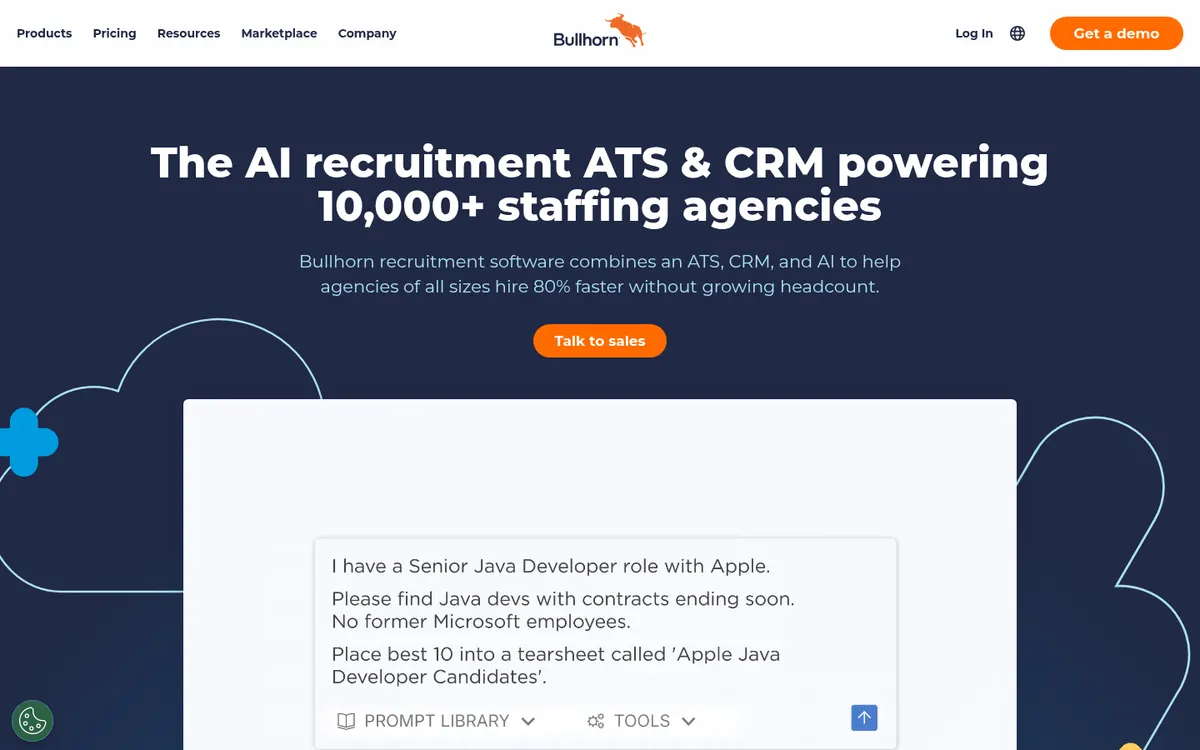
Bullhorn has served staffing agencies since 1999, and the product reflects that history. Starter at $99 per user per month covers the core ATS work: resume parsing, candidate and client management, job posting, career portals, and mass mailing. That is enough for a desk that needs a clean pipeline and nothing else. Core adds the pieces agencies grow into, including a marketplace of more than 300 partner apps, LinkedIn integration, and custom workflows. The marketplace matters more than it sounds, because partner apps can extend the core ATS with additional tools.
The catch is where the useful features start. The full recruitment CRM plus AI search and match only arrive on Pro, and Pro and Max are quote only. A buyer comparing the $99 headline against a $49 tool is not comparing like for like; the published tier is a floor, not a budget. Bullhorn also publishes no free trial and sells through a demo, so the first conversation with a salesperson sets the real number.
Agencies that stay get continuity. Bullhorn scales from a small desk to an enterprise agency without a migration, which is why large staffing firms tolerate the pricing opacity. Recruiters who work the same clients for years benefit from candidate and client management in one system, and the career portals support job posting. If you expect to grow headcount and need more than the Starter tier, the ceiling matters more than the entry price.
The weakness is friction for small teams. A small agency may pay for features it will never switch on, and the quote-only tiers turn budgeting into a negotiation.
What works
- Starter covers core ATS work from resume parsing to mass mailing
- Core adds a 300-plus partner marketplace, LinkedIn integration, and custom workflows
- Scales from a small desk to an enterprise agency without migration
What to weigh
- Full recruitment CRM and AI search and match only arrive on Pro
- Pro and Max are quote only and there is no free trial
Pick it if
You are building for scale and want one system that will still fit at 100 recruiters.
Skip it if
You need a published all-in price or want to test the product before a sales call.
Plate 03 of 08
Vincere
Best for agencies running permanent, contract, and temporary desks in one workflow
Our verdict
Best fit for agencies running permanent and temporary desks together, if GBP pricing and paid add-ons do not put you off.
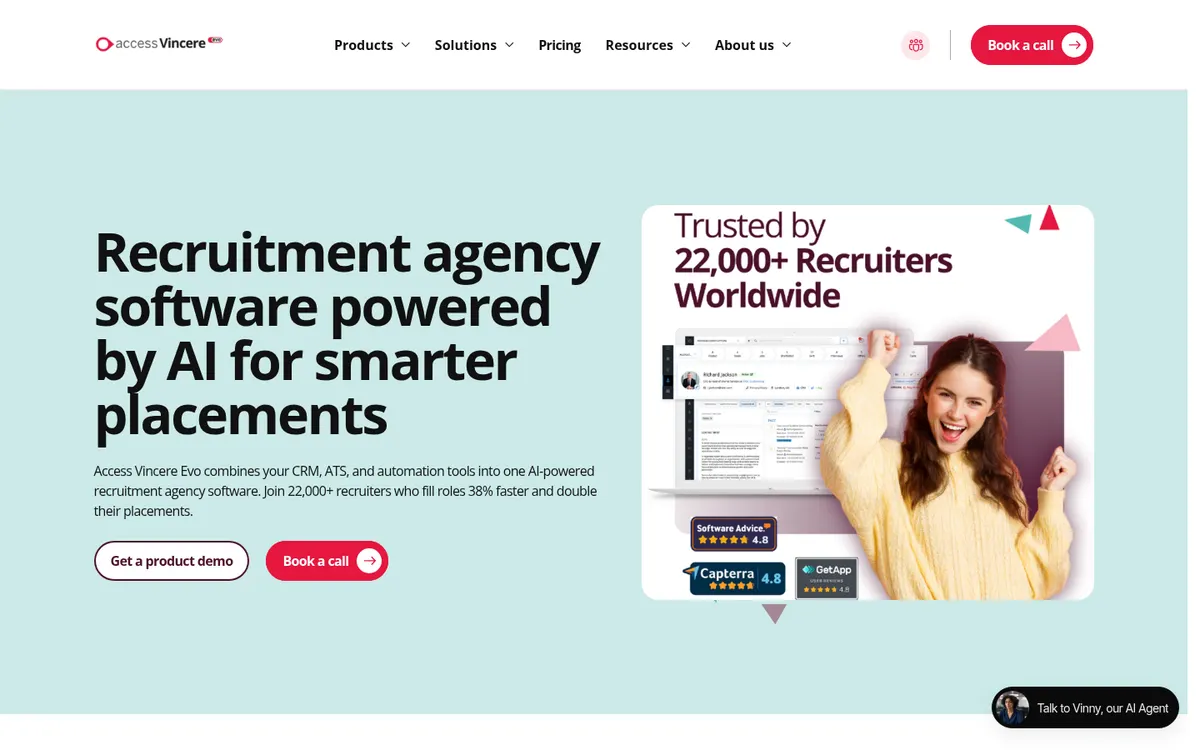
Vincere is built for the messier side of agency work. It pairs an ATS and client CRM with business-development tools, then adds temporary and contract management, scheduling, timesheets, and Pay and Bill on Pro. An agency running permanent, contract, and temp desks does not have to stitch a payroll tool onto a permanent-only ATS. Business-development pipelines sit next to candidate pipelines, which suits agencies that sell roles as well as fill them.
Candidate and client records sit in one system, so a contractor who returns for a permanent role keeps the same history. Scheduling and timesheets feed the records that Pay and Bill reads, which is the argument for keeping all three desk types in one system rather than three.
The pricing is the awkward part. Vincere publishes prices in GBP only, so buyers outside the UK are converting before they can compare against dollar-priced tools on this list, and the conversion moves. AI matching, AI agents, the meeting assistant, and Pay and Bill are paid add-ons on Core, so the useful feature set is not the base price. There is no free trial and no self-serve path; a demo is the entry point.
Contracts are more flexible than most. Startup and Core run on 30-day rolling terms without an annual lock-in, which lowers the risk of trying the product on a live desk. That flexibility is rare among agency systems, where annual prepayment is the norm.
Vincere fits agencies that treat contract and temporary placements as core revenue rather than an afterthought, and it rewards teams that negotiate the add-ons as a bundle. Small permanent-only agencies will find it heavier than they need.
What works
- Handles permanent, contract, and temporary desks in one workflow
- Includes scheduling, timesheets, and Pay and Bill on Pro
- Startup and Core run on 30-day rolling contracts without annual lock-in
What to weigh
- Prices are published in GBP only
- AI matching, AI agents, meeting assistant, and Pay and Bill are paid add-ons on Core
- No free trial
Pick it if
Temps and contractors are a real revenue line and you want one workflow across all desks.
Skip it if
You need dollar pricing published, a free trial, or AI included at the base tier.
Plate 04 of 08
Recruit CRM
Best for small and mid-size agencies needing built-in timesheets and billing
Our verdict
Timesheets and invoicing live inside the subscription, which suits agencies that bill clients for hours and placements.
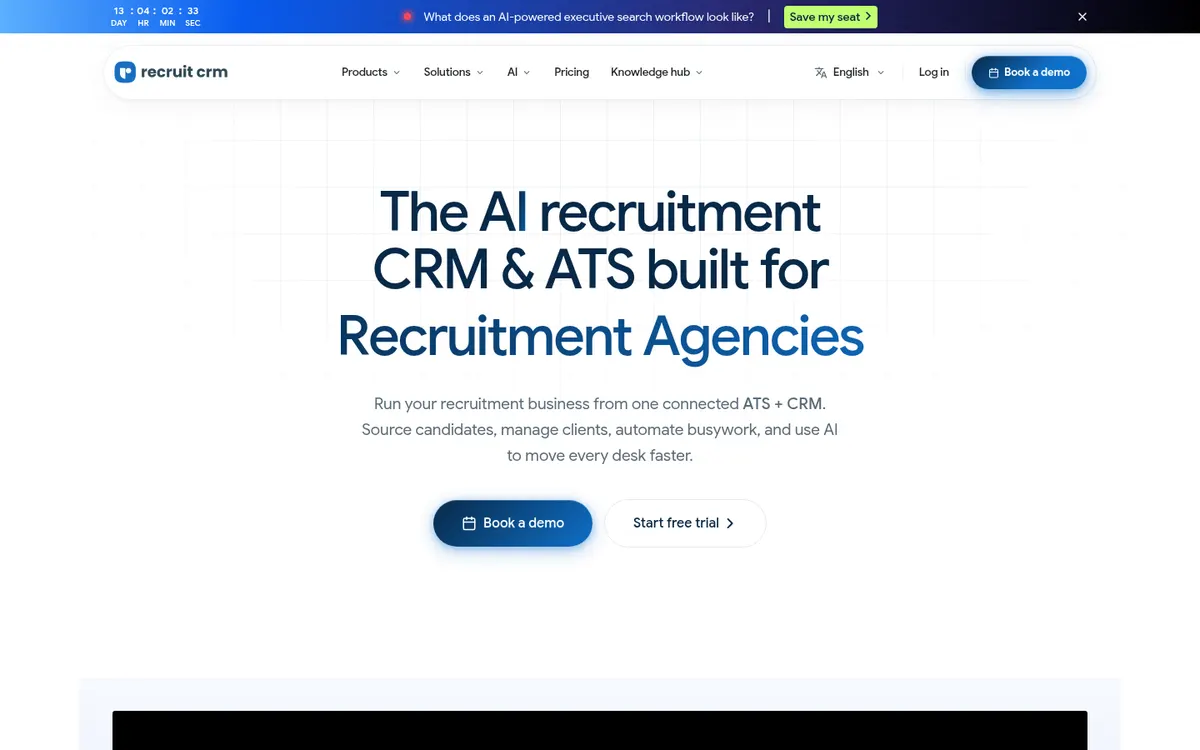
Recruit CRM treats timesheets and billing as part of the product, not a module you buy later. The Pro plan at $49 per user per month includes ATS and CRM records, timesheets, billing and invoicing, a hiring-manager portal, and a Chrome sourcing extension. Timesheet approvals feed directly into invoicing, and pay and bill rates can be calculated by margin or markup, which removes a spreadsheet from the month-end routine. For agencies that bill hours or pass through contractor pay, that alone can justify the seat.
Outreach is broad. Multichannel sequences run across email, LinkedIn, and WhatsApp, and job multiposting reaches more than 3,000 boards. The important detail is that multiposting, WhatsApp, LinkedIn messaging, AI sourcing, advanced analytics, and contractor timesheets all consume credits. The subscription price is not the total cost, and high-volume desks should model credit burn before committing to a year.
The hiring-manager portal gives clients a view without a shared inbox, and the Chrome extension lets recruiters pull candidates from LinkedIn and other sites without leaving the browser tab. The Chrome sourcing extension supports sourcing candidates from the browser.
Recruit CRM offers a 30-day free trial, which is long enough to push a real billing cycle through the system rather than a demo. There is no free plan.
Recruit CRM fits small and mid-size agencies, especially those already invoicing clients for placements or hours and wanting the CRM to hold the paperwork. Agencies that treat outreach as a volume game will spend more on credits than on seats.
What works
- Built-in timesheets and billing rather than a bolt-on module
- Timesheet approvals feed directly into invoicing
- Broad job multiposting and multichannel outreach
What to weigh
- Multiposting, WhatsApp, LinkedIn messaging, AI sourcing, analytics, and contractor timesheets consume credits
- The subscription price is not the total cost
- No free plan
Pick it if
You invoice clients for hours and want timesheets, margins, and billing in one place.
Skip it if
You run high-volume outreach and cannot forecast credit spend month to month.
Plate 05 of 08
Zoho Recruit
Best for budget-focused agencies, especially teams already using Zoho apps
Our verdict
A genuine agency edition with the only permanent free plan here, held back by pricing buried in a help-center article.
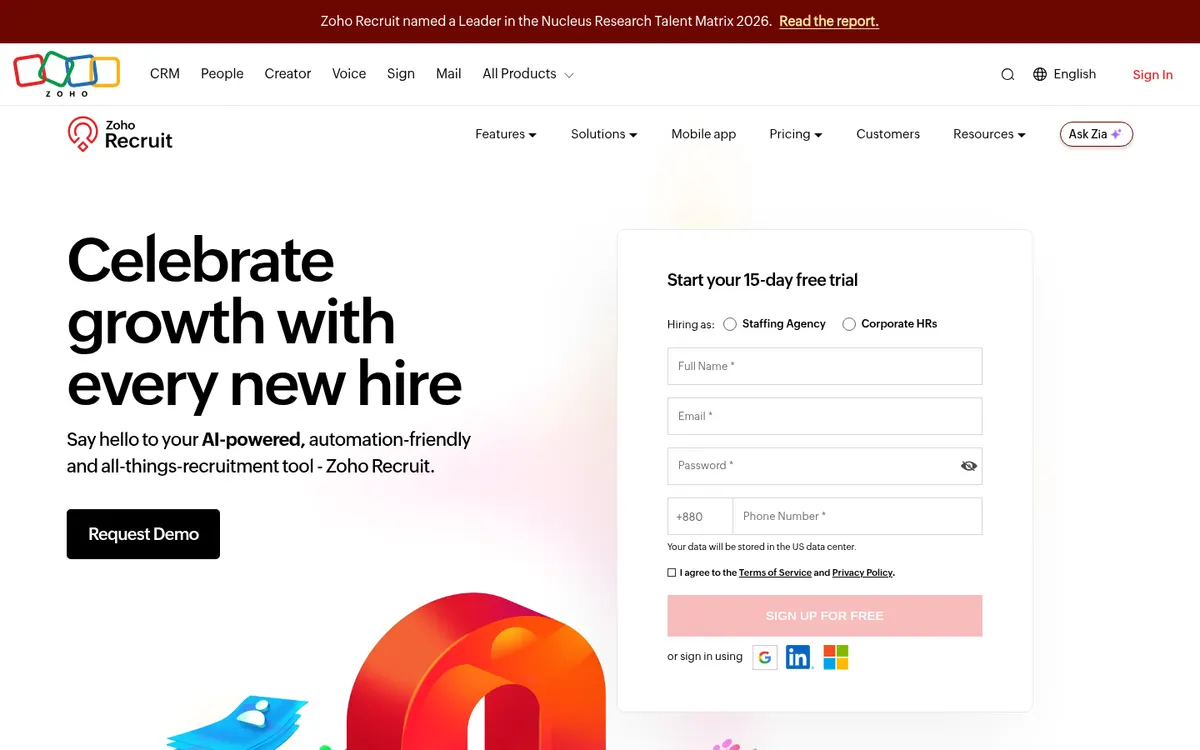
Zoho Recruit is the only tool on this list with a permanent free plan, and the free edition allows one active job. That is enough for a solo recruiter testing the market, not for a working desk. The Staffing Agency edition is a dedicated agency product, with client and staffing portals, territory management, and candidate pre-screening. Paid tiers raise the active job allowance from 100 to 750 per licence depending on tier, and Zia AI matching starts at Professional.
The pricing presentation is the problem. Agency rates live in a help-center article rather than on the public pricing page, and the public page defaults to the Corporate HR edition, so a first-time visitor can read the whole page and still not see what an agency pays. Standard is US$25 per recruiter per month billed annually, which is cheap, but the tiers that unlock portals, AI matching, and advanced automation sit above it.
Zoho lists a 15-day free trial and a 45-day money-back guarantee, which softens the risk of a paid tier. Teams already using Zoho apps get the benefit of one vendor, and that is a real reason to choose it over a standalone ATS. Advanced automation is available on higher tiers.
Budget-focused agencies and Zoho households should look first. Agencies needing heavy billing, deep customization, or transparent agency pricing on the main pricing page will find the gating and the documentation annoying.
What works
- The only permanent free plan in this pack, limited to one active job
- Staffing Agency edition is a dedicated agency product with client and staffing portals
- Active job allowance grows from 100 to 750 by tier, with Zia AI matching from Professional
What to weigh
- Agency pricing sits in a help-center article, not on the public pricing page
- Portals, AI matching, and advanced automation are gated at Professional and Enterprise
Pick it if
You are cost-sensitive, Zoho-literate, and can live with one active job or a modest paid tier.
Skip it if
You need published agency pricing on the main page or deep billing and customization.
Plate 06 of 08
Loxo
Best for agencies wanting AI agents for sourcing, screening, and outreach at scale
Our verdict
Sourcing volume through a talent graph and AI agents, at the highest entry seat price and with annual payment upfront.
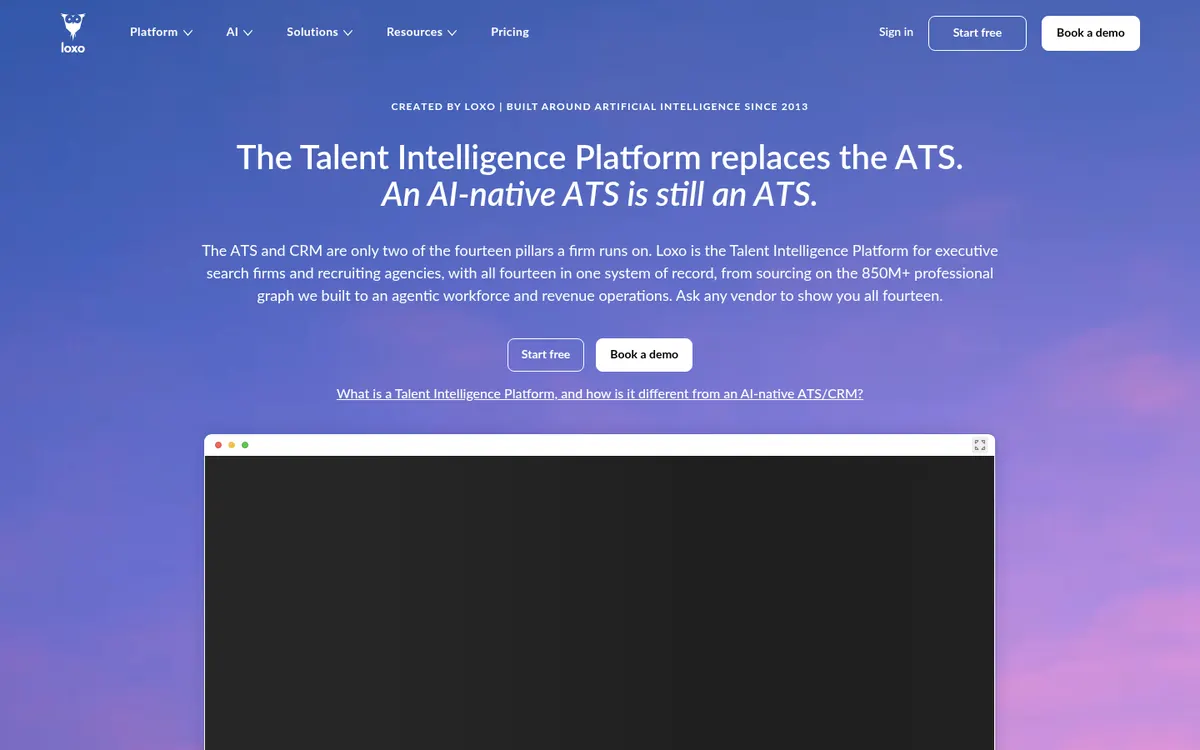
Loxo sells volume. The Core plan at $149 per user per month billed annually bundles an ATS, a recruiting CRM, and a sales CRM, then adds Loxo Source, a proprietary talent graph with more than 850 million profiles. AI agents write job descriptions, handle intake, and assemble longlists of up to 10,000 screened candidates, with ranked shortlists on top. For an agency whose bottleneck is finding enough qualified people to call, that is the whole argument.
The trade is cost and commitment. Annual plans are paid upfront, so $149 per user per month is a year of cash at signing, not a monthly decision. Agent work is metered at 2,500 credits per seat per month on Professional, and heavy sourcing will test that ceiling. The former free tier is gone, Professional pricing is no longer published, and Enterprise is custom, so the public entry point is the Core number.
Because an ATS, recruiting CRM, and sales CRM are combined, a candidate and the client relationship can stay in one system. Recruiters working a niche where the same people circulate between employers get compounding value from that history, and the sales CRM keeps client development from living in a separate tool.
The 7-day trial with no credit card covers the full Professional platform. Seven days is short for a sourcing workflow, but it is enough to run a longlist against a live role and see whether the ranking matches how your recruiters actually screen.
Loxo fits agencies running high-volume sourcing across many similar roles that can absorb an upfront annual payment. Boutique firms placing only a few senior roles a year will pay for capacity they never touch.
What works
- Combines ATS, recruiting CRM, and a sales CRM on one record
- Proprietary talent graph with more than 850 million profiles
- AI agents handle intake, longlists, ranked shortlists, and outreach
What to weigh
- Annual plans are paid upfront only
- Agent work is metered at 2,500 credits per seat per month on Professional
- Professional pricing is no longer published and the former free tier is gone
Pick it if
Sourcing volume is your bottleneck and you can commit a year of budget up front.
Skip it if
You place a handful of senior roles a year or need monthly billing.
Plate 07 of 08
Crelate
Best for US mid-market agencies needing deep customization and client portals
Our verdict
Customization and branded client portals for US mid-market agencies, with add-on fees that lift the real monthly cost.
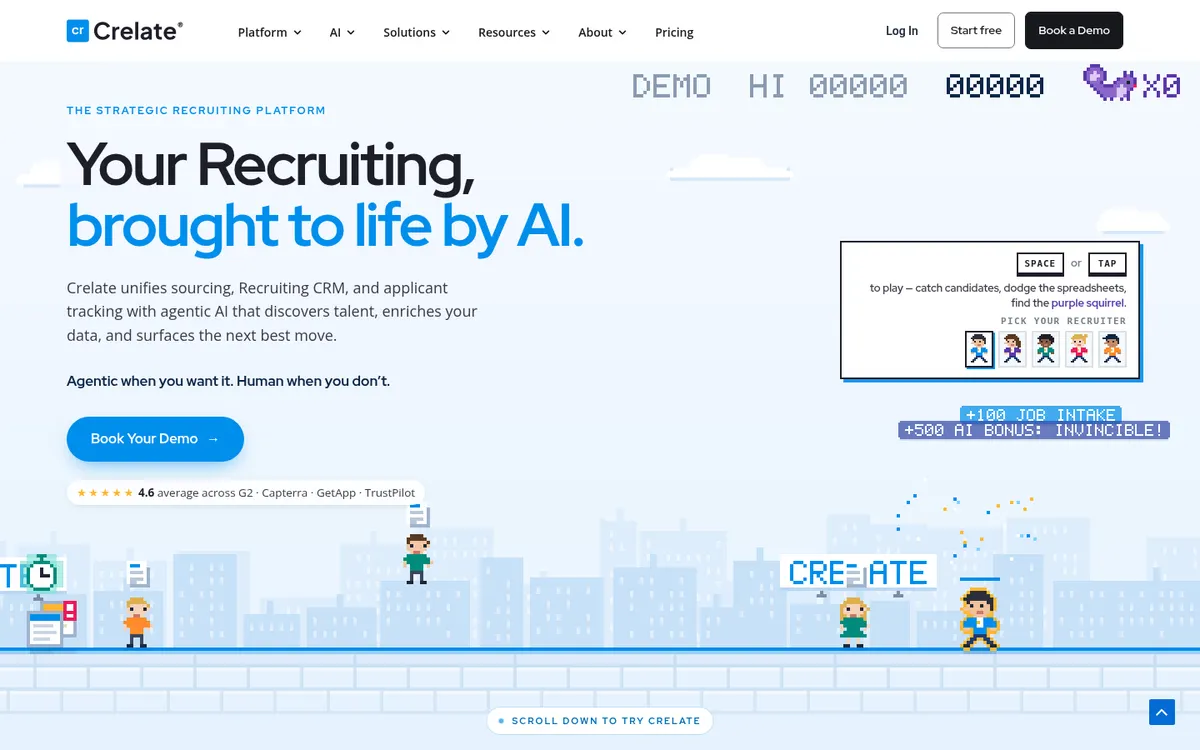
Crelate's strength is customization. Workflows, fields, activities, and document types are all configurable, so an agency can shape the system around how it actually places candidates instead of bending its process to a template. Client portals carry per-client branding, and the branded job portal keeps the agency's name in front of candidates. Integrations with Indeed, Dice, and CareerBuilder cover the main US boards, and Crelate has served US mid-market agencies since 2012.
Money is where it gets complicated. Essentials at $85 per user per month billed annually is capped at 2 users and 20,000 contacts, so the entry plan is a small-team plan. Business Plus, which carries AI Co-Pilot, automation, sequencing, premium client portals, and RingCentral, is quote only. Email, texting, eSignature, and enrichment are additional-fee add-ons on paid plans, so the seat price covers the record system and not the communication stack.
Compliance is a genuine differentiator here. Crelate holds SOC 2 Type II and ISO 27001 certifications, which matters to agencies answering security questionnaires from enterprise clients. The vendor does not state a trial length on its pricing page, so ask before you plan an evaluation timeline.
The trade-off is setup time. Deep customization means somebody has to design and maintain the fields and workflows, and that work lands on an operations lead rather than on the vendor.
Crelate fits US mid-market agencies that need custom fields and branded client portals and are willing to assemble add-ons. Agencies that want one invoice covering email, texting, and enrichment should price the bundle before they compare seats.
What works
- Deep customization of workflows, fields, activities, and document types
- Client portals carry per-client branding
- SOC 2 Type II and ISO 27001 certifications
What to weigh
- Business Plus is quote only
- Email, texting, eSignature, and enrichment are additional-fee add-ons on paid plans
- Trial length is not stated on the vendor pricing page
Pick it if
You need branded client portals and custom workflows and will pay for add-ons separately.
Skip it if
You want one price covering outreach channels or you run more than 2 users on the entry plan.
Plate 08 of 08
JobAdder
Best for agencies wanting a SEEK-owned ATS with broad job board distribution
Our verdict
Job distribution strength from SEEK ownership, sold in headcount tiers with no published price and no free trial.
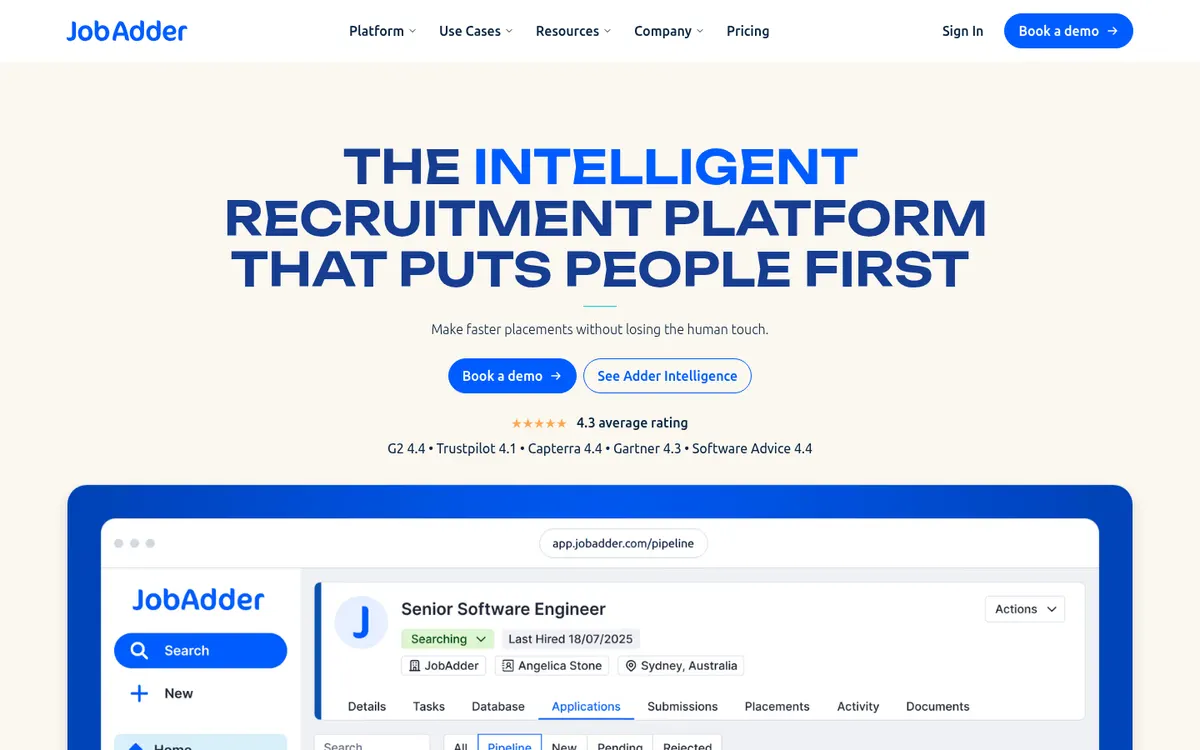
JobAdder's distinctive asset is distribution. SEEK owns the company, and the product pairs an ATS and recruitment CRM with built-in multi-posting, a branded careers page, a candidate portal, and Broadbean distribution. For agencies whose main channel is job boards, keeping posting, candidate response, and pipeline in one place removes a daily routine of copy and paste. Multi-posting covers pushing one role to several boards and collecting applicants into a single record, which is a core feature for agencies that rely on job boards.
Temporary and contractor talent pools sit alongside permanent pipelines, and business-development and sales pipelines give consultants somewhere to track client conversations. Plans are segmented by headcount rather than by features: Recruiter Lite for 1 to 5 users, Recruiter Essential for 6 to 20, Recruiter Pro for 21 or more, and Business. Every plan shows request pricing, so there is no published figure to budget from. API access is unavailable on Lite and is only an add-on on Essential, which limits integration work for small teams.
There is no free trial and no self-serve entry, only a demo. A buyer therefore evaluates through a sales process and cannot test posting volume against real roles before committing. Headcount tiers also mean your plan changes as you hire, which is worth getting in writing before you sign.
JobAdder fits agencies whose sourcing leans on job board volume rather than outbound. Agencies that live on API integrations or need a published price will find the structure restrictive.
What works
- SEEK ownership supports job distribution
- Built-in multi-posting plus Broadbean distribution
- Temp and contractor talent pools sit alongside sales pipelines
What to weigh
- Plans are tiered by headcount rather than features
- API access is unavailable on Lite and is only an add-on on Essential
- No published price and no free trial
Pick it if
Job board volume drives your sourcing and you are comfortable with a headcount-based quote.
Skip it if
You need published pricing, a trial, or API access on a small team plan.
What Is Recruitment Agency Software and How Does It Differ From a Corporate ATS?
Recruitment agency software is a candidate tracking system built for firms that place people on behalf of clients. The jobs belong to someone else, the candidates outlive any single vacancy, and revenue depends on how fast a consultant can match the two. That shape drives the feature set: a pipeline for candidates, a pipeline for clients and business development, and usually a way to handle contract and temporary placements with timesheets and pay.
A corporate ATS tracks applicants through one employer's requisition. It rarely needs to bill anyone, and it does not care what happens to a candidate after the role closes. Agency software does. The candidate who was wrong for a role in March is the placement in September, so talent pools, tagging, and search matter more than careers page design. Client records matter as much as candidate records, because the next order comes from the client relationship, not from a job board.
The practical differences show up in four places:
- Client and business-development pipelines, so consultants can work an order before a role exists (Loxo, JobAdder).
- Timesheets and billing for contract and temporary desks (Vincere, Recruit CRM).
- Job board distribution and multiposting, because agencies advertise the same role in several places (JobAdder, Recruit CRM).
- Branded portals, so the agency's name stays in front of both sides (Crelate, Bullhorn, Zoho Recruit).
Most tools in this category bundle an ATS with a light CRM. The differences are where the bundle stops. Bullhorn reaches a marketplace of more than 300 partner apps, Loxo adds a sales CRM and a talent graph above 850 million profiles, and Manatal keeps AI enrichment inside a $15 seat. Buyers who only compare the ATS half of the bundle often pay twice, once for the tracker and again for the billing or outreach tool that should have been included.
This guide sits in the Software collection. Buyers weighing nearby tools often read the guides to commission software and research platforms next.
How Do Vendors Price Agency Recruitment Software: Seats, Headcount, or Quote?
Most agency platforms bill per recruiter seat per month, and the variable that changes the number most is the contract term and what sits outside the seat. Annual billing is usually cheaper than month-to-month: Manatal prices Professional at $15 per user per month on annual billing and $19 month-to-month, so annual billing lowers the monthly rate.
| Model | How it bills | Typical fit | Example from this list |
|---|---|---|---|
| Per seat, annual | Per user per month with a yearly commitment | Agencies with stable headcount | Manatal Professional at $15 per user per month billed annually |
| Per seat, rolling | 30-day terms without annual lock-in | Agencies testing a tool or with fluid teams | Vincere Startup and Core on 30-day rolling contracts |
| Free tier plus paid seats | Free edition with hard limits, then per recruiter | Small agencies | Zoho Recruit free edition with 1 active job; Standard US$25 per recruiter per month billed annually |
| Headcount bands | Plan chosen by team size, not feature list | Growing agencies that hire steadily | JobAdder Recruiter Lite for 1 to 5 users, Essential 6 to 20, Pro 21 or more |
| Quote only | Sales-led pricing after a demo | Enterprise or unusual desk mixes | Bullhorn Pro and Max, Crelate Business Plus |
| Subscription plus credits | Base seat fee with usage metered on top | High-volume outreach and sourcing | Recruit CRM credits for multiposting, messaging, AI sourcing, and contractor timesheets |
Three patterns matter when you compare. First, the seat price covers records more often than it covers channels: Crelate charges extra for email, texting, eSignature, and enrichment, and Recruit CRM meters messaging and multiposting. Second, some vendors publish nothing. Bullhorn Pro and Max, Crelate Business Plus, and every JobAdder plan are quote only, so the budgeting work moves into the sales conversation. Third, currency and payment timing change the comparison. Vincere publishes in GBP only, and Loxo takes annual payment upfront.
Budget the seat line first, then add credits, add-ons, and implementation. A $49 seat and a $149 seat can land in the same place once outreach volume and billing modules are priced in.
Every price in this guide was read on the vendor's own pricing page on November 25, 2026. Where a vendor does not publish a figure we could confirm, the card says "See website" rather than a guess. For the arithmetic around this purchase, try the free Email campaign metrics calculator.
Which Agency Recruitment Software Fits Your Desk? A Five-Step Path
Write down your desk mix. Count how much revenue comes from permanent, contract, and temporary placements. If temps and contractors are a meaningful part of billings, start with Vincere or Recruit CRM rather than a permanent-only ATS.
Set a seat ceiling. Multiply recruiter count by the published seat price to get a floor. Manatal at $15 and Loxo at $149 frame a wide spread, so decide what sourcing capacity is worth before you take a demo.
Test the limits that stop you. Check open job caps, candidate caps, credit meters, and add-on gates. Manatal caps Professional at 15 open jobs, Recruit CRM meters credits, and Loxo meters agent work at 2,500 credits per seat.
Price the add-ons as a bundle. Ask for API, SSO, messaging, enrichment, and pay and bill on one quote. Crelate, Vincere, and Manatal all move useful features to higher tiers, so a base price alone misleads.
Run a live role through the trial. Load a few hundred real candidates and push one open job to the boards. Manatal, Recruit CRM, Loxo, and Zoho Recruit offer trials; Bullhorn, Vincere, and JobAdder do not.
Check the contract term last. Annual prepayment, 30-day rolling terms, and money-back guarantees change the risk. Vincere runs rolling contracts on Startup and Core, Loxo takes annual payment upfront, and Zoho offers 45 days of money back.
Five Mistakes That Push Agency Software Budgets Off Track
- Comparing headline seat prices only. Recruit CRM's $49 covers records, not credits, and Crelate charges extra for email, texting, eSignature, and enrichment. Ask for a total figure at your real volume before you sign.
- Ignoring job and candidate caps. Manatal Professional stops at 15 open jobs and the Zoho Recruit free edition at one. A cap that fits at first can block the desk later, after the data is already loaded.
- Buying a corporate ATS for agency work. A permanent-only tracker will not handle timesheets, pay and bill, or branded client portals. Confirm the agency edition exists and is priced before you shortlist.
- Skipping the trial when one is offered. Seven days is short but real, and 30 days can cover a billing cycle. For vendors that offer demos only, insist the demo uses your own roles and candidate records.
- Forgetting currency and contract terms. Vincere publishes in GBP only and Loxo requires annual payment upfront. Convert before comparing, and read the renewal clause rather than the first-year number.
Best Recruitment Agency Software 2026: questions
Which recruitment agency software has the lowest seat price?
Manatal has the lowest seat price at $15 per user per month on Professional billed annually, and that includes AI enrichment, recommendations, and semantic search. Zoho Recruit's Standard tier is US$25 per recruiter per month billed annually, and its free edition covers one active job. Both undercut Recruit CRM at $49, Crelate at $85, Bullhorn at $99, and Loxo at $149.
What is the difference between an ATS and an agency CRM?
An ATS tracks a candidate through one specific job, while an agency CRM tracks the candidate and the client relationship across every job. Agency platforms usually combine both. Manatal and Recruit CRM keep talent pools that survive a closed role, and Recruit CRM adds timesheets and invoicing. A pure ATS handles applications but loses the client and business-development side that agencies sell from.
Which tools handle contract and temporary desks with timesheets?
Vincere and Recruit CRM are the strongest fits for contract and temporary work. Vincere adds scheduling, timesheets, and Pay and Bill on Pro, plus temp and contract management in the base workflow. Recruit CRM includes timesheets, billing, and invoicing, with pay and bill rates by margin or markup, though contractor timesheets use credits. JobAdder keeps temp and contractor talent pools but does not list timesheets or Pay and Bill.
Which vendors offer a free plan or a free trial?
Zoho Recruit is the only tool here with a permanent free plan, limited to one active job. For trials, Manatal offers 14 days without a credit card, Recruit CRM 30 days, Loxo 7 days without a credit card, and Zoho Recruit 15 days plus a 45-day money-back guarantee. Crelate offers a trial without stating its length. Bullhorn, Vincere, and JobAdder are demo only.
Which recruitment platforms include AI sourcing or AI agents?
Manatal, Zoho Recruit, Loxo, and Vincere all ship AI help. Manatal includes AI enrichment, recommendations, and semantic search on Professional. Zoho Recruit starts Zia AI matching at Professional. Loxo includes AI agents, longlists of up to 10,000 screened candidates, and a talent graph above 850 million profiles. Vincere sells AI matching and AI agents as add-ons on Core.
Which tools provide client portals and job board distribution?
Recruit CRM posts to more than 3,000 boards and adds a hiring-manager portal. JobAdder offers built-in multi-posting, Broadbean distribution, a branded careers page, and a candidate portal. Crelate provides branded client portals, a branded job portal, and Indeed, Dice, and CareerBuilder integrations. Bullhorn includes career portals and a partner marketplace of more than 300 apps. Zoho Recruit offers client and staffing portals in its agency edition.