
Contents of this guide
The shortlist
Our top 3 for software buyers

Anaplan
Connected finance planning
- Best for
- Large enterprises needing finance and supply chain scenario planning
- Features
- 4 noted: Connected planning, What-if models, Finance alignment, Monthly S&OP cycle

o9 Solutions
Single planning model
- Best for
- Global firms seeking AI-driven end-to-end integrated business planning
- Features
- 4 noted: Knowledge graph, AI forecasting, One model, IBP workflows
Kinaxis
Concurrent scenario engine
- Best for
- Manufacturers needing concurrent scenario planning and instant impact analysis
- Features
- 4 noted: Concurrent scenarios, Ripple analysis, S&OP module, Maestro platform
Disclosure for this guide. All 9 tools here are unpaid editorial picks. The position of a paid listing can be part of what the vendor pays for. Paid and unpaid tools are scored on the same rubric and keep their cons. Details are in the advertising disclosure.
The ledger
Index of every tool
| Tool | Free plan | Trial | Rubric | Compare | ||
|---|---|---|---|---|---|---|
| 01 | AnaplanLarge enterprises needing finance and supply chain scenario planning | See websiteNot published | No free plan (demo available) | Demo available | ||
| 02 | o9 SolutionsGlobal firms seeking AI-driven end-to-end integrated business planning | See websiteNot published | No free plan (demo available) | Demo available | ||
| 03 | KinaxisManufacturers needing concurrent scenario planning and instant impact analysis | See websiteNot published | No free plan (demo available) | Demo available | ||
| 04 | SAP IBPExisting SAP customers wanting S&OP native to their ERP | See websiteNot published | No free plan (trial available) | Free trial available | ||
| 05 |  Blue YonderRetailers and distributors planning across multi-tier networks with AI | See websiteNot published | No free plan (demo available) | Demo available | ||
| 06 |  ToolsGroupInventory-intensive businesses seeking probabilistic planning with less manual effort | See websiteNot published | No free plan (demo available) | Demo available | ||
| 07 |  John Galt SolutionsMid-market manufacturers needing configurable S&OP without enterprise overhead | See websiteNot published | No free plan (demo available) | Demo available | ||
| 08 |  LogilityCompanies wanting digital-twin scenario planning with decision audit trail | See websiteNot published | No free plan (demo available) | Demo available | ||
| 09 |  NetstockSMBs on ERP needing supply and demand planning without a big project | See websiteNot published | No free plan (demo available) | Demo available |
Prices are the lowest paid plan the vendor shows, read on November 25, 2026. Sort by price ranks published monthly figures; tools without one go last. Pin up to three tools to compare them side by side.
How this guide was put together
We scored nine S&OP platforms against five criteria and weighted them. Planning depth carried 25 percent because the category is judged on whether demand, supply and consensus numbers survive a monthly executive review. Scenario modeling, integration fit and deployment effort each carried 20 percent, reflecting how often buyers get blindsided by slow rollouts, broken ERP connectors or scenarios that take a day to run. Pricing clarity carried 15 percent because private quotes make budget comparison hard.
Every price and packaging fact in this list was checked on November 25, 2026 against the vendor's own pricing pages. Where a vendor publishes no pricing page, we say so and do not invent a number. All nine entries returned See website for starting price, so the practical comparison here is packaging and quoting behavior, not list price.
One placement is Featured, which is a paid placement. It is scored with the same rubric and given the same kind of cons as every other entry. The order of this list is editorial: it reflects fit for the buyer described in each entry, plus the disclosed Featured position. It does not come from the scores or a weighted total, and the scores are shown so you can see where each tool is strong or thin.
We did not test the software ourselves in this cycle. Each write-up is built from vendor documentation, published feature lists and the disclosure materials supplied for this comparison. Treat the scores as a starting filter for a shortlist, then verify forecasting accuracy, integration behavior and rollout timing in your own proof of concept.
The full process, including how we handle corrections, is on the methodology page. Paid listings follow the advertising disclosure.
Rubric and weights
Every tool below is scored from 1 to 10 on these five criteria. The scores describe each tool; the order is an editorial call on fit for the buyer each card describes, plus the disclosed Featured position.
- 25%Planning depthHow completely the tool covers demand, supply and consensus planning inside a recurring S&OP cycle.
- 20%Scenario modelingHow quickly planners can test alternatives and see the operational and financial ripples.
- 20%Integration fitHow well the platform connects to the ERP, trading partner and financial systems a buyer already runs.
- 20%Deployment effortHow much configuration, partner work and calendar time the tool demands before go-live.
- 15%Pricing clarityHow much a buyer can learn about cost and packaging before entering a sales process.
Plate 01 of 09
Anaplan
Best for large enterprises needing finance and supply chain scenario planning
Our verdict
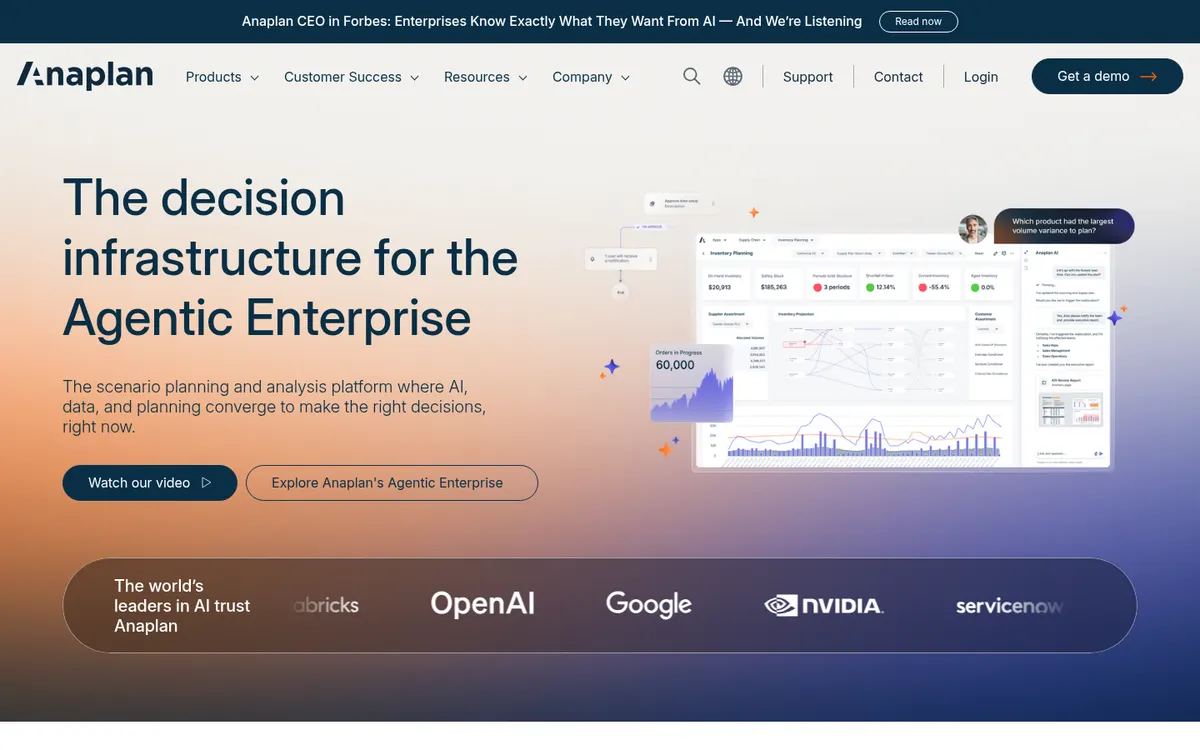
The strongest choice for large enterprises that want S&OP reconciled with financial and workforce plans in one connected model.
Anaplan is a connected planning platform that treats S&OP as one part of a wider model rather than a standalone supply chain tool. Sales forecasts, supply constraints, financial targets and workforce assumptions sit in the same place, so a demand change can be pushed through to revenue and headcount plans without exports and reconciliation. What-if scenario modeling is the strongest part of the product: planners branch a plan, change assumptions and compare outcomes before the monthly consensus meeting.
Consensus demand and supply planning run through collaborative workflows, so sales, operations and finance contribute to one version of the plan. Enterprise-scale models are the target. The vendor says Anaplan is used by nearly half of the Fortune 50, which is a signal about model complexity as much as about reach. These are not small implementations, and the planning model usually needs governance to stay usable.
Pricing is not published. You request a demo, then move into a quote process. Implementation is typically partner-led, and that partner dependency is the practical risk. A model that connects finance and supply chain planning needs someone who understands both sides, and the available partner bench varies by region. Budget for services alongside the subscription, because the two are sold differently and the services number often arrives later. Rolling monthly S&OP cycle support is part of the platform, but the cycle design itself comes from your team or the partner.
This is the pick for large enterprises that want S&OP tied to financial and workforce planning and can fund a multi-month program. It is a poor fit for a mid-market team that wants a fixed price and a go-live date inside one quarter.
What works
- Connects S&OP to financial and workforce plans
- Strong what-if scenario modeling
- Used by nearly half of the Fortune 50
What to weigh
- Complex, partner-dependent implementation
- Quote-based pricing aimed at enterprise budgets
Pick it if
You are an enterprise that needs operational and financial plans reconciled in one model and can fund a partner-led rollout.
Skip it if
You are a small planning team that needs a published price and a live system within a single quarter.
Plate 02 of 09
o9 Solutions
Best for global firms seeking AI-driven end-to-end integrated business planning
Our verdict
Built for global firms that want demand, supply and finance on one model and will fund a long transformation program.
o9 Solutions sells a single model for demand, supply and financial planning, which is the pitch most large integrated business planning programs want and few vendors deliver without bolting modules together. The Digital Brain platform sits on an enterprise knowledge graph, so a change to a promotion assumption propagates through supply, inventory and financial views rather than being re-keyed in a separate system. AI and machine learning forecasting are built in, alongside scenario simulation and cross-functional collaboration workflows.
The strength is coherence: one model, one set of numbers, one conversation in the monthly review. The weakness is the same thing viewed from a budget line. This is designed for large transformation programs, and the sales cycle reflects that. Expect a long evaluation, a services partner and a scope that grows as more planning domains get connected.
Pricing is not published. There is no free plan, and access starts with a demo. Nothing in the vendor's public material suggests a self-serve tier or a small-team package, so treat the platform as an enterprise commitment with enterprise governance.
Mid-market teams should skip it. The configuration effort and program overhead will exceed the value a smaller planning group can extract, and the knowledge graph only pays off once enough data and planning domains are connected to it. Global firms with several business units, multiple ERPs and a mandate to unify planning are the fit, and they should staff the program properly rather than treating it as an IT side project.
What works
- One model across demand, supply and finance
- Knowledge graph speeds scenario analysis
- Built for large integrated business planning programs
What to weigh
- Long sales cycles
- Overkill for mid-market teams
- Designed for large transformation programs
Pick it if
You are a global firm standardizing integrated business planning across business units and ERPs.
Skip it if
Your planning team is small, your program budget is fixed, or you need results within one quarter.
Plate 03 of 09
Kinaxis
Best for manufacturers needing concurrent scenario planning and instant impact analysis
Our verdict
The best fit for manufacturers whose monthly S&OP stalls on slow what-if analysis and unclear ripple effects.
Kinaxis, sold on the Maestro platform, is built around speed of re-planning. Its differentiator is concurrent evaluation of many scenarios: instead of testing alternatives one at a time, planners run several assumptions in parallel and compare them in the same session. Instant ripple-effect impact analysis then shows how a change in one part of the supply chain moves inventory, capacity and customer commitments elsewhere. For a monthly S&OP cycle that keeps stalling on what happens if we do this, that is a genuine operational advantage rather than a feature list item.
The dedicated S&OP module aligns functions with financial targets, so the consensus meeting works from one version of demand and supply instead of duelling spreadsheets. Supply chain planning and simulation, what-if analysis and collaboration workflows sit around it. The vendor does not publish pricing, and the platform is quote-based with a premium reputation. There is no free plan; you book a demo.
Value scales with complexity. A single-site manufacturer with a short bill of materials will pay for concurrency it never uses. A multi-plant network with shared capacity, long lead times and competing customer priorities is where the concurrent scenario engine earns its budget, because the cost of a bad monthly decision is measured in inventory and missed commitments.
The other cost to plan for is modelling discipline. Fast simulation depends on clean master data and well-defined planning rules. If your item masters and lead times are inconsistent across sites, fix that before the evaluation rather than discovering it during the rollout.
What works
- Evaluates many scenarios concurrently
- Instant ripple-effect impact analysis
- S&OP module ties functions to financial targets
What to weigh
- Premium pricing
- Best value for complex rather than simple supply chains
Pick it if
You run a complex, multi-plant network where fast comparison of scenarios changes the monthly decision.
Skip it if
Your supply chain is simple or your planning data is not yet clean enough for simulation.
Plate 04 of 09
SAP IBP
Best for existing SAP customers wanting S&OP native to their ERP
Our verdict
The default answer for SAP customers who want S&OP inside their existing ERP landscape rather than beside it.
SAP IBP is the S&OP option for companies whose planning data already lives in SAP. It runs a unified S&OP process with integrated financial and operational planning, AI demand algorithms and automated outlier correction, so the statistical side of forecasting does not need a separate tool. Simulation and what-if analysis, collaboration and approvals round out the process. Integration with SAP systems is the headline, and third-party connectors extend it to non-SAP sources.
The trade-off is that the tightest fit is the environment it was designed for. Buyers outside SAP can make it work, but they pay for integration and configuration that a native SAP customer gets more cheaply. Configuration and licensing can both be heavy, and the licensing model is the part most first proposals get wrong.
SAP IBP is the only tool on this list with a free trial alongside its demo, which is a practical advantage: you can put real data through it before committing to a program. Pricing itself is not published, so the comparison is packaging, not list price.
Pick it when your ERP, master data and finance reporting already run on SAP and the planning team is comfortable in that ecosystem. Skip it if you are on a different ERP, or if you want a narrow demand and inventory tool without a platform-level commitment.
What works
- Deep integration with SAP and third-party systems
- AI demand planning with outlier correction
- Native fit for SAP environments
What to weigh
- Tightest fit for companies already on SAP
- Configuration and licensing can be heavy
Pick it if
Your ERP and master data already run on SAP and you want S&OP native to that landscape.
Skip it if
You run a different ERP or want a narrow planning tool without a platform commitment.
Plate 05 of 09
Blue Yonder
Best for retailers and distributors planning across multi-tier networks with AI
Our verdict
A broad retail and distribution suite where S&OP is strong but never the whole reason you buy.
Blue Yonder is a large retail and distribution platform, and S&OP is one module inside it rather than the whole product. The pieces that matter for planning are machine learning predictions at scale, a common data cloud that connects tiers and trading partners, multi-tier network planning, demand and supply planning, scenario planning and a dedicated S&OP module. Trading partner collaboration is the part that stands out for retailers and distributors: forecasts and commitments can be shared across the network instead of reconciled by email each month.
The trade-off is breadth. Buyers who want a focused S&OP tool will find themselves evaluating an enterprise suite with its own implementation methodology, data model and consulting ecosystem. There is no self-serve option and no published pricing; the sale runs through enterprise account teams, starting with a demo and moving to a scoped quote.
Fit is clearest in retail and distribution, where multi-tier visibility and partner collaboration drive real value. Consumer goods manufacturers with complex distribution networks see similar returns. A manufacturer selling direct through a simple channel structure will find the data cloud and partner tooling hard to justify against a narrower planning product.
Budget for integration work. The value of a common data cloud depends entirely on getting tier and partner data into it, and that is a project in its own right, usually with the trading partners themselves involved.
What works
- Large-scale ML predictions
- Data cloud connects tiers and trading partners
- Broad retail and distribution coverage
What to weigh
- S&OP is one module in a broad platform
- Enterprise sales only; no self-serve
Pick it if
You are a retailer or distributor that needs multi-tier partner visibility and can absorb a suite rollout.
Skip it if
You want a focused S&OP tool, a published price, or a fast self-directed start.
Plate 06 of 09
ToolsGroup
Best for inventory-intensive businesses seeking probabilistic planning with less manual effort
Our verdict
Strong for inventory-heavy businesses that want probabilistic planning and fewer manual spreadsheet hours each cycle.
ToolsGroup leans hard into inventory. The platform runs always-on decision intelligence, continuously sensing demand and supply signals and adjusting plans rather than waiting for a monthly refresh. Probabilistic AI drives inventory and replenishment decisions, which means it works with distributions and risk instead of a single deterministic forecast number. The vendor cites forecast accuracy gains of 5-10 points and frames inventory optimization as the primary outcome.
The practical benefit is lower manual effort. Planners spend less time building and reconciling spreadsheets and more time on the exceptions the system surfaces. Risk-aware scenario analysis lets you test service level and inventory trade-offs before committing working capital, which is often the most valuable conversation in a distribution business.
The gap is financial integration. This is inventory and replenishment planning with S&OP support, not a connected planning platform that ties operations to the profit and loss statement and workforce plans. If your monthly cycle ends with a finance conversation about margin and cash, check carefully how far the platform takes you before you buy.
Pricing is quote-based with no free plan and a demo as the entry point. Inventory-intensive businesses, particularly in distribution, spare parts and consumer goods, get the clearest return. Companies whose main pain is financial consensus planning should look at the enterprise platforms instead.
What works
- Probabilistic, risk-aware inventory planning
- Continuous sensing of demand and supply
- Forecast accuracy gains of 5-10 points cited
What to weigh
- Lean toward inventory optimization over full financial integration
- Quote-based pricing
Pick it if
Inventory and service levels drive your business and you want risk-aware planning with less manual effort.
Skip it if
Your main requirement is reconciling operational plans with a full financial forecast.
Plate 07 of 09
John Galt Solutions
Best for mid-market manufacturers needing configurable S&OP without enterprise overhead
Our verdict
The best balance of configurability and overhead for mid-market manufacturers with genuinely awkward planning rules.
John Galt Solutions positions its Atlas platform at mid-market manufacturers, and the packaging matches that pitch better than most of this list. The platform is configurable, includes a dedicated S&OP and IBP module, and covers demand forecasting, supply planning, scenario modeling and collaboration workflows in the same product. The dedicated S&OP and IBP module is the part that matters when budget approval is tight.
The vendor is recognized for usability and quick deployment, which matters when your planning team is small and none of them are full-time system administrators. Configuration is the strength and the caveat. Highly configurable software adapts to unusual planning rules, but advanced setups may need consultant configuration, and a smaller vendor ecosystem means fewer independent partners to choose from than the tier-one names offer.
Pricing is not published. There is no free plan; a demo is the route in. For a mid-market buyer the practical comparison is total cost including configuration services, not the subscription line, because the shape of the deployment varies more than a list price would suggest.
Pick it when you have real planning complexity such as multiple plants, mixed make-to-stock and make-to-order, or unusual customer agreements, but not the headcount or budget for an enterprise transformation. Skip it if you need a global partner bench or a fixed published price.
What works
- Highly configurable for complex requirements
- Dedicated S&OP and IBP module
- Recognized for usability and quick deployment
What to weigh
- Smaller vendor ecosystem
- Advanced features may need consultant configuration
Pick it if
You are a mid-market manufacturer with unusual planning rules and no appetite for an enterprise program.
Skip it if
You need a large global partner network or expect to run the platform entirely self-serve.
Plate 08 of 09
Logility
Best for companies wanting digital-twin scenario planning with decision audit trail
Our verdict
A decision-record-first planning suite with real CPG depth, and a roadmap question worth asking post-acquisition.
Logility's planning suite is organized around decisions rather than screens. The Decision Command Center and cross-functional decision orchestration are meant to move the S&OP conversation from reviewing numbers to recording choices, and the decision audit trail keeps a record of what was decided, by whom and on what assumptions. That is a genuinely useful feature in organizations where the same debate resurfaces every month because nobody remembers why the last call was made.
Digital twin scenario planning is the other pillar: a model of the supply network that can be stressed with demand shifts, supply interruptions and capacity changes. Demand and supply planning, CPG and manufacturing templates, and collaboration and approvals round out the product.
Ownership is worth tracking. Logility was acquired by Aptean, and how the roadmap integrates with the wider portfolio is a question to raise in evaluation rather than a settled fact. Ask specifically about release cadence, support model and product direction after the integration, and get the answer in writing if the deployment is multi-year.
Pricing is enterprise-focused and not published, with no free plan and a demo as the entry point. Deep CPG and manufacturing expertise makes it a credible shortlist entry for consumer goods companies with complex production and distribution. Smaller teams should weigh the suite scope against how much of it they will actually switch on.
What works
- Decision audit trail
- Digital twin scenario planning
- Deep CPG and manufacturing expertise
What to weigh
- Aptean ownership means roadmap integration direction to watch
- Enterprise-focused with no public pricing
Pick it if
You want decisions recorded with an audit trail and you operate in CPG or complex manufacturing.
Skip it if
You need roadmap certainty before signing a multi-year deal or you want a small, fast deployment.
Plate 09 of 09
Netstock
Best for SMBs on ERP needing supply and demand planning without a big project
Our verdict
The fastest route to real forecasting and replenishment for SMBs already running a standard ERP.
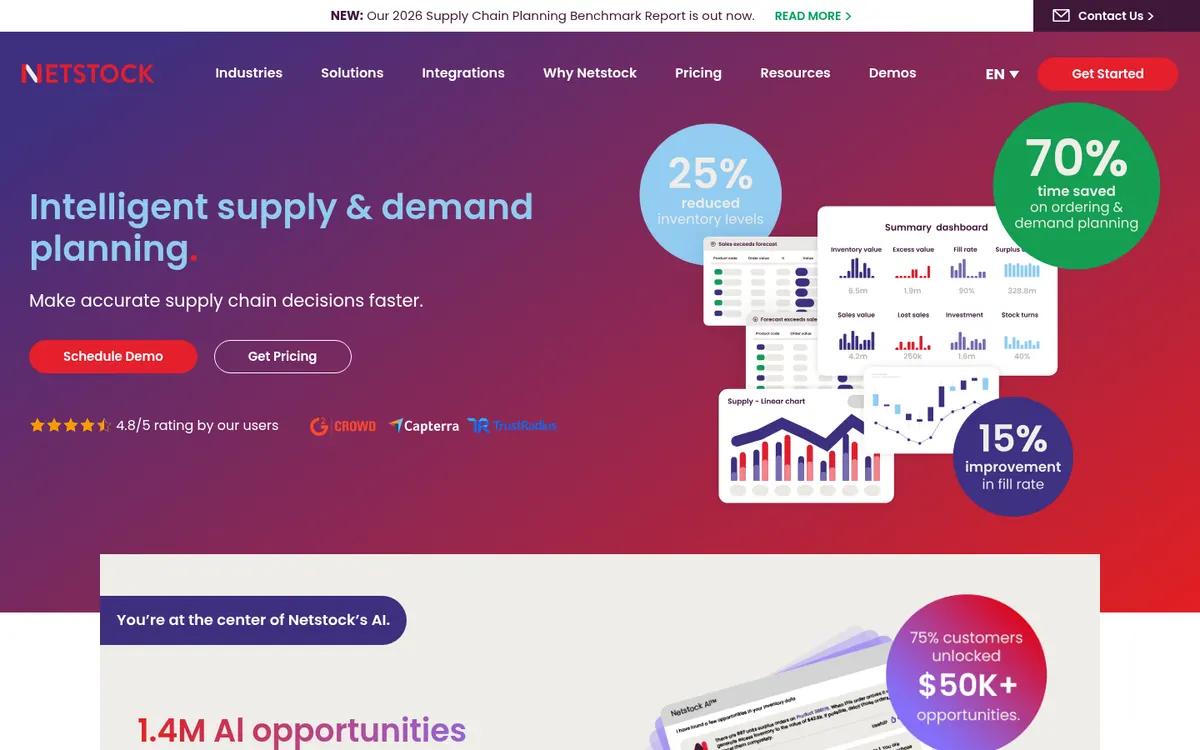
Netstock is the lightest tool on this list, and that is deliberate. It connects to a wide range of ERPs for its class, pulls in demand and supply data, and produces forecasts, replenishment recommendations and inventory optimization without a long modelling project. The vendor advertises go-live in 90 days or less on standard ERPs, which is a different order of magnitude from the enterprise programs above and is the reason many small teams shortlist it at all.
AI surfacing of critical issues is the day-to-day value: instead of scanning reports, planners get a list of items that need attention, ranked by impact. Demand planning, supply planning, forecasting and replenishment planning cover the working core of a small planning team's week without asking them to learn a modelling language first.
The limit is scope. Netstock is supply and demand planning, not full S&OP process management. Netstock focuses on supply and demand planning rather than full S&OP process management. If your monthly cycle is really a forecast and replenishment review, that is fine and you should not pay for more. If you need to reconcile operational plans with a financial forecast, you will need something else alongside it.
Pricing requires a sales conversation and there is no free plan, with a demo as the entry point. SMBs and smaller mid-market distributors on a standard ERP are the fit, especially where the alternative is another year of spreadsheet planning.
What works
- Wide ERP integration range for its class
- Live in 90 days or less
- AI highlights critical issues
What to weigh
- Supply and demand planning focus, not full S&OP process management
- Pricing requires a sales conversation
Pick it if
You are an SMB on a standard ERP that needs credible forecasting and replenishment fast.
Skip it if
You need cross-functional consensus S&OP workflows tied to a financial plan.
What Does S&OP Software Actually Do Each Month?
S&OP software is the system that runs the monthly cycle connecting demand, supply and financial plans. Sales and marketing bring a demand view, operations bring capacity and inventory constraints, finance brings revenue and margin targets, and the software holds one model where those numbers can be reconciled before an executive meeting signs off. The output is a single operating plan over the planning horizon, refreshed monthly, with agreed assumptions and a record of what changed.
The modules you usually find inside the category are:
- Demand planning and statistical forecasting, often with machine learning and outlier correction
- Supply and inventory planning, covering capacity, replenishment and service levels
- Scenario modeling so planners can test alternatives before committing
- Consensus and collaboration workflows with approvals
- Reporting that ties operational volumes back to financial measures
S&OP versus IBP is the question buyers ask most. S&OP is the operational cycle: demand, supply and the reconciliation between them, usually monthly. Integrated business planning extends the same cycle into financial, strategic and sometimes workforce planning, with a longer horizon and a heavier governance layer. Vendors use the terms loosely. o9 Solutions markets integrated business planning, while ToolsGroup and Netstock stop closer to demand and inventory planning. Ask what the tool actually reconciles, not what the category label says.
Small and mid-market buyers rarely need the full integrated business planning stack. A configurable platform such as John Galt Solutions, or an ERP-connected planner like Netstock, covers the monthly meeting without a transformation program. Enterprise buyers with multiple ERPs and a finance integration mandate are the ones who get real value from the larger platforms, because that is where reconciliation across systems becomes the hard part.
This guide sits in the Software collection. Buyers weighing nearby tools often read the guides to commission software and research platforms next.
How Do Vendors Price Software That Has No Public Price?
No vendor on this list publishes a starting price. All nine returned See website when we checked pricing pages on November 25, 2026, so the practical comparison is how each vendor packages and quotes, not a list price you can line up in a spreadsheet.
| Model | How it bills | Typical fit | Example from this list |
|---|---|---|---|
| Published list price | Not offered by any vendor here | Buyers who need budget certainty before contact | None; all nine returned See website |
| Quote after demo | Scope agreed privately after a product demo | Enterprise and upper mid-market | Anaplan, o9 Solutions, Kinaxis, Blue Yonder, Logility |
| ERP-aligned license | Quoted alongside an existing ERP relationship | Companies already running the vendor's ERP | SAP IBP |
| Sales-conversation quote | Price shared after a discovery call | SMB and mid-market | Netstock, ToolsGroup, John Galt Solutions |
Private quoting is standard for a reason. S&OP scope varies enormously: user counts, planning domains, data volume, integration count and implementation services all move the number. A single published price would mislead more than it informs. The consequence for buyers is that you cannot compare vendors until you have given each one the same scope document.
What to put in that document: number of planners and contributors, ERP and data sources, planning horizons, number of scenarios per cycle, and whether finance needs its own planning views. Vendors who quote against a fixed scope are easier to compare than vendors who quote a platform license and leave services open.
Watch the services line. Anaplan's implementation is typically partner-led, so you are buying a subscription plus an integrator. Blue Yonder sells through enterprise account teams with no self-serve path. SAP IBP carries configuration and licensing weight. Those costs rarely appear in the first proposal.
One useful data point: SAP IBP is the only tool here listing a free trial alongside its demo. Everyone else offers a demo and no free plan.
Every price in this guide was read on the vendor's own pricing page on November 25, 2026. Where a vendor does not publish a figure we could confirm, the card says "See website" rather than a guess. For the arithmetic around this purchase, try the free Email campaign metrics calculator.
How to Build a Shortlist Without Wasting a Quarter
Define the cycle first. Write down what your monthly S&OP meeting actually decides: demand sign-off, supply constraints, financial gap, or all three. That answer removes half the market before you book a single demo.
Map the data you can feed it. List every ERP, warehouse system and spreadsheet that supplies forecasts or inventory positions. S&OP tools fail on data plumbing rather than modelling features, so validate connectors early.
Set a realistic deployment window. Ask each vendor what go-live looks like in weeks, not phases. Netstock advertises 90 days or less on standard ERPs; enterprise programs run far longer and need internal staffing you must name now.
Build a three-vendor shortlist by fit, not by logo. Match each tool to the buyer description it fits: mid-market manufacturers to John Galt Solutions, SAP shops to SAP IBP, retailers and distributors to Blue Yonder.
Run a two-cycle proof of concept. Load real demand history, run one scenario and one consensus meeting inside the tool. Time the scenario run and count how many manual fixes it needs.
Compare total cost including services. Put subscription, implementation partner, integration work and internal time on one page. Quote-based pricing hides in the services line far more often than in the license.
Five Mistakes That Sink an S&OP Software Purchase
Buying the suite for one module. Blue Yonder and Logility carry broad platforms around their S&OP capability. If you only switch on planning, you still pay for the suite and the implementation methodology that comes with it.
Skipping master data cleanup. Fast simulation in Kinaxis or accurate forecasting in Netstock depends on clean item masters and consistent lead times. Fixing data after go-live turns a planning project into a data project with a planning budget.
Letting the demo set the scope. Vendors demo their best scenario. Bring your own messy data set and your own hardest question, otherwise you will scope the purchase around features you will never configure.
Treating S&OP and IBP as interchangeable. ToolsGroup and Netstock plan demand and inventory; o9 Solutions and Kinaxis market full integrated business planning. Buying the wrong one costs you either capability or budget you did not need to spend.
Ignoring the meeting after go-live. Software does not create a consensus cycle. If nobody owns the monthly review, the tool becomes an expensive forecast repository and planners drift back to spreadsheets over time.
Best S&OP Software 2026: questions
What does S&OP software cover and which modules does it usually include?
It covers the monthly cycle that reconciles demand, supply and financial plans into one operating plan. Typical modules are demand forecasting, supply and inventory planning, scenario modeling, consensus collaboration with approvals, and reporting that ties operational volumes to financial measures. Some vendors bundle all of it, while others such as Netstock stop at demand, supply and replenishment planning.
How does S&OP differ from integrated business planning?
S&OP is the operational cycle: demand, supply and the reconciliation between them, usually monthly. Integrated business planning extends that cycle into financial, strategic and sometimes workforce planning with a longer horizon and heavier governance. Vendors blur the terms, so ask what the tool actually reconciles rather than trusting the category label on the website.
Why do S&OP vendors quote pricing privately?
Because scope varies so much. User counts, planning domains, data volume, integration count and services all move the number, so a published price would mislead. Pricing for every tool here is on the vendor site or available through a quote. None of the nine publishes a starting price, so compare vendors against one written scope document rather than against a list price.
How long does S&OP software implementation take?
Deployment time varies. Netstock advertises go-live in 90 days or less on standard ERPs, while enterprise programs with partner-led modelling such as Anaplan and o9 Solutions take longer. The biggest drivers are data readiness, integration count and how many planning domains you switch on at once.
Which ERP integrations matter and how do I validate them?
You need the systems that supply demand history, inventory positions, open orders and capacity data, plus whatever finance uses for reporting. Validate connectors in a proof of concept with your own data, not a vendor sample set. SAP IBP is strongest inside SAP, Netstock covers a wide ERP range for its class, and Blue Yonder relies on a data cloud for partner tiers.
Which S&OP tools fit small businesses and mid-market teams?
Netstock and John Galt Solutions are the clearest fits. Netstock suits SMBs on a standard ERP that need forecasting and replenishment quickly, with go-live advertised at 90 days or less. John Galt Solutions suits mid-market manufacturers with complex planning rules that need a configurable S&OP and IBP module without enterprise overhead. ToolsGroup also fits inventory-heavy mid-market distributors.