
Contents of this guide
The shortlist
Our top 3 for software buyers

HireVue
Assessment library depth
- Best for
- large enterprises screening high applicant volumes
- Features
- 5 noted: One-way video, Live interviews, Game assessments, AI scoring, ATS integrations
Spark Hire
All-in-one formats
- Best for
- SMB teams needing one-way and live interviews
- Features
- 4 noted: One-way video, Live interviews, Scorecards, 30+ ATS integrations

VidCruiter
Structured hiring rigor
- Best for
- regulated employers needing standardized structured hiring
- Features
- 4 noted: Structured guides, Scorecards, Scheduling automation, Panel coordination
Disclosure for this guide. All 9 tools here are unpaid editorial picks. The position of a paid listing can be part of what the vendor pays for. Paid and unpaid tools are scored on the same rubric and keep their cons. Details are in the advertising disclosure.
The ledger
Index of every tool
| Tool | Free plan | Trial | Rubric | Compare | ||
|---|---|---|---|---|---|---|
| 01 | HireVuelarge enterprises screening high applicant volumes | See websitecustom quoted contracts, no published tiersNot published | No | Demo only | ||
| 02 | Spark HireSMB teams needing one-way and live interviews | $335Recruit Pro, applicant tracking system, per month, billed annuallyChecked Nov 25, 2026 | No | No | ||
| 03 | VidCruiterregulated employers needing standardized structured hiring | See websitecustom quoteCustom quote | No | Demo only | ||
| 04 |  Willoteams hiring in waves by open role | $59Lite, per live role per month, pay as you go, up to 5 live roles and 5 usersChecked Nov 25, 2026 | No | 14-day free trial | ||
| 05 |  Hireflixsmall companies wanting simple one-way screening | $75Small, per month billed annually, companies under 50 employeesChecked Nov 25, 2026 | No | 1 month free trial | ||
| 06 | Hirevirebudget async screening across multiple response formats | $39Essentials, per month billed annually, 1 active job, 1 user, 300 interviews per yearChecked Nov 25, 2026 | No | 7-day free trial | ||
| 07 |  Jobmamid-market teams wanting live and one-way in one tool | See websitecustom quoteCustom quote | No | Demo only | ||
| 08 |  myInterviewAI screening inside the Radancy enterprise platform | See websiteno standalone plans, enterprise quote via RadancyNot published | No | Demo only | ||
| 09 |  interviewstreamenterprises wanting a long-established flexible video platform | See websitequote-based monthly, annual and enterprise plansNot published | No | Demo only |
Prices are the lowest paid plan the vendor shows, read on November 25, 2026. Sort by price ranks published monthly figures; tools without one go last. Pin up to three tools to compare them side by side.
How this guide was put together
We scored every tool on five criteria: interview formats (25 percent), pricing clarity (20 percent), evaluation quality (20 percent), hiring integrations (20 percent) and fit and limits (15 percent). Formats carry the most weight because a platform that cannot run the interview you actually need is a shortlist failure, whatever its price. Pricing clarity rewards vendors that publish plans, caps and trial terms a buyer can check without a sales call.
Every price in this list comes from the vendor's own pricing page, checked on November 25, 2026. Where a vendor publishes nothing, we say so and keep the figure as See website rather than guessing a number or repeating an old one. Where a vendor's page has moved since figures were last recorded, we use the current page: Spark Hire now leads with plans from $335 per month, above the older $249 video interview figure, and myInterview no longer sells a standalone product after the Radancy acquisition.
Feature and limit detail comes from vendor product pages and public documentation: plan caps on active jobs, seats and interviews per year, integration lists, and security certifications the vendor states. We did not test the products ourselves, so we flag what a vendor claims rather than what we measured.
Any listing marked Featured is a paid placement. It is scored with the same rubric, held to the same evidence standard and given the same honest cons as every other entry here. Placement does not change a score.
The order is editorial. Each position reflects fit for the specific buyer described in that entry, not a weighted total, and readers with different constraints should expect a different shortlist.
The full process, including how we handle corrections, is on the methodology page. Paid listings follow the advertising disclosure.
Rubric and weights
Every tool below is scored from 1 to 10 on these five criteria. The scores describe each tool; the order is an editorial call on fit for the buyer each card describes, plus the disclosed Featured position.
- 25%Interview FormatsCovers one-way recorded, live and structured formats so one tool handles the whole interview funnel.
- 20%Pricing ClarityPublished prices, plan limits and trial terms a buyer can verify before talking to sales.
- 20%Evaluation QualityScorecards, transcripts, summaries and comparison tools that make reviewer decisions consistent.
- 20%Hiring IntegrationsApplicant tracking connectors, scheduling sync and handoffs with the recruiting tools a team already runs.
- 15%Fit and LimitsHow well seat, job and interview caps match the team size each tool is built for.
Plate 01 of 09
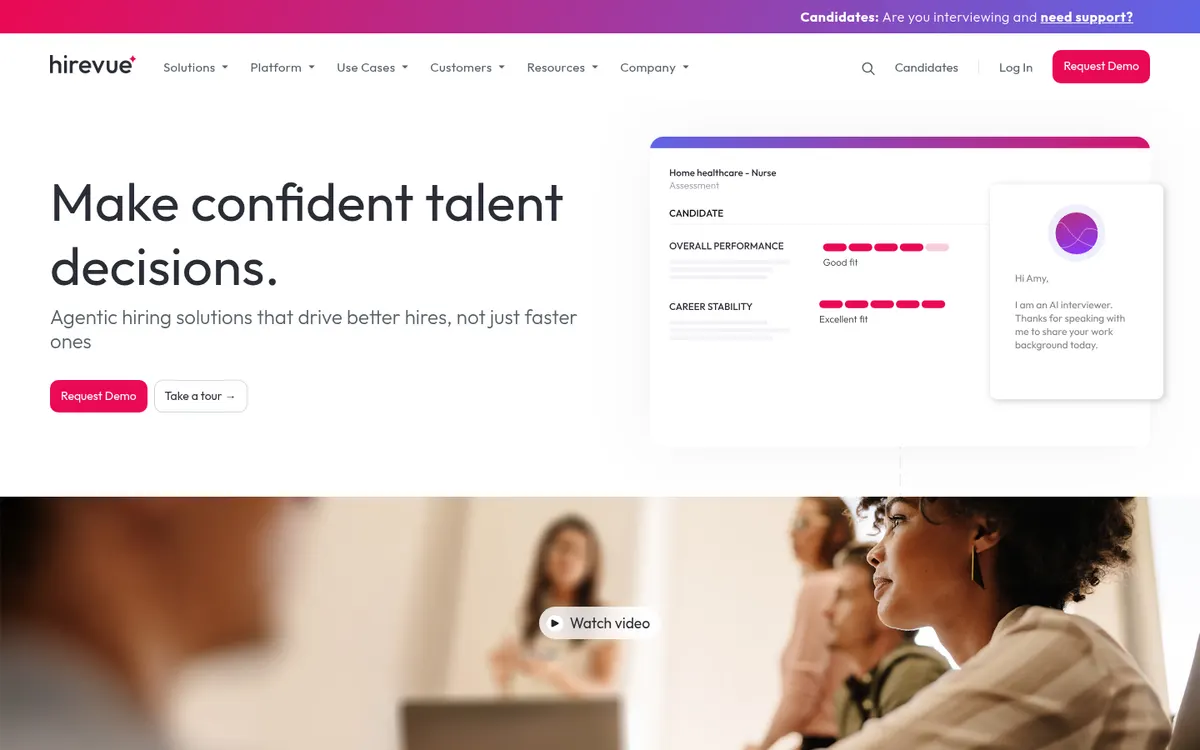
HireVue
Best for large enterprises screening high applicant volumes
Our verdict
Deep assessment and scoring for enterprise volume hiring, but quote-only pricing and long rollouts put it out of reach for small teams.
HireVue is the platform large employers reach for when applicant volume outruns human screening capacity. One system runs one-way recorded interviews, live video interviews, game-based assessments and virtual job tryouts, so a hiring team can move a candidate from a recorded screen to a live panel without exporting anything. Assessment content is written by industrial-organizational psychologists, and that grounding matters when a hiring decision gets challenged months later.
The evaluation layer is deeper than most rivals. Candidates are scored by the platform's AI-driven scoring, and results move into enterprise applicant tracking systems through ATS integrations for enterprise hiring teams. Configuration is handled with vendor help rather than self-serve, which helps consistency and slows anyone who wants to be live next week. Self-serve onboarding is not part of the offer.
Pricing is the sticking point. HireVue publishes no tiers and quotes every contract, so there is no list price to benchmark and no self-serve route in. HireVue quotes every contract, so there is no public entry price to benchmark. Multi-year commitments and long implementation cycles are common, and a demo is the only entry point. Expect a sales-led process from first call to signature.
That model suits a company hiring at high volume across many roles, with a talent acquisition operations team to absorb configuration work and defend the scoring model to compliance reviewers. For a small hiring team the assessment library does not justify the cost or the timeline. Buyers who want a published price and a self-serve trial should read further down this list.
What works
- One-way and live interviews in one system
- Assessment library built by industrial-organizational psychologists
- Deep integrations with large applicant tracking systems
What to weigh
- No published pricing; everything goes through sales
- Long implementations and multi-year commitments are common
- Cost and complexity exceed small hiring teams
Pick it if
You screen high applicant volumes at enterprise scale and need defensible, psychology-grounded assessment scoring.
Skip it if
You need a published price, a self-serve start or a live system this quarter.
Plate 02 of 09
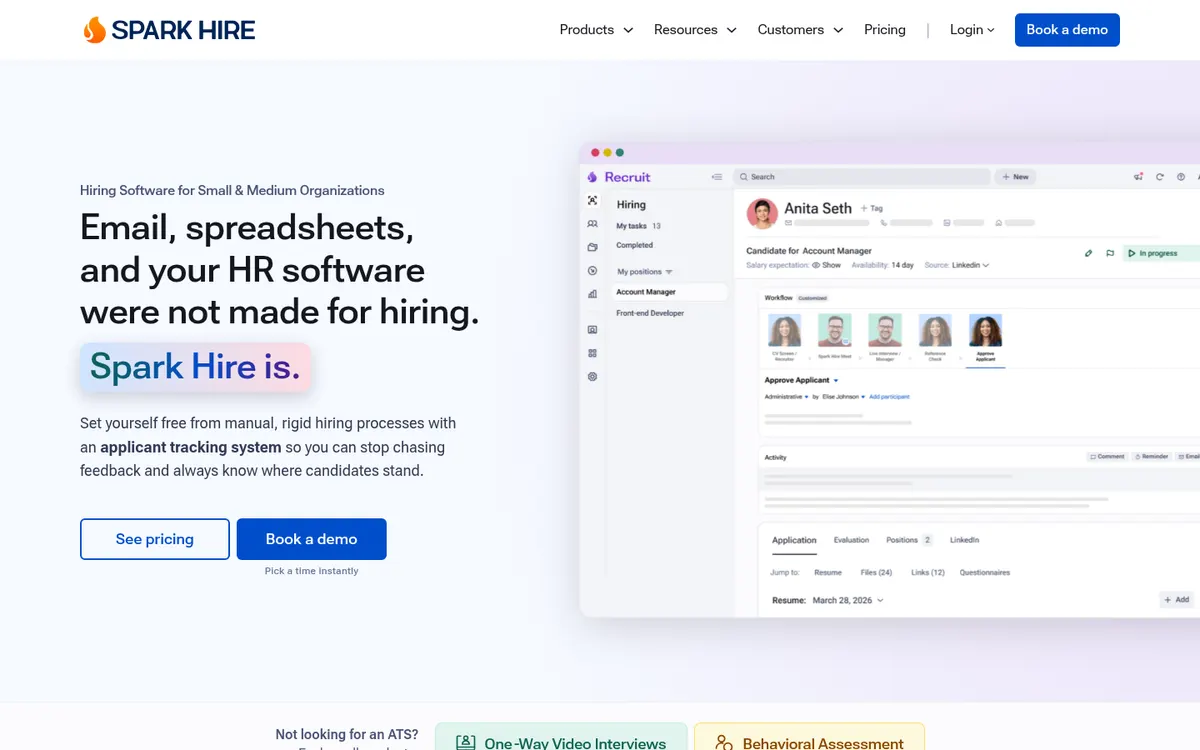
Spark Hire
Best for SMB teams needing one-way and live interviews
Our verdict
A tidy one-way plus live bundle at a published price, though the five-job, five-user entry cap pushes growing teams to sales.
Spark Hire bundles one-way recorded interviews and live video interviews into a single subscription, which is the main reason small and mid-sized recruiting teams shortlist it. Unlimited one-way interviews are included, custom branding keeps candidate-facing pages on your own look, and interview scheduling sits inside the same workspace rather than a separate calendar tool.
Reviewers get scorecards, ratings and comments attached to each interview, so a hiring panel can compare candidates on shared criteria instead of swapping notes by email. The platform connects to 30 or more applicant tracking systems, and support runs 24/7, which matters for teams recruiting across time zones or running weekend interview rounds.
Pricing is published, but the headline number has moved. The live page now leads with applicant tracking system plans from $335 per month billed annually, above the older $249 video interview entry figure. The entry tier caps active jobs at five and users at five, so a team with several concurrent recruiters will end up talking to sales. The full applicant tracking system is a separate product priced independently from the video subscription.
There is no free plan and no free trial, so the first real test is a sales conversation rather than a live round. Spark Hire fits a small recruiting function that wants async screening and live conversations in one place without building its own integrations. Larger talent acquisition teams with more than five active roles should price the tier above entry before committing, because the entry cap arrives quickly in a busy quarter.
What works
- One subscription covers async and live interviews
- Scorecards and collaboration built in
- Connectors for 30 or more applicant tracking systems
What to weigh
- No free plan and no free trial
- Entry tier limited to five active jobs and five users
- The full ATS is a separate, separately priced product
Pick it if
You run a small recruiting team that wants recorded and live interviews under one published subscription.
Skip it if
You need a trial before buying or you carry more than five active roles at once.
Plate 03 of 09
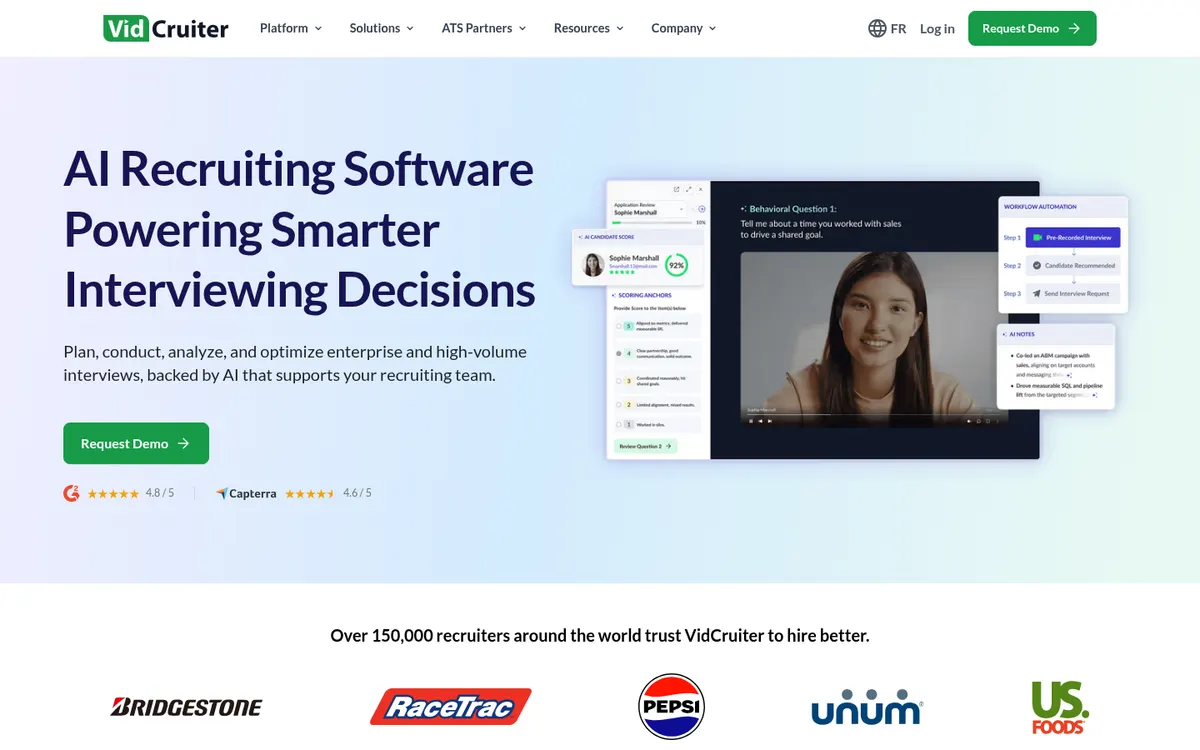
VidCruiter
Best for regulated employers needing standardized structured hiring
Our verdict
Standardized, well-documented structured hiring that regulated employers can defend, sold through quotes and heavier setup than async-first rivals.
VidCruiter is built for employers that must show a consistent, documented interview process for every candidate. Pre-recorded and live video interviews sit alongside structured interview guides, standardized rating forms and scorecards, so every applicant for a role answers comparable questions and gets scored on the same scale. That is the difference between a video tool and a hiring record.
Scheduling automation and panel coordination are the other strengths. Automated reminders cut no-shows, interviewer calendars are coordinated inside the platform, and candidate comparison workflows let a panel weigh finalists side by side. This is why the product turns up often in government, healthcare and financial services hiring, where an audit trail carries real weight.
There are no published pricing tiers, so the only way to get a number is a quote request. Plan for a guided rather than self-serve rollout. Configuration is heavier than with async-first tools, and AI capabilities arrived later than at rival platforms, which matters if automated scoring is on your must-have list today.
The platform is positioned around the full interview lifecycle rather than one-way screening alone. It fits a regulated employer with steady, high-volume hiring and someone who owns the process end to end. A startup that just wants recorded screening answers, or a team that needs AI scoring as a day-one feature, will find VidCruiter heavier and slower than the async specialists on this list.
What works
- Consistent, documented evaluation across every candidate
- Strong scheduling automation and panel coordination
- Common in government, healthcare and financial services
What to weigh
- No published pricing tiers
- Heavier configuration and rollout than async-first tools
- AI features arrived later than at rival platforms
Pick it if
You are a regulated employer that must prove a standardized, documented interview process.
Skip it if
You want a published price and a same-week self-serve rollout.
Plate 04 of 09
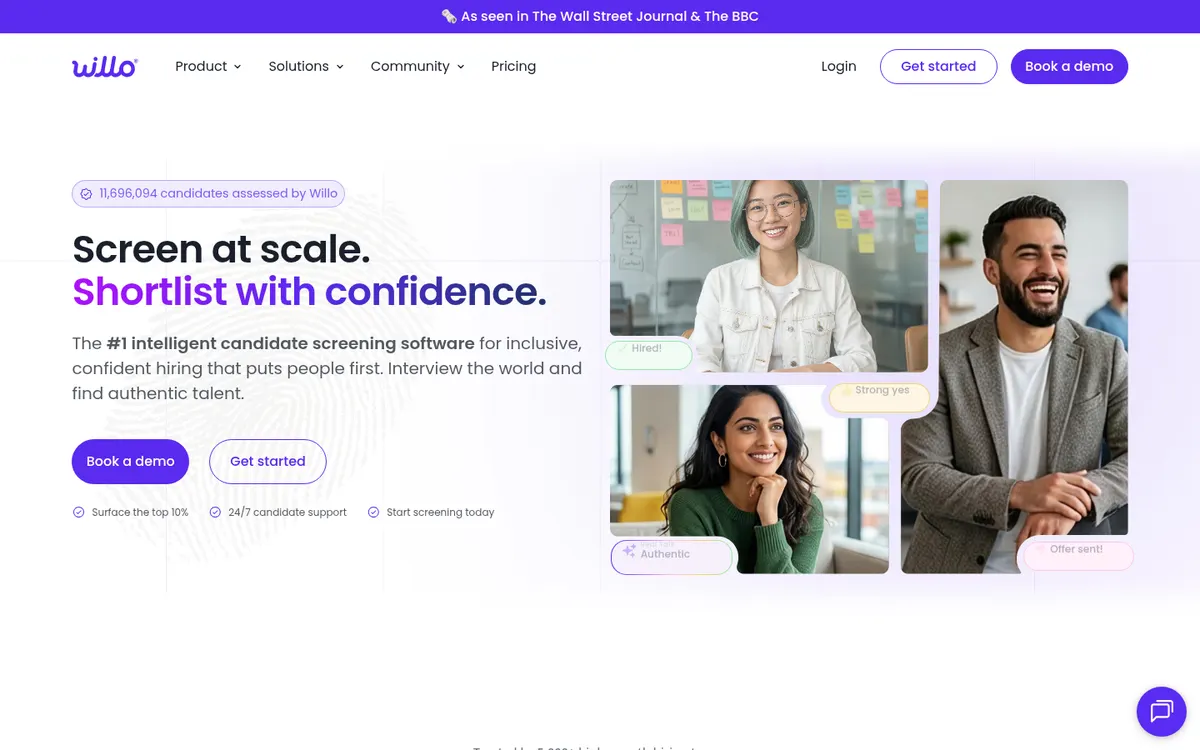
Willo
Best for teams hiring in waves by open role
Our verdict
Cheap per-role async screening with transcripts and summaries instead of black-box scores, but no live interview mode in the platform.
Willo is a recorded interview platform organized around live roles rather than seats, which suits teams hiring in waves. Candidates answer one-way video questions, and reviewers get AI-generated summaries, AI follow-up questions and transcripts instead of a black-box score, so a decision can be traced back to what the candidate actually said. Roles are the unit of organization throughout.
Reviewers see candidate evidence in the interface rather than a single ranking, and the platform supports 18 or more languages, which helps when hiring across borders. Scheduling syncs with Zoom and Google Calendar. Formal scorecards and transcription API access are held back for Enterprise, so a growing team will feel that line fairly quickly once it wants weighted comparison across a panel.
Pricing is the differentiator. Lite costs $59 per live role per month on a pay-as-you-go basis with no annual lock-in, capped at five live roles and five users, and a 14-day free trial lets a team run a full screening round before buying. An Enterprise tier starts at $3,799 per year for continuous hiring. There is no free plan. Compare that with seat-priced subscriptions, where adding recruiters raises the bill without adding roles.
The gap is live interviewing. Willo has no live interview mode, so conversations run through external video or calendar tools. That is fine for a team already on Zoom and awkward for one that wants a single system of record. Willo fits a small or mid-sized team screening in bursts and comfortable splitting live conversations from recorded screening. Teams with constant open roles should price Enterprise first, because the per-role cost compounds.
What works
- Pay-as-you-go per live role with no annual lock-in on Lite
- Transcripts and AI summaries instead of automated scores
- 14-day trial allows a full live screening round
What to weigh
- No live interview mode inside the platform
- Formal scorecards limited to Enterprise
- Lite capped at five live roles and five users
Pick it if
You hire in waves and want per-role pricing with evidence review rather than black-box scoring.
Skip it if
Live interviews must happen inside the same platform.
Plate 05 of 09
Hireflix
Best for small companies wanting simple one-way screening
Our verdict
Simple one-way screening with unlimited seats at a flat price by headcount, with no live option and light analytics.
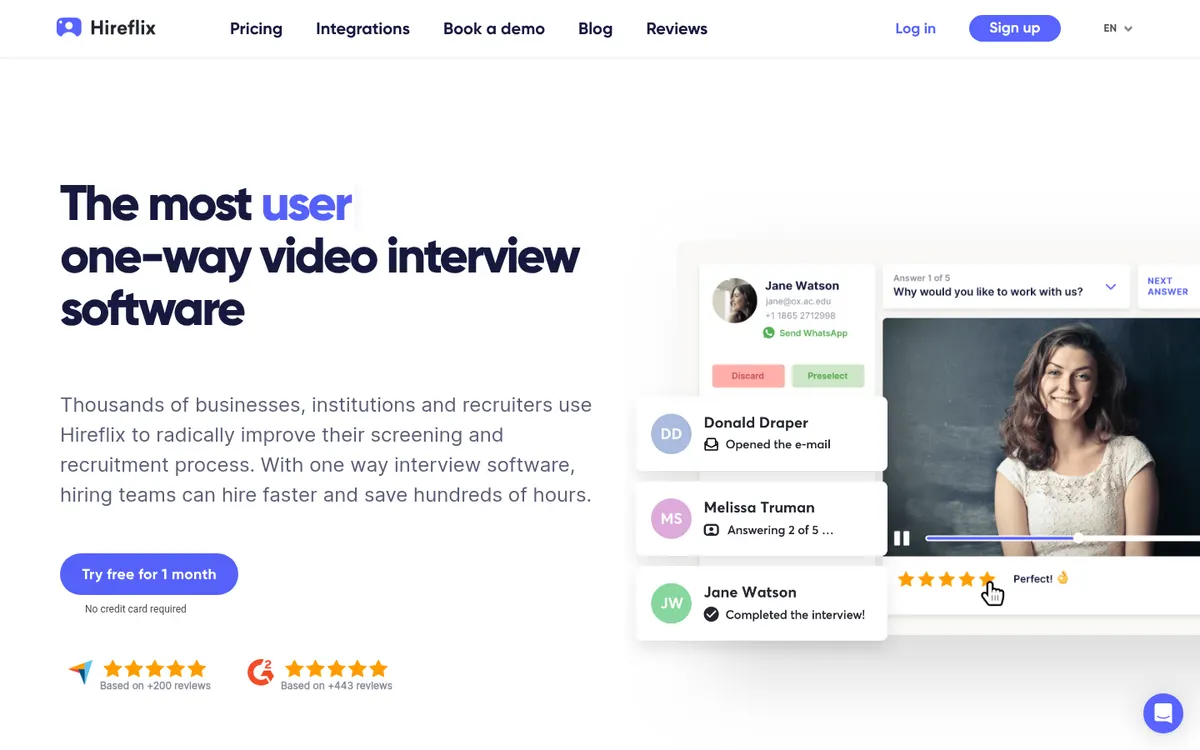
Hireflix does one thing and keeps the terms simple: one-way recorded video screening with unlimited seats, unlimited positions and unlimited video responses on every plan. Candidates record in a browser without an account, an app or a registration step, which removes a common source of friction.
Custom video questions and custom domains are included throughout, and integrations cover Greenhouse, Lever, Ashby and Workable, so screening results land in an applicant tracking system the team already runs. Setup is quick because there is genuinely little to configure, and nobody has to explain a feature matrix to a hiring manager.
Pricing follows company headcount rather than seats or interview volume. The Small plan costs $75 per month billed annually for companies under 50 employees, and every feature is included at every tier, so there is no upsell ladder to decode before you can plan a budget. A one-month free trial is available on all plans. There is no free plan.
The limits are real. There is no live interview option, analytics are thin, and evaluation leans on comments and star ratings rather than weighted scorecards, so structured comparison across many finalists is weaker than at VidCruiter or Spark Hire. Hireflix fits a small company that wants cheap, predictable asynchronous screening and already has a separate way to run live interviews. Teams that need live conversations or defensible scoring should look elsewhere rather than buy and work around it.
What works
- Flat pricing by company size, not seats or interviews
- Every feature included on every plan
- Candidates record without an account or app
What to weigh
- One-way interviews only, no live option
- Limited analytics and no advanced AI scoring
- Evaluation relies on comments and star ratings
Pick it if
You are a small company that wants unlimited seats and simple async screening at a predictable price.
Skip it if
You need live interviews, weighted scorecards or deeper reporting.
Plate 06 of 09
Hirevire
Best for budget async screening across multiple response formats
Our verdict
The lowest entry price on this list for multi-format async screening, with annual interview caps on every plan.
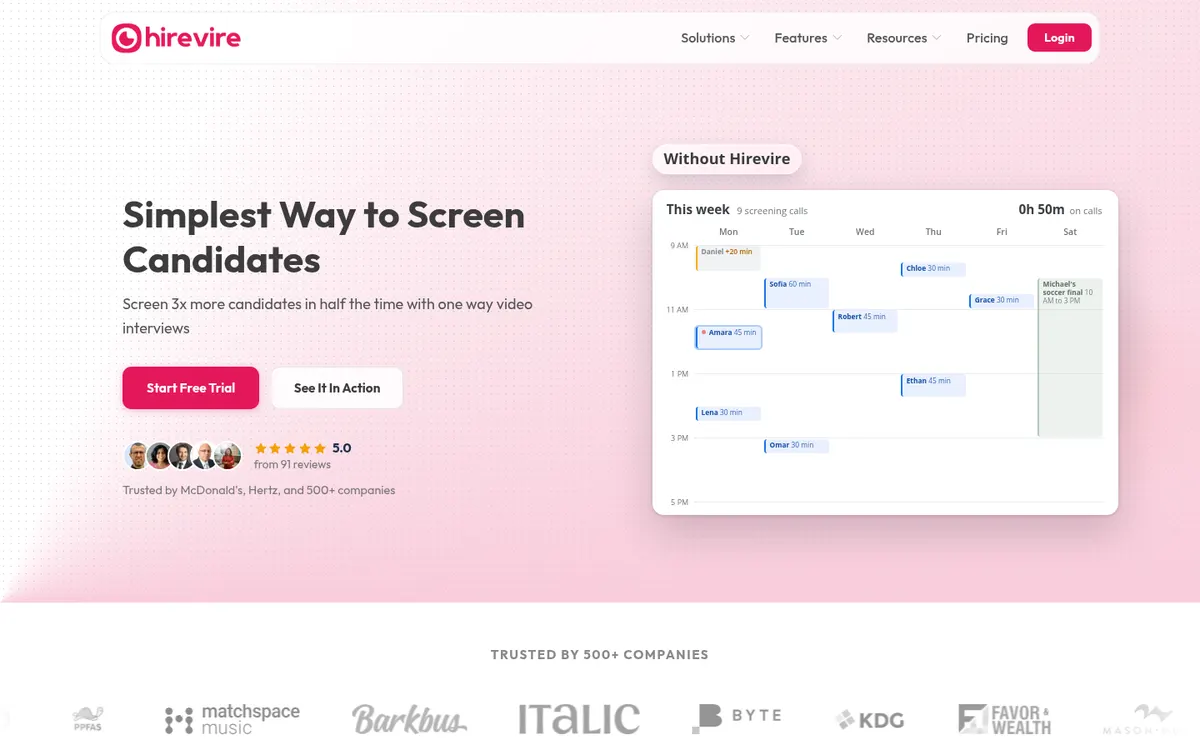
Hirevire takes video, audio, text and file upload responses through a single interview link, which makes it the cheapest way here to start screening asynchronously. Questions per interview are unlimited, candidates never create an account, and AI transcripts are included even on the entry tier rather than held back as an upgrade.
The transcript language coverage is unusually wide, at 90 or more languages, and interview links are shared per job rather than per candidate, which keeps recruiter admin low when a role gets a sudden burst of applications. Advanced AI analytics sit on higher tiers, and the product is a screening tool rather than a full hiring suite, so applicant tracking, offers and onboarding stay in whatever system you already run.
Pricing is published and low. Essentials costs $39 per month billed annually for one active job, one user and 300 interviews per year, and a 7-day free trial is available. Professional runs $99 per month billed annually with 1,200 interviews, and Agency runs $199 per month with 12,000. There is no free plan.
Every plan carries an annual interview cap, so teams screening at volume need to size the tier before they buy rather than after. Small teams screening a few dozen applicants per role will rarely touch the ceiling. Hirevire fits a budget-conscious employer or agency that wants multi-format screening without a large commitment. It is a poor fit for anyone who needs live interviews or deep analytics from day one of the trial.
What works
- Lowest entry cost among the nine tools compared
- Video, audio, text and file responses in one link
- AI transcripts across 90 or more languages
What to weigh
- Annual interview caps apply on every plan
- Advanced AI analytics reserved for higher tiers
- Screening only, not a full hiring suite
Pick it if
You want the cheapest credible async screening with several response formats and transcripts included.
Skip it if
You need live interviews or expect to exceed an annual interview allowance.
Plate 07 of 09
Jobma
Best for mid-market teams wanting live and one-way in one tool
Our verdict
Live, recorded and AI interviews with assessments in one certified platform, priced only through a custom quote.
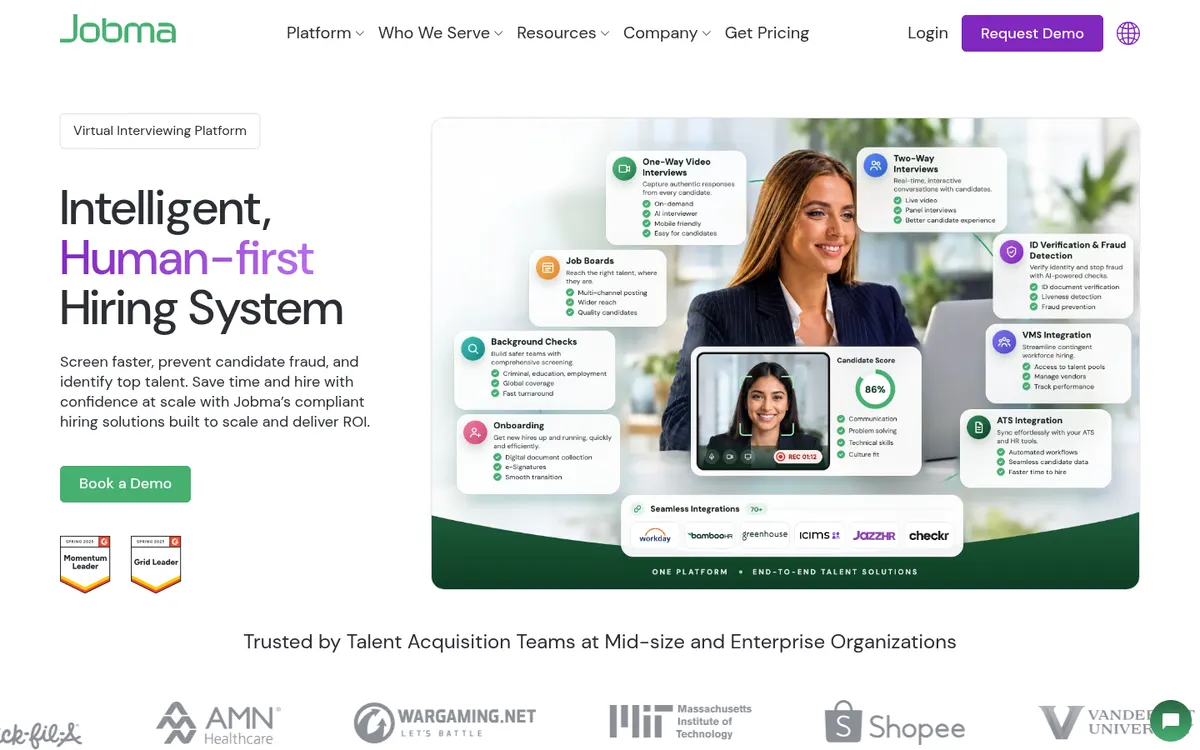
Jobma bundles pre-recorded one-way interviews, live video interviews, AI autonomous interviews and built-in skills assessments in one platform, so a mid-market team can run several screening formats without stitching vendors together. AI candidate scoring and candidate tracking are part of the same workspace rather than separate add-ons sold after the first contract.
The compliance story is stronger than most on this list. The vendor states SOC 2 Type II and ISO 27001 certification, which shortens security review for buyers in regulated industries. Applicant tracking system integrations cover the usual connectors, and the assessment module lets a team test a skill before spending interviewer hours on a conversation that will not go anywhere.
Pricing is quote-only. The pricing page lists custom packages and a request form for volume-based plans, so buyers cannot self-serve or benchmark spend before a sales conversation. Older entry-level figures circulating on the web predate the current model and should not be treated as current. Implementation time varies with how much of the assessment and AI configuration you switch on during onboarding.
Jobma fits a mid-market or larger employer that wants live and recorded formats plus assessments from one vendor, and that has procurement capacity for a quoted contract. A small team that wants a published monthly price, a card payment and a same-week start will find the sales cycle and configuration burden disproportionate to what it actually needs from video screening.
What works
- Several interview formats bundled in one platform
- Assessments and AI scoring included
- SOC 2 Type II and ISO 27001 certified
What to weigh
- Quote-only pricing with no published plans
- Implementation time varies with configuration
- Aimed at mid-market and larger buyers
Pick it if
You are a mid-market employer that wants live, recorded and AI interviews plus skills assessments from one vendor.
Skip it if
You need a published price and a small-team self-serve start.
Plate 08 of 09
myInterview
Best for AI screening inside the Radancy enterprise platform
Our verdict
AI shortlisting inside the Radancy suite, with no standalone product or published pricing left for independent buyers.
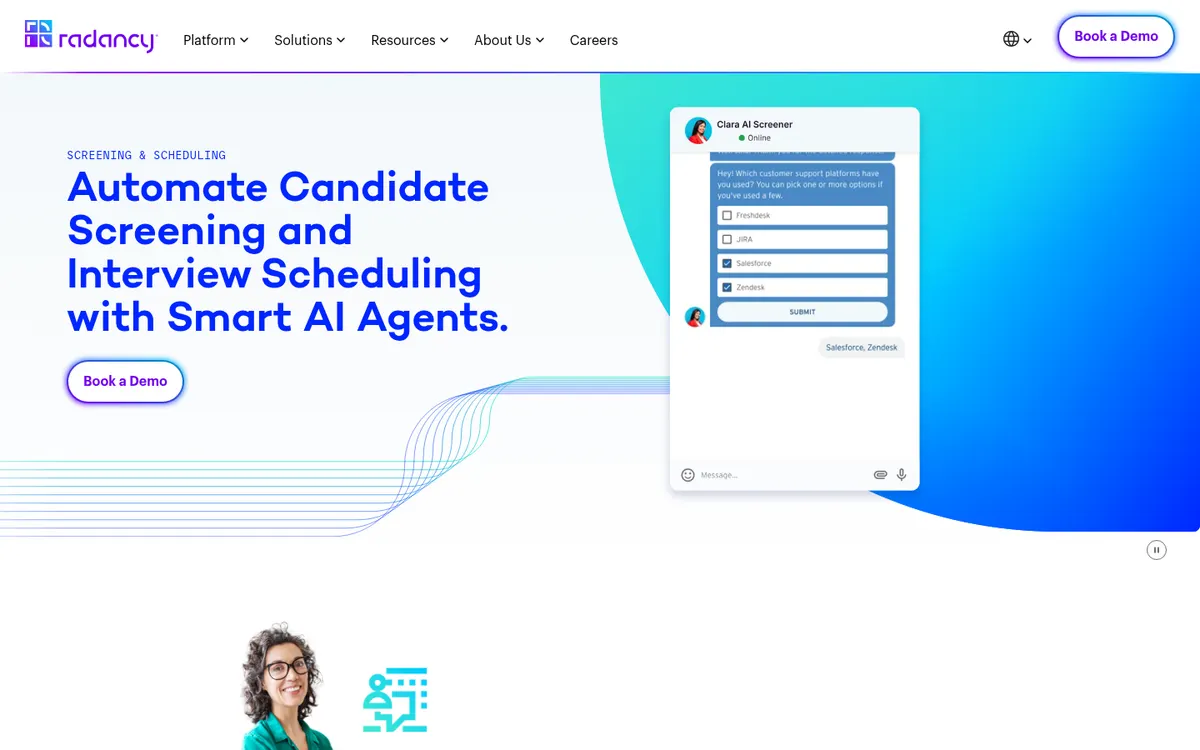
myInterview is now an enterprise screening product inside Radancy rather than a standalone tool. What remains is AI-assisted shortlisting, automated candidate ranking and mobile-friendly asynchronous video interviews delivered as part of the parent platform's recruiting suite rather than sold on its own.
The AI shortlisting and ranking sit inside the workflow rather than bolted on afterwards, and the candidate experience is mobile first, which matters for applicants who apply from a phone. Because it is part of a broader enterprise suite, the value depends heavily on how much of that suite a buyer already uses or intends to buy.
Standalone plans no longer exist. There is no published pricing, no plan list and no self-serve route: the independent offering was retired after the Radancy acquisition, and the old site now redirects into Radancy screening and scheduling pages. Older figures still circulate online but predate the acquisition and should be ignored. Budget for an enterprise quote and a platform-level conversation instead.
That makes myInterview a fit only for organizations already buying or evaluating Radancy, where video screening arrives as part of a wider recruiting stack. Anyone comparing video interview tools as a standalone purchase, especially a small team, should treat this as unavailable and look at the published-price options on this list instead. Product direction is tied to the parent platform, so roadmap questions belong inside the Radancy negotiation.
What works
- AI shortlisting and ranking built into the workflow
- Mobile-first candidate interview experience
- Part of a broader enterprise recruiting suite
What to weigh
- Standalone product and self-serve pricing no longer exist
- No published pricing or plan list
- Product direction is tied to the parent platform
Pick it if
Pick it only if you are already buying or evaluating Radancy and want screening inside that suite.
Skip it if
You need a standalone video interview tool with a price you can compare.
Plate 09 of 09
interviewstream
Best for enterprises wanting a long-established flexible video platform
Our verdict
Two decades of recorded, live and scheduling tools with cloud or on-premise deployment, sold through individually quoted contracts.
interviewstream has been selling video interviewing for two decades, and the product reflects that history: on-demand recorded interviews, live interview connectivity and interview scheduling tools in one suite, with reporting and analytics layered on top for managers who need to see pipeline activity.
Single sign-on is supported, which matters for enterprise IT, and deployment can be cloud or on-premise, a combination few competitors still offer. The vendor states SOC 2 Type 2 certification. Companies with unusual infrastructure requirements, including on-premise mandates, will find the deployment options here broader than at most cloud-only rivals on this list.
Buying is sales-led. There are no published pricing tiers, and monthly, annual and enterprise plans are quoted individually. Any monthly figure you see elsewhere is unverified and should not be treated as a quote. Customization depth also differs between plans, so what a demo shows may not be what the signed tier includes, and that gap is worth closing in writing before signature.
The public review footprint is smaller than at larger rivals, which makes independent diligence harder and raises the value of reference calls with similar-sized customers. interviewstream fits an enterprise or public sector buyer that wants a long-established vendor, on-premise flexibility and one suite covering recorded, live and scheduling. A small team that wants transparent pricing and a self-serve trial will spend more time in procurement than the product warrants.
What works
- Two decades of experience in video interviewing
- On-demand, live and scheduling tools in one suite
- SOC 2 Type 2 certified with cloud or on-premise deployment
What to weigh
- No published pricing tiers
- Smaller public review footprint than larger rivals
- Customization depth differs between plans
Pick it if
You are an enterprise or public sector buyer that needs on-premise options and a long-established vendor.
Skip it if
You want a published price and a self-serve trial before you commit.
What Is Video Interview Software and What Does It Actually Do?
Video interview software lets a hiring team record, run or review candidate interviews on video instead of booking every first conversation as a phone call or an in-person meeting. It replaces the phone screen with a structured recording, or it moves a live panel interview onto a browser link, and it keeps the resulting video, transcript and reviewer notes in one place. Most products do one of those jobs well and the other adequately, which is why format coverage is the first thing to check on any pricing page.
There are three formats in common use, and the names matter when you compare plans.
- One-way (asynchronous) interviews: the candidate records answers to a fixed question set on their own schedule, and reviewers watch later.
- Live video interviews: candidate and interviewer meet on a scheduled call inside the platform or through an integrated tool such as Zoom.
- Structured or guided interviews: the platform supplies the question set, rating scale and scorecard so every candidate for a role is judged on the same basis.
The buyer-side value is speed and consistency. A recruiter can send a recorded interview link to a batch of applicants in a morning and review them the same afternoon, skimming transcripts rather than watching full videos. Scorecards and rating forms turn scattered impressions into a comparable record that survives a hiring manager change. AI layers, where present, summarize answers, generate follow-up questions or rank candidates against a model, and every one of those features deserves a compliance question before it is switched on in production.
What it does not do is run your hiring process. Video interview software rarely replaces an applicant tracking system; it plugs into one. You still need somewhere to post roles, collect applications, manage offers and keep records. Teams that expect one purchase to cover both often end up buying twice, which is why the integration question matters in evaluation.
This guide sits in the Software collection. Buyers weighing nearby tools often read the guides to commission software and research platforms next.
How Video Interview Pricing Works, From Per-Role Fees to Quoted Contracts
Four billing models show up across these nine tools, and the model tells you more about total cost than the headline number does.
| Model | How it bills | Typical fit | Example from this list |
|---|---|---|---|
| Pay per live role | Monthly per open role, no annual lock-in | Teams hiring in waves | Willo Lite at $59 per live role per month |
| Flat by headcount | Monthly by company size, all features included | Small companies | Hireflix Small at $75 per month billed annually for companies under 50 employees |
| Published subscription with caps | Monthly or annual, capped on jobs, seats or interviews | SMB recruiting teams | Spark Hire Recruit Pro at $335 per month billed annually; Hirevire Essentials at $39 per month billed annually for 300 interviews a year |
| Custom quote | Sales-led contract, no public tiers | Enterprise and regulated buyers | HireVue, VidCruiter, Jobma, myInterview and interviewstream |
Quote-only vendors are the majority here: five of the nine publish no prices at all. That is not an accident of web design. Enterprise contracts are priced on volume, modules and implementation scope, so a list price would mislead most visitors. The cost to you is that you cannot benchmark before a sales call, and the first number you see is the one a representative chose for your account.
Published prices cluster at the low end. The cheapest entry points are $39 per month billed annually for Hirevire Essentials and $59 per live role per month for Willo Lite, and both are capped: Hirevire on interviews per year, and Willo on live roles and users. Mid-range published plans run from $75 to $335 per month. Enterprise quotes are a different order of magnitude, and HireVue pricing is quoted per contract without a published list price.
Read the qualifier attached to any price. Annual billing, seat counts, active job limits and interview allowances all change the real monthly cost, and the plan that looks cheap at one recruiter is rarely the plan you end up signing.
Every price in this guide was read on the vendor's own pricing page on November 25, 2026. Where a vendor does not publish a figure we could confirm, the card says "See website" rather than a guess. For the arithmetic around this purchase, try the free Email campaign metrics calculator.
How to Choose Video Interview Software in Six Steps
- Name the format. Decide whether you need one-way screening, live interviews or both before you look at prices. Willo, Hireflix and Hirevire are async only, so a team that still runs live panels needs a second tool or a different vendor.
- Count your caps. Write down how many open roles, recruiters and interviews per year you actually run, then compare against plan limits. Spark Hire entry caps at five jobs and five users, and Hirevire caps interviews annually.
- Set the budget band. Decide early whether a quoted contract is acceptable. If procurement needs a published number before a demo, restrict the shortlist to Spark Hire, Willo, Hireflix and Hirevire, which publish prices.
- Test the reviewer workflow. Ask for a walkthrough of what a hiring manager sees: scorecards, transcripts, summaries, side-by-side comparison. Evaluation quality separates these tools far more than video quality does.
- Check the ATS handoff. Confirm the integration you need exists and is supported, not merely listed. Spark Hire advertises 30 or more connectors, Hireflix names Greenhouse, Lever, Ashby and Workable, and enterprise tools integrate deeply.
- Run a live round. Use a trial where one exists (Willo 14 days, Hireflix one month, Hirevire 7 days) on a real open role before signing. A demo shows the product; a live round shows drop-off and reviewer friction.
Five Mistakes That Sink a Video Interview Rollout
- Buying for the AI label. AI scoring, ranking and summaries vary widely in depth and oversight. Ask what the model does, what reviewers actually see, and whether a human decision is still documented, before paying a premium.
- Ignoring seat and job caps. Entry tiers often cap active jobs and users, sometimes at five each. A growing team can hit the ceiling quickly and then renegotiates from a weak position with no leverage.
- Assuming it replaces the ATS. Video interview software screens candidates; it does not post roles, manage offers or keep hiring records. Budget for both, or confirm whether the vendor sells a full applicant tracking system separately.
- Skipping the compliance review. Recorded video and AI evaluation touch data retention, candidate consent and bias auditing. Loop legal in before the pilot rather than after the contract, especially in regulated industries.
- Testing with volunteers. A pilot run on colleagues tells you nothing about candidate drop-off. Run the trial on a real open role with real applicants and measure completion, not just the feature list.
Best Video Interview Software 2026: questions
How does a one-way video interview differ from a live video interview?
A one-way interview is recorded: the candidate answers a fixed question set on their own schedule and a reviewer watches later. A live interview happens in real time on a scheduled call. One-way screening scales cheaply and removes scheduling friction, while live interviews let you probe with follow-ups. Spark Hire, VidCruiter and Jobma do both; Willo, Hireflix and Hirevire are one-way only.
What do async, mid-range and enterprise tools cost each month?
Async entry plans include $39 per month billed annually for Hirevire Essentials, $59 per live role per month for Willo Lite and $75 per month billed annually for Hireflix Small, with caps on jobs, users or interviews. Published plans above the entry tier include Spark Hire Recruit Pro at $335 per month billed annually. Enterprise tools such as HireVue, VidCruiter, Jobma and interviewstream publish nothing and quote per contract, so a monthly figure only emerges after a sales conversation.
What drives candidate drop-off on recorded video interviews?
Friction and length, mostly. Candidates abandon when they must create an account, install an app or record on a desktop-only flow, and browser-based recording with no login, as Hireflix and Hirevire offer, removes that step. Long question sets with no practice attempt also hurt completion. Mobile support and clear instructions matter more than video quality.
Does video interview software replace an applicant tracking system?
Rarely. Most video interview tools plug into an applicant tracking system rather than replace it, handling the interview step while the ATS posts roles, collects applications and manages offers. Spark Hire sells a separate ATS product priced independently. VidCruiter and Jobma add scheduling and tracking but still expect an ATS for the wider process.
What compliance issues come with AI-based candidate scoring?
Three come up most: consent and retention for recorded video, whether candidates are told AI is used, and bias auditing of any model that ranks or rejects people. HireVue grounds assessments in industrial-organizational psychology; Jobma cites SOC 2 Type II and ISO 27001, and interviewstream cites SOC 2 Type 2, but certification covers security, not fairness. Get legal review before scoring goes live.
Which plans cap interviews, active jobs or user seats?
Several do. Hirevire caps interviews annually: 300 on Essentials, 1,200 on Professional at $99 per month, and 12,000 on Agency at $199 per month. Spark Hire entry limits five active jobs and five users. Willo Lite allows five live roles and five users. Hireflix is the exception, with unlimited seats and positions but pricing tied to headcount under 50 employees.