
Contents of this guide
The shortlist
Our top 3 for software buyers

Dyrect
QR code registration
- Best for
- D2C brands running QR code warranty registration
- Features
- 5 noted: QR registration, Free tier, Claims portal, Shopify sync, Credit based

NeuroWarranty
Engagement built in
- Best for
- QR based claims paired with customer engagement
- Features
- 4 noted: No-app registration, Duplicate detection, Built-in CRM, Rule routing

Claimlane
AI claim intake
- Best for
- Retailers wanting branded self-service claim portals
- Features
- 4 noted: Branded portal, AI intake, ERP connectors, Multipart products
Disclosure for this guide. All 8 tools here are unpaid editorial picks. The position of a paid listing can be part of what the vendor pays for. Paid and unpaid tools are scored on the same rubric and keep their cons. Details are in the advertising disclosure.
The ledger
Index of every tool
| Tool | Free plan | Trial | Rubric | Compare | ||
|---|---|---|---|---|---|---|
| 01 | DyrectD2C brands running QR code warranty registration | $19Registration, per month, 100 credits included, 1 business userChecked Nov 25, 2026 | Yes, 100 lifetime credits | No | ||
| 02 | NeuroWarrantyQR based claims paired with customer engagement | See websiteCustom pricing based on claim volume and featuresNot published | No | 14 days, reported by reviewers | ||
| 03 | ClaimlaneRetailers wanting branded self-service claim portals | See websiteCustom quoteNot published | No | No | ||
| 04 |  WarrantyHubHome warranty firms, builders and auto TPAs | See websiteVolume based pricing, quoted per contract volumeNot published | No, free demo offered | Demo only | ||
| 05 |  PTC WarrantyEnterprise manufacturers running service operations | See websiteEnterprise license, custom quoteNot published | No | No | ||
| 06 | Syncron WarrantyOEMs focused on supplier cost recovery | See websiteCustom quoteNot published | No | No | ||
| 07 |  Pega WarrantyComplex multi-party claim workflows | See websiteEnterprise license, custom quote by volume and modulesNot published | No | No | ||
| 08 |  ReverseLogixManufacturers combining returns with warranty repair | See websiteCustom quote, enterprise orientedNot published | No | No |
Prices are the lowest paid plan the vendor shows, read on November 25, 2026. Sort by price ranks published monthly figures; tools without one go last. Pin up to three tools to compare them side by side.
How this guide was put together
We built this list for buyers who have to choose a warranty system, not browse a category. Each tool was assessed against five criteria: claim intake and registration, pricing clarity, integrations, enterprise depth, and time to live. Claim intake carries the most weight because it is where most warranty projects succeed or fail: if customers and dealers cannot file a claim without help, nothing downstream matters.
Pricing clarity scores whether a vendor publishes plans, limits and a free tier or trial you can evaluate without a sales call. Integrations covers the ecommerce, support desk, ERP and accounting connections named by each vendor. Enterprise depth looks at supplier recovery, approvals, analytics and multi-party handling. Time to live reflects stated rollout guidance and how much IT involvement the product demands.
Prices were checked on November 25, 2026, on vendor pricing pages. Where no pricing page exists, pricing is on the vendor site. Seven of the eight tools here publish no price. Where pricing is quoted, we say so and do not estimate a number. Plan names, credit allowances and billing terms are reproduced as published. Nothing here is a currency conversion.
No entry in this list carries a Featured placement. When a vendor holds one, it is paid placement, it is scored with the same rubric including the cons, and it is labeled as Featured so you can weigh it accordingly. The order reflects fit for the buyer described in each entry.
The full process, including how we handle corrections, is on the methodology page. Paid listings follow the advertising disclosure.
Rubric and weights
Every tool below is scored from 1 to 10 on these five criteria. The scores describe each tool; the order is an editorial call on fit for the buyer each card describes, plus the disclosed Featured position.
- 25%Claim intakeHow well the tool captures registrations and claims, from QR code registration on packaging to branded self-service portals and dealer filing.
- 20%Pricing clarityWhether the vendor publishes plans, limits and a free tier or trial a buyer can evaluate without a sales call.
- 20%IntegrationsCoverage of the ecommerce, support desk, ERP, payment and accounting systems a warranty team already runs.
- 20%Enterprise depthSupplier recovery, multi-tier approvals, contract administration and analytics for multi-party warranty programs.
- 15%Time to liveStated rollout guidance and how much IT, developer or architect involvement the deployment demands.
Plate 01 of 08
Dyrect
Best for D2C brands running QR code warranty registration
Our verdict
The only tool here with public pricing and a free tier, best for D2C brands registering products by QR code.
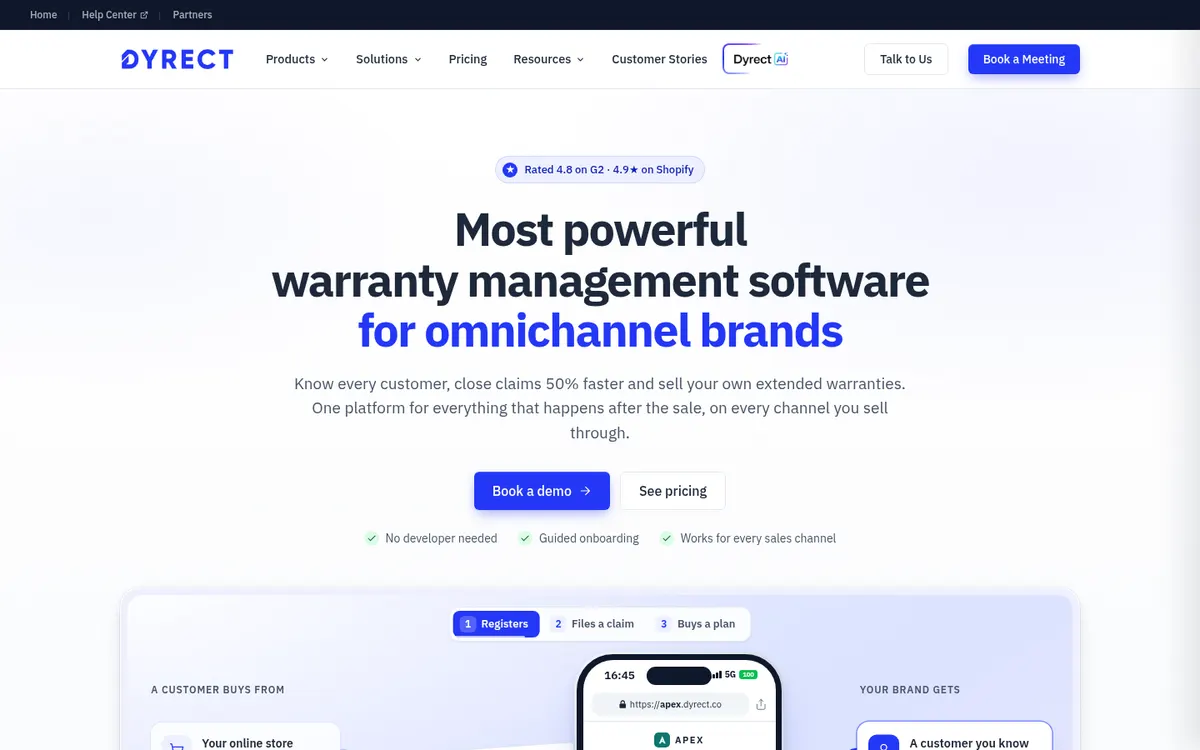
Dyrect handles the two jobs most consumer brands need first: getting a product registered and taking a claim when something goes wrong. A buyer scans a QR code printed on the packaging and registers through a branded portal. Claims arrive through the same portal rather than an inbox, which keeps registration and claim records in one place. One credit covers a single registration, claim or repair action, so usage maps directly onto how much support work you generate.
Pricing is the reason to start here. The free plan gives 100 lifetime credits, enough to test the flow with real customers, and the three paid tiers are published: Registration at $19, Claims at $49 and Claims Pro at $149 per month, each including 100 monthly credits. Past that, credits are consumed per action, so a busy claims month costs more than the plan price suggests. Model your worst quarter before you commit, especially if a product recall or a bad batch would push volume.
The integration list suits an ecommerce stack rather than an IT department. Shopify, Klaviyo, HubSpot and Mailchimp cover storefront, email and CRM, and Zendesk and Gorgias cover support desks. Registration data can be reused for post-purchase marketing, which is often the argument that gets the project funded: the warranty record becomes an owned contact rather than a spreadsheet row.
The limits show up when distribution gets complicated. Dyrect is built for consumer brands selling direct or through retail, not for industrial dealer networks with multi-tier approvals, distributor contracts or supplier recovery. If your claims route through dealers and then to component suppliers, look at the enterprise entries further down this list. If you sell direct and want registration and claims in one tool, this is a published starting point here, and the only one you can price without a sales call.
What works
- Publicly listed plans plus a real free tier
- Registration and claims handled in one portal
- Shopify, Klaviyo, Zendesk and Gorgias connections
What to weigh
- Credits are consumed per action, so overage charges grow with volume
- Built for consumer brands, not industrial dealer networks
Pick it if
You sell direct to consumers and want QR code registration and claims live quickly at a published price.
Skip it if
Your claims route through dealers, distributors or supplier chargebacks.
Plate 02 of 08
NeuroWarranty
Best for QR based claims paired with customer engagement
Our verdict
A claims tool that doubles as a customer engagement channel, held back by pricing you can only get from a demo.
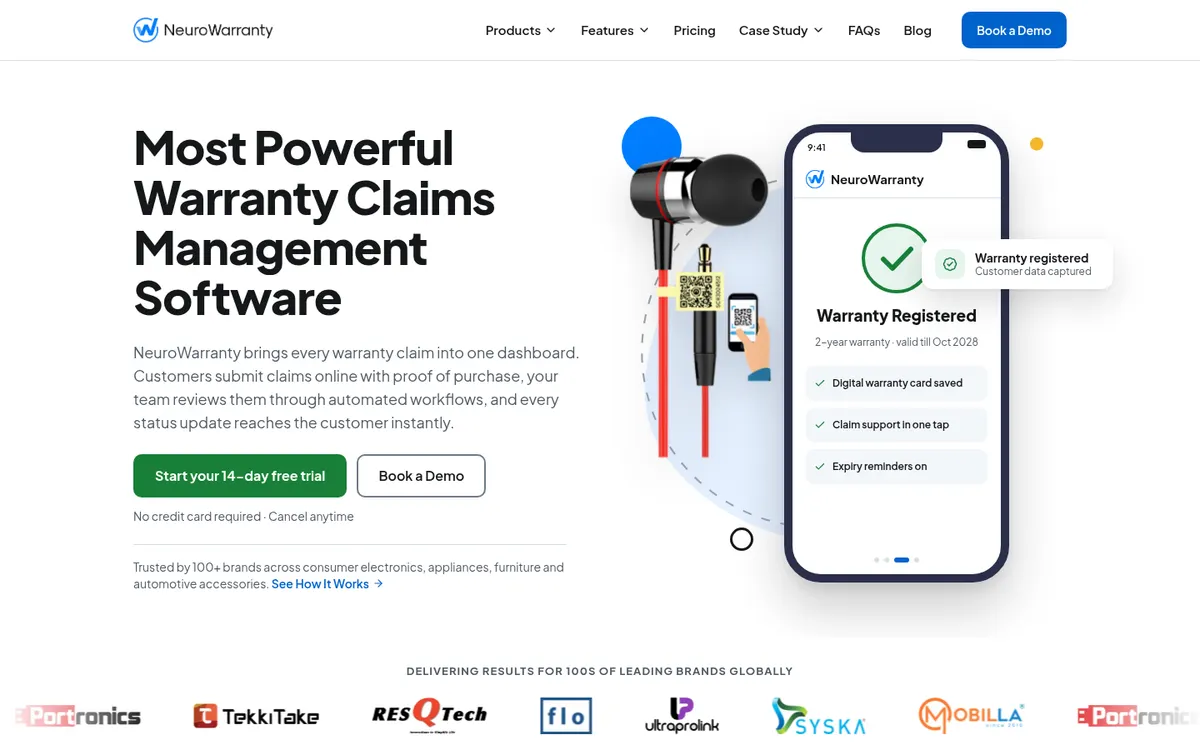
The pitch here is that a claim is a conversation, not a form. A customer registers a product digitally without installing an app, then files a claim with a serial number, an invoice and photos. NeuroWarranty verifies the purchase details against the documents submitted, checks for duplicate claims at intake, and routes cases through rule based workflows instead of a shared inbox. For electronics, appliances, furniture and automotive accessories brands, that covers the routine work which otherwise consumes a support team.
The unusual part is what sits on top: a built in CRM that collects feedback and sends review requests. Warranty contact becomes a reason to talk to the customer again, which is a better use of the interaction than a closed ticket. Duplicate detection at intake also matters more than it sounds, because the same claim filed twice through two channels is a common and expensive leak.
Pricing is the open question. There is no pricing page to check; the vendor quotes after a demo, sized to claim volume and features. Trial availability should be confirmed with the vendor rather than assuming a self-serve signup exists. That means an evaluation cycle with a sales conversation before you can compare costs against Dyrect's published tiers, and no free plan to test with real traffic. Budget the time.
Feature depth points at consumer brands. Feature depth is aimed at consumer brands rather than dealer networks, so a manufacturer that charges failed components back to suppliers will outgrow it. If your claims are mostly consumer facing and you want the claim to end in a review request, this is a reasonable shortlist entry. If you need contract administration or supplier chargebacks, keep reading.
What works
- Claim process doubles as an engagement channel
- Duplicate claim detection built into intake
- Feedback and review requests included
What to weigh
- No published pricing page to check
- Consumer focus limits dealer and supplier workflows
Pick it if
Warranty claims are a customer touchpoint you want to monetize through feedback and reviews.
Skip it if
You need a firm price and a self-serve free plan before you will run a demo.
Plate 03 of 08
Claimlane
Best for retailers wanting branded self-service claim portals
Our verdict
Broad retail integrations, with AI intake and ERP links, sold on custom quotes with no trial.
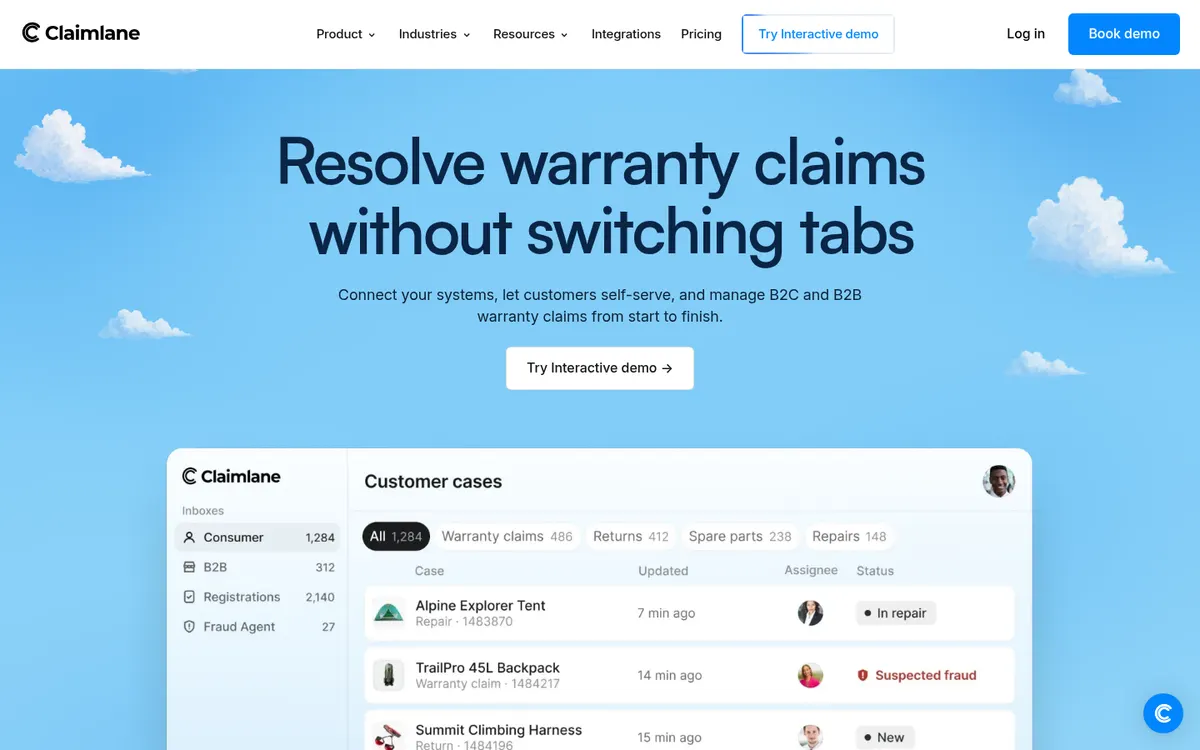
Claimlane replaces the email thread with a branded portal. A customer picks the product, describes the fault, and uploads photos and video in one pass, which cuts the back and forth that usually stretches a claim over days. An AI agent asks follow up questions on routine cases, warranty terms are checked automatically, and integrations with Shopify, Magento and WooCommerce pull order data so the buyer does not have to prove a purchase you already know about.
Integration coverage is broad for retail. Zendesk and Klaviyo cover support and email, and ERP and CRM connections include Dynamics 365, NetSuite and SAP. Multi-part products are supported, which matters for products sold as a configuration rather than a single SKU. If your claims involve an assembly with multiple parts, that support is not a detail.
There is no published pricing and no free trial. Everything runs through a custom quote, so an evaluation carries a real cost in time before you see a number. Rollout guidance is 2 to 4 weeks for a straightforward Shopify configuration and 4 to 8 weeks for complex enterprise setups, and you should treat those as best cases that assume clean product data and someone on your side owning the integration work.
The lack of a trial is the main friction, because a branded portal is easy to demo and harder to prove under real claim volume. Ask for a scoped pilot with your own product catalog and a sample of last quarter's claims. For retailers that want self-service intake without building it, Claimlane is the strongest fit here. For a small D2C brand watching cash, Dyrect's published $19 tier is the easier place to start.
What works
- Self-service intake replaces email claim threads
- Broad ecommerce, ERP and CRM integration coverage
- Handles multipart product configurations
What to weigh
- No published pricing and no free trial
- Rollout takes weeks, longer for complex setups
Pick it if
You run a retail catalog with complex products and want self-service claims wired into your ERP and support desk.
Skip it if
There is no budget for a quote based evaluation cycle with no trial to fall back on.
Plate 04 of 08
WarrantyHub
Best for home warranty firms, builders and auto TPAs
Our verdict
Built for contract style warranty administration, with contractor dispatch and 80 plus notification triggers, priced by contract volume.
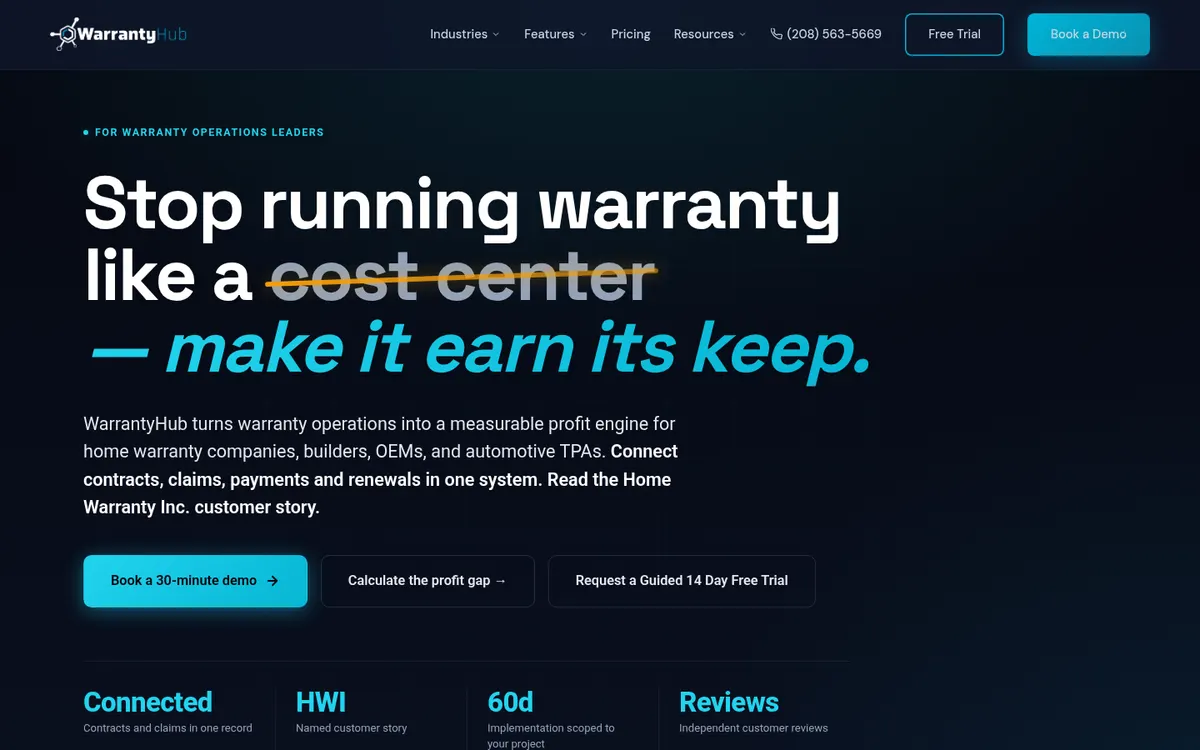
This is administration software for warranties sold as contracts. Home warranty companies, residential and commercial builders, manufacturers and automotive third party administrators use it to run policy administration, claims processing, contractor dispatch and renewals in one place. Where a consumer brand tool stops at the claim, WarrantyHub keeps going: who is dispatched, when the contract renews, and whether the payment cleared.
The notification engine is the most concrete feature on the list: over 80 automated triggers covering the events a contract business runs on, from claim status changes to renewal reminders. Payments run through Stripe and Authorize.net, CRM through Salesforce and HubSpot, accounting through QuickBooks and Xero, and a public API covers what those do not. For a team that has grown on spreadsheets and a payment gateway, that is meaningful consolidation.
Pricing is volume based, quoted per contract volume, with no free plan and a demo rather than a trial. No long term contracts are advertised, which softens the commitment question, but you still cannot see a number until a sales conversation. Implementation is quoted at 30 to 60 days, so plan for a quarter before the system is carrying live contracts.
The fit question is straightforward. If you administer contracts, dispatch contractors and chase renewals, this is a stronger match than any consumer facing tool here. If you sell electronics direct and your claims are individual product failures, the contract machinery is overhead you will pay for and not use, and Dyrect or Claimlane will get you live faster.
What works
- Built for contract style warranty administration
- Payment, CRM and accounting integrations plus a public API
- No long term contracts advertised
What to weigh
- Pricing only available through a quote
- Weaker fit for consumer electronics brands selling direct
Pick it if
You administer warranties as contracts and dispatch third party contractors to resolve claims.
Skip it if
Your warranty is a product guarantee with no contract, renewal or dispatch involved.
Plate 05 of 08
PTC Warranty
Best for enterprise manufacturers running service operations
Our verdict
Warranty analytics and supplier recovery inside a service lifecycle suite, priced as an enterprise license with a full project deployment.
PTC Warranty is one module in a larger service lifecycle management portfolio, and that is the right way to evaluate it. Claim validation, supplier recovery, parts ordering, warranty analytics and policy management for global service networks sit alongside engineering and service data the manufacturer already holds. The value proposition is connection: a failure recorded in the field can be traced to the part, the design and the service history rather than living in a separate warranty silo.
The analytics angle is cost driver focused. Instead of reporting claim counts, the platform is positioned around which parts, models and suppliers generate warranty spend, and supplier recovery turns that finding into a chargeback. For a manufacturer with an established service operation and an installed base measured in years, that loop is the reason to buy.
Pricing is enterprise only, with no pricing page to check. The sales motion is enterprise only too, and deployment is a full project requiring IT involvement, so buyers typically plan it into an annual budget cycle rather than trialing it. There is no free plan and no trial. Expect procurement, security review and an implementation statement of work before anything goes live.
That makes it a poor fit for small teams and consumer brands, and a reasonable fit for manufacturers who already run the vendor's systems and want warranty records tied to engineering data. If you are starting from nothing and want claims handled next month, this is the wrong order of operations. If you have a service network, a supplier recovery problem and an IT team with capacity, put it on the enterprise shortlist next to Syncron Warranty and Pega Warranty.
What works
- Part of a broader service lifecycle management suite
- Analytics focused on warranty cost drivers
- Ties warranty records to engineering and service data
What to weigh
- Enterprise only sales with no public pricing
- Deployment is a full project requiring IT involvement
Pick it if
You are a manufacturer who wants warranty records connected to engineering and service data you already keep.
Skip it if
You need a system live this quarter without an IT project behind it.
Plate 06 of 08
Syncron Warranty
Best for OEMs focused on supplier cost recovery
Our verdict
Best for OEMs that treat supplier recovery as a core workflow and want warranty data feeding parts planning and pricing.
Syncron Warranty is built around the money that leaks out of a warranty program. Claim workflows are standardized and approvals automated, and supplier recovery is treated as a core workflow rather than a reporting afterthought, which is what separates it from the consumer facing tools in this list. A manufacturer that cannot charge failed components back to suppliers is paying for defects it did not cause, and this platform is organized around closing that gap.
The second differentiator is that warranty data is linked to parts planning and pricing. Failure rates and claim costs inform aftermarket inventory and price decisions, so the warranty record stops being a cost center report and starts feeding commercial planning. AI assisted analytics sits over the top, and coverage spans the warranty lifecycle end to end.
Target buyers are automotive, agriculture, construction and industrial equipment manufacturers, and the sales motion matches: custom pricing, a consultative cycle, no pricing page to check, no free plan and no trial. The vendor positions the product around lowering warranty cost through accuracy and recovery rates, which are the two numbers the vendor emphasizes.
For a small team or a consumer brand, it is oversized. You would be buying dealer network administration, parts planning links and recovery workflows you cannot use. For an OEM with a multi-dealer network and a supplier recovery problem worth real money, the business case is easier to write than the implementation plan. Budget for a consultative cycle and a project rollout, and compare it directly with PTC Warranty and Pega Warranty before deciding.
What works
- Supplier recovery treated as a core workflow
- Warranty cost data feeds aftermarket parts decisions
- Suited to multi-dealer OEM networks
What to weigh
- Custom pricing with a consultative sales cycle
- Oversized for small teams and consumer brands
Pick it if
You are an OEM whose warranty cost problem is really a supplier recovery and parts planning problem.
Skip it if
You sell direct to consumers and have no dealer network to administer.
Plate 07 of 08
Pega Warranty
Best for complex multi-party claim workflows
Our verdict
Covers claims from prior approval to appeals with predictive analytics, at the cost of an architect led platform deployment.
Pega Warranty covers a long claim lifecycle. Cases move from prior approval and validation through auto-adjudication or manual review, then to settlements and appeals, with multi-tier approval chains and dealer claim handling along the way. Supplier recovery and corrective action programs are included, so a fault can trigger a chargeback and a fix rather than just a payment. If your claims process has exceptions on top of exceptions, the case model handles them.
The analytics are predictive and adaptive, aimed at fault diagnosis rather than retrospective reporting. That is a different ambition from a dashboard, and it only pays off with enough historical claim data to train against. Organizations already on the vendor's platform get a further benefit: the same skills, governance and integration patterns carry over, which lowers the marginal cost of adding warranty.
Everything else about the purchase is heavy. Pricing is an enterprise license quoted by claim volume and selected modules, with no pricing page to check, no free plan and no trial. The vendor's own documentation frames deployment as an architect led project, so developer and architect resources are a prerequisite, not a nice to have. Mid-market teams will find the platform complexity exceeds what they need.
Pega Warranty belongs on a shortlist where the claim process is genuinely complex: multiple parties, appeals, corrective actions and a platform team in house. If your requirement is a branded claim form and a warranty term check, this is a large hammer. Compare it against Syncron Warranty for recovery led programs and PTC Warranty where engineering data connection is the priority.
What works
- Covers the claim lifecycle through settlements and appeals
- Predictive analytics support fault diagnosis
- Reuses platform skills your team may already have
What to weigh
- Implementation needs developer and architect resources
- Platform complexity exceeds mid-market requirements
Pick it if
You already run the vendor's platform and your warranty claim process involves appeals and corrective actions.
Skip it if
Nobody on your team can staff an architect led deployment.
Plate 08 of 08
ReverseLogix
Best for manufacturers combining returns with warranty repair
Our verdict
The pick when warranty claims mean a physical unit coming back, since returns, repair and entitlement checks share one system.
ReverseLogix starts from the physical unit. Claim validation runs against warranty terms and distributor contracts, then the platform routes the unit through inspection, grading and depot repair, tracking parts consumption at component level. Fraud alerts and audit trails sit across the process. For a manufacturer whose claims usually mean a box arriving at a depot, that is a more accurate model of the work than a form based claim tool.
The strength is the single system of record. Returns, warranty and repair share one dataset, so entitlement checks are tied to distributor contracts rather than to a support agent's judgment, and repair tracking reaches the component so you can see what a failure actually consumed. Integrations with major ERP and carrier systems cover the shipping and financial side that a warranty tool usually leaves to spreadsheets.
The honest caveat is that returns management is the core and warranty administration is secondary. Policy setup, registration and consumer facing self-service are not the center of the product, so a D2C brand that wants QR code registration on packaging will find it the wrong shape. There is no published pricing, no free plan and no trial; pricing is a custom quote and the product is enterprise oriented.
It fits manufacturers and retailers for whom the claim ends in a returned unit, a repair decision and a parts charge. If your warranty operation is depot based, put it against WarrantyHub for contract administration and PTC Warranty for analytics. If your claims are consumer conversations with photos attached, the lighter tools at the top of this list will cost less and go live sooner.
What works
- Returns, warranty and repair share one system of record
- Entitlement checks tied to distributor contracts
- Repair tracking down to component level
What to weigh
- Returns management is the core, warranty administration is secondary
- Enterprise pricing through custom quotes only
Pick it if
Most of your warranty claims involve a unit coming back for inspection, grading and depot repair.
Skip it if
You need consumer self-service registration and policy setup as the center of the product.
What is warranty management software, and when do you need it?
Warranty management software is the system that records what you sold, what you promised, and what you owe when a product fails. It sits between the sale and the repair: it captures the registration, stores the terms attached to that product or contract, checks a claim against those terms, and tracks the money through to a settlement, a repair or a supplier chargeback.
The category overlaps with two neighbors that buyers often confuse it with. Returns management handles the physical unit: the return authorization, the shipping label, the inspection, the restock or scrap decision. A help desk handles the conversation with the customer. Warranty management decides entitlement and cost, which is why it usually needs to talk to both.
Most platforms in this list cover a common core:
- Registration and entitlement, often through a QR code, a portal or an import from the order system
- Claim intake with serial numbers, invoices and photos
- Validation against warranty terms, with duplicate and fraud checks
- Adjudication, approval chains and settlements
- Supplier recovery, where a failed part is charged back to the component maker
- Analytics on failure rates and cost per part, model or dealer
- Self-service portals for customers, dealers or contractors
The split in this market is by buyer. Consumer brands selling direct want fast registration, a branded claim page and integrations with Shopify, email and support desks, and they want to start in days. Manufacturers with dealer networks want contract terms, multi-tier approvals, supplier recovery and analytics that feed engineering and parts planning, and they accept a project rollout.
You probably need this software when claims live in an inbox, when nobody can say what a product's warranty term was at the time of sale, or when supplier chargebacks are tracked in a spreadsheet. You probably do not need it if you sell a handful of units a month and handle returns case by case.
This guide sits in the Software collection. Buyers weighing nearby tools often read the guides to commission software and research platforms next.
How do vendors charge for warranty management software?
Published prices are the exception. Only Dyrect lists its plans, and it is the only tool here with a free tier: 100 lifetime credits, then $19, $49 and $149 per month across Registration, Claims and Claims Pro, each with 100 monthly credits. Every other vendor sells through a quote, sized on a different unit depending on the product: claim volume and features for NeuroWarranty, a custom quote for Claimlane, contract volume for WarrantyHub, and claim volume plus selected modules for Pega Warranty.
Two buyers comparing the same shortlist can therefore be quoted different numbers for the same product, and neither number is wrong. Ask what unit the quote scales on and what happens when you exceed it. Dyrect's credits are consumed one per registration, claim or repair, so growth shows up as overage. A contract platform scales with contracts administered, which is a slower moving number and easier to forecast.
Implementation is usually a separate line. Claimlane's guidance puts go-live at 2 to 4 weeks for a straightforward Shopify setup and 4 to 8 weeks for complex enterprise configurations, and WarrantyHub quotes implementation at 30 to 60 days. PTC Warranty and Pega Warranty are project deployments with IT involvement, so treat the first year as license plus services.
Trials are rare. Dyrect offers a free plan rather than a trial, NeuroWarranty's trial should be confirmed with the vendor, WarrantyHub offers a demo, and the rest list neither. Plan on a scoped pilot or a paid evaluation instead, and put the exit terms in writing before you start.
| Model | How it bills | Typical fit | Example from this list |
|---|---|---|---|
| Published subscription | Per month, credits consumed per action | Small and mid-size consumer brands | Dyrect: free with 100 lifetime credits, then $19, $49 and $149 per month with 100 monthly credits each |
| Custom quote | Quote based on claim volume or scope | Consumer brands and retailers | NeuroWarranty and Claimlane |
| Volume based contract pricing | Quoted per contract volume | Home warranty firms, builders, auto TPAs | WarrantyHub |
| Enterprise license | Custom quote by volume and modules, often inside a suite | Large manufacturers running service operations | PTC Warranty, Pega Warranty, Syncron Warranty |
| Custom enterprise quote | Enterprise oriented custom quote | Manufacturers combining returns with repair | ReverseLogix |
Every price in this guide was read on the vendor's own pricing page on November 25, 2026. Where a vendor does not publish a figure we could confirm, the card says "See website" rather than a guess. For the arithmetic around this purchase, try the free Email campaign metrics calculator.
Which warranty management tool fits your operation?
Start with the intake path. Does a consumer scan a code on a box, or does a dealer file against a contract? Consumer flows point at Dyrect, NeuroWarranty or Claimlane. Contract flows point at WarrantyHub. Write the path down before you look at any feature list.
Name who pays for the claim. If failed components get charged back to suppliers, supplier recovery is a buying requirement rather than a bonus, and only Syncron Warranty, PTC Warranty and Pega Warranty cover it in depth.
Check the integration you already own. List the systems holding orders, tickets and invoices. Claimlane covers Dynamics 365, NetSuite and SAP, WarrantyHub covers Stripe, QuickBooks and Xero, and Dyrect covers Shopify, Zendesk and Gorgias.
Size volume in the vendor's unit. Credits, claims, contracts or modules: whichever the quote scales on. Model your busiest quarter rather than your average month, and ask for the overage rate before you sign anything.
Put a rollout date in the contract. Claimlane quotes 2 to 4 weeks on a simple Shopify setup, WarrantyHub 30 to 60 days, and Pega Warranty documents an architect led project. Get the date and the named owner in writing.
Run your own claim sample. Demo data flatters every platform. Take a sample of real claims, including the awkward ones, and ask each shortlisted vendor to process them. Compare exception rates rather than the polish of the interface.
What goes wrong when buyers pick warranty software
- Judging on a scripted demo. Every platform looks fast when the claim is clean and the product is known. Ask to process a claim with a missing invoice and a disputed purchase date, because that is the case your team handles daily.
- Ignoring the overage math. Dyrect consumes a credit per registration, claim or repair, and contract platforms scale by contract volume. A price that fits your average month can rise in your worst one, so model the peak.
- Treating returns as warranty. ReverseLogix is strong because returns and repair share a record, but it is returns led. If your problem is entitlement and policy, a claims led platform is the better purchase.
- Assuming a trial exists. Only Dyrect offers a free plan here, the NeuroWarranty trial should be confirmed with the vendor, and WarrantyHub offers a demo. Build a paid pilot into the budget instead of planning around a trial that may not appear.
- Buying consumer tooling for a dealer network. Dyrect and NeuroWarranty are shaped for direct brands. A dealer network with approval chains and supplier chargebacks needs the enterprise entries, and retrofitting the lighter tools costs more than buying correctly.
Best Warranty Management Software in 2026: questions
What does warranty management software cost in 2026?
Mostly a quote. Seven of the eight tools here publish no price and size deals to claim volume, contract volume or selected modules. Only Dyrect lists prices: free with 100 lifetime credits, then $19, $49 and $149 per month with 100 monthly credits each. Treat an enterprise license as a capital project with a separate implementation fee rather than a monthly subscription.
How is warranty management different from claims management?
Claims management is one part of it. Warranty management covers registration, entitlement and term checks, policy setup, claim intake and adjudication, supplier recovery, and the analytics that show which parts cost you money. A claims only tool handles the ticket; a warranty platform decides whether the ticket was covered, what the term was at the time of sale, and who pays for it.
How long does warranty software implementation take?
Weeks for consumer brands, months for enterprise. Claimlane quotes 2 to 4 weeks for a straightforward Shopify configuration and 4 to 8 weeks for complex enterprise setups, and WarrantyHub quotes implementation at 30 to 60 days. PTC Warranty and Pega Warranty are project deployments, and Pega's documentation frames rollout as architect led.
Does automated claim validation reduce fraudulent claims?
Vendors position it that way, and the mechanics are plausible: Claimlane checks warranty terms automatically, NeuroWarranty flags duplicates and verifies purchase documents, and ReverseLogix raises fraud alerts with audit trails. None of them publishes a fraud reduction figure, so run your own claim sample through validation during evaluation and measure the exception rate rather than accepting the claim.
Does QR code registration improve claim handling?
It shortens the gap between purchase and claim. Dyrect prints a QR code on packaging so a buyer registers in a branded portal, and NeuroWarranty also registers customers digitally without an app. A registered serial number and purchase record lets intake verify entitlement immediately, which removes the email back and forth before a claim is even assessed.
Why do enterprise warranty platforms not publish prices?
Because the deal is sized per deployment. Pega Warranty licenses by claim volume and selected modules, WarrantyHub quotes per contract volume, and PTC Warranty sells an enterprise license inside a service lifecycle suite. A public number would mislead when the same product carries different volumes, integrations and implementation scope at each buyer, so the quote is the price.