
Contents of this guide
The shortlist
Our top 3 for software buyers

Fishbowl
Accounting sync
- Best for
- Manufacturers and distributors running QuickBooks or Xero
- Features
- 5 noted: QuickBooks sync, Work orders, Barcode scanning, AI replenishment, Mobile app

Cin7
Channel connectivity
- Best for
- Multichannel sellers with complex inventory across many storefronts
- Features
- 4 noted: EDI built in, 700+ integrations, B2B portal, 3PL routing
Logiwa
Unlimited users
- Best for
- High-volume ecommerce fulfillment operations and 3PLs
- Features
- 4 noted: Wave picking, Barcode mobile, AI-native, Unlimited users
Disclosure for this guide. All 8 tools here are unpaid editorial picks. The position of a paid listing can be part of what the vendor pays for. Paid and unpaid tools are scored on the same rubric and keep their cons. Details are in the advertising disclosure.
The ledger
Index of every tool
| Tool | Free plan | Trial | Rubric | Compare | ||
|---|---|---|---|---|---|---|
| 01 | FishbowlManufacturers and distributors running QuickBooks or Xero | $229Essentials, includes 2 users, billed annuallyChecked Nov 25, 2026 | No | Demo only | ||
| 02 | Cin7Multichannel sellers with complex inventory across many storefronts | $349Standard, per month, 5 users, prices in USD and exclude taxesChecked Nov 25, 2026 | No | Free 14 day trial | ||
| 03 | LogiwaHigh-volume ecommerce fulfillment operations and 3PLs | See websiteNot published | No | See website | ||
| 04 |  InfoPlusGrowing warehouses that see heavy seasonal volume spikes | See websiteNot published | No | Three months free for new customers who book a consultation | ||
| 05 |  ExtensivThird-party logistics providers that bill clients for storage and handling | See websiteNot published | No | See website | ||
| 06 |  ShipHeroEcommerce brands fulfilling their own orders at scale | $15,000Core, per year, unlimited users, SKUs and warehouses, priced by volumeChecked Nov 25, 2026 | No | See website | ||
| 07 | DeposcoFast-growing brands, retailers and 3PLs moving beyond spreadsheets | See websiteNot published | No | See website | ||
| 08 |  ShipedgeBrands and 3PLs that want order and warehouse management together | See websiteNot published | No | See website |
Prices are the lowest paid plan the vendor shows, read on November 25, 2026. Sort by price ranks published monthly figures; tools without one go last. Pin up to three tools to compare them side by side.
How this guide was put together
Every tool here was scored against the same five criteria, and the scores are printed on each entry so you can disagree with them. Warehouse depth carries 25 percent: does the product direct work inside the building, or only record stock levels? Pricing transparency carries 20 percent: is there a published rate a buyer can budget from? Integration breadth carries another 20 percent, weighted toward accounting systems, marketplaces and carriers. Ease of use carries 20 percent, judged on interface reports and whether the mobile app matches desktop. Implementation speed carries the last 15 percent, because a long go-live changes the business case before the subscription does.
Prices come from vendor pricing pages fetched on November 25, 2026. Where a vendor publishes a starting rate, we quote it exactly as shown and name the plan it belongs to. Where a page returned no pricing content, the entry says pricing is on the vendor site and no figure is given. We did not estimate rates, convert currencies or average third-party figures into a price. No rate here is carried over from outside reports; every figure comes from the vendor's own site or the entry says pricing is on the vendor site.
The Featured listing is a paid placement. It is written and scored with the same five criteria as every other entry, cons included, and it sits in the position shown as a Featured spot.
The order of this list is editorial. It reflects fit for the buyer described in each entry rather than a weighted total of the scores, and the Featured position is disclosed.
The full process, including how we handle corrections, is on the methodology page. Paid listings follow the advertising disclosure.
Rubric and weights
Every tool below is scored from 1 to 10 on these five criteria. The scores describe each tool; the order is an editorial call on fit for the buyer each card describes, plus the disclosed Featured position.
- 20%Pricing transparencyWhether the vendor publishes a rate a buyer can budget from, and whether the plan that rate belongs to is clearly named.
- 25%Warehouse depthWhether the product directs work inside the building through picking, put-away and scan-confirmed tasks, or only records stock levels.
- 20%Integration breadthCoverage of accounting systems, marketplaces, carriers and 3PL connections, weighted toward the ones operators actually run.
- 15%Implementation speedHow quickly a warehouse can reach go-live, based on vendor-stated timelines, onboarding claims and mandatory setup work.
- 20%Ease of useHow learnable the interface is for floor staff, including whether the mobile app matches what desktop users can do.
Plate 01 of 08
Fishbowl
Best for manufacturers and distributors running QuickBooks or Xero
Our verdict
Best fit for manufacturers and distributors on QuickBooks or Xero, provided you budget for the Advanced Warehouse tier.
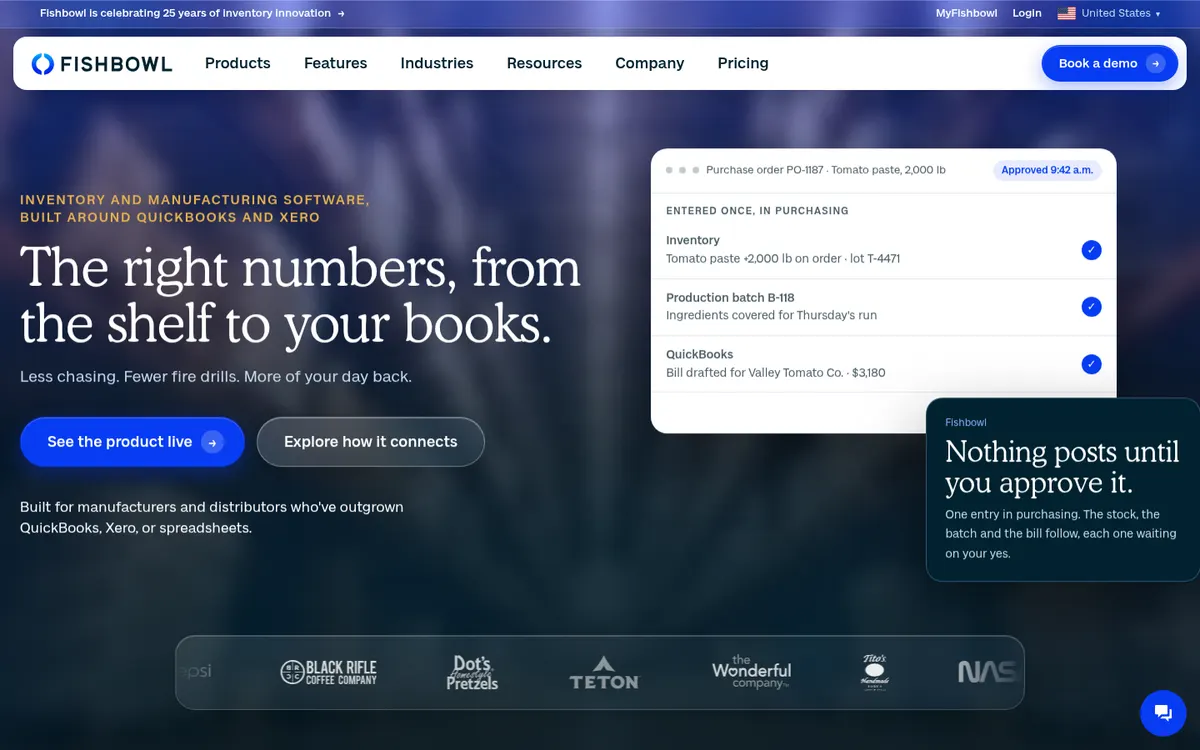
Fishbowl combines inventory control, manufacturing and warehouse management in one system, which is why it leads this list for manufacturers and distributors already running QuickBooks or Xero. The two-way accounting sync is the reason most buyers arrive: stock movements, bills of materials and work orders post back to the ledger, so finance and the floor work from the same figures instead of a monthly reconciliation project. Part tracking through assembly means a subassembly consumed on a work order shows up as a component and as a finished item.
The floor side runs through the Fishbowl GO mobile app, which covers barcode receiving, picking, packing and shipping. Bills of materials, work orders and part tracking give it manufacturing depth that plain stock control tools do not attempt, and AI-assisted features flag at-risk orders and support replenishment and scheduling. Advanced warehouse functions sit in a separate higher tier rather than the entry plan, so confirm which capabilities you need before comparing headline rates.
Pricing starts at $229 per month on the Essentials plan, which includes two users on annual billing. Advanced Warehouse starts at roughly $595 per month, so budget for the higher tier if you need true warehouse management rather than inventory plus manufacturing. Implementation is packaged with the purchase rather than optional, and vendors quote two to six weeks for the inventory products, which is fast for this category but still a project.
The limits are real. There is no free trial, only demos, so you cannot run your own data through it before signing. The gap between the $229 headline and the warehouse tier is serious money for a small operation, and teams expecting bin-level control on Essentials will be disappointed. It fits businesses where accounting accuracy and assembly tracking matter more than marketplace connectors. A seller with twenty sales channels should look at Cin7 first.
What works
- Two-way QuickBooks and Xero sync
- Manufacturing depth with bills of materials and work orders
- Mobile barcode workflows through Fishbowl GO
What to weigh
- No free trial, demos only
- Full warehouse management needs the Advanced Warehouse tier
- Implementation package is mandatory rather than optional
Pick it if
Your inventory has components, assemblies and a ledger that has to agree with the floor.
Skip it if
You need marketplace sync across many channels or will not pay for the Advanced Warehouse tier.
Plate 02 of 08
Cin7
Best for multichannel sellers with complex inventory across many storefronts
Our verdict
The strongest connector library here, but real warehouse management costs $1,199 per month, not the $349 headline.
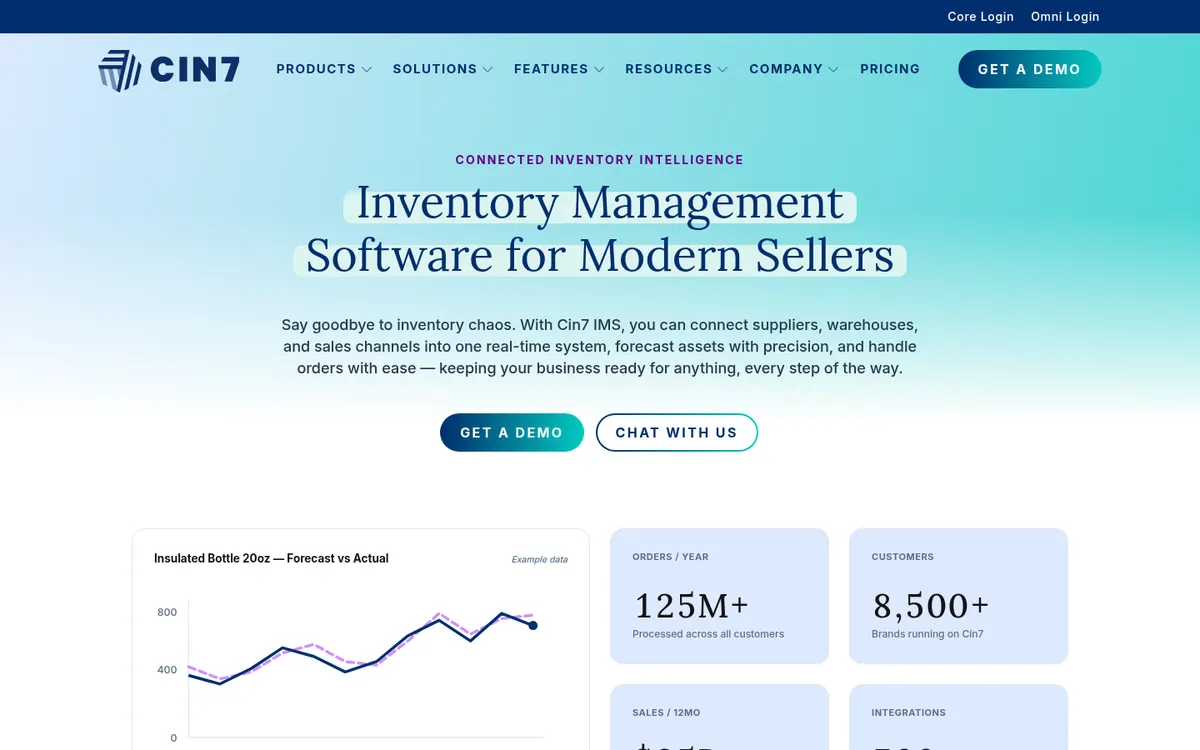
Cin7 is the strongest fit on this list for multichannel sellers whose inventory is spread across storefronts, marketplaces and 3PLs. Stock sync runs across Amazon, Shopify, eBay, Walmart and other channels, so a sale on one channel reduces the count everywhere rather than waiting for a nightly file. Built-in EDI handles wholesale trading with large retailers without a separate provider, and the connector library runs to more than 700 integrations covering marketplaces, carriers and third-party logistics partners.
Beyond stock sync, Cin7 includes a B2B portal, point of sale, 3PL automation and order routing. Directed put-away and advanced picking appear at the Advanced tier, which is where the product stops being inventory management and starts being a warehouse management system. Reporting and dashboards aim at operators who need to see performance across channels rather than inside a single building.
Pricing starts at $349 per month on the Standard tier, quoted in USD and excluding taxes, covering five users at that annual billing rate. Warehouse capability proper sits at $1,199 per month on the Advanced tier. A free 14 day trial is offered, which is unusual in this category and worth using to test the marketplace sync against real listings before you commit to a year.
The limits are about tier and learning curve. Lower tiers are inventory management, not full WMS, so a buyer weighing Cin7 Standard against Logiwa is not comparing like for like. New teams report a learning curve, and the jump from $349 to $1,199 is steep for a small operation. Pick Cin7 if channel sprawl is the problem and the warehouse is one part of a bigger stock puzzle. Skip it if you need deep manufacturing or assembly tracking, where Fishbowl is the better answer.
What works
- More than 700 marketplace and 3PL integrations
- EDI included without a separate provider
- Free 14 day trial to test channel sync
What to weigh
- Directed put-away and advanced picking only at the $1,199 Advanced tier
- Reported learning curve for new teams
Pick it if
Your stock lives across many storefronts and wholesale EDI is part of the picture.
Skip it if
You need manufacturing logic or your budget stops at a few hundred dollars a month.
Plate 03 of 08
Logiwa
Best for high-volume ecommerce fulfillment operations and 3PLs
Our verdict
Volume pricing with unlimited users suits large fulfillment floors, if you can accept quote-only pricing and a complex interface.
Logiwa is built for throughput. The cloud WMS, sold as Logiwa IO, targets high-volume ecommerce fulfillment operations and third-party logistics providers, with wave and batch picking, barcode-driven mobile workflows and an AI-native architecture aimed at labor planning and automation. If your day is thousands of orders and a floor full of temporary staff, the design assumptions match yours rather than being bolted onto a retail stock tool.
The integration set covers more than 200 connections to marketplaces, carriers and ERPs, with standard integrations bundled into the subscription rather than sold as add-ons. That matters because connector fees are a common hidden cost in this category and they scale badly as you add channels. Mobile tooling is strong, which follows from the target buyer: most of the work happens on a handheld, not at a desk, and the interface reflects that.
Pricing is the catch. Logiwa publishes no rates. The vendor prices on fulfillment volume and workflow complexity with unlimited users, and positions the product against legacy per-seat systems. Unlimited seats genuinely favor large floor teams that would pay heavily per head elsewhere, and they remove the annual argument about whether to buy another ten licenses. But you cannot budget from the website. Contracts are quoted, so the first sales conversation should be about order volume bands and what happens when you cross one mid-quarter.
The interface draws complaints from first-time users, which is unsurprising given the automation depth and the number of screens. Expect training time and a floor champion who learns the system properly. Logiwa fits operations that have already outgrown a simple inventory tool and want volume pricing without seat math. It does not fit a ten-person warehouse that wants a published monthly rate and a self-serve setup.
What works
- Volume-based pricing with unlimited users
- 200+ marketplace, carrier and ERP integrations
- Strong mobile and automation tooling for large floors
What to weigh
- No published pricing, so budgeting needs a sales conversation
- Interface reported as complex for first-time users
Pick it if
Your order volume justifies unlimited seats and you want standard integrations inside the subscription.
Skip it if
You need a published rate to get budget approval or a small team needs to learn it fast.
Plate 04 of 08
InfoPlus
Best for growing warehouses that see heavy seasonal volume spikes
Our verdict
A good answer to seasonal peaks and unusual workflows, held back by a cluttered interface and a mobile app that lags desktop.
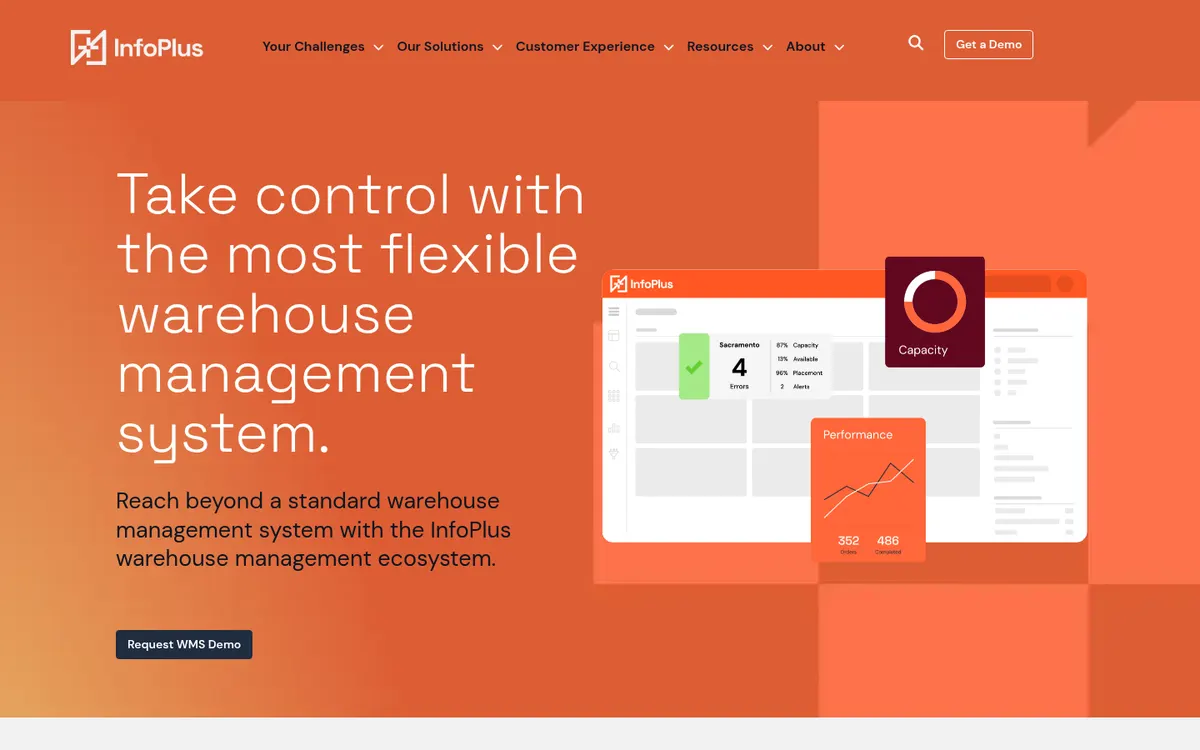
InfoPlus targets warehouses whose volume is uneven. The product is built around wave picking and batch workflows, priority order sorting and real-time operational dashboards, with the vendor citing support for holiday peaks at two to three times normal volume. For a brand that does a large share of annual orders in six weeks, that framing is more useful than a feature list about bin types, because the question is whether the system bends or breaks when the floor fills up.
Workflows are customizable without heavy IT work, which is the practical difference for operations with unusual processes: kitting rules, special labeling, custom packing sequences, a client who wants something no other client wants. Integrations cover Shopify, QuickBooks and major carriers, so the core ecommerce and accounting stack is addressed. Dashboards give supervisors a live view of what is stuck and where orders are waiting.
Pricing is quote-only, and the fetched page shows no figures at all. The vendor states a base of more than 6,500 businesses and offers three months free to new customers who book a consultation, which is the closest thing to a trial here. Treat that offer as your evaluation window and insist on running your own peak scenario through the system during it, including the mobile workflows your pickers would actually use.
Two weaknesses recur. The interface is reported as cluttered, with a lot of information competing for attention, and the mobile app lacks features available on desktop, which matters if floor staff work from phones rather than scanners. InfoPlus fits growing warehouses with seasonal spikes and processes that do not fit a template. It fits less well if you want a clean, minimal interface or need full mobile parity for every task.
What works
- Workflows configurable without heavy IT work
- Built to absorb peaks at two to three times normal volume
- Shopify, QuickBooks and major carrier integrations
What to weigh
- No published pricing
- Interface reported as cluttered
- Mobile app lacks features available on desktop
Pick it if
Seasonal peaks and non-standard processes are the two things your current system handles worst.
Skip it if
Your team needs a spare, clean interface or every task to work on a phone.
Plate 05 of 08
Extensiv
Best for third-party logistics providers that bill clients for storage and handling
Our verdict
Purpose-built for 3PL billing and client portals, and unnecessary overhead for a single-brand warehouse that never bills a client.
Extensiv is the specialist choice for third-party logistics providers, and its architecture shows it. Inventory is held in separate pools per client, so a 3PL can store competing brands in the same building without leaking stock data between them. Automated billing calculates storage, handling and shipping charges per client, and customer-facing portals let clients check their own inventory and orders instead of emailing account managers for a stock count.
The mobile side runs on SmartScan workflows, and labor analytics show where hours go across clients and functions, which is how a 3PL prices a new contract without guessing. The vendor says new users can be onboarded in an hour or two, which is fast for warehouse software and reflects a task-driven interface rather than a configuration project. The wider platform adds network and order management tools beyond the core warehouse product.
Pricing is quote-only. The product, formerly known as 3PL Warehouse Manager, is used by more than 1,200 3PLs according to the vendor. Extensiv does not publish a rate, so pricing is on the vendor site and any figure should come from a quote. Plan for a quote, a scoped implementation and a billing setup conversation.
The honest limit is fit. Multi-client architecture is overhead if you run one brand's warehouse: you pay for billing modules and client portals you will never open, and the setup work assumes client-level rules you do not have. Single-brand ecommerce operations should look at ShipHero or InfoPlus first. For a 3PL that bills clients monthly, Extensiv removes a spreadsheet and a set of manual invoices, and that is the whole value case.
What works
- Separate inventory pools per client with automated billing
- Client self-service portals reduce account management work
- New users can be onboarded in an hour or two
What to weigh
- Quote-only pricing
- Multi-client architecture is overhead for single-brand warehouses
Pick it if
You bill clients for storage and handling and need those charges calculated without a spreadsheet.
Skip it if
You run one brand's warehouse and will never invoice a third party.
Plate 06 of 08
ShipHero
Best for ecommerce brands fulfilling their own orders at scale
Our verdict
High-volume picking, packing and cheap labels, at a $15,000 per year entry price that small brands cannot justify.
ShipHero is built for the last hundred feet of the warehouse: picking, packing and getting labels on boxes at speed. AI-directed picking, mobile pick and pack workflows and pack-to-light stations are the core of the product, and the vendor reports warehouses on the platform ship more than 100 million orders a year. That scale figure is the vendor's own, but the design assumptions are consistent with it: every screen is shaped around moving an order out the door.
Two features stand out for cost control. Built-in carrier rate shopping selects the cheapest label per order, which on high volume can outweigh the subscription cost. Reporting runs from cost of goods through to picker efficiency, so margin and labor sit in one place rather than two reports. Returns handling is included rather than bolted on, and integrations cover Shopify, Amazon, WooCommerce and major carriers.
Pricing is $15,000 per year on the Core plan, which includes unlimited users, SKUs and warehouses and is priced by volume. That published figure is the number to budget from, and the plan is priced by volume above the entry point. Unlimited users at the entry tier is unusual and helps warehouses that swell with seasonal crews and then shrink again.
ShipHero does not fit small brands. The entry price and the throughput orientation assume meaningful order volume, and a business shipping fifty orders a day pays for capability it cannot use. It is also not a manufacturing system: no bills of materials or work orders, so assembly tracking has to live somewhere else. Pick it if picking speed and label cost dominate your economics. Look elsewhere if you need manufacturing depth or a low entry price.
What works
- AI-directed picking with pack-to-light stations
- Carrier rate shopping on every order
- Unlimited users, SKUs and warehouses on Core
What to weigh
- Entry price targets higher-volume operations
- No bills of materials or work orders for manufacturing
Pick it if
Picking speed and per-order label cost are the numbers you actually manage.
Skip it if
You ship a few dozen orders a day or assemble products from components.
Plate 07 of 08
Deposco
Best for fast-growing brands, retailers and 3PLs moving beyond spreadsheets
Our verdict
Mid-market warehouses get fast go-live claims, a 3PL portal and 150+ integrations, with pricing that stays behind a quote.
Deposco targets the jump from spreadsheets to a real system. It combines cloud warehouse operations management with order management, 3PL client portals and real-time visibility into inventory, orders and SLA performance. The positioning is mid-market growth: brands, retailers and logistics providers that have outgrown manual tracking but are not ready for a multi-year enterprise deployment with a consultancy attached.
The headline claim is implementation in 90 days or less, which the vendor presents as typical rather than guaranteed. Treat it as a target to write into a contract with dates and scope, not a promise on a slide. The client portal supports 3PL relationships, AI-driven fulfillment optimization is applied to order and labor decisions, and more than 150 pre-built integrations cover the usual ecommerce, carrier and ERP connections.
Pricing is quote-only, so no starting rate can be checked on the vendor site. The vendor reports more than 3,000 customers and tens of millions of orders processed annually. Ask for the quote to separate subscription from implementation and from any integration work, because those three lines move independently in this category and the cheapest subscription can hide the most expensive project.
Warehouse staff report the interface as easy to learn, which is a meaningful advantage when turnover on the floor is high and training happens in a busy week. The limits are scope and size: quote-only pricing slows budgeting, and the product aims at mid-market growth rather than very small warehouses. A five-person operation with one location will find it heavier than needed. Deposco fits a business planning to double order volume within two years and wanting a system that will not need replacing at that point.
What works
- Go-live in 90 days or less as a stated target
- 3PL client portal with SLA visibility
- More than 150 pre-built integrations
What to weigh
- Quote-only pricing
- Aimed at mid-market growth rather than very small warehouses
Pick it if
You are moving off spreadsheets and want a 90-day go-live written into the contract.
Skip it if
You run a single small site or need a published rate before you will take a call.
Plate 08 of 08
Shipedge
Best for brands and 3PLs that want order and warehouse management together
Our verdict
One platform for orders, warehouse and shipping cuts integration work, at the cost of a broader learning curve and quote-only pricing.
Shipedge bundles order management, warehouse management and shipping into one platform, which is the reason to shortlist it. Brands and 3PLs that have stitched together an inventory tool, a shipping app and a returns process end up maintaining three sets of data and reconciling them weekly. Shipedge replaces all three with one system, one set of records and one place where an order changes status.
The feature set spans kitting and light manufacturing, reverse logistics and returns, cartonization and a self-service rules engine for custom workflows. Cartonization picks box sizes that cut dimensional weight charges, and the rules engine lets an operator change routing or handling logic without a developer. An embedded shipping engine carries pre-negotiated carrier rates, which the vendor cites as discounts of up to 74 percent. The open API covers integration work and the mobile app handles floor scanning.
Pricing is quote-only and quoted per account, so there is no rate to compare on the website. Ask what the quote includes: the shipping engine, the carrier rates, the number of warehouses and any per-order fees. Because the platform covers several functions, a Shipedge quote is not directly comparable with a warehouse-only product, and the useful comparison is against the combined cost of the tools it replaces.
The trade-off is breadth. Covering order management, warehouse management and shipping means more screens and a longer learning curve than a focused pick and pack tool. Teams that want a two-day setup should look at a narrower product. Shipedge fits a brand or 3PL that wants one system of record and will invest training time in return for fewer integrations to maintain and shipping rates built in.
What works
- One platform for orders, warehouse and shipping
- Rules engine and open API for custom workflows
- Pre-negotiated carrier rates inside the shipping engine
What to weigh
- Quote-only pricing
- Breadth of scope means a longer learning curve
Pick it if
You want to retire two or three separate tools and keep shipping rates in the same system.
Skip it if
A quick setup matters more than consolidating platforms.
What does a warehouse management system actually do?
A WMS is the software that decides where stock sits inside the building, what each worker does next, and when an order is ready to leave. Inventory software tracks quantities by location and channel. A warehouse management system tracks movement: receiving, put-away into bins, replenishment, wave or batch picking, packing, shipping and returns, each step confirmed by a scan.
The clearest dividing line is directed work. In a WMS the system assigns a task to a named worker on a handheld device and records the scan that closes it. That record is what makes labor reporting, per-client billing and accurate on-hand counts possible. Tools on this list sit on both sides of the line: Fishbowl and Cin7 lead with inventory and add warehouse functions at a higher tier, while Logiwa, Extensiv and Shipedge are warehouse-first products.
Signals that you have outgrown inventory software:
- Pickers walk the same aisles twice because the system has no pick paths
- You cannot tell a customer which bin their stock is in
- Seasonal volume forces a spreadsheet and a temporary process every year
- Client billing takes a day of manual work each month
Cloud delivery is the default for small and mid-size warehouses. Every tool here is sold as a subscription. What varies is architecture. Logiwa prices on volume with unlimited users, Extensiv keeps a separate inventory pool per client, ShipHero builds around pack stations and rate shopping, and Shipedge folds shipping into the same system.
Confirm four things before a demo. Does barcode scanning work when the wireless drops? Which accounting system does the integration update, and in which direction? How long does implementation take, and who does the data cleanup? Does the starting tier include directed picking, or only record stock levels? Those four answers separate a system that changes how the floor works from one that simply replaces a spreadsheet with a subscription.
This guide sits in the Software collection. Buyers weighing nearby tools often read the guides to commission software and research platforms next.
How WMS pricing works, and why so many vendors hide it
Most WMS vendors do not publish a price. Five of the eight tools here return a quote instead of a rate, which means the number you compare is total first-year cost, not the subscription line on a pricing page.
Four billing models show up in this list.
| Model | How it bills | Typical fit | Example from this list |
|---|---|---|---|
| Published monthly, named users | Flat monthly fee with a set number of seats | Small teams that want a known number | Fishbowl Essentials at $229 per month including two users on annual billing |
| Published tiers | Higher tiers unlock warehouse functions | Multichannel sellers | Cin7 Standard at $349 per month, Advanced at $1,199 |
| Volume-based, unlimited users | Billed on order volume and workflow complexity | High-volume fulfillment and 3PLs | Logiwa; ShipHero Core at $15,000 per year |
| Quote-only | Custom quote per account | 3PL billing and mid-market operations | Extensiv, Deposco, Shipedge, InfoPlus |
Published rates rarely cover the full job. Fishbowl's $229 Essentials is inventory and manufacturing; true warehouse management starts around $595 per month on Advanced Warehouse. Cin7's warehouse functions sit at $1,199 per month. Both figures come from vendor pricing pages checked on November 25, 2026, and both are the kind of gap that turns a budget conversation into a second budget conversation.
For quote-only vendors, ask for a written first-year total that separates subscription, implementation, integrations and any per-order or per-client fees. Implementation is often the largest single line and the one most likely to be quoted separately, so a low subscription can sit on top of a large project fee.
Watch the contract term. Several vendors here quote their starting rate on annual billing, so confirm what the monthly term costs before you sign. Trials are rare: only Cin7 advertises a free 14 day trial, InfoPlus offers three months free to prospects who book a consultation, and Fishbowl runs demos only.
Every price in this guide was read on the vendor's own pricing page on November 25, 2026. Where a vendor does not publish a figure we could confirm, the card says "See website" rather than a guess. For the arithmetic around this purchase, try the free Email campaign metrics calculator.
How to choose a WMS in six steps
Measure your worst week, not your average one. Write down peak orders per day, headcount on the floor, and how many hours a supervisor loses to manual work. Those three numbers set the tier you need and stop a salesperson selling you capacity you will use twice a year.
Decide which problem you are solving. If channel sync and wholesale EDI are the pain, start with Cin7. If assembly tracking and ledger accuracy are the pain, start with Fishbowl. If you bill clients for storage, start with Extensiv. Naming the problem rules out half the list.
Find the tier boundary before you fall in love. Fishbowl's warehouse functions start around $595 per month and Cin7's at $1,199. Ask directly which features sit above the advertised starting price, and get the answer in writing with the plan name attached.
Request a first-year total from quote-only vendors. For Logiwa, InfoPlus, Extensiv, Deposco and Shipedge, ask for subscription, implementation, integrations and volume fees as separate lines. Compare totals, not opening numbers, and ask what triggers a price change mid-contract.
Test the scan workflow with your own product. Run a receiving, put-away, pick and pack cycle on a handheld using your own labels and your own awkward items. Check whether the mobile app can do everything desktop can, because that gap shows up on the floor, not in the demo.
Name an owner and a go-live date. Implementation timelines range from an hour or two of onboarding to a 90-day project, and data cleanup drives most of it. Put a person and a date against it, with a fallback plan for the first peak season after launch.
Five WMS buying mistakes that cost money later
Buying the headline tier and expecting a WMS. Fishbowl Essentials at $229 and Cin7 Standard at $349 are inventory products; warehouse functions sit higher. Read the plan note, then check the feature you actually need against that tier, not against the demo environment.
Treating integrations as a checkbox. "Integrates with QuickBooks" can mean a nightly export or a two-way sync. Ask which direction data flows, which records map to which accounts, and who fixes a mismatch when one appears at month end.
Skipping the mobile parity question. A system that looks complete on a desktop monitor can leave pickers without the task list they need. Demo the app on the same device your floor uses, in a dead zone, and confirm which tasks fall back to paper.
Underestimating implementation and data cleanup. Vendors quote two to six weeks for Fishbowl's inventory products and Deposco targets 90 days or less. Neither covers the weeks you spend fixing item masters and bin locations, which usually decide the real go-live date.
Choosing a 3PL system for a single-brand warehouse. Extensiv's per-client inventory pools and client billing are overhead if you never invoice a third party, and the setup assumes client-level rules. Match the architecture to your business model rather than to the longest feature list.
Best WMS Software 2026: questions
What does entry-level WMS pricing look like?
Published entry points in this list run from $229 per month to $15,000 per year. Fishbowl starts at $229 per month on Essentials with two users on annual billing, Cin7 at $349 per month on Standard, and ShipHero at $15,000 per year on Core. Five of the eight vendors publish no rate at all, so entry pricing is often a quote rather than a number you can find on a page.
When does a business outgrow inventory software?
When the system records stock but cannot direct the next task. The signals are pickers walking the same aisles twice, no bin-level visibility when a customer asks where their stock is, manual client billing that eats a day each month, and a spreadsheet running alongside the software every peak season. At that point directed picking, scan-confirmed tasks and labor reporting matter more than another channel connector.
Which WMS suits 3PL providers that bill clients?
Extensiv is the specialist pick, with separate inventory pools per client, automated billing for storage, handling and shipping, and client self-service portals. Deposco also includes a 3PL client portal with SLA visibility, and Logiwa and Shipedge both serve 3PL operations. Confirm how each system calculates storage charges, by day, week or pallet position, because billing logic is the hardest part to change after go-live.
How long does WMS implementation take?
Quoted timelines in this list range from two to six weeks to 90 days or less. Vendors quote two to six weeks for Fishbowl's inventory products, Deposco presents go-live in 90 days or less as a headline rather than a guarantee, and Extensiv says new users can be onboarded in an hour or two. Data cleanup and integration testing usually set the real date, not the software install.
How do WMS tools integrate with QuickBooks and Xero?
Fishbowl runs a two-way sync with both, so stock movements and work orders post to the ledger and finance sees the same figures as the floor. InfoPlus lists QuickBooks among its integrations, and Cin7 lists more than 700 integrations covering marketplaces, carriers and 3PLs. Confirm the direction of the sync, which records map to which accounts, and whether invoice and bill creation are included, since a one-way export creates reconciliation work every month.
Why is quote-only pricing hard to compare?
Because the subscription is rarely the biggest first-year line. Five vendors here publish no rate, and quotes bundle implementation, integrations and per-order or per-client fees in ways that are difficult to line up side by side. Ask every quote-only vendor for a written first-year total with each line separated, plus renewal terms, so you compare total cost rather than an opening number.