
Contents of this guide
The shortlist
Our top 3 for software buyers

Matter
Slack-native recognition
- Best for
- Slack and Teams-first teams on small budgets
- Features
- 5 noted: Slack and Teams, Free unlimited users, Values tagging, eGift cards, Surveys add-on

Guusto
Gift cards without points
- Best for
- Frontline and deskless teams wanting simple gift cards
- Features
- 4 noted: Sender plus recipient, Free tier, 100 or more brands, No points system

Assembly
Workflow automation
- Best for
- Recognition paired with workflow automation
- Features
- 4 noted: Points-based recognition, Workflow automation, Custom merchandise, Anniversary shoutouts
Disclosure for this guide. All 8 tools here are unpaid editorial picks. The position of a paid listing can be part of what the vendor pays for. Paid and unpaid tools are scored on the same rubric and keep their cons. Details are in the advertising disclosure.
The ledger
Index of every tool
| Tool | Free plan | Trial | Rubric | Compare | ||
|---|---|---|---|---|---|---|
| 01 | MatterSlack and Teams-first teams on small budgets | $1Basic, per user per month, billed annuallyChecked Nov 25, 2026 | Yes, unlimited users | 14-day trial on paid plans | ||
| 02 | GuustoFrontline and deskless teams wanting simple gift cards | $125Lite, per month, billed option toggle present, 1 sender seat and 250 recipient seatsChecked Nov 25, 2026 | Yes, free tier included | See website | ||
| 03 | AssemblyRecognition paired with workflow automation | $3Empower, per user per month, billed yearlyChecked Nov 25, 2026 | No | No | ||
| 04 |  MotivositySMB teams wanting straightforward peer recognition | See websitecustom quoteCustom quote | No | No | ||
| 05 |  ThriveSparrowTeams wanting recognition and engagement surveys together | $4Engage + Kudos, per month per employee, billed annually, 20% offChecked Nov 25, 2026 | Free modules included | No | ||
| 06 |  NectarRecognition bundled with internal communications | See websitecustom quoteCustom quote | No | No | ||
| 07 |  AwardcoEnterprises wanting Amazon-integrated reward catalogs | See websitecustom quoteCustom quote | No | No | ||
| 08 |  KudosValues-tagged recognition and culture analytics | See websiteNot published | No | No |
Prices are the lowest paid plan the vendor shows, read on November 25, 2026. Sort by price ranks published monthly figures; tools without one go last. Pin up to three tools to compare them side by side.
How this guide was put together
We scored eight employee recognition tools against the same five criteria and published every price we could verify from vendor pricing pages on November 25, 2026. Where a vendor sells only through a quote, we say so and score price clarity down instead of estimating a number.
Price clarity carries 25 percent. We looked for a published entry rate, clear billing terms and, critically, whether a minimum applies that overrides the per-user math. Recognition depth carries another 25 percent: peer recognition, values tagging, points and redemption built into the core product rather than bolted on. Reward catalog carries 20 percent, covering gift card breadth, merchandise and custom rewards, and whether the catalog works outside North America. Admin effort carries 15 percent, meaning how much manual work the program takes, from workflow automation to manager dashboards. Adjacent extras carries the last 15 percent: surveys, communications and engagement modules included in the subscription rather than sold as separate add-ons.
We read each vendor's plan structure rather than a single headline number, because this category hides cost in minimums, add-ons and reward spend. Motivosity's $3,000 annual floor and Guusto's $200 and $500 monthly minimums change the answer for small teams more than the per-user rate does. We compared the same facts across every tool (entry price, plan terms, free tier, trial and reward catalog) so a reader can line up two vendors and see the gap without sitting through a demo.
Matter is a Featured placement in this list, which is a paid position. It was scored against the same rubric as every other tool and carries the same kind of cons; placement buys visibility, not a better score.
The full process, including how we handle corrections, is on the methodology page. Paid listings follow the advertising disclosure.
Rubric and weights
Every tool below is scored from 1 to 10 on these five criteria. The scores describe each tool; the order is an editorial call on fit for the buyer each card describes, plus the disclosed Featured position.
- 25%Price clarityA published entry rate, clear billing terms and any minimum that overrides the per-user math.
- 25%Recognition depthPeer recognition, values tagging, points and redemption built into the core product rather than bolted on.
- 20%Reward catalogBreadth of gift cards, merchandise and custom rewards, and whether the catalog serves buyers outside North America.
- 15%Admin effortHow much manual work running the program takes, from workflow automation to manager dashboards and reporting.
- 15%Adjacent extrasSurveys, communications or engagement modules included in the subscription rather than sold as add-ons.
Plate 01 of 08
Matter
Best for slack and Teams-first teams on small budgets
Our verdict
The lowest published price here plus a free unlimited-user tier make Matter the default first look for chat-based teams.
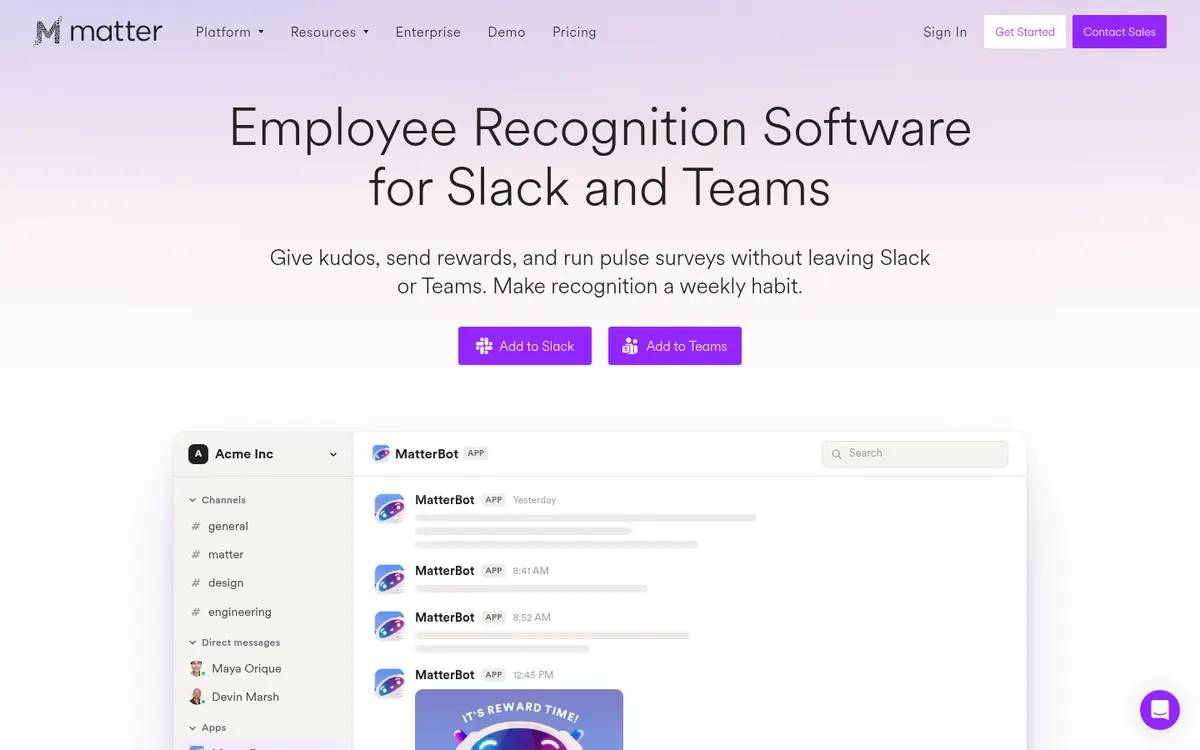
Matter is the cheapest way into peer recognition here, and the only tool on this list with a free tier that does not cap headcount. Basic is $1 per user per month billed annually and Pro is $3, so a 100-person team spends roughly $1,200 to $6,000 a year before reward spend. Paid plans include a 14-day trial.
Recognition happens inside Slack and Microsoft Teams, so employees send kudos without opening another tab. Kudos are tied to company values, and automated prompts such as weekly feedback reminders keep the feed alive without an admin chasing people. Rewards redeem as eGift cards, and Matter charges reward spend only after an admin approves a redemption, which keeps the reward line a controlled budget. Custom rewards come at no extra cost, and redemptions queue for approval, so finance sees one bill and one approval log rather than scattered expense claims.
Two limits matter when you compare. Surveys are a paid add-on at $2 per user, so a team that wants recognition plus engagement feedback is buying two products. The catalog centers on eGift cards rather than branded merchandise. Analytics are basic next to enterprise tools: you get recognition activity and reporting, not the culture analysis Kudos sells.
For a small company already living in Slack or Teams, that combination is hard to beat on cost. It fits teams that want values-based recognition with light administration and an approved reward budget. It fits less well if you need surveys inside the same subscription, a merchandise catalog, or deep analytics you can present to a board.
What works
- Lowest published price in this group
- Free plan with unlimited users
- Recognition inside Slack and Teams
What to weigh
- Surveys cost $2 per user extra
- Reward catalog leans on eGift cards
- Analytics stay basic
Pick it if
Your team already works in Slack or Teams and you want values-based recognition at $1 per user with reward spend an admin approves.
Skip it if
You need engagement surveys in the same subscription or a merchandise-heavy reward catalog.
Plate 02 of 08
Guusto
Best for frontline and deskless teams wanting simple gift cards
Our verdict
The simplest way to hand managers a gift card budget, with a free tier covering one sender and 250 recipients.
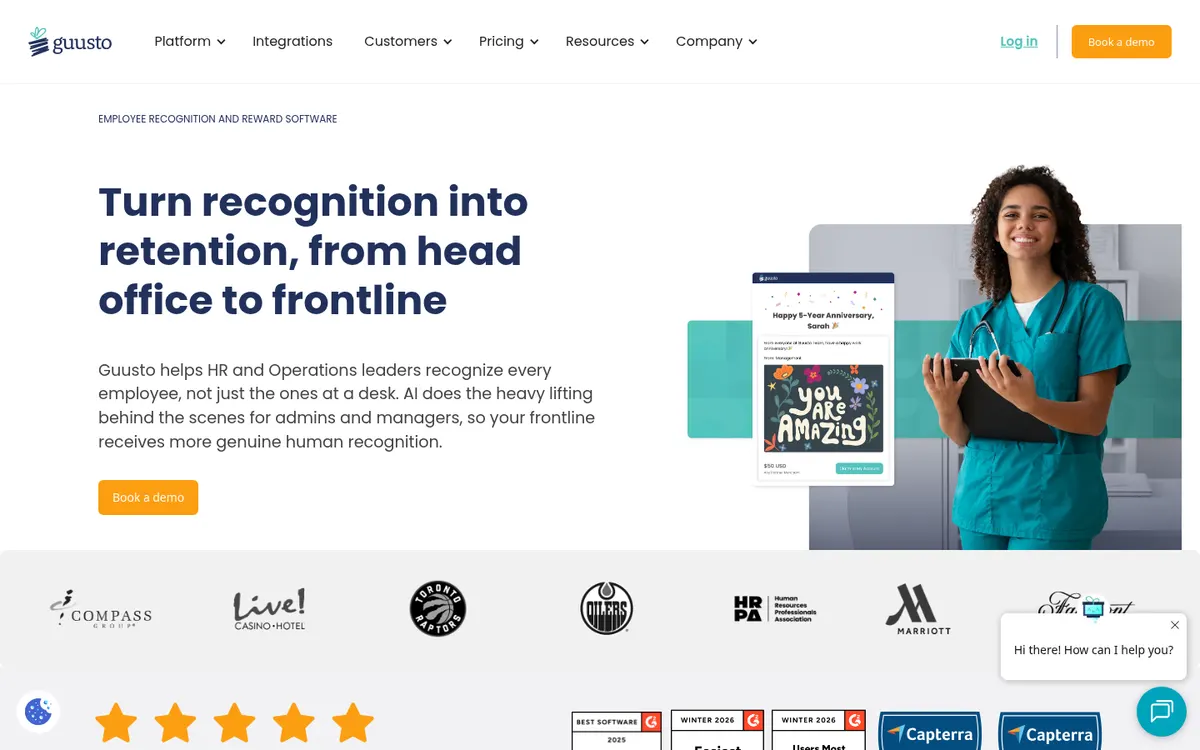
Guusto is the simplest model on this list: a manager sends a gift card, the recipient spends it. There is no points economy to explain and no separate catalog to browse. Pricing splits between senders and recipients, which suits operations where a handful of team leads recognize a large frontline workforce.
The pricing page leads with Lite at $125 per month for one sender seat and up to 250 recipient seats, and a free tier covers a single sender with up to 250 recipients. Read the numbers carefully: other Guusto material cites Lite at $150 per month, so confirm the rate before you sign. Essential is $4.00 per sender plus $0.70 per recipient with a $200 monthly minimum, and Premium is $5.00 plus $1.00 with a $500 minimum. No trial is stated. Setup is light: there are no points balances to fund.
Recipients choose from a merchant catalog of 100 or more brands. That catalog is North America-first, which is fine for US and Canadian operations and less so if you employ people across Europe or Asia. Because the structure charges for reach rather than activity, cost scales with headcount rather than with how often someone gets recognized.
It fits frontline and deskless teams where simple gift card delivery matters more than a social feed, and companies that want to hand recognition decisions and budgets to managers instead of running a central program. It fits poorly if you want values-tagged recognition, culture analytics or an engagement survey in the same tool, and it fits poorly if your headcount sits outside North America.
What works
- No points economy to learn
- Free tier covers 250 recipients
- 100 or more merchant brands
What to weigh
- Lite cited at both $125 and $150
- Monthly minimums on higher tiers
- Catalog is North America-first
Pick it if
A few managers need to send gift cards to many frontline staff and you want to skip points balances entirely.
Skip it if
You want values-tagged recognition, culture analytics or rewards that work well outside North America.
Plate 03 of 08
Assembly
Best for recognition paired with workflow automation
Our verdict
Recognition paired with workflow automation, priced at $3 per user with automation as the reason to pay.
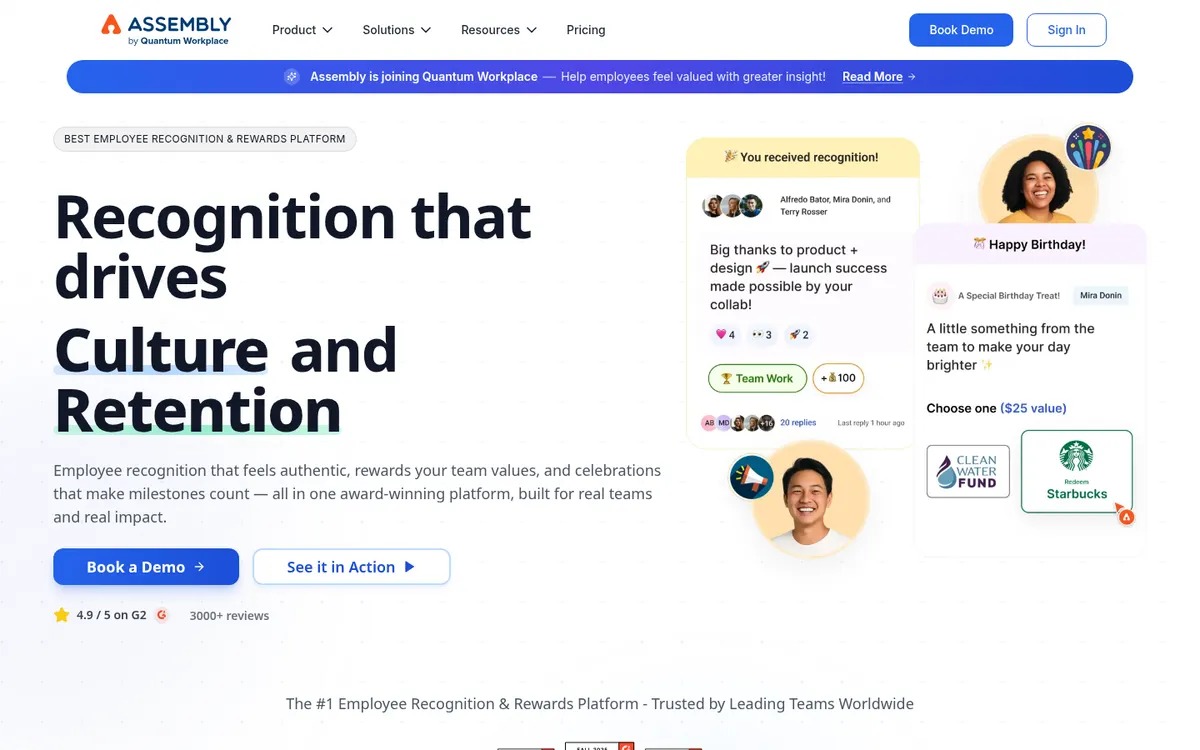
Assembly bundles peer recognition with workflow automation, which is unusual in this group. The entry plan, Empower, is $3 per user per month billed yearly. There is no free tier and no trial, and Enterprise is quote-only, so larger buyers end up in a sales conversation before they see a number.
The automation is what you pay for: recognition flows, automated anniversary and onboarding shoutouts, and a workflow layer that reduces manual admin. Anniversary and onboarding messages post without anyone remembering, which removes the manual admin that usually falls on one HR generalist and keeps the feed populated through quiet months.
Recognition runs on points. Employees give each other points, the feed shows what people did, and points redeem against a catalog you can stock with branded merchandise and unique perks rather than gift cards alone. Custom rewards are the differentiator if your people value branded kit, team events or perks a prepaid card cannot buy.
Two things to weigh. Enterprise pricing is quoted rather than published, so you cannot model larger deployments without a call. Analytics are limited compared with enterprise platforms, so culture reporting is thinner than what Kudos offers. A buyer who only needs kudos and gift cards can find cheaper options, and a buyer who needs surveys needs a second vendor.
It fits mid-size companies that want recognition paired with workflow automation, and companies that want a merchandise catalog rather than gift cards. It fits less well for very small teams that will not use the automation, because the value sits in the workflow layer.
What works
- Recognition plus workflow automation
- Custom merchandise rewards
- Automated milestone shoutouts
What to weigh
- Enterprise is quote-only
- Analytics are limited
- No free plan and no trial
Pick it if
You already automate HR events and want recognition to trigger from the same workflows with merchandise rewards attached.
Skip it if
You only need kudos and gift cards, or if you need to see a published price for a large deployment.
Plate 04 of 08
Motivosity
Best for SMB teams wanting straightforward peer recognition
Our verdict
Straightforward SMB recognition held back by a $3,000 annual floor that decides the bill for small teams.
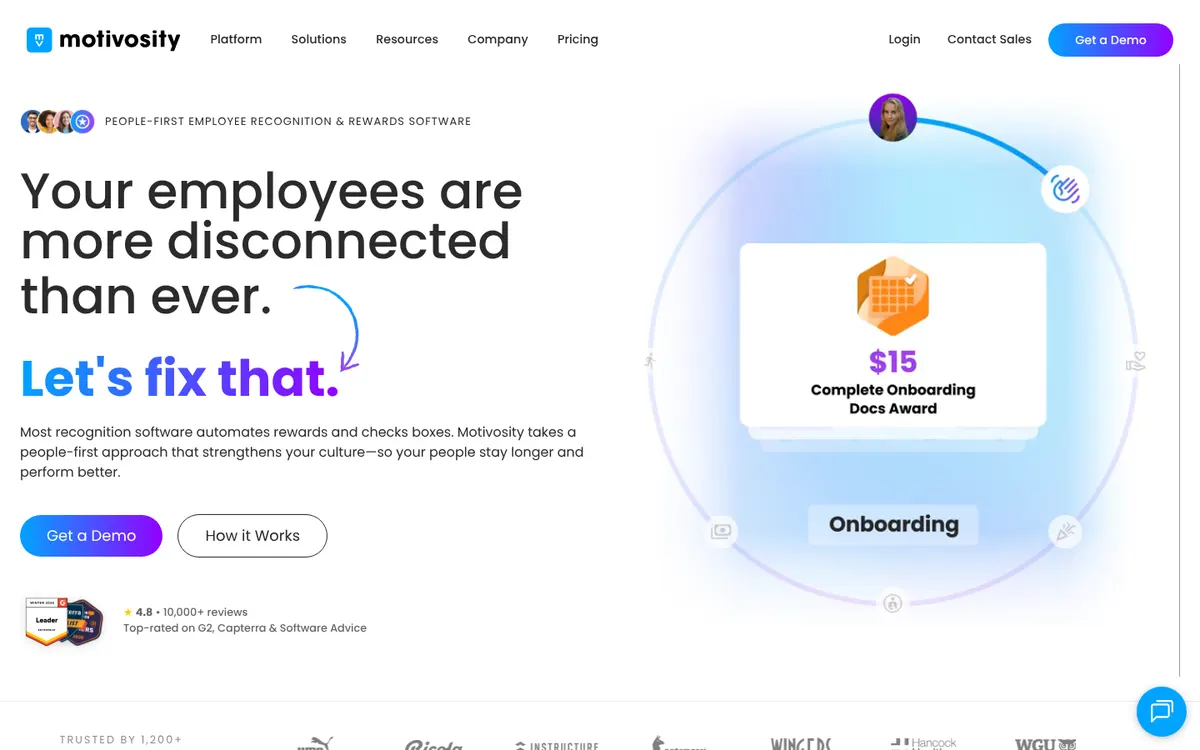
Motivosity is an SMB recognition product with a price that looks smaller than it is. Per-user pricing runs $2 to $3 per month, but a $3,000 annual minimum applies, so a 20-person team pays the floor rather than the $480 the per-user rate implies. The pricing page now frames everything as custom, with bundles shown for inspiration only.
The product covers the recognition basics: peer-to-peer kudos, a visible recognition feed, gift cards plus custom rewards, a rewards store and manager dashboards. Custom rewards let you add perks that a gift card catalog cannot cover, which matters for teams with a strong internal culture and a preference for experiences over prepaid cards.
Optional add-on modules extend the program, and each is priced separately, so the total climbs as you add capability. The hard limit is scope: Motivosity does not include engagement surveys, so a team that wants to link recognition to survey data needs another vendor. Analytics are manager dashboards rather than culture analytics.
The annual minimum is the number to model. At a larger headcount the $3,000 floor is close to the published per-user range. At 20 employees it is much higher per user, which changes the comparison against every per-user tool here.
It fits companies that want straightforward peer recognition with gift cards and custom rewards and will clear the floor. It fits less well for a 20-person startup that wants to start small, or for a team that wants surveys and recognition in one contract.
What works
- Peer recognition with custom rewards
- Manager dashboards included
- Built for SMB programs
What to weigh
- $3,000 annual minimum
- No engagement surveys
- Add-on modules raise the total
Pick it if
You have 100 or more employees, want peer recognition with gift cards and custom rewards, and will clear the annual floor.
Skip it if
You are a 20-person team, or if you need engagement surveys in the same subscription.
Plate 05 of 08
ThriveSparrow
Best for teams wanting recognition and engagement surveys together
Our verdict
Recognition and pulse surveys under one per-employee rate, with the broadest global gift card catalog here.
ThriveSparrow is the recognition tool here that also runs engagement surveys in the same subscription. The pricing page shows Engage + Kudos at $4 per employee per month with a 20 percent annual discount, so check the rate for your term before you budget. Free modules are included and no trial is stated.
On the recognition side you get peer recognition, an activity feed and a global reward catalog with 800 or more gift cards, the broadest global catalog in this group. On the engagement side you get pulse surveys, AI-driven sentiment analysis and reporting for managers. Buying both from one vendor avoids the add-on fee you pay on Matter, where surveys cost $2 per user extra, and it avoids running two renewal dates.
The trade-offs are benchmarking and scale. Sentiment analysis is useful for spotting trends early, but benchmarking is limited next to dedicated engagement platforms, and ThriveSparrow is a smaller vendor, which matters if procurement wants a long track record and heavy references. For recognition-only teams, surveys and sentiment are features you pay for and never open.
It fits companies that want recognition and a lightweight engagement pulse from one contract at a predictable per-employee rate, especially teams spread across countries that need gift cards that work locally. It fits less well if you need deep engagement benchmarking, a merchandise catalog, or free modules that are substantial enough to pilot before you commit.
What works
- Recognition and pulse surveys together
- 800 or more gift cards
- AI sentiment analysis
What to weigh
- Limited benchmarking
- Smaller vendor
- Entry price rose to $4
Pick it if
You want recognition and a light engagement pulse from one vendor with gift cards that work across countries.
Skip it if
You need deep engagement benchmarking or you only want recognition and nothing else.
Plate 06 of 08
Nectar
Best for recognition bundled with internal communications
Our verdict
One vendor for recognition, comms and engagement, with the catch that you cannot see a price before a demo.
Nectar sells recognition as one of four modules: Recognize, Engage, Comms and Flows. Pricing is quote-only through a demo request form. Ask directly about per-user rates, minimums and what each module costs. No free plan and no trial are stated.
The pitch is consolidation. A company can run peer recognition, engagement, internal communications and automated flows from one vendor, with Flows automating messages and recognition. Rewards include Amazon and gift cards, and there is a Microsoft Teams integration for companies that work in Teams. For a Microsoft shop, that means one tab for recognition and one place for announcements.
Where it falls down is the details. Because pricing sits behind a demo form, you cannot model cost before a sales call, and buyers should ask directly about per-user rates, minimums and what each module costs on its own. Analytics are basic, so culture reporting is thinner than Kudos advertises. The reward catalog is North America-first, a real limit for multi-currency payrolls.
It fits Microsoft-centric companies that want recognition and internal comms in one place and can absorb a quote-based buying process. It fits less well for a small team that wants a published price this week, or a global team whose employees need rewards outside North America. Ask for a written quote with module pricing before you agree to a pilot.
What works
- Recognition, comms and engagement
- Amazon plus gift card rewards
- Microsoft Teams integration
What to weigh
- Pricing requires a demo
- Basic analytics
- North America-first catalog
Pick it if
You want recognition, internal comms and engagement from one vendor and are comfortable buying through a quote.
Skip it if
You need a published price before a call or your staff need rewards outside North America.
Plate 07 of 08
Awardco
Best for enterprises wanting Amazon-integrated reward catalogs
Our verdict
The deepest Amazon reward integration in this group, with a $3,000 package floor that rewards scale.
Awardco is built around one idea: rewards fulfilled through Amazon Business. The catalog integration is deeper than the gift-card catalogs elsewhere on this list, and for US buyers with an Amazon Business account it removes most of the fulfillment work. Packages start at $3,000 for organizations of 100 employees or fewer, and no per-user rate is published, so every deal is quoted.
Five named plan packages cover recognition, points-based awards, milestone and service awards, plus the reporting an administrator needs to run them. If you run service awards at scale, that combination is well covered: tenure awards, points balances and fulfillment sit in one system, and employees pick from a catalog they already know how to use.
The limits are cost transparency and geography. A $3,000 floor for up to 100 employees is a fixed cost, good value at the top of that range and expensive for a smaller team. No per-user rate means you cannot benchmark without a quote, and the catalog skews toward US buyers, so multinational teams will find gaps in what their employees can actually redeem.
It fits enterprises and upper-mid-size companies that already buy through Amazon Business and want milestone, service and peer recognition in one program with one fulfillment path. It fits poorly for small teams with a tight budget or companies whose employees sit outside the US. Ask for the five package levels in writing, including what changes above 100 employees, before you compare it against a per-user tool.
What works
- Amazon Business catalog integration
- Milestone and service awards
- Five packaged plans
What to weigh
- $3,000 floor for 100 employees
- No per-user rate published
- Catalog skewed to US buyers
Pick it if
You run service awards at scale, buy through Amazon Business, and want fulfillment handled in one system.
Skip it if
You are a small team below the package floor or your employees are mostly outside the US.
Plate 08 of 08
Kudos
Best for values-tagged recognition and culture analytics
Our verdict
Values-tagged recognition with real culture analytics, sold only through a quote and a sales cycle.
Kudos ties every piece of recognition to a company value, and the analytics are built around that: you can see which values are practiced most and by which teams. That is a different product from a gift-card dispenser, and it is why culture-focused HR leaders shortlist it.
Functionally you get peer and manager recognition, values tagging, points-based redemption, a custom reward catalog and reporting for culture leaders. Custom rewards allow unique perks rather than gift cards alone, and the value tagging means a recognition feed doubles as evidence for values-based performance conversations and internal storytelling.
The problem is buying it. No pricing page is published, and the pricing URL returned a 404 during 2026 checks, so you cannot compare cost without a quote. Global reward fulfillment is limited next to ThriveSparrow's 800 or more gift cards. Budget time for a sales cycle, and ask what a point is worth in reward currency before you sign, because that number decides the real cost per recognition.
It fits companies that treat values as a management system and want recognition data to show which values are lived, with a dedicated people function and someone who will actually read the analytics. It fits less well for a small team that needs a published price quickly, or a distributed workforce that needs rewards in many countries.
What works
- Every recognition tied to a value
- Culture analytics
- Custom rewards for unique perks
What to weigh
- No published pricing
- Pricing page returned a 404
- Limited global fulfillment
Pick it if
Values drive your performance conversations and you want recognition data that shows which values people actually live.
Skip it if
You need a published price today or your employees need rewards in many countries.
What does employee recognition software actually do?
Employee recognition software does two jobs: it gives people a structured way to thank each other, and it pays out rewards for that thanks. Buyers searching for Bonusly alternatives end up comparing the same handful of moving parts.
The core is a recognition feed. An employee writes a note, tags a colleague, sometimes tags a company value, and attaches points. Everyone can see it. Managers get a dashboard. At the end of the month the points convert into something: a gift card, merchandise, a charity donation, a custom perk. The software is the record of who thanked whom and the control point for the budget behind it.
Around that core, vendors split into three shapes:
- Recognition-focused, priced per user, with gift cards or custom rewards (Matter, Assembly).
- Recognition plus a large reward catalog, priced per sender and per recipient or by package (Guusto, Awardco).
- Recognition bundled with surveys, communications or workflows, priced per user or by quote (ThriveSparrow, Nectar).
What it replaces is informal: thank-you emails, a spreadsheet of gift card purchases, an all-hands shoutout that only reaches the room. A dedicated tool makes recognition visible, repeatable and reportable, and it moves the reward budget into an approval flow instead of an expense claim. That last part matters more to finance than to HR.
The category is not the same as engagement survey software, though several vendors here blur the line. If your goal is measuring sentiment, buy a survey tool. If your goal is making recognition consistent and tying spend to it, buy this. The overlap products are worth a look when you want one contract, but expect either lighter benchmarking or a quote-based buying process.
This guide sits in the Software collection. Buyers weighing nearby tools often read the guides to commission software and research platforms next.
How employee recognition pricing works in 2026
Recognition software rarely bills one way, and the model matters more than the headline rate. The five billing shapes below cover every tool in this list, and each produces a different number for the same headcount.
| Model | How it bills | Typical fit | Example from this list |
|---|---|---|---|
| Per user, per month | A flat rate multiplied by employees, billed monthly or annually | Teams with stable headcount and a fixed budget | Matter at $1 per user on Basic, billed annually |
| Sender plus recipient | One rate for the managers who send, one for the people who receive | Frontline teams with many recipients and few senders | Guusto Essential at $4.00 per sender plus $0.70 per recipient |
| Per user with an annual minimum | A per-user rate with a floor that overrides small bills | Teams that clear the floor | Motivosity with its $3,000 annual minimum |
| Package fee | A flat package price by company size | Enterprises buying milestone and service awards | Awardco packages from $3,000 for up to 100 employees |
| Quote only | Custom pricing after a demo | Larger or multi-module deals | Nectar, Kudos and Assembly Enterprise |
The first thing to sort out is what the per-user rate multiplies. Per-user plans charge on employees, and Guusto charges one rate for senders and another for recipients. Use total headcount as your estimate, then confirm which seats are billable.
Reward spend is usually separate from the subscription. Matter charges reward spend only after an admin approves a redemption, which makes the reward line a budget you control rather than an open tab. Ask every vendor whether the quoted price includes rewards or only the software.
Add-ons are where budgets slip. Matter's surveys cost $2 per user on top of the plan, and Motivosity's optional modules are priced separately. If you need surveys, compare the combined price against ThriveSparrow, which includes pulse surveys in the $4 per employee Engage + Kudos plan.
Annual minimums deserve their own spreadsheet cell. Motivosity's $3,000 floor makes a 20-person team pay $3,000 rather than $480. Awardco's packages start at $3,000 for up to 100 employees. Both are fine value at the floor headcount and expensive below it. Free tiers distort comparisons too: Matter's free plan has unlimited users and Guusto's covers one sender and 250 recipients, so a small team can run a real program at zero software cost and pay only for rewards. That is the honest baseline against which every paid plan should be judged.
Every price in this guide was read on the vendor's own pricing page on November 25, 2026. Where a vendor does not publish a figure we could confirm, the card says "See website" rather than a guess. For the arithmetic around this purchase, try the free Email campaign metrics calculator.
A decision path for picking one of these eight
Count senders, recipients and total headcount. Guusto bills senders and recipients on separate rates, while per-user plans bill employees. Write down both numbers before you book a demo, because they change which model is cheapest.
Set the reward budget apart from the subscription. Decide what you will spend on gift cards or merchandise per employee per year. That number, not the software fee, is usually the largest line in the program.
Test every quote against your real headcount. Run the per-user rate, the annual minimum and any add-on through your own numbers. A $3,000 floor and a $1 per-user plan look very different at 20 people and at a much larger headcount.
Decide whether surveys and comms belong in scope. If they do, compare bundled products like ThriveSparrow, which includes pulse surveys, and Nectar, which bundles recognition, comms and engagement, against the cost of adding surveys to Matter at $2 per user. If they do not, do not pay for them.
Check the reward catalog in your countries. Awardco leans on Amazon Business for US buyers, ThriveSparrow carries 800 or more gift cards, and Guusto and Nectar are North America-first. Look at what your employees would actually see.
Start with a pilot. Run one team through the tool before a company-wide launch. Watch participation, approval queues and reward redemption rates, then expand or switch while the contract is still small.
Mistakes that inflate recognition spend
- Comparing headline rates only. A $2 per-user rate with a $3,000 annual minimum can cost more than a higher per-user rate without a minimum. Model the annual bill at your actual headcount before you shortlist.
- Forgetting reward spend. Subscription fees are only part of the budget, and rewards often cost more. Ask whether rewards are included, who funds them, and whether an admin approves each redemption.
- Buying surveys as an afterthought. Adding $2 per user surveys to a $1 plan changes the per-user cost. Compare a bundled product against the add-on total before you sign two contracts.
- Assuming the catalog travels. Several catalogs here are North America-first. If you employ people in other countries, test the reward options they would actually see before you commit to an annual term.
- Launching to everyone on day one. A company-wide rollout with no pilot can make participation hard to manage. Start with one team, watch participation, then expand with evidence.
Bonusly Alternatives: questions
What does Bonusly cost, and where do its limits sit?
We did not verify Bonusly's own rate for this November 2026 update, so get its pricing sheet from the vendor before using it as a benchmark. The four limits buyers usually hit are the per-user price, whether a reward catalog is included, whether surveys or analytics cost extra, and any annual minimum. Every tool in this list is documented on those four points, so you can compare like with like.
Which tool has the lowest published entry price?
Matter, at $1 per user per month on Basic when billed annually, with Pro at $3. It also has a free plan with unlimited users, which is the lowest possible entry price. Guusto's free tier covers one sender and 250 recipients and its Lite plan is $125 per month, and Assembly is next at $3 per user per month billed yearly.
Which option fits frontline and deskless workers?
Guusto, because it splits pricing between a few senders and many recipients and skips the points economy, so a manager sends a gift card and the recipient spends it. Its free tier covers one sender and 250 recipients. The catalog is North America-first, so check brand availability in the countries where your frontline staff work before committing.
How can I combine recognition with engagement surveys without paying twice?
ThriveSparrow includes pulse surveys, AI sentiment analysis and an 800 or more gift card catalog in its Engage + Kudos plan at $4 per employee per month. On Matter, surveys cost $2 per user as an add-on, so a recognition and survey program on Matter is really two line items. Compare the combined totals, not the entry prices.
What should a 100-person team budget before reward spend?
On Matter, between roughly $1,200 and $6,000 a year at $1 Basic or $3 Pro per user per month billed annually. On Awardco, packages start at $3,000 for up to 100 employees. On Motivosity, the $3,000 annual minimum applies regardless of the $2 to $3 per-user rate. None of these figures include the rewards themselves.
Which reward catalogs are broadest for US versus global teams?
For US buyers, Awardco's Amazon Business integration is the deepest catalog, and Guusto's 100 or more merchant brands have a North America focus. For global teams, ThriveSparrow's 800 or more gift cards is the broadest option here. Nectar and Guusto are both North America-first, and Kudos has limited global fulfillment.