
Contents of this guide
The shortlist
Our top 3 for software buyers

Fivetran
Managed ingestion at scale
- Best for
- Managed SaaS data ingestion into a warehouse
- Features
- 4 noted: Managed ELT, 700+ connectors, CDC, dbt transforms

Airbyte
Open source connectors
- Best for
- Open source data movement and custom connectors
- Features
- 4 noted: Open source, 700+ connectors, Connector Builder, Self-hosted

Qlik Talend Cloud
Governance built in
- Best for
- Enterprise integration with data quality and governance
- Features
- 4 noted: Data quality, Governance, CDC, Hybrid fabric
Disclosure for this guide. All 8 tools here are unpaid editorial picks. The position of a paid listing can be part of what the vendor pays for. Paid and unpaid tools are scored on the same rubric and keep their cons. Details are in the advertising disclosure.
The ledger
Index of every tool
| Tool | Free plan | Trial | Rubric | Compare | ||
|---|---|---|---|---|---|---|
| 01 | FivetranManaged SaaS data ingestion into a warehouse | FreeFree plan, up to 500,000 monthly active rows for connections, 3,500 for activations, paid plans usage basedChecked Nov 25, 2026 | Yes, up to 500,000 monthly active rows | 14-day free trial per new connection | ||
| 02 | AirbyteOpen source data movement and custom connectors | $20Standard, per month, 5 credits included, about 1 GB of syncsChecked Nov 25, 2026 | Yes, self-hosted Core edition | 14-day free trial, 400 credits | ||
| 03 | Qlik Talend CloudEnterprise integration with data quality and governance | See websiteQuote-only pricing based on data volume, job executions, and job durationNot published | No | No | ||
| 04 |  MatillionWarehouse-native ELT for cloud data warehouses | See websitecustom quoteCustom quote | No | Yes, free trial available | ||
| 05 |  Integrate.ioFixed-fee pipelines with predictable monthly costs | $1,999Core, per month, unlimited data volumes, pipelines, connectors and usersChecked Nov 25, 2026 | No | No | ||
| 06 |  Hevo DataNo-code ELT for small and mid-size teams | $265Starter, per month, billed annually,12% off monthly $299, 5M events, up to 10 usersChecked Nov 25, 2026 | Yes, up to 1 million events | 14-day free trial, no credit card | ||
| 07 | Azure Data FactoryMicrosoft ecosystem and hybrid ETL pipelines | See websitePay per activity run and integration runtime hour, for example $1 per 1,000 orchestration runs and $0.25 per DIU-hourNot published | No | Free Azure account with $200 credit for 30 days | ||
| 08 |  Apache NiFiReal-time data flow and streaming pipelines | See websiteOpen source with no license costNot published | Yes | No |
Prices are the lowest paid plan the vendor shows, read on November 25, 2026. Sort by price ranks published monthly figures; tools without one go last. Pin up to three tools to compare them side by side.
How this guide was put together
We scored eight tools against the five criteria above, weighting connector coverage highest because connector gaps are the most common reason a migration stalls. Deployment flexibility covers managed, self-hosted, hybrid, and on-premises options, since Informatica estates are rarely cloud-only. Pricing clarity asks a simple question: can a buyer find a number before a sales call? Transformation depth separates tools that run SQL, Python, or visual logic from tools that only move rows. Operational load is scored so a higher number means lighter work for your team.
Prices, free tiers, and trial terms in this list come from vendor pricing pages checked on November 25, 2026. Where a vendor publishes no price, the entry says so and gives the billing model instead. We did not estimate quotes, convert currencies, or infer discounts that were not stated.
The order is editorial. Each position reflects how well a tool fits the specific buyer described in its entry, not a weighted total, and no position is derived from the scores. One slot in this format can be a paid Featured placement; it is scored with the same rubric and carries the same honest cons as every other entry. No tool in this list is marked Featured.
We also checked every tool against what Informatica customers actually run: connectors, scheduled movement, change data capture, mapping-style transformation, master data management, and on-premises deployment. Several tools here cover the first four, and none covers all six, which is why most migrations end up as a stack of two or three products rather than a straight swap.
The full process, including how we handle corrections, is on the methodology page. Paid listings follow the advertising disclosure.
Rubric and weights
Every tool below is scored from 1 to 10 on these five criteria. The scores describe each tool; the order is an editorial call on fit for the buyer each card describes, plus the disclosed Featured position.
- 25%Connector coverageHow many prebuilt sources and targets the tool supports before you have to write code.
- 20%Deployment flexibilityWhether the tool runs as managed SaaS, self-hosted, hybrid, or fully on-premises.
- 20%Pricing clarityWhether entry prices and billing units are published rather than quote only.
- 20%Transformation depthWhether SQL, Python, or visual transformations run in the tool or in the target warehouse.
- 15%Operational loadHow much infrastructure, monitoring, and upgrade work stays with your team, scored so a higher number means lighter load.
Plate 01 of 08
Fivetran
Best for managed SaaS data ingestion into a warehouse
Our verdict
The lowest-effort route off Informatica ingestion work, if your sources are cloud-reachable and your row volumes stay predictable enough for a usage bill.
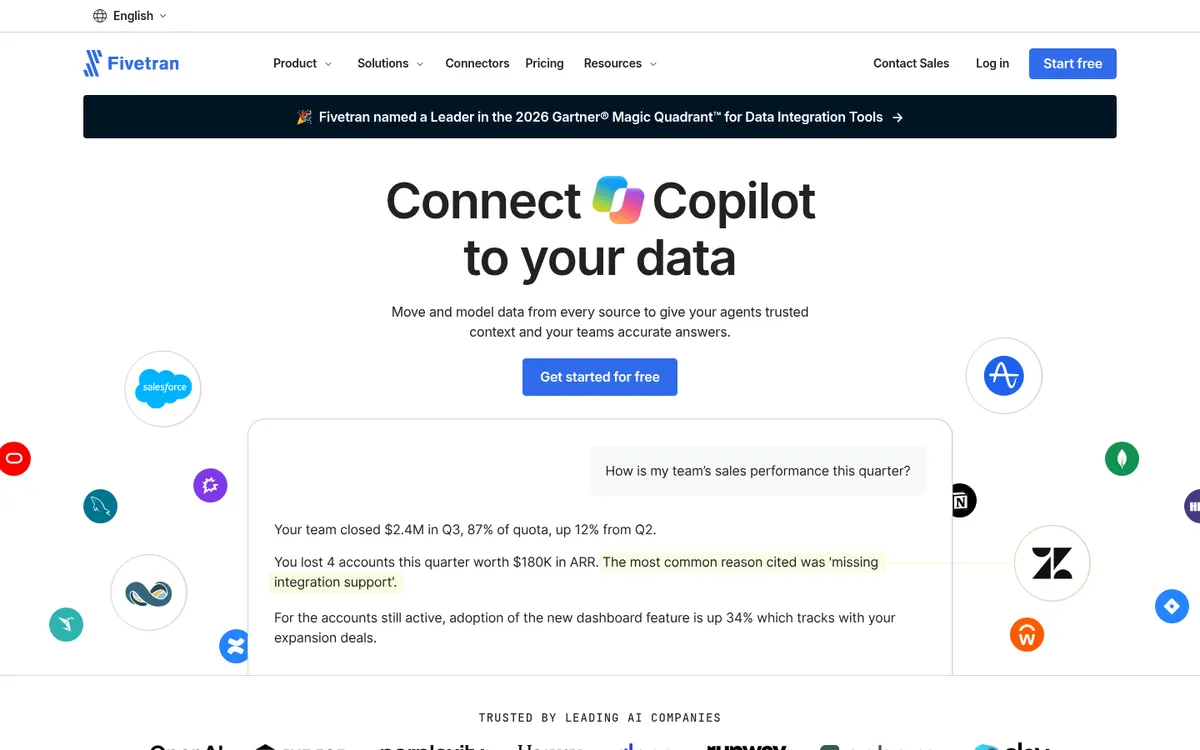
Fivetran is a managed ELT service: you point it at a source, it extracts, and it loads into a cloud warehouse on a schedule you set. The library covers 700+ prebuilt connectors across SaaS applications, databases, and files, with log-based change data capture for database sources. Since the all-stock merger with dbt Labs completed on June 1, 2026, dbt transformation sits inside the same platform, so the light transformation layer that used to need a separate tool now runs alongside ingestion.
Pricing is consumption based. The free plan covers up to 500,000 monthly active rows for connections and 3,500 for activations, and each new connection carries a 14-day free trial. Paid contracts carry a $12,000 annual minimum according to available guidance, and costs climb when row churn is high or when many connections each churn a moderate volume. Teams with steady, low-churn tables get the most from that model; teams syncing volatile event tables pay for every change.
What it does not do matters for anyone leaving PowerCenter. Fivetran does not replace PowerCenter transformation mappings, master data management, or on-prem deployment. If your pipelines depend on mapping logic, matching and merging across domains, or agents installed inside a data center, you will still need a transformation layer, a master data tool, or a different integration product next to it.
Operationally, the appeal is that there is no cluster to size and no connector to patch. That is the trade: you pay a minimum commitment rather than paying in engineering hours. Mid-size analytics teams with cloud warehouses and SaaS-heavy source estates are the natural fit. Large enterprises with a heavy on-premises estate should treat Fivetran as a partial replacement and plan the transformation and master data pieces separately.
What works
- Managed service removes pipeline operations work
- Broad connector coverage with change data capture
- dbt transformation included after the June 2026 merger
What to weigh
- Paid contracts carry a $12,000 annual minimum in available guidance
- Costs rise with high row churn across many connections
- Does not replace PowerCenter mappings, master data management, or on-prem deployment
Pick it if
You want connectors, change data capture, and transformation handled without running any infrastructure.
Skip it if
Your pipelines depend on complex mapping logic, master data management, or on-premises agents.
Plate 02 of 08
Airbyte
Best for open source data movement and custom connectors
Our verdict
Best when you want open source control and custom connectors, and you have platform engineering capacity to run what you build.
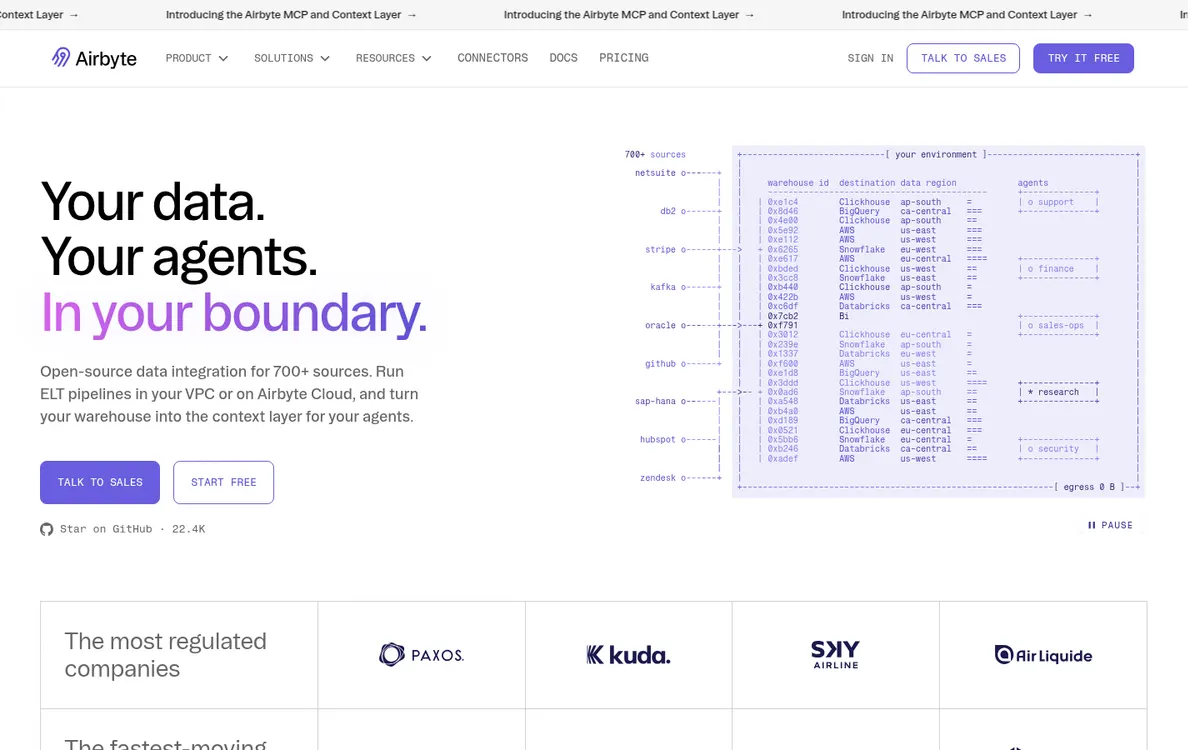
Airbyte is an open source data movement platform with a commercial cloud. The catalog covers 700+ connectors across SaaS APIs, databases, files, and unstructured sources, and the platform runs self-hosted, in Airbyte Cloud, hybrid, or fully on-premises. Custom sources come from three routes: a no-code Connector Builder with AI assist, a low-code connector development kit, and a Python connector development kit. That combination is why teams with unusual internal APIs shortlist it.
Pricing is published. The Standard plan starts at $20 per month with 5 credits included, about 1 GB of syncs, and there is a 14-day free trial with 400 credits. The self-hosted Core edition is free, which is a genuine difference from every other tool here apart from Apache NiFi. Published entry pricing makes budgeting easier, though credit consumption still tracks how much data you actually move.
The cost of the free route is operational. Self-hosted setup requires Docker or Kubernetes expertise and several hours of work, and ongoing infrastructure monitoring and upgrades remain internal. Connector updates ship frequently, so someone has to own the release cycle. Teams without platform engineering capacity drift toward the cloud option and its credits, which is the trade the freemium model is built to produce.
Compared with PowerCenter, Airbyte covers extraction, loading, and basic transformation, not mapping-heavy batch jobs or master data management. It fits data teams that want control over deployment, are comfortable owning infrastructure, and have at least one non-standard source. It is a weaker fit for enterprises that want a vendor to own the runtime, or for teams whose main requirement is governed, audited transformation logic.
What works
- Free self-hosted Core edition with 700+ connectors
- Published pricing from $20 per month
- Deployment flexibility across cloud, hybrid, and on-premises
What to weigh
- Self-hosted setup requires Docker or Kubernetes expertise and several hours
- Ongoing infrastructure monitoring and upgrades stay internal
Pick it if
You want an open source core, custom connector tooling, and control over where the runtime lives.
Skip it if
Nobody on your team can own container infrastructure and connector upgrade cycles.
Plate 03 of 08
Qlik Talend Cloud
Best for enterprise integration with data quality and governance
Our verdict
The closest functional match for governance-heavy enterprises, at the cost of quote-only pricing and a cloud-first deployment model.
Qlik Talend Cloud is the enterprise integration line that has sat under Qlik since 2023. It bundles data integration, transformation, data quality, and data governance in one platform, with a broad connector library and log-based change data capture inherited from Qlik Replicate. For buyers replacing PowerCenter in a regulated environment, that combination is the closest functional match on this list: ingestion alone rarely satisfies an audit, and quality rules plus governance usually have to come along with it.
There is no published price. Pricing is quote-only and based on data volume, job executions, and job duration, so the number you get depends on how much you run and how long each job takes. That structure rewards teams that can forecast workload and penalizes teams that cannot. There is no free plan and no trial listed, which means an evaluation usually starts with a sales conversation rather than a signup form.
The bigger change is the open source route. Talend Open Studio was retired on January 31, 2024, so the free desktop tool many teams used for job development is gone. Anyone who built jobs in Open Studio and assumed they could stay there indefinitely needs a migration plan, and the paid platform is the vendor's intended destination.
Deployment is cloud-first, with hybrid available only through Data Fabric. Teams with a hard requirement to run everything on-premises will find the fit awkward. The product suits large organizations that value governance and quality over speed of setup, have a realistic budget for quote-based enterprise licensing, and can plan a migration over months rather than weeks.
What works
- Combines integration with data quality and governance
- Broad connector coverage with Replicate-based CDC
- Strong fit for regulated, audit-heavy environments
What to weigh
- Quote-only pricing based on volume, executions, and job duration
- Cloud-first design with hybrid only through Data Fabric
- No open source route since Talend Open Studio retired
Pick it if
Governance, data quality, and change data capture have to arrive under one enterprise contract.
Skip it if
You need a published price, a free trial, or a fully on-premises deployment.
Plate 04 of 08
Matillion
Best for warehouse-native ELT for cloud data warehouses
Our verdict
A strong fit for warehouse-native transformation, with credits priced by task hours.
Matillion is warehouse-native ELT: transformation work runs inside the cloud data warehouse rather than in a separate engine. That means push-down SQL transformations, Python transformations, and near-real-time pipelines all execute where the data already sits. Agentic pipeline building, where the tool generates pipeline components from a description, is aimed at cutting the setup time that traditionally made ELT projects slow. Streaming change data capture is available on the Scale tier.
Pricing is quote-only. The Developer, Teams, and Scale editions all come without a published price, and credits are based on task hours. That makes the commercial conversation workload-dependent: how many pipelines you run, how often, and for how long. There is a free trial but no free plan, so teams evaluating it should expect a scoped quote rather than a self-serve number.
The architecture has a consequence. Because pipelines execute in the warehouse, the warehouse choice becomes a long-term dependency, and moving warehouses later means rework. Teams running on a single cloud warehouse generally accept that. Teams with significant on-premises sources, or with a warehouse strategy still in flux, should weigh it carefully, because a warehouse-native tool is only as flexible as the warehouse underneath it.
Matillion fits data engineering teams that already have a cloud warehouse, want transformation close to the data, and can forecast task hours well enough to negotiate credits. It is a partial Informatica replacement: it handles the ELT and transformation side well, but it is not a master data management platform and it is less suited to on-premises sources. Buyers should expect to keep a separate tool for governance-heavy or on-premises-heavy workloads.
What works
- Transformation runs inside the cloud warehouse
- Agentic pipeline building speeds pipeline creation
- Streaming change data capture on the Scale tier
What to weigh
- Quote-only pricing on credits tied to task hours
- Warehouse-native design ties customers to their warehouse choice
- Less suited to on-premises sources
Pick it if
Your data already lives in one cloud warehouse and you want transformation executed there.
Skip it if
You need a published price or you still run significant on-premises sources.
Plate 05 of 08
Integrate.io
Best for fixed-fee pipelines with predictable monthly costs
Our verdict
Predictable monthly cost for standard pipelines, provided your sources are covered and you can commit without a trial.
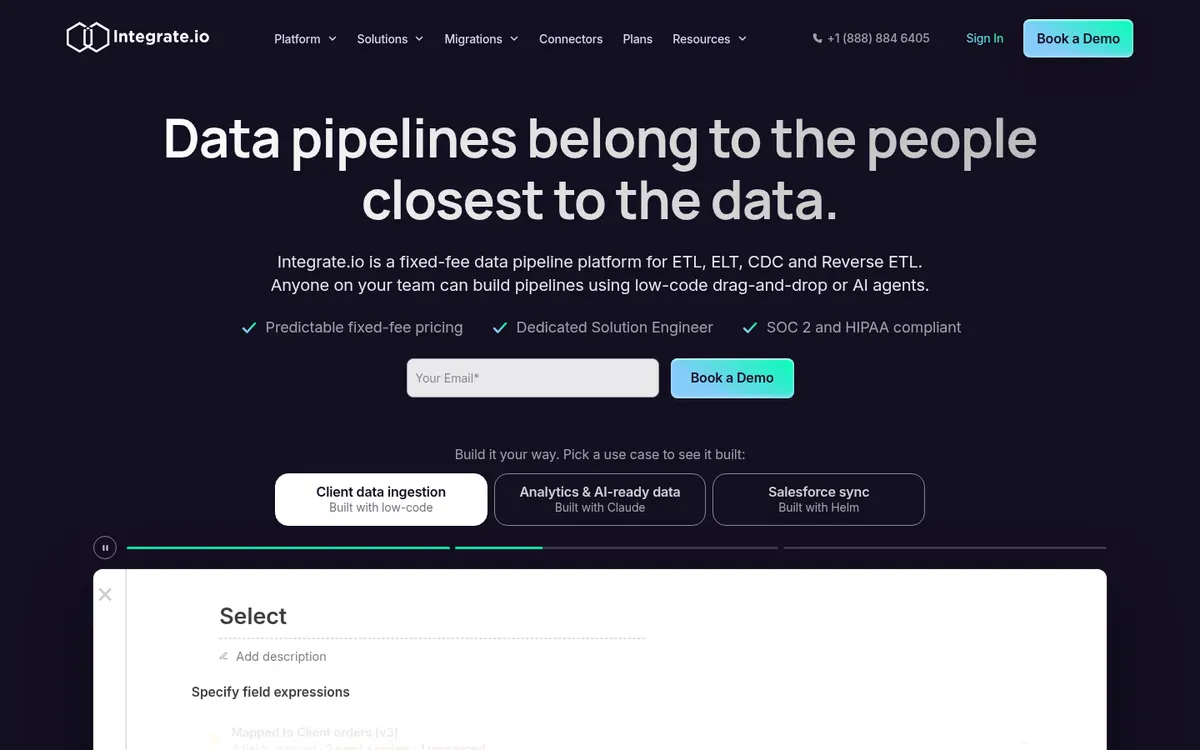
Integrate.io sells predictability. Pricing is a fixed monthly fee rather than a per-row or per-credit meter, and the Core plan starts at $1,999 per month with unlimited data volumes, pipelines, connectors, and users. For teams whose Informatica bill moved every month with workload, that is the headline: the number does not change when a source starts churning more rows or a new pipeline goes live.
The platform covers several integration modes in one place: fixed-fee ETL, ELT pipelines, change data capture, and reverse ETL. Transformation is handled through 220+ transformation steps plus SQL and Python, with Snowflake and BigQuery support for warehouse destinations. Reverse ETL is the piece many Informatica estates never had, and for teams pushing modeled data back into CRM or marketing tools it removes a second purchase.
The limit is breadth. The connector catalog is smaller than Fivetran's or Airbyte's, so the shortlist decision often comes down to whether your specific sources are covered. There is no free tier and no trial, which means committing to the fee before you have run a pipeline in production. That combination is uncomfortable for buyers who like to test first, and it is the main reason teams with unusual source requirements look elsewhere.
The fixed fee only pays off at volume. A small team syncing a handful of sources will find $1,999 per month hard to justify against a consumption-priced tool with a free tier, while a team moving large volumes across many pipelines will find it cheap relative to per-row billing. It fits mid-size and larger teams that want budget certainty, have standard sources, and value ETL, CDC, and reverse ETL under one contract.
What works
- Fixed monthly fee with unlimited data volumes and users
- ETL, CDC, and reverse ETL in one platform
- 220+ transformation steps plus SQL and Python
What to weigh
- $1,999 per month entry price
- No free tier and no trial
- Smaller connector catalog than Fivetran or Airbyte
Pick it if
A flat monthly bill matters more to you than a large connector catalog or a free trial.
Skip it if
Your sources are unusual or you refuse to sign before testing in production.
Plate 06 of 08
Hevo Data
Best for no-code ELT for small and mid-size teams
Our verdict
A fast, no-code start for small teams, with event-based billing that needs modeling before you sign an annual term.
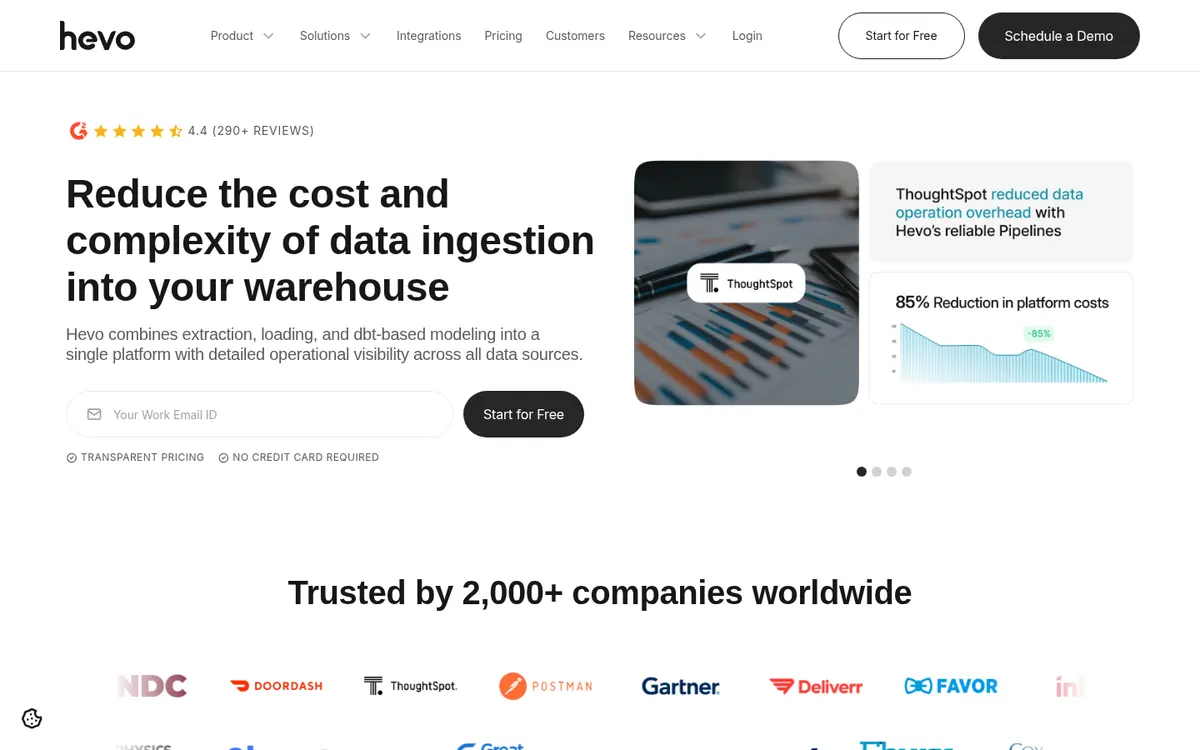
Hevo Data is no-code ELT aimed at small and mid-size teams. Pipelines are built through a point-and-click interface, transformations can be drag-and-drop or written in Python, and dbt support is available on paid plans. Change data capture is included. The appeal is straightforward: an analyst can build and maintain a pipeline without waiting on a data engineering sprint, which is the gap most teams feel when they leave a heavily customized integration environment.
Pricing is event-based. There is a free tier up to 1 million events and a 14-day free trial with no credit card. The Starter plan costs $265 per month billed annually, which is 12% off the monthly $299 rate, and includes 5M events and up to 10 users. That is a low entry point compared with quote-only platforms, but event-tier pricing rises with volume, so the figure at month one is not the figure at month twelve.
The trade-off is enterprise depth. Hevo does not carry the governance, master data, or on-premises integration capability of the larger enterprise platforms, and it is not designed for the mapping-heavy batch jobs that PowerCenter ran. Teams with a handful of SaaS sources and a cloud warehouse get a fast start. Teams replacing a decade of PowerCenter workflow will find themselves adding tools rather than consolidating them.
It fits analytics teams at small and mid-size companies that want pipelines running this week, have a cloud warehouse, and are comfortable with event-based billing. The 10-user cap on Starter also suits teams that size. Larger organizations should treat it as a departmental tool rather than an enterprise replacement, and should model event growth before signing an annual term.
What works
- No-code pipeline building that analysts can own
- Free tier up to 1 million events
- dbt support on paid plans
What to weigh
- Starter near $265 per month billed annually
- Event-tier pricing can climb with volume
- Smaller enterprise depth than larger rivals
Pick it if
A small team needs no-code pipelines live quickly at a low entry price.
Skip it if
You need enterprise governance, master data, or room for heavy volume growth.
Plate 07 of 08
Azure Data Factory
Best for microsoft ecosystem and hybrid ETL pipelines
Our verdict
The natural choice inside Azure, where per-activity billing and integration runtimes handle hybrid pipelines at usage-based cost.
Azure Data Factory is Microsoft's cloud ETL service, priced by usage rather than subscription. You pay per activity run and per integration runtime hour, for example $1 per 1,000 orchestration runs and $0.25 per DIU-hour. There is no single monthly starting price, which is the honest answer to most pricing questions about it: the bill is a function of how many activities you run and how long your integration runtime stays active.
The feature set is broad. Visual pipeline tools sit alongside Spark and Python support, so the same service covers drag-and-drop orchestration and code-heavy transformation. Integration runtimes let pipelines reach on-premises sources, which makes hybrid architectures practical. For organizations already on Azure, identity, billing, and monitoring all come through the same tenant, and that administrative fit is often worth more than any single feature comparison.
The pricing model is also the weakness. Usage-based billing is hard to predict without a workload estimate, and estimates are hard to produce before pipelines exist. Best value accrues inside Azure: the same product outside the Microsoft ecosystem loses much of its advantage, and complex pipelines still require data engineering skill rather than a no-code analyst. A free Azure account with $200 credit for 30 days is the usual way to test it.
Against Informatica, Data Factory covers orchestration, movement, and transformation for cloud and hybrid sources, but it is not a master data management product and it does not offer mapping-heavy tooling in the PowerCenter style. It fits Microsoft-centric organizations that already have Azure governance and billing in place, and it fits teams that want to build pipelines as code with Spark or Python.
What works
- Native fit for Azure identity, billing, and monitoring
- Integration runtimes support hybrid and on-premises sources
- Visual pipelines plus Spark and Python
What to weigh
- Usage-based pricing is hard to predict without workload estimates
- Best value only inside Azure
- Complex pipelines require data engineering skill
Pick it if
Your data platform already sits in Azure and you want pipelines billed per activity.
Skip it if
You run outside the Microsoft ecosystem or need a predictable monthly figure.
Plate 08 of 08
Apache NiFi
Best for real-time data flow and streaming pipelines
Our verdict
Free, visual, and built for streaming, as long as you have engineers to run and scale the cluster yourselves.
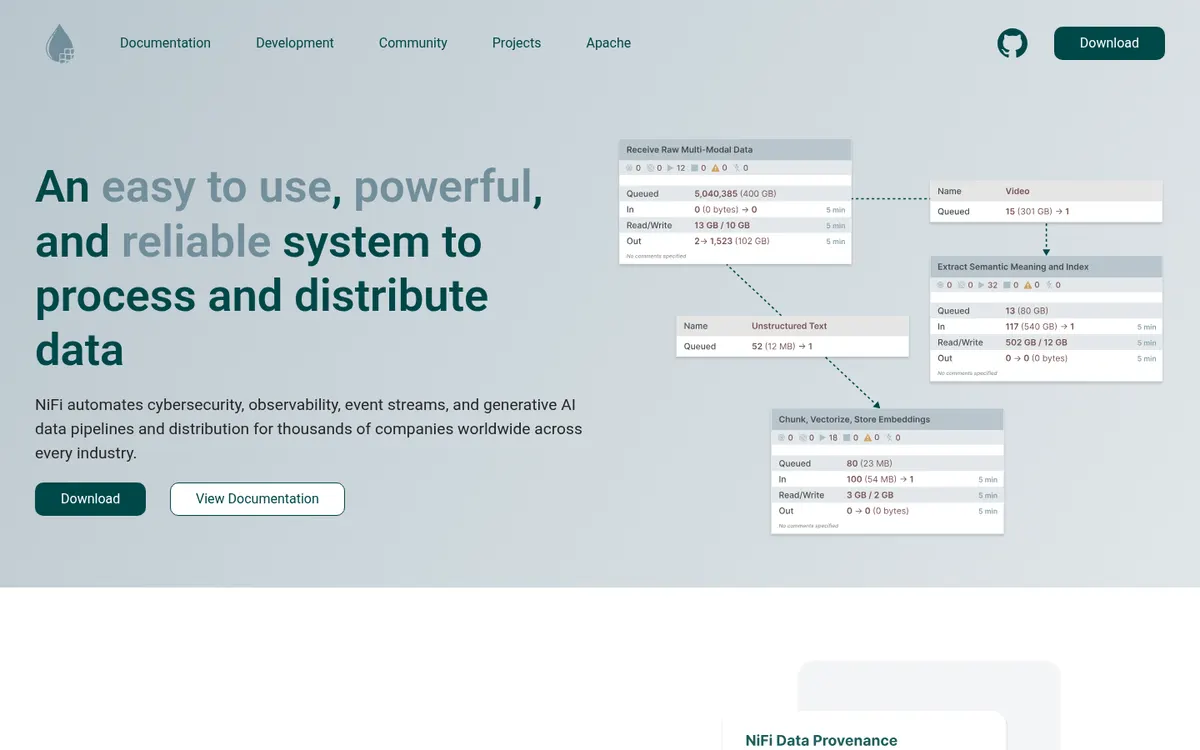
Apache NiFi is an open source data flow tool for moving events, logs, and files in real time. Flows are designed visually: you drag processors onto a canvas, connect them, and route data through the path you define, with transformation and backpressure handling built into the model. Backpressure matters more than it sounds, because a flow that can slow a fast producer instead of dropping data is the difference between a reliable pipeline and a nightly incident.
There is no license cost and no official pricing page, because the project does not sell anything. That is the whole commercial story: the software is free, and the cost moves to engineering time. There is no free trial because there is nothing to trial, and no subscription tiers to compare. What you spend is salary, infrastructure, and whatever support arrangement you choose to buy.
The project does not offer a managed cloud edition. Enterprise support comes from third-party vendors who package NiFi with support and, in some cases, management tooling. That is workable, but it means evaluating a support vendor as well as the software, and it means the upgrade path is yours to plan. Running and scaling NiFi requires engineering skill, and clusters need care as throughput grows.
NiFi fits a narrow but important job: real-time movement of events, logs, and files, where routing logic and backpressure control matter more than warehouse loading. It is not a replacement for PowerCenter transformation mappings or master data management, and it is not a managed SaaS ingestion service. Teams with streaming sources, an operations team that can own the runtime, and a preference for open source should shortlist it.
What works
- Free open source with no license cost
- Visual flow design with backpressure handling
- Strong fit for event, log, and file pipelines
What to weigh
- Requires engineering skill to run and scale
- No managed cloud edition from the project
- Enterprise support comes from third-party vendors
Pick it if
You need real-time routing of events, logs, or files and you can staff the runtime.
Skip it if
You want a managed service, a support contract from the maker, or warehouse loading.
What do Informatica alternatives actually do?
Informatica covers a lot of ground, which is why no single alternative replaces all of it. Historically the platform handled extraction from source systems, transformation of that data through mapping logic, loading into targets, change data capture, data quality checks, and master data management. A modern alternative usually does two or three of those jobs well and leaves the rest to another product.
The tools in this list fall into recognizable groups:
- Managed ELT services (Fivetran) run extract and load for you and push transformation into dbt or the warehouse.
- Open source data movement (Airbyte, Apache NiFi) gives you the runtime and asks you to operate it.
- Enterprise integration platforms (Qlik Talend Cloud) bundle integration with quality and governance.
- Warehouse-native ELT (Matillion) executes transformation inside the cloud warehouse.
- Fixed-fee ETL (Integrate.io) trades a flat monthly price for a smaller connector catalog.
- Cloud-provider ETL (Azure Data Factory) bills per activity and fits the surrounding cloud ecosystem.
What separates them in practice is not the connector count on a marketing page. It is where transformation runs, who owns the runtime, how the bill behaves as volume grows, and whether the tool can reach sources inside your own data center. A team that only needs to copy SaaS data into a warehouse has a short list. A team that needs mapping logic, matching and merging, and an audit trail has a much longer one, and may need two products.
That is the practical definition of this category: software that moves and transforms data between operational systems and analytics systems, sold either as a managed service or as software you run. Informatica alternatives are the subset a buyer would consider as a replacement for some part of that estate, not necessarily all of it. Knowing which part you are replacing is the decision that comes before any product comparison.
This guide sits in the Software collection. Buyers weighing nearby tools often read the guides to commission software and research platforms next.
How pricing works across Informatica alternatives
Informatica alternatives bill in five distinct ways, and the model matters more than the headline number. Consumption pricing charges for rows, events, or credits, so a pilot is cheap and production is not. Flat monthly pricing charges one fee regardless of volume, which is predictable but expensive at small scale. Quote-only pricing depends on data volume, executions, or task hours, which rewards teams that can forecast. Pay-per-activity pricing bills each run and each runtime hour. Open source has no license fee at all and moves the cost to labor.
| Model | How it bills | Typical fit | Example from this list |
|---|---|---|---|
| Consumption | Monthly active rows, events, or credits | Teams with variable or growing volume | Fivetran free plan at 500,000 monthly active rows; Airbyte Standard at $20 per month with 5 credits |
| Flat monthly | One fee, unlimited volumes and users | Teams that need budget certainty | Integrate.io Core at $1,999 per month |
| Quote only | Data volume, job executions, task hours | Enterprises that can forecast workload | Qlik Talend Cloud; Matillion |
| Pay per activity | Activity runs and integration runtime hours | Cloud-native teams with engineering capacity | Azure Data Factory, $1 per 1,000 orchestration runs and $0.25 per DIU-hour |
| Open source | No license fee, you pay in labor | Teams with platform engineering | Apache NiFi; Airbyte self-hosted Core edition |
Two details change the real comparison. The first is a contract minimum: Fivetran's free plan covers 500,000 monthly active rows, while paid contracts carry a $12,000 annual minimum according to available guidance, so a small team's consumption estimate can sit well below what it actually pays. The second is the trial. Airbyte gives 14 days with 400 credits, Fivetran gives 14 days per new connection, Hevo Data gives 14 days with no credit card, Integrate.io gives nothing, and Qlik Talend Cloud lists no trial at all.
Ask each vendor three questions before comparing totals: what is the minimum commitment, what unit am I billed on, and what happens to the price when volume doubles. The answers usually sort the shortlist faster than a feature matrix.
Every price in this guide was read on the vendor's own pricing page on November 25, 2026. Where a vendor does not publish a figure we could confirm, the card says "See website" rather than a guess. For the arithmetic around this purchase, try the free Email campaign metrics calculator.
How to choose an Informatica alternative in six steps
Map what you actually run. Inventory every job in your current estate: sources, targets, transformation logic, schedules, and downstream consumers. Most environments contain a long tail of jobs nobody has opened in a year, and those should be retired rather than migrated.
Split the estate into job types. Separate plain copy work from mapping-heavy transformation and from master data management. Managed ELT covers the first, warehouse-native or enterprise tools cover the second, and the third usually stays a separate purchase.
Set the deployment constraint early. Decide whether data can leave your network. If sources sit behind a firewall or regulation forbids egress, keep self-hosted or hybrid options on the shortlist before you compare features.
Price your real volume. Take last year's row counts, event counts, or task hours and run them through each vendor's model. A free tier that covers a pilot rarely covers production, and a flat fee only wins at volume.
Test with one pipeline. Pick the messiest pipeline you own and build it in two tools. Setup time, error handling, and the amount of custom code tell you more than any feature list.
Plan the support boundary. Decide who owns the runtime, the connector upgrades, and the on-call rota. Managed services move that work to the vendor and charge for it; open source keeps the work and the control.
Mistakes that derail an Informatica replacement project
Treating a connector count as coverage. A large catalog does not mean your specific source, version, or authentication method is supported. Test the exact systems you run before you trust the number on the page.
Migrating jobs nobody uses. Lifting every legacy job preserves work that no longer delivers value. Retire first, migrate second, and you cut the project scope before it starts.
Assuming ingestion replaces transformation. Managed ELT tools move and lightly transform data. Mapping-heavy logic, matching and merging, and master data management still need a dedicated tool.
Skipping the volume model. Consumption pricing looks cheap in a pilot and expensive at production volume. Model your busiest month, not your average, and check whether a contract minimum applies.
Leaving the run team out of the decision. Whoever carries the pager should see the tool before the contract is signed. Operational fit determines whether a migration succeeds more often than feature comparisons do.
8 Informatica Alternatives for 2026: questions
Which Informatica alternatives suit managed SaaS ingestion versus open source data movement?
Fivetran is the managed option: it runs the pipelines, covers 700+ connectors, and includes dbt transformation after the June 2026 merger with dbt Labs. Airbyte and Apache NiFi are the open source options. Airbyte has a free self-hosted Core edition with 700+ connectors and custom connector kits, while NiFi is a free flow tool for real-time events, logs, and files rather than warehouse loading.
How should buyers handle Informatica ownership and PowerCenter support timelines?
Informatica's current ownership and the PowerCenter support timeline should be confirmed with the vendor, since the support timeline is the practical trigger behind most migration reviews. Confirm the exact dates with Informatica and with your account team, because the dates that matter are the ones in your contract and renewal paperwork. Treat any timeline you see elsewhere as a prompt to verify, not as a planning input.
Can Fivetran replace PowerCenter transformation mappings and master data management?
No. Fivetran is a managed ELT service, and it does not replace PowerCenter transformation mappings, master data management, or on-prem deployment. It handles extraction, loading, and change data capture, and dbt covers a light transformation layer. Mapping-heavy batch logic, matching and merging across domains, and data center agents still need a separate tool or a different platform.
Which alternatives offer free tiers or free self-hosted editions?
Four do. Fivetran has a free plan up to 500,000 monthly active rows, Hevo Data has a free tier up to 1 million events, Airbyte offers a free self-hosted Core edition, and Apache NiFi is open source with no license cost. Azure Data Factory has no free tier but offers a free Azure account with $200 credit for 30 days.
What are the entry prices for Airbyte, Integrate.io, Hevo Data, and Fivetran contracts?
Airbyte's Standard plan starts at $20 per month with 5 credits included. Integrate.io Core is $1,999 per month with unlimited data volumes, pipelines, connectors, and users. Hevo Data Starter is $265 per month billed annually, 12% off the $299 monthly rate, with 5M events. Fivetran's free plan covers 500,000 monthly active rows, and paid contracts carry a $12,000 annual minimum in available guidance.
Which options fit enterprise governance, fixed-fee budgets, warehouse-native ELT, Azure, or real-time streaming?
Qlik Talend Cloud fits enterprise governance with data quality and hybrid deployment through Data Fabric. Integrate.io fits fixed-fee budgets at $1,999 per month flat. Matillion fits warehouse-native ELT with push-down SQL and streaming CDC on Scale. Azure Data Factory fits Microsoft estates. Apache NiFi fits real-time streaming of events, logs, and files, and Hevo Data fits small teams that want no-code pipelines.