
Contents of this guide
The shortlist
Our top 3 for software buyers

Segment
Destination catalog breadth
- Best for
- Developer-first teams needing the broadest integration ecosystem
- Features
- 4 noted: 700-plus destinations, Identity resolution, Personas audiences, Free tier

Tealium
Consent and governance
- Best for
- Enterprises with strict compliance, consent, and governance needs
- Features
- 4 noted: 1,300-plus integrations, Tag management, Consent controls, Audit tooling

mParticle
Mobile event scale
- Best for
- High-scale consumer apps needing mobile data and prediction
- Features
- 4 noted: Mobile events, AI prediction, Value-based credits, High volume
Disclosure for this guide. All 8 tools here are unpaid editorial picks. The position of a paid listing can be part of what the vendor pays for. Paid and unpaid tools are scored on the same rubric and keep their cons. Details are in the advertising disclosure.
The ledger
Index of every tool
| Tool | Free plan | Trial | Rubric | Compare | ||
|---|---|---|---|---|---|---|
| 01 | SegmentDeveloper-first teams needing the broadest integration ecosystem | See websiteNot published | Yes | No | ||
| 02 | TealiumEnterprises with strict compliance, consent, and governance needs | See websiteNot published | No | No | ||
| 03 | mParticleHigh-scale consumer apps needing mobile data and prediction | See websiteNot published | No | No | ||
| 04 | HightouchWarehouse-mature teams wanting composable reverse ETL activation | See websiteNot published | No | No | ||
| 05 |  DinMoMarketing teams activating warehouse data without code | See websiteNot published | No | No | ||
| 06 | JitsuDeveloper teams wanting open-source event collection | FreeFree plan, 200k active events per month included, paid Business plan $99 per monthChecked Nov 25, 2026 | Yes | Yes | ||
| 07 |  SnowplowTeams needing deep, controlled behavioral event data | See websitecustom quoteCustom quote | Yes, Signals tier up to 5M events/mo | 14 days free, no credit card | ||
| 08 |  BlueConicMarketer-led B2C teams wanting no-code first-party data | See websitecustom quoteCustom quote | No | Trial available |
Prices are the lowest paid plan the vendor shows, read on November 25, 2026. Sort by price ranks published monthly figures; tools without one go last. Pin up to three tools to compare them side by side.
How this guide was put together
We ranked these eight tools for the buyer each entry describes, not by a single score. Every tool was read against the same five criteria: integration breadth, pricing clarity, activation depth, operational load, and fit for scale. Integration breadth covers how many sources and destinations connect without custom work. Pricing clarity covers whether list prices and plan limits are published or gated behind a sales call. Activation depth covers how well collected data becomes audiences, traits, and synced campaigns. Operational load covers how much engineering time the tool demands. Fit for scale covers whether the pricing model holds up as volume grows.
Prices and plan terms come from vendor pricing pages checked on November 25, 2026. Where a page returned no readable figure, resolved to a contact form, or pointed at a different product, we say so and mark the price as "See website" rather than guessing. Published figures appear exactly as listed, with no currency conversion. Annual spend ranges in the entries are estimates from the listing notes, not quotes.
The order is editorial. Each position reflects how well that tool fits the buyer described in its entry, given its cost and operational demands. No entry in this edition carries the Featured label. When a listing is Featured, that position is paid placement, and the tool is still scored with the same five criteria and carries the same kind of cons.
Two things did not move a tool up: brand recognition, and a long integration count on its own. A tool that needs a data team ranks below one a marketing team can run when the buyer is a marketing team.
The full process, including how we handle corrections, is on the methodology page. Paid listings follow the advertising disclosure.
Rubric and weights
Every tool below is scored from 1 to 10 on these five criteria. The scores describe each tool; the order is an editorial call on fit for the buyer each card describes, plus the disclosed Featured position.
- 25%Integration breadthHow many sources and destinations the tool connects without custom engineering work.
- 20%Pricing clarityWhether list prices and plan limits are published or gated behind a sales call.
- 20%Activation depthHow well collected data becomes audiences, traits, and synced campaigns in other tools.
- 20%Operational loadHow much engineering time the tool demands to implement, run, and maintain.
- 15%Fit for scaleWhether the pricing model and architecture hold up as event volume and team size grow.
Plate 01 of 08
Segment
Best for developer-first teams needing the broadest integration ecosystem
Our verdict
The broadest catalog here, with the maturity to match, but tracked user billing gets expensive as your audience grows.
Segment is a developer-first CDP with a broad destination catalog. It collects events from web, mobile, and server sources, routes them to 700-plus destinations, and builds computed traits and audiences in Personas. Cross-channel identity resolution is the piece that gets it onto enterprise shortlists, because it decides which profile an event belongs to before activation runs.
Pricing is not published. The pricing URL now resolves to a Twilio Customer Data overview with no figure on it, the cheapest plan links out elsewhere, and the CDP tiers go to contact sales. What the plan terms do document: team pricing covers up to 10,000 monthly tracked users, and the free tier is capped at 1,000 visitors and 2 sources. Billing runs on monthly tracked users, so the bill follows the size of your known audience rather than event volume.
That model is predictable early and uncomfortable later. Costs escalate sharply at scale, and costs can rise well beyond list price at larger volumes, so finance should model audience growth at 12 and 24 months before signing. Ask for a tracked user quote at two and three times your current audience size. The compensation is familiarity: developer-first tooling, a broad destination catalog, and wide team familiarity, which shortens onboarding.
Pick it if you are a developer-first team that wants the widest integration ecosystem and can live with tracked user billing. Skip it if your warehouse already holds clean customer data and you only need activation, where Hightouch or DinMo will do the job without a second copy of the profile. Otherwise you are paying for a second profile store alongside the one you already maintain.
What works
- 700-plus destination integrations
- Mature cross-channel identity resolution
- Developer-first tooling most teams already know
What to weigh
- No published list price
- Monthly tracked user billing climbs with audience size
- Costs can rise well beyond list price at volume
Pick it if
You are developer-first, want the widest integration catalog, and can absorb tracked user billing as your audience grows.
Skip it if
Your warehouse already holds clean profiles and you only need activation.
Plate 02 of 08
Tealium
Best for enterprises with strict compliance, consent, and governance needs
Our verdict
The strongest compliance and consent story on the list, priced as an enterprise platform and complex for lean teams to run.
Tealium is the compliance-first option. It brings a 1,300-plus integration library, tag management, consent and governance controls, audit and compliance tooling, and event collection with audience activation on top. For regulated businesses, the consent and audit layer is the reason to look at it at all, because it decides what you are allowed to collect and can show the evidence later. Tag management is the heritage, and it shows.
Pricing is not on the page. The page checked on November 25, 2026 contained no readable pricing text, just an image file reference, so treat any figure you have heard as unconfirmed until you have a written quote. The listing records no published figure, so the first real data point is the quote itself.
That enterprise pricing model is the honest problem. Mid-market all-in costs are high once activation, tag management, and support are counted, and the platform is complex for small teams without a dedicated marketing ops owner. Small teams also underestimate the configuration work behind consent categories and vendor lists. The trade is governance depth: consent controls and audit trails that developer-led CDPs usually leave you to build.
Pick it if you are an enterprise with strict compliance, consent, and governance needs and a marketing ops team to run it day to day. Brands that get value here usually have a privacy or legal stakeholder in the buying process from week one. Skip it if you are a lean team that mostly needs event routing, because you will pay enterprise prices for controls you may never configure.
What works
- 1,300-plus integration library
- Consent, audit, and governance controls
- Mature tag management heritage
What to weigh
- High entry price
- Mid-market all-in costs are high
- Complex for teams without marketing ops
Pick it if
You are an enterprise with strict consent and governance obligations and a marketing ops team to run the platform.
Skip it if
You are a lean team that mainly needs event routing and a short implementation.
Plate 03 of 08
mParticle
Best for high-scale consumer apps needing mobile data and prediction
Our verdict
Built for mobile-heavy consumer apps at volume, with prediction features that need a data team standing behind them.
mParticle is built for consumer apps at volume. It handles mobile event collection, high-volume event streams, data routing to marketing tools, and AI prediction features, with value-based credits as the commercial frame. Media and consumer app use cases are its home turf, which shows in its mobile data focus and in the amount of raw event volume it expects before the platform looks comfortable.
Pricing is quote based. The page checked is a Rokt mParticle product overview that ends in a contact form with no figures on it, so there is no list price to budget against. The number you get depends on event volume, destinations, and which prediction modules you switch on.
The tool assumes you have a data team. Prediction features and value-based credits are only useful if someone owns the model inputs and the identity logic behind them, and high-volume routing needs monitoring and schema discipline. Teams without that resource tend to buy the platform, launch one or two destinations, and use a fraction of what they pay for. There is no free tier to test with, so the evaluation costs real money.
Pick it if you run a high-scale consumer app with mobile-heavy data and want prediction built in. Skip it if you are a B2B company, a small ecommerce store, or a team without data engineering capacity to run identity and routing. The mobile story is strong; the overhead is real, and quote-based pricing means the first number you see is rarely the final one.
What works
- Strong mobile and high-volume event handling
- AI prediction built into the platform
- Suited to media and consumer app use cases
What to weigh
- Quote-based pricing with no public tier
- High enterprise all-in costs
- Needs data team capacity to run well
Pick it if
You run a high-scale consumer app with mobile-heavy event volume and want prediction features inside the CDP.
Skip it if
You are B2B, small, or have no data engineering resource to own identity and routing.
Plate 04 of 08
Hightouch
Best for warehouse-mature teams wanting composable reverse ETL activation
Our verdict
The cleanest composable option: sync audiences from a warehouse you already trust, with no duplicate profile store to maintain.
Hightouch is the warehouse-native answer. It runs reverse ETL from the data warehouse, syncing audiences and traits into marketing tools, with connectors for Snowflake, BigQuery, and Redshift. Nothing is duplicated: the warehouse stays the source of truth, and the composable CDP model means you keep the modeling work you already did instead of rebuilding segments in a vendor interface. For teams with a mature warehouse, that is the whole pitch.
Pricing is custom and demo gated. The fetch on November 25, 2026 returned no page content, so no price could be checked and there is no list figure to quote. Ask for a quote to compare against your warehouse spend and the engineering time you would burn building syncs yourself. Expect a demo before you see a number.
The dependency is the point. If your warehouse is not already clean, modeled, and trusted, Hightouch has nothing good to sync, and the project stalls while you fix upstream data. No amount of connector polish fixes a table nobody trusts. Teams that have done that work get to activation in days; teams that have not spend the first quarter on data quality and arguments about which table is correct.
Pick it if you have a mature warehouse and want composable reverse ETL activation without copying customer data into another system. Skip it if you have no warehouse, or if your marketing team needs a no-code interface rather than SQL and models. It is the leading composable option, which means it is probably the one your data team has already suggested.
What works
- Warehouse-native reverse ETL
- No data duplication
- Snowflake, BigQuery, and Redshift connectors
What to weigh
- Custom, demo-gated pricing
- Mid-size annual estimates are substantial
- Requires an existing, modeled warehouse
Pick it if
Your warehouse already holds clean, modeled customer data and you want composable activation without a second profile store.
Skip it if
You have no warehouse or your marketing team needs a no-code interface.
Plate 05 of 08
DinMo
Best for marketing teams activating warehouse data without code
Our verdict
Marketer-friendly warehouse activation with native connections and modular pricing, though it is newer to the market than Hightouch.
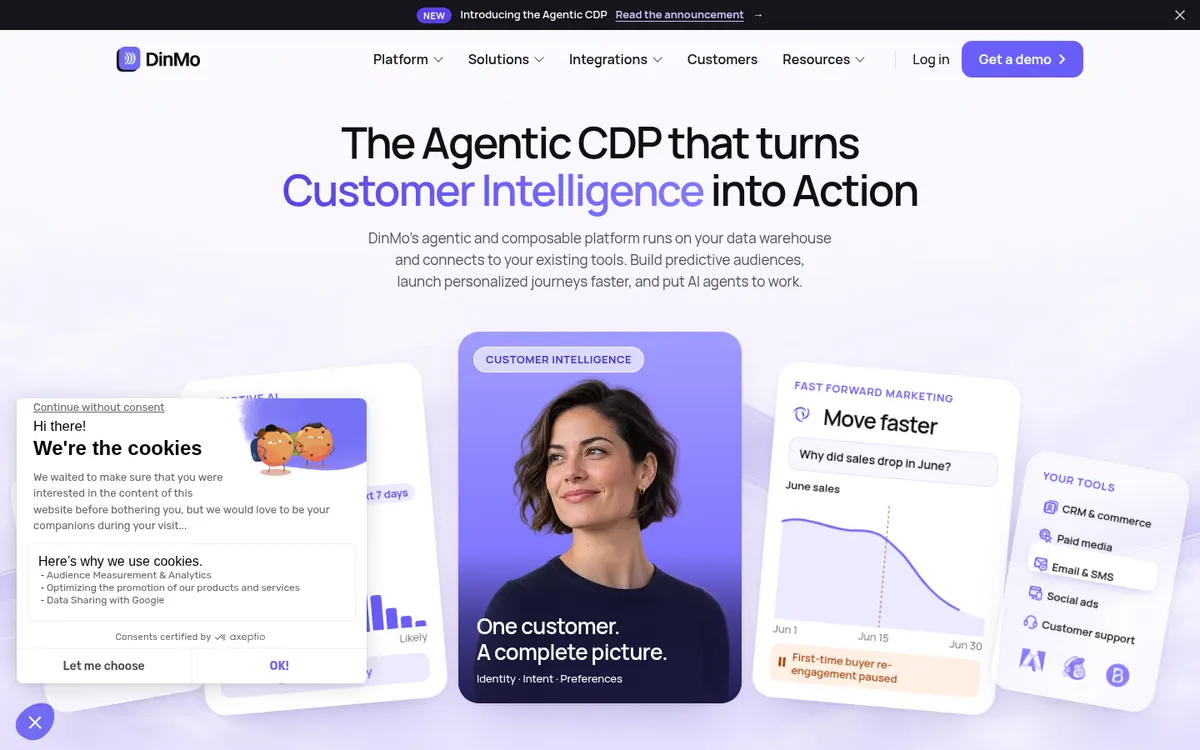
DinMo is aimed at marketers rather than engineers. It offers no-code audience creation on top of warehouse data, native Snowflake, BigQuery, and Redshift connections, modular feature selection, and campaign personalization built from warehouse tables. Initial use cases go live quickly because setup leans on connections you already have rather than a new collection layer with new tracking to design.
Pricing is modular and custom quoted. The pricing URL resolved to a demo booking page with no published figures, so every budget conversation starts with sales and no list price exists to check. Modular feature selection is the useful part of that: you can scope activation without buying collection you do not need. A custom quote still means a negotiation, and negotiations need a comparison point.
The trade against Hightouch is maturity. DinMo is newer to the market than Hightouch, so edge cases may take longer to resolve. Ask for two references running the same warehouse as yours. What it wins on is interface. Marketers can build and adjust audiences themselves instead of filing a ticket for every segment change, which is the difference between a warehouse that gets used and one that gets admired.
Pick it if your marketing team wants to activate warehouse data without writing SQL and you already run Snowflake, BigQuery, or Redshift. Skip it if you need the largest connector catalog, or if you have no warehouse to sit on top of. Run one campaign end to end in a pilot before you commit to an annual term, because setup speed is the claim you are buying.
What works
- No-code audience building for marketers
- Native Snowflake, BigQuery, and Redshift connections
- Modular feature selection
What to weigh
- Custom quoted pricing only
- Newer vendor with a thinner connector catalog
- Requires an existing warehouse
Pick it if
Your marketers want to build and activate warehouse audiences without SQL and your warehouse already runs Snowflake, BigQuery, or Redshift.
Skip it if
You need the broadest connector catalog or have no warehouse in place.
Plate 06 of 08
Jitsu
Best for developer teams wanting open-source event collection
Our verdict
The cheapest honest way to run event collection yourself, provided you have engineers who will own the infrastructure.
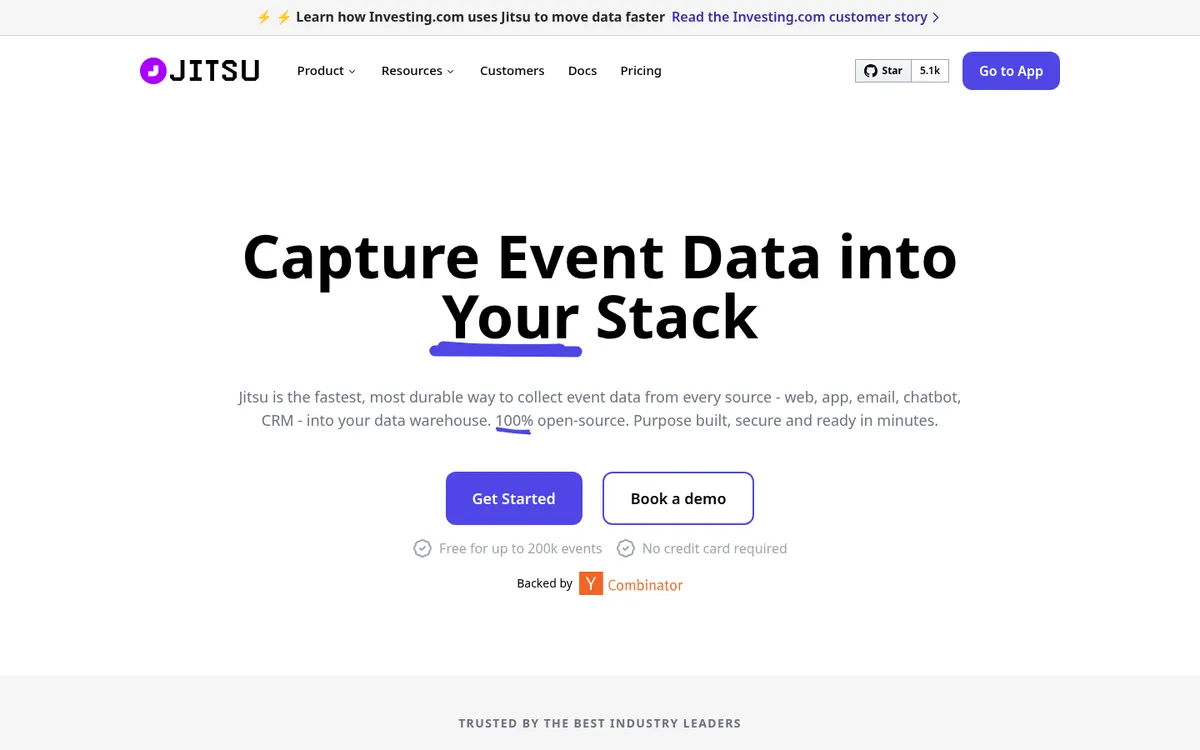
Jitsu is the open-source route. It handles event collection from websites, apps, and SaaS tools, routes events into warehouses and destinations, and can be self-hosted so data stays in your own infrastructure. There are no per-event vendor fees, and the open-source license means no vendor lock-in at the collection layer, which is the layer where lock-in is hardest to undo. It is also the easiest tool here to test without a sales call, because the free plan and the source are both public.
This is the only tool on the list with a published paid tier. The free plan includes 200,000 active events per month, and the Business plan is $99 per month. A trial is available. Self-hosted and open-source use carry no license fee at all, which makes it the cheapest way to get a working pipeline if you have engineering time to spend instead of budget.
That is the catch. Running it needs engineering: upgrades, monitoring, and schema changes are yours, and the destination catalog is smaller than Segment's 700-plus, so some tools will need custom work or a webhook. The community is smaller too, which matters most at 2am when a pipeline fails and the forum thread is two years old. Budget the engineering hours before you count the savings.
Pick it if you are a developer team that wants open-source event collection, a self-host option, and low per-event cost. Skip it if nobody wants to own infrastructure, or if you need a long list of prebuilt destinations and a support contract behind them. For a small team with a competent platform engineer it is the best value here; for a team without one it is a second job.
What works
- Free and open source with a self-host option
- Published pricing: free tier then $99 per month
- No per-event vendor fees or lock-in
What to weigh
- Requires engineering to run and maintain
- Fewer destinations than Segment
- Smaller community for troubleshooting
Pick it if
You have engineers who will own the pipeline and you want open-source collection with a published paid tier.
Skip it if
Nobody on the team wants to run infrastructure or you need a large prebuilt destination catalog.
Plate 07 of 08
Snowplow
Best for teams needing deep, controlled behavioral event data
Our verdict
The deepest control over behavioral event data, bought with real implementation work and ongoing operational ownership.
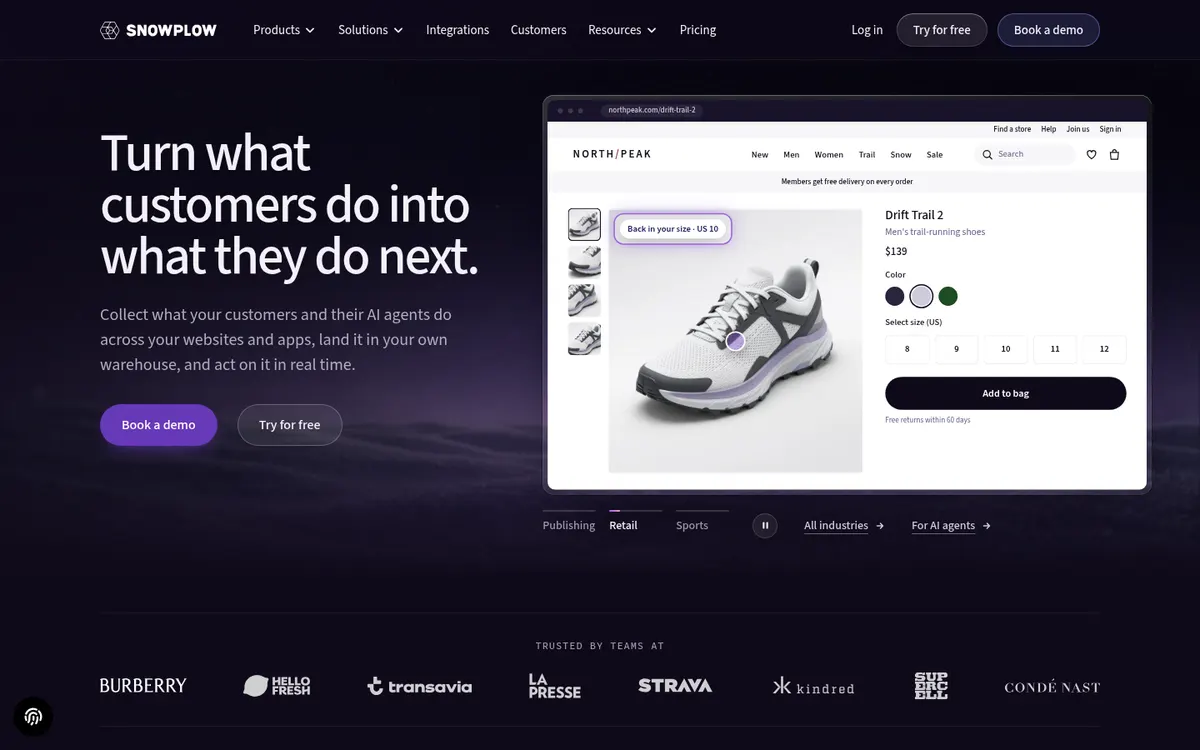
Snowplow is for teams that treat behavioral data as an asset. It provides open-source behavioral data collection, structured event schemas, data quality modeling, and a warehouse-first pipeline, with full control over event definitions. You decide what an event means and how it is validated, and the output lands in your warehouse for whatever activation tool you choose. That separation is the design, not a limitation.
Pricing is quoted for both managed deployment options, and no figure is published. Managed options are quoted, so the two numbers you compare are a vendor quote and your own infrastructure estimate. A 14-day free trial is offered with no credit card, and there is a free Signals tier covering up to 5 million events per month, which is enough to validate a pipeline on real traffic before you talk to sales. Open-source use is free, with implementation and operations handled in house.
The honest cost is engineering. Implementation is heavier than a packaged CDP: schemas, tracking design, and validation all need owners, and ongoing operational overhead continues after launch. That is the trade for richer behavioral event data and schema control that packaged tools rarely give you. Teams that skip the schema work end up with a warehouse full of events nobody can query.
Pick it if you need deep, controlled behavioral event data and have data engineering to build and run the pipeline. Skip it if you want a working CDP in a week, or if nobody can own schemas, validation, and infrastructure. It pairs well with a separate activation tool. Budget a quarter of engineering before the first clean event lands.
What works
- Structured schemas and data quality modeling
- Free Signals tier up to 5M events per month
- Full control over event definitions
What to weigh
- Heavy implementation and ongoing overhead
- Needs data engineering to run
- Managed options are quote only
Pick it if
You need precise, schema-controlled behavioral event data and have data engineers to own the pipeline.
Skip it if
You need a packaged CDP running in a week or have no one to own schemas and operations.
Plate 08 of 08
BlueConic
Best for marketer-led B2C teams wanting no-code first-party data
Our verdict
Gives marketers direct control of first-party data without tickets, at an enterprise price and with less developer depth.
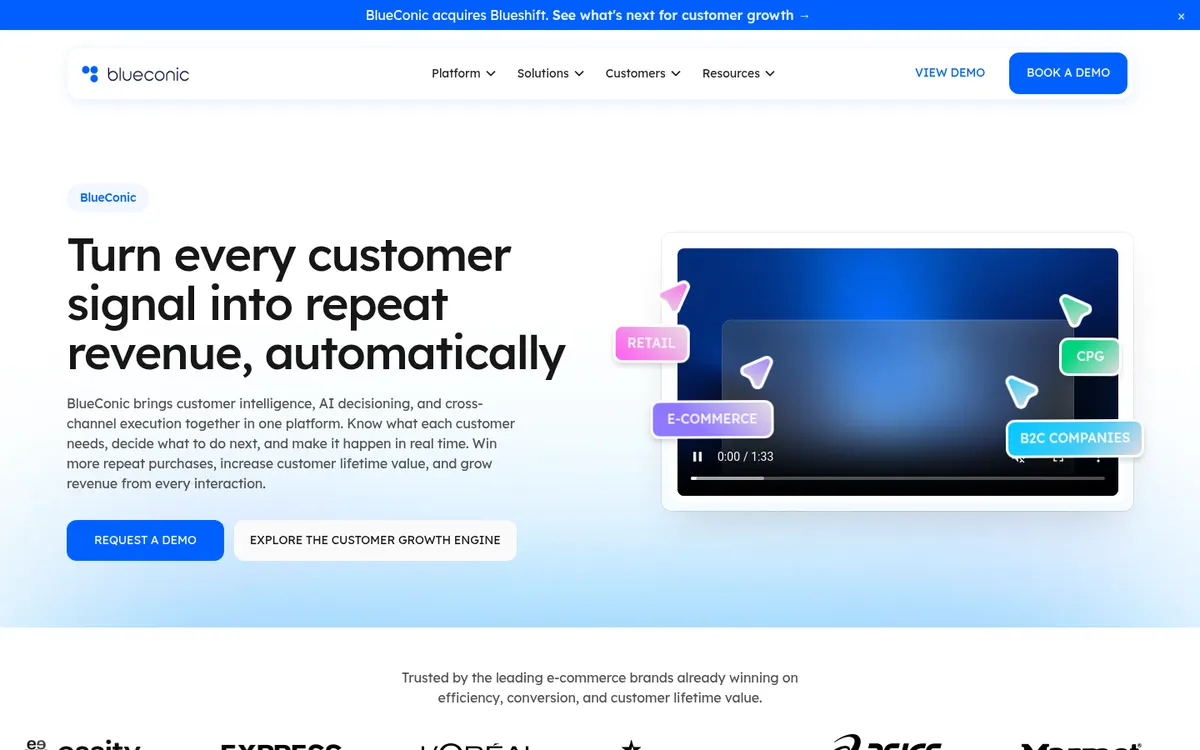
BlueConic is built for marketers. No-code Listeners collect first-party data, unified customer profiles pull interactions together, and segmentation and audience activation happen in the same interface without engineering tickets. B2C brands are the target, and the product is designed so a marketing team can run it after implementation rather than handing every change to a developer. Trial access exists, so the evaluation can start before procurement does.
Pricing is quote based. The contact page directs every pricing request to a sales form and no figure is published, so there is nothing to check against a budget line until you are in a conversation. Pricing is enterprise-oriented and quote-based. Two quotes at different volumes will tell you how the model scales.
The weakness is developer depth. If your team wants SQL-level control, custom event schemas, or warehouse-native modeling, BlueConic will feel like a layer between you and the data, and a well-meant one at that. Ask whether the trial includes activation or only collection. Enterprise focus also means a heavier sales process than signing up for a warehouse tool, plus a trial that still ends in a quote.
Pick it if you are a marketer-led B2C team that wants no-code first-party data collection, unified profiles, and segmentation without waiting on engineering. Skip it if you are developer-led, need warehouse-native activation, or cannot support a six-figure annual commitment. The test is whether your marketing team will actually own the tool after launch.
What works
- No-code Listeners for first-party data
- Marketer-led segmentation and activation
- Built for B2C marketing use cases
What to weigh
- Quote-based pricing, with no published figure
- Enterprise focus and heavy sales process
- Less developer depth than composable tools
Pick it if
You are a marketer-led B2C team that wants to collect and segment first-party data without engineering tickets.
Skip it if
You are developer-led, need warehouse-native modeling, or cannot support an enterprise annual commitment.
What is a customer data platform, and when does one earn its price?
A customer data platform collects customer events and profile data from your websites, apps, and backend systems, resolves them into one identity per person, and pushes the result into the tools that send emails, ads, and in-product messages. That is the whole job: collect, unify, activate. Everything else in a CDP pitch is a variation on those three steps.
The market splits into three shapes, and the shape matters more than the feature list.
- Packaged CDPs (Segment, Tealium, mParticle, BlueConic) bring their own collection layer, their own profile store, and a large destination catalog. You pay for the package and accept that customer data lives in the vendor's system as well as yours.
- Composable or warehouse-native tools (Hightouch, DinMo) skip the collection layer and the profile store. They read the warehouse you already have and sync audiences out of it. Cheaper per record, but only if the warehouse is already clean.
- Open-source collectors (Jitsu, Snowplow) give you the pipeline and leave the running of it to you. No license fee, real engineering cost.
RudderStack sits in the open-source-leaning collector camp, which is why people shopping for alternatives are usually deciding between a packaged CDP and a warehouse-native approach rather than between two identical products.
The decision usually comes down to where your customer data already lives and who operates the tool. If a marketing team owns the roadmap and there is no warehouse to speak of, a packaged CDP is the shorter path. If a data team already models customers in Snowflake or BigQuery, paying twice for collection and storage is hard to justify. If engineering is strong and budget is thin, an open-source collector plus a warehouse is viable.
One caution: identity resolution is the part that is hardest to replace later. Destination counts change with a connector release; the profile logic you build inside a CDP is the thing you have to migrate.
This guide sits in the Software collection. Buyers weighing nearby tools often read the guides to commission software and research platforms next.
How customer data platforms bill: tracked users, events, or a signed quote
Most CDP pricing is not published, and the models differ enough that two quotes are rarely comparable line by line. Four billing models cover everything on this list.
| Model | How it bills | Typical fit | Example from this list |
|---|---|---|---|
| Monthly tracked users | Charges per user identified in a month, so cost follows audience size | Consumer businesses with large known audiences | Segment |
| Event volume tiers | Charges per event with a free allowance, then a paid tier | Product teams with high or spiky event volume | Jitsu |
| Custom annual quote | Priced per contract after a demo, usually on volume plus modules | Enterprises with governance and compliance needs | Tealium, mParticle, BlueConic |
| Open source plus self-hosting | No license fee; you pay in engineering and infrastructure | Teams with platform engineers | Jitsu, Snowplow |
Monthly tracked user billing looks cheap in year one and expensive in year three, because it scales with success. Event tier billing is friendlier to teams whose audience is small but whose instrumentation is heavy. Quote-based contracts hide the number until late in the process, which is why the pricing conversations in this list matter: they tell you whether you are in a smaller or larger annual contract before you book a demo.
Three practical checks before you compare anything. First, ask what counts as a tracked user or an event, since identity resolution can inflate both. Second, ask for the price at two and three times current volume, because the first tier is not the price you will pay. Third, separate collection from activation: several vendors here will sell you one without the other, and the modular pricing that DinMo uses is the exception rather than the rule.
For tools marked "See website" in this list, pricing is on the vendor site or behind a sales form. We did not guess a figure.
Every price in this guide was read on the vendor's own pricing page on November 25, 2026. Where a vendor does not publish a figure we could confirm, the card says "See website" rather than a guess. For the arithmetic around this purchase, try the free Email campaign metrics calculator.
From warehouse audit to signed contract: a six-step decision path
- Audit the warehouse first. Confirm whether customer data already sits in Snowflake, BigQuery, or Redshift in a modeled, trusted state. If it does, warehouse-native tools belong on your shortlist. If it does not, a packaged CDP that collects and stores profiles is faster.
- Name the operator. Decide whether a marketing team or a data team will run the tool day to day. That single answer removes half the list: BlueConic and DinMo assume marketers, while Jitsu and Snowplow assume engineers.
- Set a volume model. Take your current event and tracked user counts, then triple them. Ask every vendor for pricing at that level, not at today's number, because first tiers are designed to look cheap.
- Test identity resolution. Ask each vendor to walk through how it merges an anonymous visitor, a logged-in user, and a purchase on a different device. This is the logic that is hardest to migrate later.
- Run a paid pilot on one use case. Pick a single audience or sync, run it end to end, and measure time to first activation. A demo shows the interface; a pilot shows the data quality work you will actually inherit.
- Price the exit before you sign. Ask what happens to your profiles and event history if you leave, and how long exports take. A two-year contract on a tool you cannot exit is a data ownership problem, not a discount.
Five mistakes that turn a CDP purchase into a cleanup project
- Buying collection you already own. Teams that already run a warehouse often buy a full CDP and pay twice for storage and identity. Check whether reverse ETL from Hightouch or DinMo covers the activation need before you buy a packaged platform.
- Budgeting at the first tier. Prices quoted at current volume rarely survive a growth year. Segment's tracked user model and quote-based enterprise contracts both climb with usage, so model the bill at three times current volume.
- Choosing on connector count alone. A 700-plus or 1,300-plus catalog is only useful if the destinations you need are in it and maintained. List your ten must-have destinations and verify each one before comparing totals.
- Skipping the identity design. Identity resolution is the part you cannot swap out later. Teams that leave it to implementation time end up with duplicate profiles and audiences that fire twice, then rebuild under pressure.
- Assuming the marketing team can run it. No-code interfaces still need someone to own schemas, consent categories, and QA. A tool that fits marketers on paper needs an owner with time, or it becomes another unused subscription.
RudderStack Alternatives: questions
What does RudderStack cost, and what do its plans include?
We did not verify RudderStack's current pricing for this edition, so check the vendor's own pricing page before you budget against it. What we can tell you is what the alternatives here cost. Segment, Tealium, mParticle, Hightouch, DinMo, Snowplow, and BlueConic all show no published figure or quote-based pricing, while Jitsu publishes a free tier of 200,000 active events per month and a $99 per month Business plan.
Which options on this list are free or open source?
Three entries have a free route. Segment offers a free tier capped at 1,000 visitors and 2 sources. Jitsu is open source and self-hostable, with a free plan covering 200,000 active events per month and a $99 per month Business plan. Snowplow is open source and also offers a free Signals tier up to 5 million events per month, plus a 14-day trial with no credit card.
How does a packaged CDP differ from reverse ETL and warehouse-native tools?
A packaged CDP collects events itself, stores its own customer profiles, and ships a large destination catalog. Reverse ETL and warehouse-native tools skip collection and the profile store: Hightouch and DinMo read the warehouse you already have and sync audiences out of it. Packaged CDPs suit teams without a clean warehouse, while warehouse-native tools suit teams that already model customers there.
When does a small ecommerce store need a CDP?
Usually later than vendors suggest. A small store with one storefront, one email tool, and a few thousand customers can run on its platform analytics and email data. A CDP starts earning its price when you have several touchpoints, a warehouse with order data, and audiences that must sync to more than one ad or messaging tool. Before that, the bill outweighs the gain.
How should a CDP migration be handled?
Run it in parallel, not as a switch. Stand up the new tool, replay a defined window of events, and compare profile counts and audience sizes against the old system before cutting over. Document identity rules and event definitions first, because those are what break in migration. Keep exports from the old tool until two full billing cycles pass and audiences match.
What should you check before signing an annual customer data contract?
Check three things: the price at three times your current volume, the export path for profiles and event history, and what counts as a tracked user or billable event. Then ask which modules are included and which are add-ons, since activation, tag management, and support are often priced separately. Get the exit terms in writing before you negotiate the discount.