
Contents of this guide
The shortlist
Our top 3 for software buyers
DFIN ActiveDisclosure
Excel-based SEC filing
- Best for
- Public companies filing SEC reports in Excel
- Features
- 4 noted: EDGAR submission, 10-K and 10-Q, Disclosure controls, Excel interface

Toppan Merrill
Software plus services
- Best for
- Teams that want filing software plus managed services
- Features
- 4 noted: Managed services, Proxy statements, Filing lifecycle, Document production

Certent Disclosure Management
Equity data linkage
- Best for
- Filers whose SEC and proxy work centres on equity data
- Features
- 4 noted: Proxy prep, Equity plans, Disclosure controls, Consistency checks
Disclosure for this guide. All 8 tools here are unpaid editorial picks. The position of a paid listing can be part of what the vendor pays for. Paid and unpaid tools are scored on the same rubric and keep their cons. Details are in the advertising disclosure.
The ledger
Index of every tool
| Tool | Free plan | Trial | Rubric | Compare | ||
|---|---|---|---|---|---|---|
| 01 | DFIN ActiveDisclosurePublic companies filing SEC reports in Excel | See websiteCustom quote only, no published list priceNot published | No | No | ||
| 02 | Toppan MerrillTeams that want filing software plus managed services | See websiteCustom quote, managed services billed on top of softwareNot published | No | No | ||
| 03 | Certent Disclosure ManagementFilers whose SEC and proxy work centres on equity data | See websiteCustom quote onlyNot published | No | No | ||
| 04 |  FloQastMid-market accounting teams running the monthly close | See websiteCustom packages, third-party purchase data puts the median buyer near $24,500 a year, with contracts roughly $10,000 to $69,000Not published | No | No | ||
| 05 |  BlackLineLarge enterprises with complex, high-volume close controls | See websiteFully custom enterprise quotes, mid-size deployments reported near $100,000 a year and large enterprises $300,000 to $1 million plusNot published | No | No | ||
| 06 |  OneStreamMulti-entity groups consolidating close, planning and reporting | See websiteQuote-only enterprise pricingNot published | No | No | ||
| 07 |  VenaExcel-native finance teams wanting governance and workflow | See websiteQuote-only pricingNot published | No | No | ||
| 08 |  PlanfulMid-market teams linking close work with FP&A cycles | See websiteQuote-only pricingNot published | No | No |
Prices are the lowest paid plan the vendor shows, read on November 25, 2026. Sort by price ranks published monthly figures; tools without one go last. Pin up to three tools to compare them side by side.
How this guide was put together
Every tool here was assessed against the same five criteria: SEC reporting depth, close and reconciliation capability, pricing clarity, implementation lift and mid-market fit. SEC reporting depth asks whether a platform can produce and file a 10-K or 10-Q, not whether it exports a PDF. Close and reconciliation looks at checklists, matching, sign-offs and entity coverage. Pricing clarity scores how much a buyer can learn before a sales call. Implementation lift rewards tools a finance team can adopt without a multi-month project. Mid-market fit asks whether the product and price band suit a mid-market finance team.
Prices and plan details come from vendor pricing pages checked on November 25, 2026. Where a page was unavailable or returned no pricing text, that is noted in the entry and the price is shown as See website rather than estimated. Several vendors in this category publish nothing at all, so entries that lack a published price say so and point to the vendor site.
The order is editorial. Each position reflects how well the tool fits the buyer described in that entry, not a weighted total of the scores. No vendor holds a Featured position in this November 2026 list. When one does, that position is a paid placement, and the vendor is scored with the same rubric as every other entry, cons included.
Capability claims come from vendor feature descriptions. Limitations come from the same material where a vendor discloses them, and from the documented gaps between what a reporting tool and a close tool each do.
The full process, including how we handle corrections, is on the methodology page. Paid listings follow the advertising disclosure.
Rubric and weights
Every tool below is scored from 1 to 10 on these five criteria. The scores describe each tool; the order is an editorial call on fit for the buyer each card describes, plus the disclosed Featured position.
- 25%SEC reporting depthWhether the tool can produce and file a 10-K, 10-Q or proxy statement, not just hold the numbers.
- 25%Close and reconciliationDepth of checklists, reconciliations, transaction matching and sign-off for the period end.
- 20%Pricing clarityHow much a buyer can learn about cost before a sales call, from published pricing or the vendor's pricing information.
- 15%Implementation liftHow much effort and elapsed time a finance team needs to get live, scored so lighter lift earns a higher mark.
- 15%Mid-market fitWhether the product and its price band suit a mid-market finance team.
Plate 01 of 08
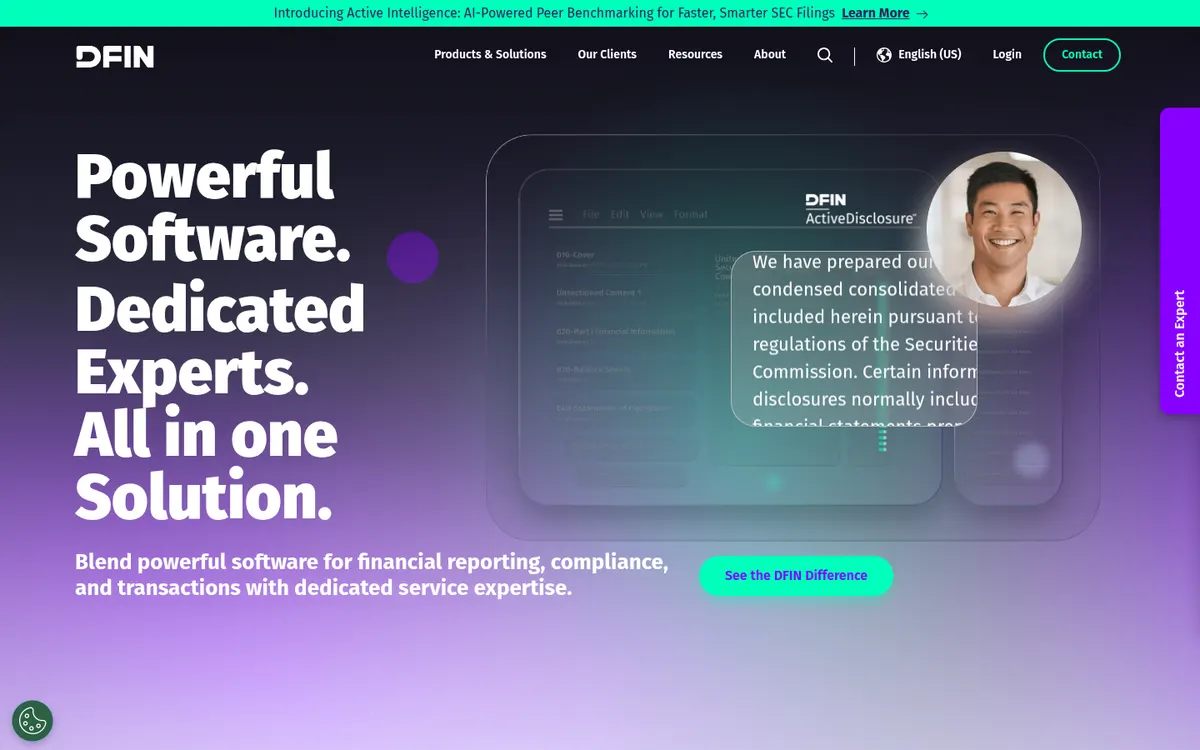
DFIN ActiveDisclosure
Best for public companies filing SEC reports in Excel
Our verdict
The pick for public companies whose 10-K and 10-Q work starts in Excel and ends at EDGAR, priced only by quote.
DFIN ActiveDisclosure is the SEC reporting pick on this list for finance teams that already build their 10-K and 10-Q in Excel. Preparation happens in a spreadsheet interface staff already know, and the platform carries the filing through to EDGAR submission, so the working document and the submitted document stay in one system.
The feature set is aimed at reporting cycles rather than at the monthly close. You get disclosure controls and review steps, filing document management, and workflow tracking that carries across reporting periods. For a team in the middle of filing season, that structure is the point: reviewers see the same document, in the same version, with a review trail behind each change. That matters when several people touch the same table in the same week.
The limits are worth stating plainly. ActiveDisclosure is built around filings, so reconciliations, task lists and close checklists need a separate tool, and the notes position it as a direct SEC reporting substitute rather than a close-to-report suite. There is no published price, no free plan and no trial listed; you request a quote and the number depends on scope. Implementation effort varies with that scope, so a small filer and a large multinational will have very different first-year experiences.
Pick it if your filings start life in Excel and you want EDGAR submission in the same place. Budget separately for a close management tool if reconciliations and period-end task tracking also need a home, and price the two purchases together rather than treating reporting as the whole project.
What works
- Familiar Excel interface shortens the learning curve
- Native EDGAR filing support in the same system
- Built around 10-K and 10-Q workflows
What to weigh
- No published pricing, quotes only
- Reporting-focused, so close work needs another tool
- Implementation effort varies with scope
Pick it if
Your 10-K and 10-Q drafts start in Excel and you want EDGAR submission handled in the same system.
Skip it if
You also need reconciliations and close checklists, which require a separate close tool.
Plate 02 of 08
Toppan Merrill
Best for teams that want filing software plus managed services
Our verdict
Filing software with a service team attached, best for small finance departments that want a partner during filing season.
Toppan Merrill sells filing software with a service team attached. That combination is the reason it ranks here: for a small finance department facing a proxy statement or an unusual submission, the deliverable is not just a tool but someone who has run that kind of filing before.
The software covers the filing lifecycle and document production for public companies, with support for proxy statements and other regulatory documents. Where scope gets complicated, the service team steps in and handles part of the submission. That matters most in the weeks before a deadline, when internal reviewers are already stretched and the cost of a missed step is high.
There is a trade-off in that model. Managed services are billed on top of the software, so total spend depends on how much production work you hand over, and the more you hand over, the less your team learns to run in house. Self-service depth is lower than a pure software platform, which is fine if you want a partner and frustrating if you want control of every step. No price is published, there is no free plan, and no trial is listed; everything starts with a scoping conversation.
Pick it if your team is small, the filing calendar is demanding, and you would rather buy expertise than build it. Companies with an experienced reporting group and a strong internal process may find a pure software platform cheaper and more flexible over several filing cycles.
What works
- Combines software with people who handle part of the submission
- Full-service support for complex or unusual filings
- Long history serving public company filers
What to weigh
- No published pricing
- Managed services increase total cost beyond the license
- Less self-service than a pure software platform
Pick it if
Your reporting team is small and you want experienced people alongside the software during filing season.
Skip it if
You want full self-service control and prefer to run every submission in house.
Plate 03 of 08
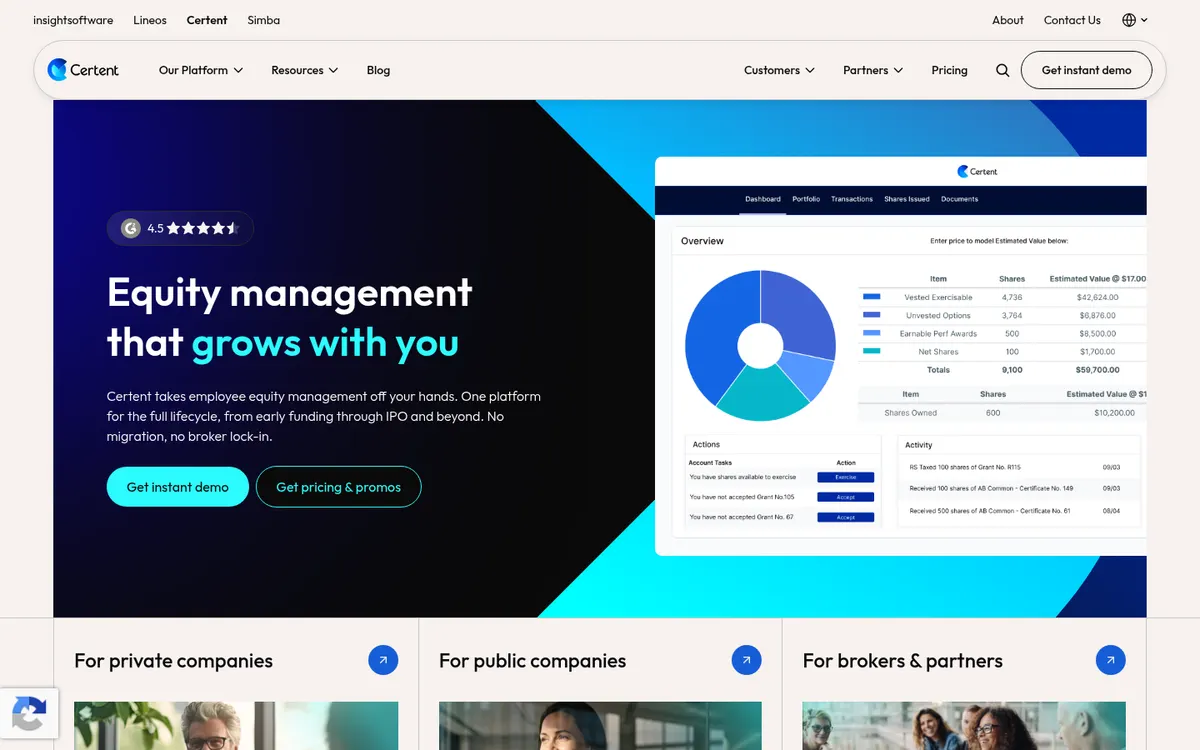
Certent Disclosure Management
Best for filers whose SEC and proxy work centres on equity data
Our verdict
A reporting specialist that ties SEC and proxy work to equity plan records, with narrower scope than a full platform.
Certent Disclosure Management is the specialist option for filers whose SEC and proxy work runs through equity data. Report production, proxy statement preparation and disclosure workflow sit alongside a link into equity plan and stock compensation records.
The platform handles consistency checks across reporting periods and supports option grant and share-based disclosures. Where a company has a large equity program, that linkage removes the manual step of copying grant tables into a document and hoping the version is current. Disclosure controls keep filings comparable from one period to the next, which is the part reviewers value most.
Scope is narrower than a connected SEC, ESG and audit platform. Teams that also need ESG reporting or board reporting will be buying additional tools, and the equity-heavy focus will not suit every filer, particularly companies with modest share-based compensation. Certent is now part of insightsoftware following acquisition, so buyers should confirm roadmap and support arrangements during evaluation rather than assuming continuity.
Pricing is quote-only with no published list price, no free plan and no trial. Ask for the scope assumptions behind the quote, and confirm that proxy and 10-K production are both included in the scope you are quoted.
What works
- Ties SEC and proxy reporting directly to equity plan records
- Disclosure controls keep filings consistent period to period
- Well matched to companies with large equity programs
What to weigh
- No published pricing
- Narrower scope than a connected SEC, ESG and audit platform
- Equity-heavy focus may not fit every filer
Pick it if
Equity compensation drives your proxy and share-based disclosures and you want them tied to plan records.
Skip it if
You need one platform covering SEC, ESG and audit reporting.
Plate 04 of 08
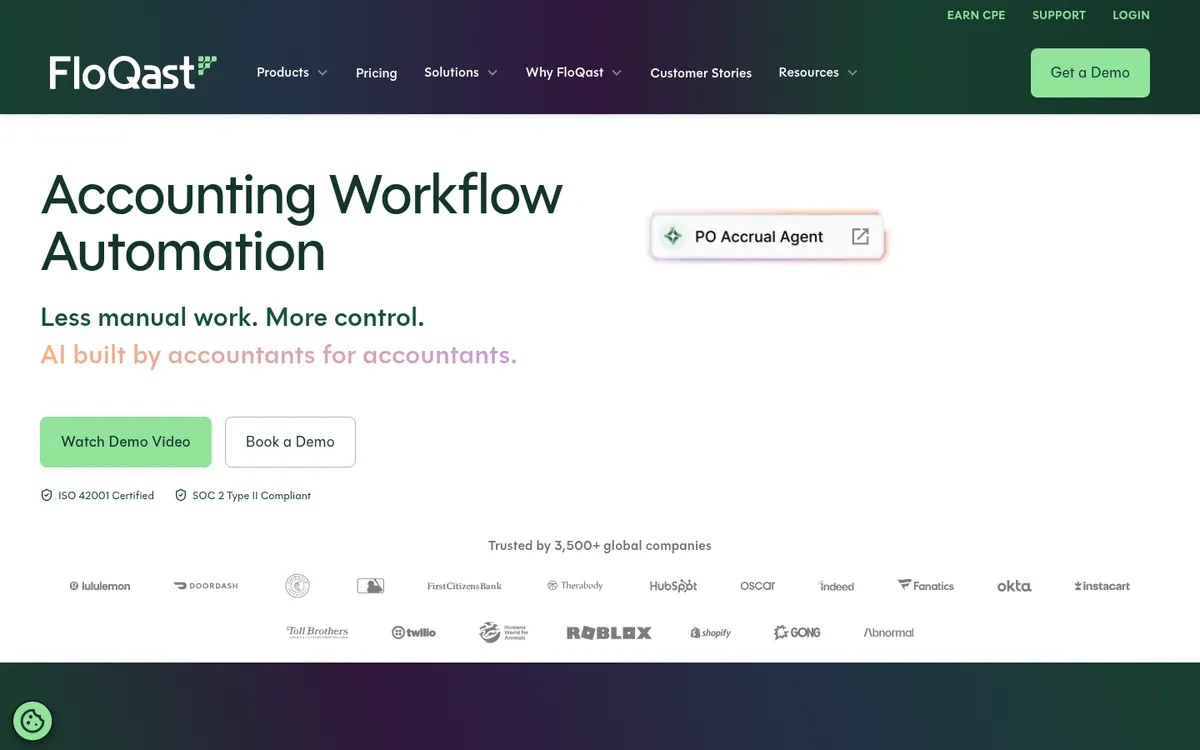
FloQast
Best for mid-market accounting teams running the monthly close
Our verdict
Built by accountants for the monthly close, with AutoRec matching and no per-user fees; check ERP refresh times before signing.
FloQast is the close management tool on this list, built by accountants for the monthly close rather than for filing. Checklists and task lists, reconciliations, review and sign-off workflows, and a reporting module cover the recurring period-end work that mid-market accounting teams handle.
AutoRec is the feature that separates it from a spreadsheet-based close: transaction-level matching on high-volume accounts, which is where reconciliation time disappears. ERP integration pulls balances in, and there are no per-user licensing fees, so adding a controller, a staff accountant or an auditor seat does not change the bill. Compliance and connected compliance modules are priced separately from the core package, which is worth noting before you compare quotes.
Pricing is not published and is quote-only, so expect a scoping call before you see a number.
Two limits matter. ERP data refresh timing should be tested against your close calendar. And SEC and ESG reporting depth is thinner than a dedicated reporting platform, so public filers still need a reporting tool sitting alongside it.
What works
- Built by accountants specifically for close management
- No per-user fees, so cost does not scale with headcount
- AutoRec automates matching on high-volume accounts
What to weigh
- No published pricing and custom package structure
- Reporting and compliance modules priced separately
- ERP data refresh timing should be tested against your close calendar
Pick it if
The monthly close is the bottleneck and you want reconciliations, checklists and sign-offs in one place.
Skip it if
You need to produce and file SEC reports from the same system.
Plate 05 of 08
BlackLine
Best for large enterprises with complex, high-volume close controls
Our verdict
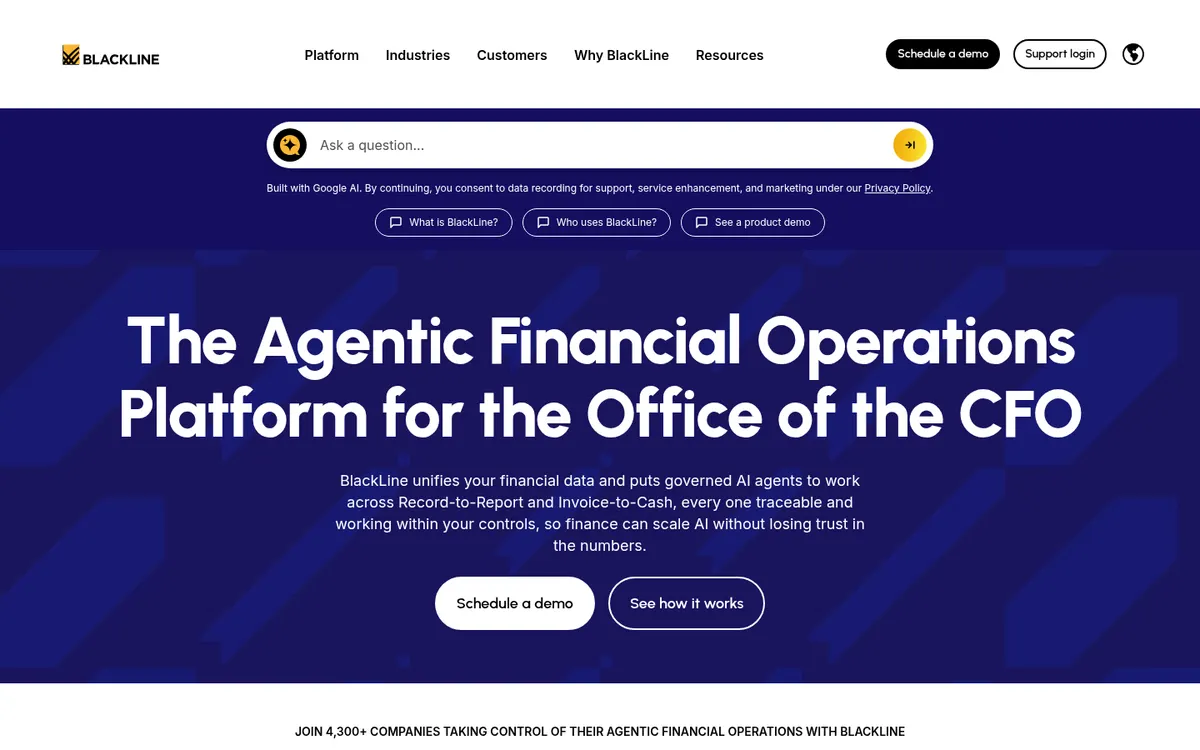
The deepest reconciliation engine here, aimed at multinationals and priced for them, with partner implementation on top of license.
BlackLine is the heaviest reconciliation engine here, and it is priced and built accordingly. High-volume account reconciliation, intercompany reconciliation and matching, transaction matching, and financial controls with audit trails are the core. It is designed for organizations running many legal entities and large transaction volumes every period, not for a single-entity team closing a simple set of books.
Regional coverage is a real differentiator: the platform covers 50 plus country-specific close requirements, which matters to multinationals closing statutory books in several jurisdictions at once. Task and close checklist management sit on top of the reconciliation work, so the period-end calendar and the matching run in the same system.
This is not a mid-market purchase. Pricing is quote-only. Partner-led implementation runs roughly $75,000 to $250,000 plus, and the platform expects dedicated administrators, which is a staffing cost as well as a software one. Total cost of ownership therefore includes license, partner implementation and administrative headcount, and the business case has to survive all three.
Pick it if you are a financial services firm or multinational with complex entity structures and the team to run it. Skip it if you are a mid-market accounting department that needs tasks and reconciliations done quickly without a partner project attached.
What works
- Deepest reconciliation engine among the tools compared
- Handles high transaction volumes and complex entity structures
- Statutory close coverage across 50 plus countries
What to weigh
- Quote-only premium pricing, with mid-size deployments near $100,000 a year
- Expects dedicated administrators
- Partner-led implementation runs roughly $75,000 to $250,000 plus
Pick it if
You reconcile high transaction volumes across many entities and have administrators to run the platform.
Skip it if
You are a mid-market team without budget for partner implementation and a dedicated admin.
Plate 06 of 08
OneStream
Best for multi-entity groups consolidating close, planning and reporting
Our verdict
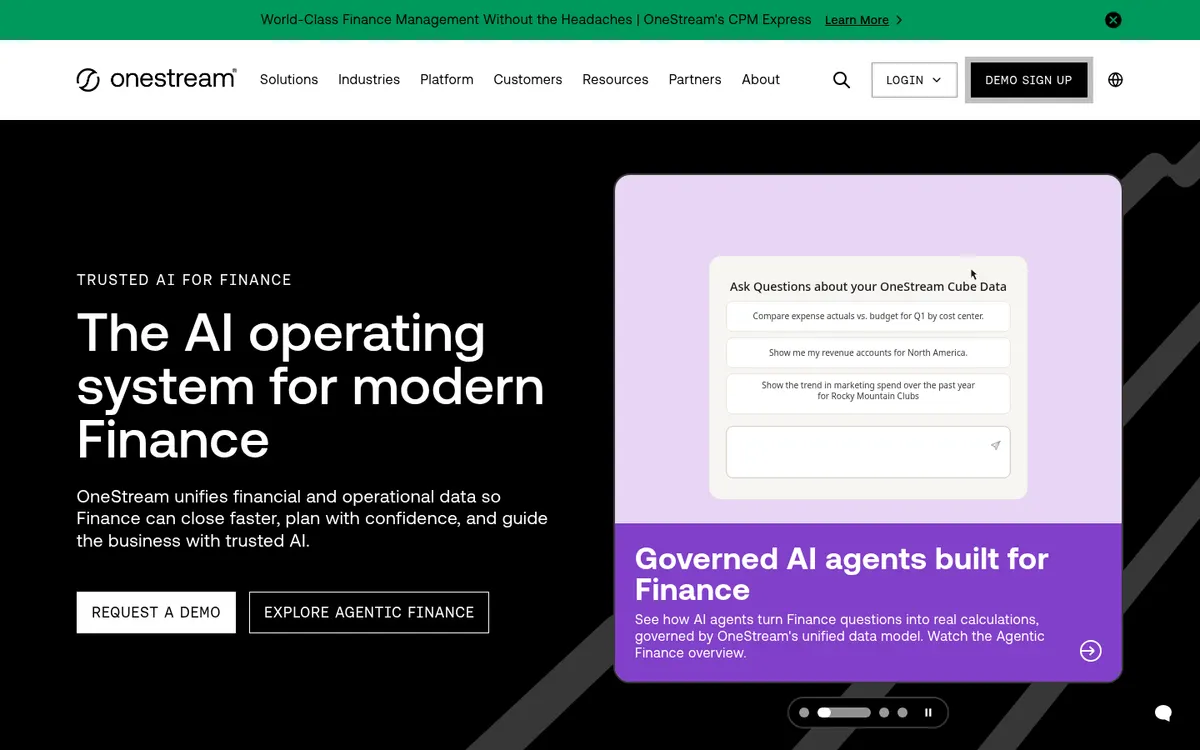
A consolidation-first CPM platform that replaces several systems for multi-entity groups, at the cost of a multi-month project.
OneStream is a consolidation-first CPM platform, in contrast to the reporting-first tools at the top of this list. Financial consolidation, close management, planning and budgeting, and management and financial reporting sit on one shared model, so the group does not reconcile a close system against a separate consolidation system against a separate reporting layer.
For complex multi-entity groups, that single version of financial data is the argument. Consolidation and reporting draw from the same place, and the platform replaces several tools rather than adding one. Teams that spend time each month reconciling separate systems recognize the problem it is solving.
The cost of that approach is time and money. Pricing is quote-only enterprise pricing with nothing published, and implementation is a multi-month project rather than a switch-on. Buyers should plan for a multi-month project that includes design, build and parallel running, and for internal staff time alongside the vendor's team. Budget owners who expect a quick rollout may be disappointed.
It is also excessive for single-entity companies. If you file one set of books and close once a month, the consolidation and modeling machinery is more than the job needs, and a dedicated close tool will be faster to deploy and easier to justify.
What works
- Replaces separate close, consolidation and reporting tools with one platform
- Removes reconciliation between disconnected systems
- Strong fit for complex multi-entity groups
What to weigh
- Quote-only enterprise pricing
- Implementation is a multi-month project
- Excessive for single-entity companies
Pick it if
You are consolidating multiple entities and want close, planning and reporting on one shared model.
Skip it if
You are a single entity with a straightforward monthly close.
Plate 07 of 08
Vena
Best for excel-native finance teams wanting governance and workflow
Our verdict
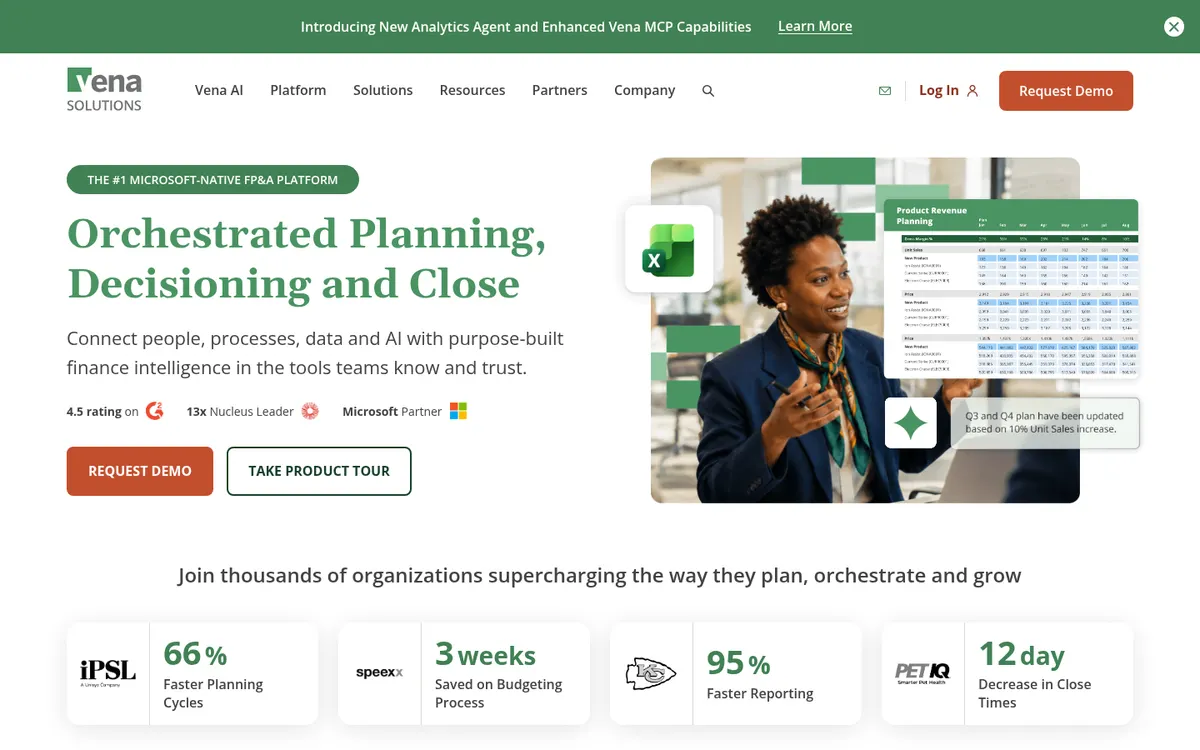
Excel with guardrails: version control, approvals and integration around existing workbooks, plus close and planning on one model.
Vena keeps Excel as the front end and adds control around it. Existing formulas and formatting survive, so the finance team does not relearn how to build a model, while version control, approval workflows and data integration with source systems sit underneath so the workbook stops being an unmanaged file on a shared drive.
The platform combines close management with planning and budgeting, and reports against a governed model. That combination fits teams that close and reforecast in the same cycle, where the actuals feeding the forecast come straight out of the close. Data integration with source systems reduces the copying and pasting that can sit between the two, and approvals give reviewers a record of who changed what.
Excel dependence is the honest limit. Some workflows that a purpose-built interface handles more cleanly will still feel like spreadsheet work, and SEC reporting capability is narrower than a dedicated reporting platform, so public companies with heavy filing obligations will need a reporting tool as well. Pricing is quote-only, with no free plan and no trial listed, so the first real number arrives after a scoping conversation.
Pick it if your team lives in Excel and wants governance without a rebuild. Skip it if you need deep SEC filing production or want finance users off spreadsheets entirely, since both of those goals point at different products.
What works
- Keeps existing Excel formulas and formatting while adding control
- Familiar interface reduces retraining
- Combines close and planning in one platform
What to weigh
- Quote-only pricing
- Excel dependence limits some workflows
- SEC reporting capability narrower than a dedicated reporting platform
Pick it if
Your models already live in Excel and you want approvals, version control and integration without a rebuild.
Skip it if
You need heavy SEC filing production or want finance users off spreadsheets.
Plate 08 of 08
Planful
Best for mid-market teams linking close work with FP&A cycles

Our verdict
Close tasks and reconciliations sitting next to FP&A, a good fit when one small team runs both cycles.
Planful puts close task management and reconciliations next to financial planning and analysis, so actuals and forecasts live on one model. For a mid-market team that currently maintains a close tool and a separate planning tool with a spreadsheet bridge between them, the pitch is fewer handoffs and one place where the numbers agree.
Close task management and reconciliations cover the recurring period-end work, while budgeting, forecasting and FP&A carry the planning cycle. Reporting draws on the combined dataset, which is the practical benefit: the forecast reflects what was actually closed. One small team can run both cycles without switching systems or rebuilding the bridge.
The close side is thinner than dedicated close platforms. Teams with complex reconciliation requirements, high transaction volumes or many entities should test that depth carefully before choosing Planful over a close specialist, and implementation requires planning effort on the customer side. Pricing is quote-only with no published list price, no free plan and no trial, so scope drives the number.
Pick it if close and planning are run by the same small team and the handoff between them keeps breaking. Skip it if reconciliation volume and complexity are the main driver, since a dedicated close vendor will go deeper on matching and controls at that end of the work.
What works
- Unifies close management with financial planning
- One platform for close tasks and forecast cycles
- Avoids maintaining separate close and planning systems
What to weigh
- Quote-only pricing
- Close depth is thinner than dedicated close platforms
- Implementation requires planning effort
Pick it if
One small team runs both the close and the forecast and the handoff between them keeps breaking.
Skip it if
Complex, high-volume reconciliations are the main requirement.
What is financial close, SEC reporting and CPM software?
The category is three categories wearing one label. Financial close software handles the recurring work between period end and the numbers being final: checklists, reconciliations, matching, review and sign-off. SEC reporting software handles the document side: drafting a 10-K, 10-Q or proxy statement, running disclosure controls, and submitting to EDGAR. CPM software, which stands for corporate performance management, handles consolidation, planning, budgeting and management reporting across entities.
Buyers arrive here because the platform they are leaving combined enough of these to feel like one product, and most of the alternatives do not. That is the single most useful thing to understand before shortlisting: only a few tools on this list span more than one of the three areas, and the ones that span them all are enterprise priced and take months to implement.
A rough split of the eight:
- Reporting first: DFIN ActiveDisclosure, Toppan Merrill and Certent Disclosure Management produce and file documents, with close work left to another tool.
- Close first: FloQast and BlackLine reconcile and control the period end, with limited filing depth.
- Platform first: OneStream, Vena and Planful combine close, consolidation or planning work in one model, with reporting that varies in depth.
The overlap that trips buyers up is reconciliation. A reporting tool will show a number in a document; it will not match transaction-level detail against a bank account. A close tool will match the transactions; producing an EDGAR-ready 10-K still calls for a dedicated reporting platform. Teams that assume one purchase covers both may end up buying twice, with a spreadsheet bridge in between and a frustrated controller on either side.
The practical test is to list what your team does in the days after period end, then check which of those tasks the shortlisted vendor has actually demonstrated. The second test is entity count. Entity count, currencies and consolidation layers are common scope drivers.
This guide sits in the Software collection. Buyers weighing nearby tools often read the guides to commission software and research platforms next.
Why almost nobody in this category prints a price
Almost no vendor here publishes a number, and the reason is scope. The same product costs very different amounts depending on how many legal entities you consolidate, how many modules you switch on, how many currencies you report in and how much implementation help you buy. A single published number would not fit every buyer, so vendors quote instead and the quote becomes a negotiating document.
That does not mean you budget blind. FloQast and BlackLine are the entries with additional pricing context in their plan notes. FloQast pricing is quote-only, so ask the vendor for a scoped quote. BlackLine pricing is quote-only, and partner-led implementation runs roughly $75,000 to $250,000 plus. Everything else here is quote-only with nothing published.
| Model | How it bills | Typical fit | Example from this list |
|---|---|---|---|
| Quote-only license | Custom quote with no published list price | Public filers and multi-entity groups | DFIN ActiveDisclosure, Certent, OneStream, Vena, Planful |
| Software plus managed services | Software quote with service work billed on top | Teams outsourcing filing production | Toppan Merrill |
| Custom packages without per-user fees | Package price that does not rise with headcount | Mid-market close teams | FloQast |
| Enterprise quote plus partner implementation | License quoted separately from implementation | Large, high-volume finance operations | BlackLine |
Three habits make quotes comparable. Ask for the same entity count, module list and user count in every request, because vendors scope differently by default. Ask what the first-year number includes and what the following year looks like, since implementation and services can be one-time while license is recurring. And put the scope assumptions in writing, because a quote built for one scope is not a quote for a larger one.
None of the eight offers a free plan or a trial, so a paid pilot or a scoped proof of concept is the only way to test the software before committing. Ask for the vendor's pricing sheet before the second call, not after the demo.
Every price in this guide was read on the vendor's own pricing page on November 25, 2026. Where a vendor does not publish a figure we could confirm, the card says "See website" rather than a guess. For the arithmetic around this purchase, try the free Email campaign metrics calculator.
How to choose in six steps
Map the gap. Write down what your current platform does that you use weekly, and what you have been handling in Excel around it. The answer should point at one category: reporting, close, or a combined CPM platform.
Count the entities. Entity count, currencies and consolidation layers are common scope drivers in the price difference between a mid-market quote and an enterprise one. Get that number right before you request any pricing.
Confirm the filing obligation. If you file a 10-K, 10-Q or proxy statement, check that the shortlisted tool produces and submits the document itself, not just the numbers inside it.
Test the close. Ask for a demonstration on your highest-volume reconciliation, using your transaction counts. Data refresh timing between the ERP and the platform belongs in that same conversation.
Price the whole project. License, implementation, partner fees and administrative staff all count. BlackLine's partner implementation alone runs roughly $75,000 to $250,000 plus, which changes the business case quickly.
Plan in months, not weeks. OneStream implementations run multi-month. Ask each vendor for a reference timeline at your entity count and scope, and name an internal owner for the project.
Mistakes that inflate the cost of switching
- Buying a reporting tool to fix a close problem. If reconciliations run late, a disclosure platform makes the 10-K tidier and the close just as slow. Separate the two problems before you shortlist anything.
- Treating the quote as the budget. License is one line. Implementation, partner fees, module add-ons and the administrator you will need to hire are the others, and together they can exceed the subscription in year one.
- Skipping the data refresh test. ERP data refresh timing matters if your team closes on a tight calendar. Test the timing with your own data during evaluation.
- Assuming one platform covers filing and close. Only a few tools here span both, and the ones that do are enterprise priced. Buyers may need two systems unless scope is confirmed in writing.
- Signing without agreed scope. Quotes built for one scope do not cover a larger scope. Put entity count, currencies, modules and user numbers in the contract so the next renewal does not surprise you.
8 Workiva Alternatives for 2026: questions
Which tools handle SEC reporting if a company leaves Workiva?
DFIN ActiveDisclosure, Toppan Merrill and Certent Disclosure Management are the three SEC reporting options on this list. DFIN is the Excel-based choice with EDGAR submission, Toppan Merrill adds managed services to the software, and Certent ties filings to equity plan data. All three are quote-only, with no free plan or trial listed. Confirm 10-K, 10-Q and proxy coverage during the demonstration.
Do these vendors publish list prices, and how should buyers budget?
None of the eight publishes a list price, so budgeting starts with a scoped quote. Ask each vendor for a quote on identical scope, and add implementation, services and administrative staff to the first-year figure.
Can a close management tool replace a full reporting platform?
No. Close tools handle checklists, reconciliations, matching and sign-off, and their SEC reporting depth is thinner than a dedicated platform. A dedicated reporting platform is still the better fit for producing an EDGAR-ready 10-K. Public filers may run a close tool alongside a reporting platform, or move to a platform such as OneStream that spans consolidation and reporting.
How should buyers budget for close management tools on this list?
FloQast pricing is quote-only and carries no per-user fees, so cost does not rise with headcount. Ask for a scoped quote that covers implementation and any compliance modules you need.
How does close software differ from an ERP?
An ERP records transactions; close software manages the period-end work around them. FloQast lists ERP integration, and close platforms run checklists, reconciliations, matching and sign-offs with a record of who approved what. That layer is the part ERPs handle weakly, which is why a close layer is added rather than replacing the ERP.
Why do almost no vendors in this category publish list prices?
Because scope varies so much. Entity count, currencies, modules and implementation help change the number substantially for the same product, so vendors quote per deal. The practical effect for buyers is that comparisons only work when you request identical scope from each vendor and put those assumptions in writing before anyone signs.